In the autumn of 1892, a Charleston court clerk named Marshall Coleman traveled deep into the Appalachian mountains at the request of Judge Harlon, an old colleague. The judge wanted him to document a case before the truth was lost to time. His destination was Black Hollow, a remote community of 47 souls accessible by a single, treacherous mountain road.
Coleman arrived in November, his wagon navigating frost-hardened mud and steep drops shrouded in fog. The town was isolated, settled in the 1820s by seven families, including the Blackwoods, who had founded the community and built a grand house on the hillside. The Blackwood family had once been wealthy, their fortune tied to a coal mine that dried up in 1877.
The subject of Coleman’s investigation was Rebecca Blackwood, a 54-year-old woman found hanging from an elm tree on her property in April 1892. The coroner ruled her death a suicide, but the locals whispered darker truths. They called her the mountain witch of Black Hollow.
Coleman settled into Tanner’s Inn, where the innkeeper was wary of outsiders. The sheriff, Josiah Miller, agreed to speak with him. Miller had found Rebecca’s body and admitted to a troubling detail: her feet were clean. If she had climbed the tree herself, her feet should have been muddy from the spring rains. The sheriff noted the inconsistency but said Judge Harlon advised against including it in the official report.
The sheriff explained that Rebecca had lived alone after the death of her companion, Eliza Marsh, three years earlier. She had been educated in Boston and practiced botanical medicine, gathering herbs and making remedies for locals who sought her help in secret. But after six children fell ill last winter and three died, suspicion turned against her. Grief-stricken parents began to whisper that she had poisoned the children.
Dr. Wilson, who had treated the sick children, told Coleman that the deaths were caused by pneumonia complicated by malnutrition. He insisted Rebecca was a healer, not a witch, and that she had helped patients when his own treatments failed. But he also revealed that the night before Rebecca died, a meeting was held at the church about cleansing the community of evil. He believed someone in town knew more than they were saying.
A grieving mother, Sarah Palmer, approached Coleman in the cemetery. Her son Thomas had died after drinking from a creek near Rebecca’s property. She claimed Rebecca had given him flowers and told him they would make him brave. She urged Coleman to speak with Martha Thorne, the pastor’s wife, who knew things about the house.
Martha Thorne met with Coleman secretly. She told him Rebecca had been her teacher and a brilliant woman. She also confessed that on the night before Rebecca’s death, her husband, Pastor Thorne, had called a special prayer meeting. The men left at midnight carrying lanterns. He did not return until dawn, his boots caked with mud and scratches on his hands. He burned his clothes the next morning.
Martha gave Coleman a brass key to the back door of the Blackwood house. Inside, Coleman found a house frozen in time, with bookshelves lined with medical texts and botanical studies. In the kitchen, bundles of dried herbs hung from the ceiling. In the attic, he discovered letters tied with ribbon, including one from Eliza, expressing love for Rebecca and inviting her to live in peace in Philadelphia.
In the cellar, Coleman found Rebecca’s workshop. Jars of preserved plants and roots lined the walls, along with detailed notebooks on medicinal uses and dosages. The final entries revealed that Rebecca had been trying to save the sick children, not harm them. She suspected the creek water was poisoned by runoff from the old mine. She had sent samples to a doctor in Charleston for testing, but feared his answer would come too late.

A final entry, dated April 17th, 1892, stated plainly: “They came last night, pounding at the doors, calling me witch and murderess. I hid in the root cellar until they left. I know they will return. If I am found dead, know that it was not by my own hand.”
Sheriff Miller found Coleman in the cellar. He admitted he knew about Rebecca’s notes and the contaminated water. He confessed that Judge Harlon had ordered the old mine entrance sealed and the creek diverted. But he had not stopped the mob. By the time the men reached Rebecca’s house, it was a mob, not men he knew. They made her death look like suicide, and the sheriff covered it up with Judge Harlon’s approval.
The sheriff explained that Judge Harlon had brought Coleman to Black Hollow deliberately, giving him access to everything so the truth could be told, even if the killers’ names were not named. As they left the house, the sheriff mentioned that lightning had struck the elm tree where Rebecca was hanged, splitting it down the middle. Some saw it as a sign of judgment.
That night, a young boy named Jeremiah Palmer, who had lost his brother and wandered to the Blackwood house, came to Coleman’s door. He handed Coleman a small vial of dark water and a note that read, “From the old mine entrance, the proof you need.”
Coleman returned to Charleston and met with Judge Harlon. He confronted him about the cover-up. The judge confirmed that water tests confirmed Rebecca’s suspicions: arsenic, lead, and other heavy metals from the mine had poisoned the creek. The mine had been sealed, but it was too late for the children and too late for Rebecca. He raised a glass to her memory, acknowledging she deserved better than she got.
Coleman published his manuscript in 1893, titled “The Death of Rebecca Blackwood: A True Account.” It sold modestly and faded into obscurity. Judge Harlon died the following year, and Sheriff Miller resigned and left Black Hollow. The Blackwood House remained empty and slowly fell into ruin.
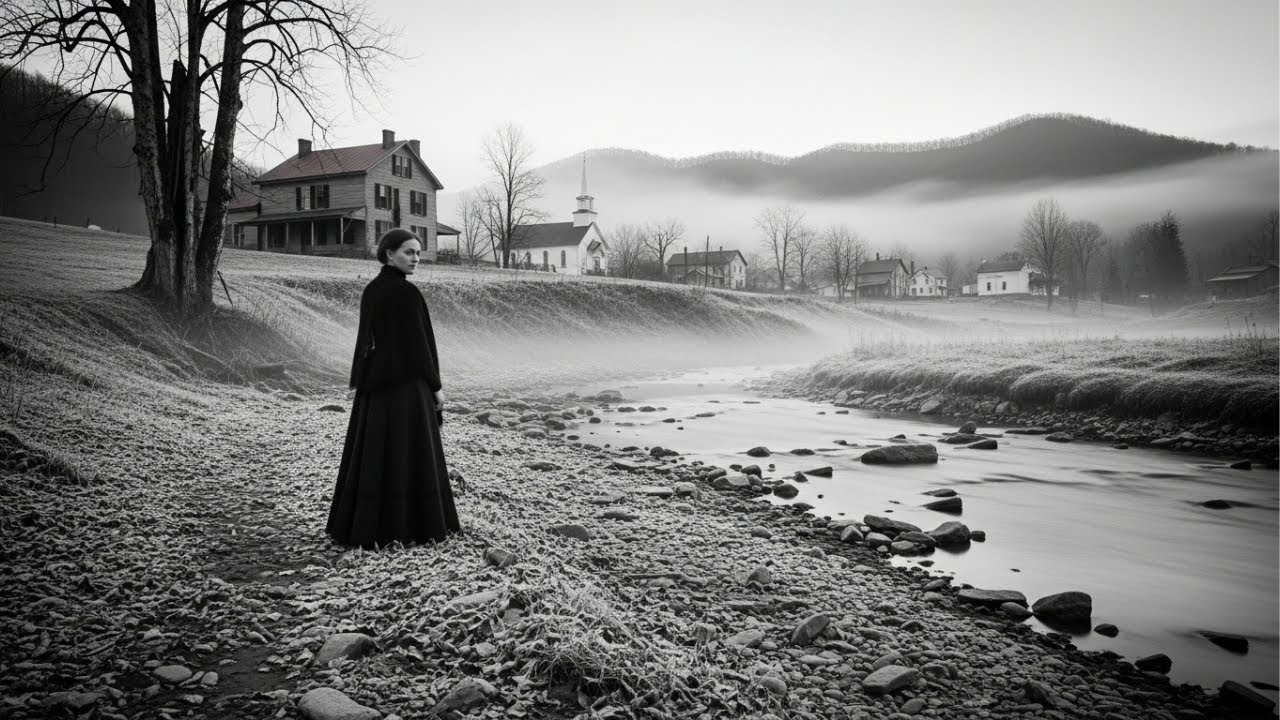
Over time, the truth faded into legend. Travelers spoke of a tall woman in black seen walking near the creek at dusk. Children were warned not to drink from certain waters. On the anniversary of her death, flowers would appear on an unmarked grave where Rebecca was buried outside the church cemetery. Foxglove and nightshade, healing herbs that could also harm, were left behind.
In 1971, workers demolishing the Blackwood House discovered a sealed mason jar containing a letter and a small vial of water. The letter read, “The truth is in the water, RB.” The jar was cataloged and placed in storage, where it remains unexamined and forgotten.
Today, children in Black Hollow still speak of a lady in black who walks by the creek. She tells them not to drink the water. She is trying to keep them safe. A mining company that reopened the old mine in 2012 denies any connection between their operations and high rates of childhood leukemia in the area. But the parents of Black Hollow know better. They keep their children away from the creek and tell them the story of Rebecca Blackwood, who tried to warn them and died for trying to protect them.
In the overgrown Blackwood Cemetery, one grave always has fresh flowers. No name marks the stone, but everyone knows who lies there. Not a witch, but a healer, a woman who saw the truth and paid the ultimate price for speaking it.