On the night of January 8, 1901, 109 children settled into sleep at the Rochester Orphan Asylum after an afternoon of playing in the snow at Hubble Park. The children ranged in age from infants to early teenagers and lived in a brick complex that had expanded through additions since 1843. Shortly after midnight, a gas flame used to heat a flatiron ignited nearby fabrics in the basement. The guard had gone home for the night at 7 PM, as was his routine, because the asylum’s superintendent preferred that he sleep outside the building.
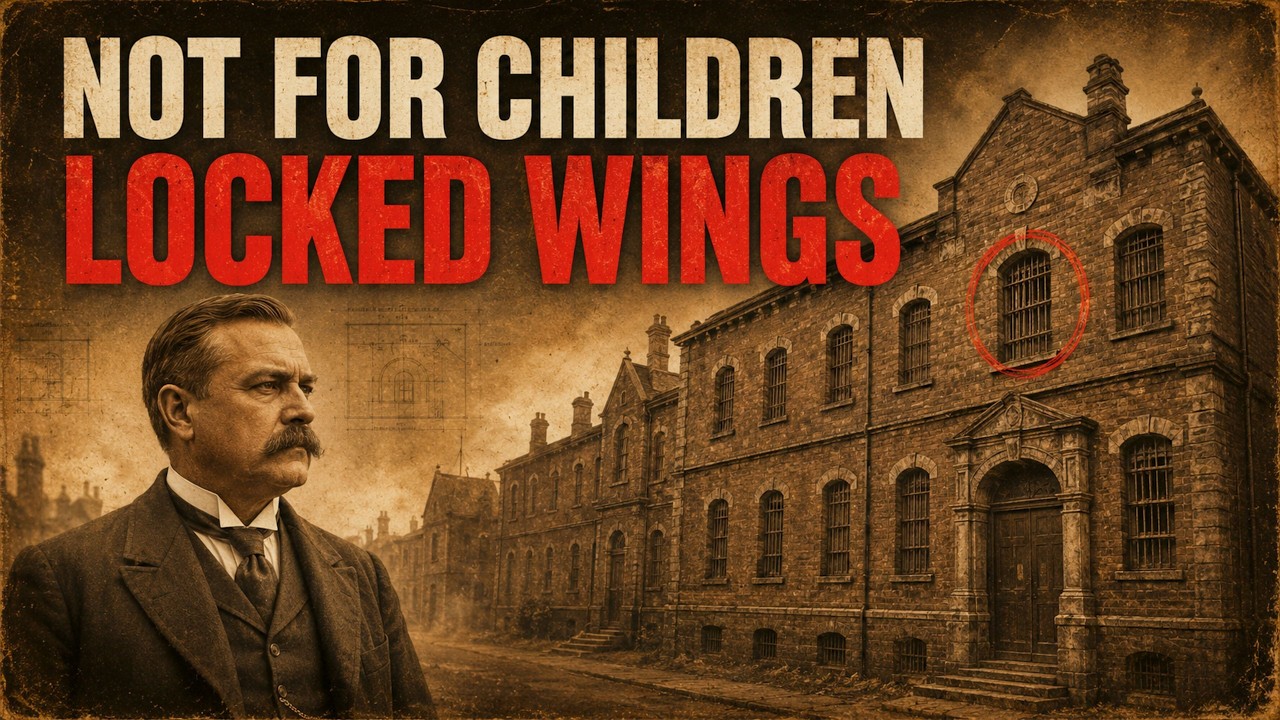
By the time someone smelled smoke, the fire was already spreading through the walls of the west wing. That wing housed the youngest children, those least able to run on their own, and it had no fire escape. Some of the older children managed to reach the roof, while others found themselves at windows that would not open. Twenty-eight children and three staff members died before the night was over.
Some accounts put the total closer to 31. Most of the children in that building were not orphaned in the literal sense. Many had a living father, a widowed father, or a single mother who paid a small weekly fee, often about a dollar and a half, to house the child while she worked long hours. The youngest victims were barely past infancy, age three and four, and were buried within days in the asylum grounds beside the cooks and workers who died alongside them.
Neighbors rushed out into the cold in their nightclothes and wrapped the half-clothed children in blankets before taking them into their homes. By 3 AM, the fire engines had left, and there was nothing left at the site to save. News spread through the city in the next day’s papers. The tone of the coverage reflected less shock than a grim, exhausted sense that everyone had expected this eventually, given the building’s design and the limited funds a charity for poor children could raise for something as invisible as a second staircase.
A later investigation found that the asylum had not violated any law. Rochester’s building codes at the time did not require a fire escape in every wing of residential institutions, and the west wing, added a decade earlier, met every standard the city had set when it was built. That finding satisfied almost no one, because it meant the fire was not the product of anyone’s negligence so much as a law that had never asked whether a dependent child, alone at night in a locked dormitory, could reasonably save himself. The trustees were criticized anyway, and within months the city rewrote its fire code for buildings housing children, mandating exterior exits on every floor with sleeping quarters.
The orphanage itself was not rebuilt at Hubble Park. The trustees chose a more distant site on Pinnacle Hill, and the organization that grew from the ruins still exists today as a children’s services agency. Its records relating to the fire are preserved in a university archive a few miles from where the original building once stood. The Rochester fire was not exceptional in what it revealed.
It was exceptional only in the number of children who died in a single night. Institutions created to house dependent, abandoned, or orphaned children multiplied across Britain and the United States during the eighteenth and nineteenth centuries, and few were designed with a child’s free movement in mind. By the time of Britain’s 1861 census, more than 13,000 orphaned or abandoned children were counted living in workhouses alone. That number does not include the far larger number of children residing in dedicated orphanages, foundling hospitals, and industrial schools.
Being illegitimate was enough to guarantee a shorter, more dangerous life. Even as late as 1918, a child born out of wedlock in Britain was twice as likely to die before its first birthday as a child born to married parents. The orphanage, foundling hospital, industrial school, or workhouse nursery existed first to receive children who had nowhere else to go, and second to keep them confined until the institution, not the child, decided otherwise. This second function rarely appeared in the charity sermons and annual reports these institutions published to attract donors, which tended to describe rescue and moral improvement rather than detention.
But it appeared clearly in building specifications, staffing schedules, and rules of conduct posted on dormitory walls. The windows were part of that design. So were the locked dormitory doors, the single staircases, the high surrounding walls, and the dining halls with no second exit. These choices were recorded in charters, minute books, and architects’ plans, reflecting an assumption most adults running these places would readily state if asked directly: poor and destitute children needed correction and containment almost as much as food and bedding.
To understand where that assumption came from, it helps to return to where institutional child care began at scale in the English-speaking world. In 1739, after 17 years of campaigning and support from figures like the painter William Hogarth and the composer George Frideric Handel, a retired sea captain and merchant named Thomas Coram obtained a royal charter from King George II to open the Foundling Hospital in London, a home for infants at risk of being abandoned or dying in the city’s streets. London at that time saw about a thousand infants abandoned by their parents each year, usually because the mother was unmarried, destitute, or both. Illegitimacy carried enough stigma that abandonment could seem like the only option left.
Demand exceeded capacity from the moment the hospital opened in 1741. Admissions ran for a time by lottery. A mother would draw a ball from a sack: a white ball meant provisional acceptance, a red ball meant she might wait to see if a place opened up, and a black ball meant her child was refused outright. By some estimates the hospital had to refuse up to five out of every six children brought to its doors.
Mothers who wanted to reclaim their children later were encouraged to leave a token with the infant, such as a coin split in half, a piece of fabric, or a small carved trinket that could be matched later as proof of identity. Of more than 16,000 children admitted between 1741 and 1760, only 152 were ever reclaimed. The rest were sent to wet nurses in the countryside until about age five, then returned to the institution to be raised, educated, and eventually trained for a trade. Hogarth donated his own works to decorate the hospital’s public rooms and persuaded other leading artists of the era to do the same, turning the building into what many historians now consider Britain’s first public art gallery.
Handel conducted annual charity performances of his oratorios in the building for years to help keep the institution funded. None of that goodwill changed the numbers in the hospital’s wards. Mortality figures from that period are difficult to read with any comfort. The hospital’s overall child mortality rate stood at 61% over its first six decades, and during a period in the 1750s known as the “General Reception,” when Parliament funded the hospital on condition that it accept every child brought to it regardless of health or age, the rate jumped to 81%.
Later reforms brought infant mortality below 30%, though the total child deaths across the institution’s long history remained close to half, a figure the governors themselves considered a worthwhile improvement to announce to donors, because the alternative they compared it to was not a healthy childhood but the streets the hospital was built to rescue infants from. The word “nursery” in that era did not describe a cheerful, softly lit room in a home. It described a ward, and workhouse nurseries in particular were among the deadliest rooms in the entire poor law system until well into the twentieth century. Under the New Poor Law framework established in 1834, husbands, wives, and children were routinely separated into different wards upon entering a workhouse, and a nursing mother might be allowed access to her infant only at set feeding times rather than living beside him.
In 1909, the economist and social reformer Beatrice Webb wrote an open letter objecting to an official government report that defended conditions in these nurseries. Citing figures the government itself had published, Webb noted that of 2,653 children born inside London workhouses in 1907, 312 died in the building during their first year, a mortality rate near 12%, with a death rates in the first week of life more than double the rate among infants born outside the workhouse system. Across about 450 workhouses in England in that same year, more than a thousand of the more than 8,000 children born inside them died before their first birthday. These were not hidden statistics.
They were debated in Parliament and in the letters pages of medical journals. The controversy itself, over whether an institution built to house destitute infants was quietly killing a significant share of them through overcrowding and neglect, continued for decades without definitive resolution. The typical workhouse nursery was a single long room with rows of cots, staffed by a few paupers forced into service as unpaid attendants alongside perhaps one trained nurse for the entire ward, and it shared air, bedding, and often infection with the adjoining lying-in ward where women who could not afford a doctor gave birth under no greater supervision than a fellow inmate could provide. The nursery door, like the dormitory door of an orphanage or industrial school, existed to keep a controlled population inside a controlled space.
In 1907, no one was designing that door with a house fire in mind. They were designing doors to keep employable workhouse inmates at labor, to separate unmarried mothers from scandal, and to keep the budget from growing. The infant in its crib at the far end of the room was, in the calculation of the guardians who ran these places, a cost to be minimized rather than a life to be actively protected. Reformatories and industrial schools added a second, more obvious motive for securing windows and doors beyond mere hygiene or reputation.
Children ran away, and an institution that could not physically hold its inmates could not carry out the legal mandate that had placed many of them there in the first place. In Rochester itself, the Western House of Refuge opened in 1849 as the first state-run reformatory in the United States, receiving children convicted of crimes along with others whose only offense was vagrancy or a judge’s judgment that they were headed for trouble. Courts in western New York were required to send convicted juveniles there and had discretion to send others as well, including children whose only real crime was having nowhere else a judge could send them. A building holding court-ordered children needed to prevent escape as a basic functional matter.
Tightly sealed or barred windows, high perimeter walls, and locked emergency stairs were the usual architectural answer to that requirement, and they were not hidden. The same logic extended more mildly into ordinary orphanages and foundling homes, where the concern was less about crime and more about reputation and control. An institution housing illegitimate or destitute children depended on donors and government grants to survive, and its administrators had a strong interest in controlling who saw the children, when, and under what circumstances. Securing dormitory windows and restricting visiting hours served that interest directly just as much as any stated concern about child welfare.
The two motives were rarely separated clearly in the minute books where these decisions were recorded. The material detail is worth reflecting on because it is easy to imagine something more sinister than what these buildings usually contained. In most cases the barred window was not specially fitted for a hidden purpose. It was cheap, readily available iron, the same material used in ground-floor windows of shops and banks against burglars, reused on upper floors because it was inexpensive, familiar to local blacksmiths, and simple to install and maintain by unskilled labor.
Upper-floor dormitory windows were often designed to open only a few inches, or fitted with a stop block a child could not remove without a key kept by staff. That feature was justified at the time as protection against a small child falling from a windowsill or climbing onto a roof unsupervised. That justification was not invented after the fact. It appears in institutional reports and building specifications from that period, alongside separate, blunter notes about preventing escape and unauthorized visitors.
Both concerns were real, and both produced the same physical result: a window from which a child inside could not rapidly leave, however the window was originally secured in the first place. Meanwhile, there was a darker alternative facing children not confined behind institutional walls. Unmarried mothers who could not keep a child and could not, or would not surrender it to a hospital like the Foundling often turned to a private arrangement known as “baby farming. ” Money was paid to a woman, usually advertising herself as a nurse or a widow with space to take in an infant for a weekly fee.
Most baby farmers were exactly what they claimed to be. Some were not. Amelia Dyer was born Amelia Hobley in 1837 near Bristol, the daughter of a skilled shoemaker who gave her a comfortable early childhood and an education good enough to develop a lifelong love of reading. Her mother contracted typhus when Amelia was still a child, and the illness left her with severe mental disturbance.
Amelia trained briefly as a corset maker, then trained more formally as a nurse and midwife, and in her thirties married a much older brewery worker named William Dyer. By the 1860s she had entered the baby-farming trade, advertising in local newspapers under respectable-sounding names, offering to adopt or nurse infants for what she described as modest fees, collecting payment from mothers who had no practical way to check on the child again once the arrangement was made. For years she allowed many children in her care to die slowly of starvation and neglect. They were often quieted along the way with an opium-based preparation sold under names like “Mother’s Friend.
When that method proved too slow and attracted attention from doctors asked to sign death certificates, she sometimes killed infants directly, usually by strangulation and disposal in the Thames wrapped in brown paper. A doctor’s suspicion about the enormous number of infant deaths under her care led to her first arrest in 1879, but the charge was only neglect, and she served six months before returning to the same trade under a new name and address. She was finally arrested in 1896 after police traced a parcel recovered from the river to an address in Reading. Estimates of her victims, based on the length of her career and the pattern of her advertisements, range from a handful confirmed to several hundred.
She was hanged at Newgate Prison that June. Her case, more than any earlier legislation, forced Parliament to act, producing the Infant Life Protection Act of 1897 and the Children Act of 1908, which for the first time required anyone caring for a child under seven to notify local authorities within forty-eight hours of any change in care or death. Against this background, managers could defend a locked, fortified institutional ward as the safer choice rather than the crueler one. There was a real argument behind that defense.
A chartered orphanage or foundling hospital, no matter how grim its wards, kept an admissions register, had a board of governors, and could in principle be visited and inspected, none of which applied to child dealers working from rented rooms. The uncomfortable truth is that both paths, the fortified institution and the unregulated private home, killed children in large, largely unacknowledged numbers for reasons that overlapped but differed. Neither was designed around a child’s ability to be seen, tracked, or protected as an individual with a future worth keeping records for. A third path opened in the United States in 1854 when a young minister named Charles Loring Brace, who had founded the Children’s Aid Society of New York the year before, sent a group of 46 children by train from the city to Dowagiac, Michigan, to be placed with local farming families.
Brace was responding to a real crisis. New York in the 1870s saw between 20,000 and 30,000 children living on its streets in any given year, sleeping in doorways and on stairwells, supporting themselves by selling matches, newspapers, or through petty theft. With no institution able to house them all and no organized safety net to rely on, Brace’s central conviction, which shaped every part of the later program, was that no institution, however well intentioned, could do for a homeless child what a working farm family in the countryside could: useful labor, fresh air, and careful moral supervision, far from what he saw as the corrupting density of the city. The system that grew from that conviction, later known as the Orphan Train movement, ran for about 75 years and moved an estimated 150,000 to over 250,000 children from eastern cities to homes across the rural Midwest, South, and West.
A few were placed on the basis of letters from families requesting a child of a particular age, sex, or hair color. More often, groups ranging from 5 to 30 children traveled with an adult escort along a set route, stopping town by town, where they were displayed before crowds of prospective families on a platform or in a local hall and inspected, sometimes asked to show their teeth or hands before being chosen or moved on to the next station. Screening of receiving families was minimal for most of the program’s history, and almost no follow-up occurred once a child was placed in a home. Later critics of the movement noted that some children were effectively absorbed as unpaid farm labor rather than raised as family members, with no government office checking their treatment once the train pulled out.
Siblings were often separated between different towns, and sometimes different states, with no promise or expectation they would ever find each other again. A child’s name, birthplace, or recorded age could be changed by the receiving family for reasons as simple as the convenience of the new family. Once that happened, the paper records connecting the child to any institution or biological family often ended forever. That matters for understanding the broader pattern, because it means that when records from the era go missing or contradict each other, the explanation is rarely a deliberate attempt to erase the truth.
It is closer to the routine chaos of a system moving over 100,000 vulnerable children across a limited bureaucracy at speed, decade after decade, without any built-in mechanism for preserving their history on their behalf. Millions of people alive today can trace a direct family line back to a child who rode one of those trains, and many of them did not learn the full story until generations later, if at all. Ireland developed its own version of this institutional network under a different legal framework, and it produced the clearest example of what a closed, poorly ventilated design could cost a generation of children four decades after the Rochester fire, in a small town far from London or New York. The Irish Industrial Schools Act of 1868 created a system in which a court could commit orphaned, abandoned, neglected, or supposedly neglected children, or children born to families the state deemed unfit, to an industrial school for years at a time.
Most were run day to day not by government staff but by Catholic religious orders working under contract with the state. Structurally, the system was very close to the reformatory model already operating in places like the Western House of Refuge in Rochester, except that the operators in Ireland answered to their religious superiors and, ultimately, the church, rather than to any locally elected body. The system grew quickly. By 1898 there were 71 industrial schools across the island holding nearly 8,000 children at a time.
Later government calculations estimated the number of children who passed through about 50 of these schools between 1936 and 1970 alone at around 170,000. St. Joseph’s Industrial School and Orphanage stood on Main Street in the town of Cavan, attached to a convent founded by the Poor Clare sisters there in 1861, with the orphanage itself opening a few years later. The Poor Clares are a contemplative, cloistered order, meaning that under the order’s rules the nuns did not leave the convent grounds under ordinary circumstances at all, a detail that would prove crucial on the night the building caught fire.
The building was three stories of dense, mostly wooden construction, built up over decades in a way that made it ill-suited to rapid evacuation if anything went wrong on an upper floor. It had a single main staircase serving both dormitories and a single iron fire escape reached through a door that was kept locked under ordinary circumstances to prevent children wandering out without supervision. By February 1943, the orphanage housed about 90 children, mostly girls, many of them placed there not because both parents had died but because a court ruled that a widowed father or unmarried mother was unable or unwilling to raise them. On the night of February 23, a fire broke out in the basement laundry, probably from a defective chimney or electrical fault, though the exact cause was never definitively established at the inquest that followed.
It went unnoticed for some time in a building with no fire alarms and no regular evacuation drills, as the fire crept through wooden floors and staircases before those above realized what was happening. When one of the orphan girls smelled the smoke and raised the alarm, one of the nuns in charge made a decision that shaped the rest of the night. Instead of beginning an evacuation, she gathered about 70 girls sleeping in two upper-floor dormitories, ordered them to pray, and left them there while she went to deal with the fire herself. The fire escape door on that floor was locked.
Outside, townspeople who noticed the smoke ran to the convent doors and found every one of them locked too, unable to get in no matter how hard they knocked or called up at the upstairs windows. Six minutes passed, a long time to stand outside a burning building full of children before electricity returned, the lights came on, and the convent doorbell rang. At that point, a girl inside named Rosemary Cavetty managed to open the front doors herself and let the gathered crowd of volunteers into the yard. A local electrician named Mattie Hand arrived shortly after with a ladder long enough to reach the upper windows, and a businessman named Lewis Blessing climbed up and pulled five girls to safety before the fire made any further rescue impossible.
Thirty-five children and one adult staff member, an 80-year-old cook named Mary Smith, died that night. Every nun in the convent and all the lay employees survived. The remains recovered afterward were so badly destroyed by the fire that they could only be placed in eight coffins, buried together without individual identification, in a grave that remained unmarked for decades. The town almost forgot the site almost completely before a memorial bearing the name of every child, arranged by age and years, was finally placed there.
A public inquiry followed with official findings pointing to a defective chimney, an untrained and poorly equipped local fire brigade, and a fatal decision by those on site directing rescuers and children alike toward the smoke-filled upper floors rather than the safe exits. The nuns were officially cleared of any wrongdoing. Locally, almost no one believed that report told the whole story. The narrative passed down by survivors’ families for generations afterward was that the nuns delayed evacuating the children and possibly kept them deliberately confined upstairs in the first place, fearing that the girls’ appearance on the public street in their nightclothes would embarrass the convent.
A court secretary, a civil servant named Brian O’Nolan, who wrote novels under the pen name Flann O’Brien, secretly composed a short satirical poem with one of the inquiry lawyers, a young solicitor named Tommo Higgins who later served as a government minister, suggesting that blaming a faulty electrical wire was a convenient outcome for everyone more than a real examination of what happened inside the convent walls that night. No individual was ever held accountable for those thirty-five deaths. St. Joseph’s continued operating as an industrial school for years afterward.
It was one knot in a much larger network of Irish institutions that faced no serious public accountability for how they treated children in their care until 2009, when the Commission to Inquire into Child Abuse, a government body established in 2000, published its final findings, commonly known as the Ryan Report, after nearly a decade of hearing testimony from thousands of survivors of Ireland’s industrial schools. The thousands-page report concluded that systemic physical, sexual, and emotional abuse was endemic throughout the system for decades, and that perpetrators were often protected by their religious superiors rather than reported to any outside authority. That was a different kind of harm than what happened in the basement laundry fire on one February night, spreading across decades rather than contained in a single evening. But it grew from the same structural arrangement: children committed by the state to buildings managed largely outside genuine state supervision, run by institutions answerable first to their own internal chain of authority and second, if at all, to the families and public whose trust they depended on.
The thirty-five names now carved on the Cavan memorial and the thousands of survivors who eventually testified before the Ryan Commission described essentially the same structural gap from opposite directions. One generation wonders why no one could open a locked door in time. The next generation wonders why no one outside those doors was checking what was happening behind them in the first place. Placed side by side, the Rochester and Cavan fires are four decades in which the infrastructure of institutional child care barely changed, despite everything fire investigators and legislators claimed to have learned in the meantime.
In both cases, the buildings contained dozens of children on upper floors behind windows and doors not built to allow rapid departure and, in Cavan’s case, actively used to prevent those children from leaving quickly. In both cases, the adults responsible for the children’s safety made choices under pressure that prioritized something other than the fastest possible exit: reputation in the case of Rochester, religious custom in Cavan. Neither group of adults planned to let the children die. Each built or inherited a set of assumptions about where the real dangers to these children lay, and neither gave much weight to the specific scenario of fire moving quickly through a locked upper floor at midnight.
The difference in what followed each fire is evidence in itself. Rochester’s fire code was rewritten within months because the institution was accountable, at least on paper, to a municipal government that could be pressured to move quickly and publicly. The Cavan inquiry produced a report, as a scapegoating mechanism that targeted the length of a faulty electrical wire, without changing anything permanent about how religious orders ran the institutions in their care, because the order answered to an ecclesiastical hierarchy most Irish civil society was unwilling or unable to challenge in 1943. It took another 66 years and testimony from thousands of survivors of dozens of other schools before the state formally acknowledged what the industrial school system had permitted inside buildings very like St.
Joseph’s. None of the outcomes required something hidden or suppressed to be achieved. Everything described here exists in committee minutes, parish burial records, newspaper archives, and the histories of the organizations themselves, documents available to anyone who asked. Most of it is digitized, and some simply waits in a local records office for someone who asks.
The delay in the Cavan case was never about the evidence being unavailable. It was about who, at any given moment, held enough standing in Irish society to demand action on that evidence. What remains physically is more modest than the story itself. The original Rochester institution site at Hubble Park has vanished, dissolved into the ordinary residential streets of a modern American city, though the children’s services agency that descended from it still operates today under a different name.
Its founding fire is remembered mostly in local historical societies and in a cluster of small headstones in Mount Hope Cemetery. In Cavan, the convent building where the fire started no longer functions as an orphanage, and the 35 children buried together for decades without individual markings now have a proper memorial bearing each of their names, revealed only after generations of local pressure for formal recognition. The tokens of the Foundling Hospital are on public display in a small museum on the site of the original hospital in London. The workhouse records, the Orphan Train passenger lists, and the court transcripts all sit today in archives that welcome researchers, because none of the people who ran these systems believed they were doing anything worth hiding.
They mostly believed they were handling an intractable problem as responsibly as their budgets, their era, and their assumptions about poor children allowed, and most would have been genuinely surprised to be told otherwise. The records simply show what that responsibility looked like from inside a locked dormitory on an ordinary night when things finally went wrong. If you ever encounter a barred window in an old institutional building now converted into apartments or offices, it is not evidence of anything hidden.
It is a small, ordinary, quietly disturbing record of how society once decided which of its children deserved a way out.