On August 9, AD 378, outside the walls of Adrianople, the Roman emperor Valens led his legions into a defeat so catastrophic that Roman writers reached back six centuries for a comparison and landed on Hannibal at Cannae. Two-thirds of the Eastern Field Army was gone before sunset. Valens himself vanished into the ruin, and his body was never recovered. For 1,600 years, the verdict against him has held without challenge.
He stands accused of pride, of impatience close to madness, and of incompetence deep enough to break the Eastern Empire. But that charge rests on the account of a single man: Ammianus Marcellinus, the retired soldier and last great historian Rome produced. His account of Valens and the Gothic War is the only detailed eyewitness version that survived. But a closer examination of his testimony, his grievances, and the events that preceded the battle suggests a far more complicated story about how the legions actually died.
The crisis began two years earlier, in AD 376, on the northern bank of the Danube near the fortress of Durostorum. The Tervingi Goths, driven west by the Huns, arrived at the river not as an army but as a displaced people. Whole families stood on the bank, and many drowned trying to cross the swollen river on rafts and hollowed logs. Their leader, Fritigern, sent envoys to Emperor Valens with a formal petition for asylum.
The terms were generous to Rome: the Goths would surrender their weapons, give their young men as auxiliary soldiers, and settle quietly on Roman land in Thrace. In return, they asked for protection and grain. This was routine; Rome had absorbed barbarian peoples for four centuries. Valens approved.
He was campaigning in the east and short of recruits. But the frontier commanders placed in charge, Count Lupicinus and an officer named Maximus, saw the refugees as a profit opportunity. The grain shipped to feed the Goths was diverted into military storehouses and locked there. Hunger was manufactured on purpose to raise prices.
Ammianus recorded the details with horror: dogs were sold as food, one animal traded for one human being led into slavery. Rotting meat went for silver. When coin ran out, the commanders named a final currency: children. For one loaf of bread, a Gothic family could hand over a son or daughter into bondage on Roman soil.
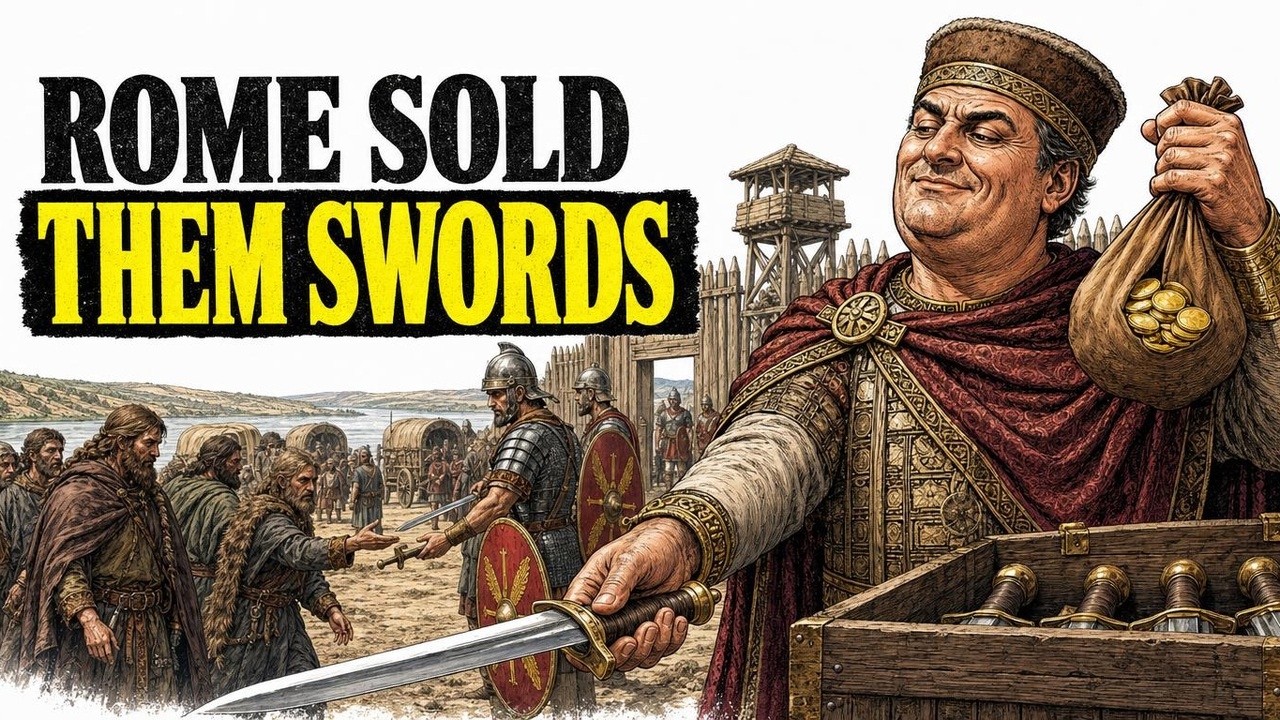
The commanders also took bribes to let the Goths keep their weapons. For a fee, a warrior kept his blade; for a larger fee, he could buy a fresh Roman-forged sword from the very men meant to disarm him. Ammianus recorded flatly that not one Gothic chief was made to give up his arms. A second Gothic people, the Greuthungi, had been refused entry and ordered to stay on the far bank.
But with frontier guards distracted by profit, they crossed anyway, uncounted and unwatched. The corruption built the engine of rebellion piece by piece: a starving people, families broken and sold, and steel in their fists. It needed only a spark, and the spark was struck at a dinner table. Lupicinus invited the two foremost Gothic leaders, Fritigern and Alavivus, to a banquet in the city of Marcianople, planning a decapitation strike: kill the leaders inside, then fall on the leaderless men outside.
But Roman soldiers outside began jeering at the Goths penned in the streets, and the situation turned violent. The noise traveled up into the banquet hall. Fritigern kept his face still, rose, and told his hosts that only he could go out and calm his people. It was a manipulation of the first order, and Lupicinus, whose greed was matched by his slowness, believed it.
He opened the door and let Fritigern walk free. Alavivus disappears from the record entirely, leaving Fritigern as the sole Gothic leader. Fritigern mounted his horse and rode out of Marcianople as a commander in open revolt. The armed and famished Goths tore across Thrace, seizing grain, storming villas, and freeing enslaved kin from mines and barracks.
Ammianus noted bitterly that Goths sold into servitude weeks earlier now guided the raiders to the richest houses and deepest granaries, because they knew where everything was kept. Lupicinus scraped together local troops and marched out to face Fritigern, but the encounter was a route. Two legions lost their standards. The rebels stripped the Roman dead of their arms and armor and put them on, fighting henceforth equipped as Romans in Roman mail behind Roman shields.
Thrace was not lost at Adrianople. It was lost 18 months earlier, in a panicked route produced by the corruption and cowardice of Rome’s own frontier command. The revolt spread, joined by Goths serving in the Roman army near Adrianople who killed their officers, and by miners who knew the hidden valleys of the Thracian hills. Ammianus records the darkest turn: some raiders who had been sold south of the mountains months earlier now returned over the passes, pointing out the estates that had bought them.
Valens finally received word in Antioch, where he was preparing a major campaign against Persia. He negotiated a hasty truce, shelved the Persian war, and marched west. He reached Constantinople in the spring of AD 378 to a hostile city. He was jeered as a coward who let barbarians roam free while the citizens stayed safe behind the great land walls.
Insults appeared on the streets, and in the hippodrome the crowds chanted at him. Ammianus draws Valens as thin-skinned and easily wounded. Then came a message from his nephew, Gratian, the 19-year-old ruler of the west. Gratian had just crushed the Alamanni at Argentovaria on the Rhine and was marching east with a veteran army to reinforce his uncle.
The cautious military advice was flawless: wait, let the western army arrive, and crush the Goths together. The prosecution’s case is that Valens refused to wait because he was eaten by envy of a nephew barely more than a boy, wanting the victory as his own possession to silence the streets of Constantinople. Scout reports put the Gothic force at roughly 10,000 fighting men, a number his army could manage alone. The figure was badly wrong; the scouts had missed a heavy cavalry force of Greuthungi and Alan horsemen off foraging, invisible the day the count was taken.
Valens’s seasoned generals pressed for restraint. Victor argued to wait for the west. Richomeres, an officer Gratian had sent ahead, offered himself as a hostage of good faith to buy the delay. But other officials, chief among them a general named Sebastianus, urged an immediate attack after a successful ambush of a Gothic foraging party.
Ammianus fixes the moment with a phrase: a lamentable display of arrogance. Valens chose to attack. On the morning of August 9, AD 378, the Roman army marched roughly eight miles through the open Thracian heat over broken ground, carrying no water. The Goths had set fire to the dry fields, so the Romans advanced through smoke and ash under a hammering sun.
Fritigern sent envoys one after another, stalling deliberately while waiting for the Greuthungi horsemen to return. From inside their wagon fort, he proposed an exchange of hostages to draw the negotiation out for hours. A Roman officer named Richomeres volunteered to go. The Roman soldiers stood in full array for hours, cooking inside their armor while the envoys talked.
Then the cavalry crested the ridge. The Gothic heavy cavalry came down “like a thunderbolt,” in Ammianus’s words, driving full weight into the exposed flank of the Roman infantry. The Roman cavalry was scattered. The legions, already committed and pressing toward the wagon circle, were surrounded and squeezed inward until a man could not draw his arm back to strike.
Soldiers stood so tightly packed they could not even fall; the dead were held upright by the living. The killing went on from past midday until the light began to fail. Two-thirds of the Eastern Field Army lay in the grass, perhaps 20,000 professional soldiers. Ammianus made the comparison to Cannae, the deepest scar in the national memory for nearly 600 years, and wrote that no battle since had cost Rome so dear.
Thirty-five tribunes died, the entire officer spine of the force. The generals Traianus and Sebastianus, the very man who had urged the attack, went down with their men. Valens disappeared in the confusion. In one version, he took an arrow and died beneath a heap of common soldiers, never identified.
In another, his men carried him to a farmhouse, where the Goths, not knowing whose life they were storming, piled brushwood against the walls and set it ablaze. A single guardsman who leapt from a window was taken alive and told the captors who had burned inside. His body was never recovered. There was no state funeral, no tomb, no marker.
The man who inherited the wreckage was a Spanish general named Theodosius, raised to the eastern throne in January 379 with an army that no longer existed. He could not beat the Goths. He spent three years rebuilding, and on October 3, 382, he signed a treaty unlike any Roman emperor before him. The Goths were not disarmed or dispersed.
They were settled whole as one self-governing people on Roman soil south of the Danube, serving the Roman army as federated troops under their own chiefs. On the surface it looked like statecraft. Underneath, it was a slow-acting poison. For the first time, a barbarian nation existed inside the Roman frontier as a distinct whole, a state lodged within the state.
The pattern set for the century that followed: hire barbarians to fight Rome’s wars became the standing military policy. Within a generation, the most powerful soldier in the west would be a man of Vandal blood named Stilicho. The Goths settled in 382 were the fathers of the federate soldiers who, one generation on, felt cheated by a Roman state that never paid what it promised. Their leader was Alaric, who commanded Gothic federates in Theodosius’s campaigns, including the bloody victory at the Frigidus River in September 394, where Gothic troops were spent by the thousand in the front ranks while Roman units held back.
In August 410, he did what had not happened in 800 years: he led his Gothic army through the Salerian Gate and gave Rome over to three days of plunder. The defeat at Adrianople was not finally tactical or military; it was existential. Rome lost its sole right to wield legitimate force inside its own borders. The empire began paying the men at the gate to serve as the gatekeepers, and in paying them, handed over the keys to the house.
The western empire would fall in 476, but Ammianus knew the lock was broken on that plain in the dust and burning grass. The battle was lost in the account book of Lupicinus and Maximus, weighing bread against children and swords against silver, long before it was lost in the field.