In January 104 BC, Rome was packed. Crowds filled the streets between the Forum and the Capitol, spilling onto rooftops and balconies for a better view. Trumpets blared, drums beat in steady rhythm, and wooden wheels clattered over the stones as cart after cart rolled by, loaded with African gold, carved ivory, and weapons stripped from the dead. Near the end of the procession, chained behind the chariot of a Roman general, walked the man the crowd had waited for.
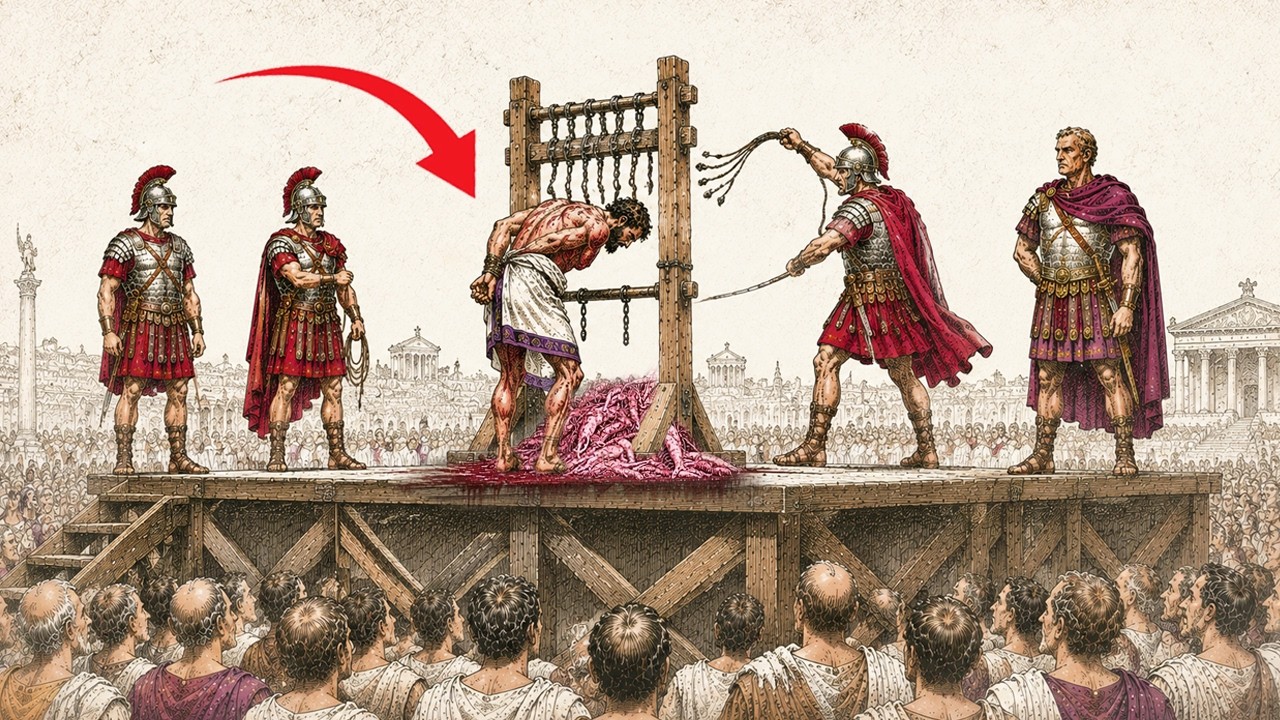
Bare-chested, with an unkempt beard and hands bound tightly behind his back, he was a king. Six years earlier, he had told his friends that Rome was a city for sale. Now Rome would show him what it did to men who bought and lost. Within about six minutes, the time needed to walk half a mile on foot, Jugurtha of Numidia would be lowered on a ladder into a stone pit below the Roman Forum.
He would die there in darkness, cold, and isolation in less than a week. The Romans did not have to keep him alive to kill him. They could have executed him on a Numidian battlefield. Instead, they transported him a thousand miles across the sea for a single purpose: so that half a million people could watch him publicly lose his humanity.
For more than 300 years, Roman leaders faced a unique and highly specific question. When you defeat a king, a crowned ruler, a living symbol of a nation, what exactly do you do with him? The obvious answer might seem simple: kill him. But Rome rarely did that.
Rome invented something worse. And it did the same terrible thing to daughters, sons, and heirs, including children as young as four. Only one defeated monarch in the long history of the empire survived it. That person was a woman.
Her name was Cleopatra, and what she chose instead is considered one of the most calculated acts of defiance in the ancient world. Rome did not invent this cruel system all at once. It was learned, developed, and perfected, defeated king by defeated king. The man who truly taught Rome how to do it was not a soldier but a 61-year-old aristocrat named Lucius Aemilius Paullus.
A former consul from an old patrician family, Paullus was known in Rome for his precision, discipline, and rare humanity. He spent his career distinguished by avoiding civilian massacres. But in 168 BC, standing on a Greek battlefield, he made the decision that would set the model for three centuries of Roman practice. He did not kill the king he had defeated.
He kept him alive. The king was Perseus of Macedon, 44 years old, son of Philip V and the last legitimate ruler of the dynasty founded by Alexander the Great’s family. Perseus was not a warrior king like his famous ancestors. He was cautious and frugal, and he had married a princess for political alliance rather than love.
For years he tried to bribe and negotiate Rome out of war, something Rome would remember and hold against him. The men Perseus led were not conscripts dragged from conquered villages. They were the last remnants of a nearly 200-year-old legacy. Their fathers had marched with Alexander, their grandfathers with Philip.
Their weapons — 18-foot sarissa spears and the interlocking phalanx formation — had once conquered the known world from Greece to India. On the morning of June 22, 168 BC, they lined up on a field called Pydna. They believed, as their fathers had, in the invincibility of Macedon. Rome, standing on the other side of the field, understood exactly what it was facing.
This was not merely an army. It was a story, a dynasty, a living link to Alexander himself. Rome had already learned a lesson no ancient state had truly used as a weapon: the story mattered more than the killing. Ending Perseus’s life quickly on the battlefield would end the battle.
Ending his life slowly in public in Rome would end the idea. The two armies at Pydna were similar in size but not in power. Perseus mustered about 40,000 infantry and 4,000 cavalry, the largest Macedonian force in a generation. Among them were the elite bearers of bronze and silver shields, descendants of Alexander’s royal guard.
But Pydna was not flat ground. The battlefield stretched across cracked slopes and gullies carved by streams. As the phalanx advanced slowly and terribly, like a single mass of spears, the terrain began to distort the line. Gaps appeared.
They were not large and not visible from a distance, but the Roman commander saw them. Aemilius Paullus was watching from high ground. After decades of campaigning, he understood something the Macedonian officers did not: a phalanx is only invincible as long as it stays together. A slight breach is enough to turn the wall into a scattered hedge of men, each holding a spear far too long to be useful in close combat.
Paullus gave the order. Roman maniples, small and flexible units armed with short swords, poured into the gaps in the phalanx. A Macedonian with an 18-foot spear could not draw a knife fast enough to save his life. The decisive phase of the Battle of Pydna lasted one to two hours.
It ended a ruling dynasty. Ancient sources do not describe Perseus dying in this battle. They describe his departure. Polybius uses a word that can be translated as “fled” or “withdrew.
” What is not disputed is that when the wing collapsed, its king had already mounted his horse and ridden away. Perseus went first to the city of Pella, then to the sacred island of Samothrace. He carried with him as much treasure as he could and as much of his family as he could: his wife, his two young sons, and his daughter. He believed the ancient protections of the Samothrace temple would shield him.
He was wrong. Roman ships arrived within days. The temple priests did nothing to prevent it. Perseus and his children were trapped, isolated, and about two weeks after the Battle of Pydna, they were taken to a Roman camp at Amphipolis.
There, the king of Macedon entered the tent of Lucius Aemilius Paullus. He did not enter as a king. Polybius tells us he threw himself on the ground in despair. This is the crucial moment, the decision that shaped all subsequent Roman practice.
Perseus lay on the ground before Paullus, his children with him. The youngest was a small boy holding his father’s hand. Paullus’s officers watched, and a crowd of soldiers gathered outside the tent. According to Polybius, Paullus did something that shocked the men present.
He stepped forward and lifted Perseus to his feet. He spoke to him gently in Greek, as one nobleman to another. Then Perseus, still trembling, pleaded: “I surrender myself and my children to you and the Romans in the hope that you will save us. ”
At this point the story could have ended in any number of ways.
Paullus could have granted him honorable exile. He could have executed him secretly and reported his death as a casualty of battle. He could have returned the children to Macedon and left the father in a Greek city to grow old in obscurity. Any of these options would have been consistent with Greek and Persian tradition.
Instead, according to the sources, Paullus’s face darkened, and he spoke words that told Perseus everything he needed to know about the kind of empire he was now part of: “You should have thought of this earlier when you were negotiating with Rome’s enemies. Now the decision is not in my hands but in the Senate’s. ” Whether Paullus uttered these exact words is debated among scholars. The emotional truth is not in dispute.
In that sentence, Paullus told a defeated king that he was no longer a king and no longer a person with his own fate. He was now property of a state that would decide how to use his body. Perseus was going to Rome. So were his children.
And in Rome, a plan was already being prepared. It was not punishment. It was spectacle. An elaborate celebration, precisely designed, deliberately engineered to strip a man of everything but his eyes and voice, so thoroughly that surviving it would be worse than any death by the sword.
The triumph was the oldest and most sacred celebration in the Roman state. To hold one, a general had to have killed at least 5,000 enemies, ended a foreign war, and officially received the honor from the Senate. It was the highest reward Rome could give, and by the mid-2nd century BC, it had also become the empire’s most precise weapon against defeated kings. The triumph was not an execution.
That is the point. Execution ends things. The triumph displays them, giving crowds time — hours, sometimes a full day — to walk past a captive king and stare, laugh, and spit, watching the man who once ruled a nation now wearing chains made by a Roman blacksmith specifically for him. Every detail of the ceremony was designed for maximum humiliation.
Captives were forced to walk. They wore special clothing, often altered versions of their royal robes, deliberately tattered or torn. They walked near the end of the procession behind the carts of spoils, so the crowds were already worked into a frenzy when they appeared. Their placement was crucial: directly in front of the general’s chariot, so thousands of Roman citizens could see in one sight line the two most important things Rome wanted them to see — the victorious general above, and the humiliated king below, made small.
Sixty-three years after Pydna, another Roman general made the same decision Paullus had. His name was Gaius Marius. His prisoner was Jugurtha of Numidia, the man from the opening of this story. Jugurtha was not a stranger to Rome.
In his youth, in the 130s BC, he had served in the Roman army in Spain under Scipio Aemilianus. He mixed with Roman officers, learned their language, their politics, and their vices, before inheriting the throne of Numidia. Jugurtha used that knowledge to kill his rivals and bribe Roman senators to overlook his crimes. It was during this period that Sallust recorded his famous judgment on the Republic: Rome was a city for sale, and it would perish as soon as it found a buyer.
Jugurtha was 55 when Rome finally caught up with him. He was not defeated in battle but betrayed and handed over by his father-in-law, Bocchus of Mauretania, at a diplomatic meeting arranged specifically for that purpose. He was put in chains before he realized what was happening. The pattern was becoming established, and Rome would perfect it.
In 52 BC, at the hilltop fortress of Alesia, one of the most famous captives in Roman history sealed this principle forever. His name was Vercingetorix. Probably in his thirties, he was the son of a Celtic nobleman named Celtillus, and he accomplished what no other Gallic leader had managed: he united the warring tribes of Gaul against a common enemy, Julius Caesar. Caesar besieged Alesia with a double line of fortifications, 21 kilometers of walls — an inner wall to keep Vercingetorix in, and an outer wall to keep any relief force out.
When the relief force arrived and failed, Vercingetorix realized the end had come. Caesar himself recounts the Gallic Wars. Vercingetorix called his tribal council and announced his surrender to the Romans to save his men’s lives. Caesar wrote this decades before Plutarch dramatized the surrender scene with the horse, the armor, and the parade ride.
The simpler account may be closer to the truth. But what is not in dispute is what happened afterward. Caesar did not execute Vercingetorix that day, or that year. He kept him alive, chained in a Roman prison for six years.
Six years while Caesar fought a civil war against Pompey, crossed the Rubicon, and became dictator. Six years, so that Vercingetorix could participate in a procession on a single afternoon. This was the pattern. Kings were no longer seen as property to be destroyed but as assets to be preserved.
Vercingetetorix entered a Roman prison and stayed there until Caesar’s political moment arrived. Decades earlier, Perseus had been marched from Greece to Italy in the summer heat, his children walking beside him. Jugurtha had been shipped across the Mediterranean like cargo. For a defeated king, the road to Rome was itself a form of preparation.
Each day of the journey stripped away part of his past. Escorts spoke to him in a language he might not fully understand. The food was Roman. The rhythm of his life was set by the men keeping him alive until the day he would be used.
By the time these kings reached Rome, they had made significant progress toward becoming something else. Not humans, not even prisoners, but symbols, living props whose only purpose was to walk on a specific day at a specific pace before specific crowds, and then disappear. What happened to them after the triumph is what makes the story truly unsettling. Rome had already answered a question you may not have thought to ask.
If the defeated king was a living symbol, what do you do with the symbol once the parade is over? The answer is in three case studies. The triumph of Aemilius Paullus lasted three days. On the first day, captured Macedonian art paraded through the city: statues, paintings, and carved reliefs plundered from Greek temples, loaded onto 250 carts.
On the second day came the weapons. Rows upon rows of captured shields, helmets, and armor were stacked so high that Plutarch says the carts groaned under the weight. Then on the third day came the money: 250 additional carts carrying only coins and silver bullion. That is Plutarch’s number.
Enough wealth that Rome, according to some ancient sources, temporarily suspended direct taxation on Roman citizens because the Macedonian treasury alone could fund the state. Imagine, not one cart of gold, not even ten, but 250 carts. If each took two minutes to pass a given point on the road, the money alone took more than eight hours to roll through the city. And this was one triumph for one king.
Rome was doing this every few years. Then came Perseus. He was forced to walk at the end of the procession, chained before Paullus’s chariot, but he did not walk alone. Plutarch describes the scene in detail.
Perseus’s three small children, shackled with heavy chains, walked ahead of him. The oldest was no more than ten. The youngest was so small that Plutarch says the crowd saw him crying and clinging to his father’s hand, unaware of what was happening or why all these strangers were screaming: a child of four walking chained through a strange city among hundreds of thousands of people shouting at his father. He did not know his mother had died, nor that his kingdom was gone.
All he knew was that his hand hurt where the iron cut into his wrist. But the sources record something else. Some of the crowd, Roman citizens hardened by decades of war, began to weep. Even Paullus himself, according to Plutarch, felt the ambiguity of the situation.
Days later, reflecting on the fate of the family he had captured, he was said to have remarked: “I weep for the fate of kings, but I must obey the orders of the Roman people. ” That was the logic of the entire system in one sentence. Personal pity had no value. The state demanded it, and the state got it.
After the triumph, Perseus was not executed. He was sent secretly to a small town in central Italy called Alba Fucens. There he lived under guard in solitary confinement for a period ancient sources disagree on. Some say a few months, others two years.
What they agree on is how he died: alone in isolation, perhaps starved, perhaps sick, perhaps deliberately deprived of sleep by guards who kept him awake for days. The last king of Macedon disappeared in a cell in Italy, and no one alive today can point to his grave. The cautious king was simply erased. Marius did not have Paullus’s patience.
When Jugurtha’s triumph ended after a similarly long day of carts, weapons, and staring crowds, Marius did not send his prisoner to a distant town. He sent him to a pit beneath the Roman Forum. The Tullianum, also known as the Carcer, was Rome’s most horrifying prison. It was small and ancient, consisting of an upper chamber and a lower chamber.
The lower chamber could only be entered by lowering a man on a rope or ladder through a hole in its floor. It had no windows, no light, and at its base a spring of foul water. The Roman historian Sallust describes it as a place of absolute darkness, dampness, and stench. Jugurtha was brought here directly from the triumphal procession.
His clothes were torn off him — the same royal garments used to display him in the parade. Within minutes, he went from symbol to a naked, shivering 55-year-old man. He was forced to stand at the edge of the pit he would be lowered into. He lived for about six days.
Some sources say he was strangled; others say he was simply left in the cold and darkness until exposure and hunger killed him. Both accounts are consistent with what the Romans did to other prisoners in that pit. It was not meant to be quick. It was meant to be the final chapter of a story that began with a triumph.
Sallust tells us that as Jugurtha was being dragged into the pit, he was screaming, sometimes for days. His last recorded words in Roman history were: “By your gods, Romans, how can a city like this stand? ” It is one of the most famous lines in Latin literature. It may or may not be a literal quote.
Sallust was writing decades later and shaped his speeches for moral effect. But the emotional content is unmistakable. Jugurtha, the cynic who once believed everything in Rome could be bought, was ending his life in a pit beneath the Forum, astonished at the capacity of such a cruel people to survive. Forty-eight years later, Vercingetorix died in the same chamber, after being kept alive for six years for a single afternoon.
Then, in the summer of 30 BC, in a palace in Alexandria, a 39-year-old woman looked at everything Rome had built, this system of triumphs, prisons, and public humiliation spanning 300 years, and she spoke the word no other defeated king had managed to say: no. This was Cleopatra VII, the last queen of Rome’s enemies. She had ruled Egypt for more than 20 years. She spoke between five and nine languages, and she was said to have spoken ancient Egyptian itself, a language none of her royal ancestors had bothered to learn.
She had already outlasted two Roman civil wars: first through her relationship with Julius Caesar, then through her alliance with Mark Antony, after the naval defeat at Actium on September 2, 31 BC, and the collapse of resistance in Alexandria the following summer. She was alone. Antony had committed suicide. Her fleet had vanished.
Octavian was in her palace. Cleopatra realized, in a way Perseus and Jugurtha never fully grasped in their moments, what would happen next. She knew about the triumph. She knew Octavian could not simply ignore her, a foreign queen, the object of his propaganda, the living justification for his entire war.
She knew about the chains, the crowds, the march. She knew about the Tullianum. Plutarch records the message she sent, or perhaps the words she spoke to her companions. It is only one sentence, and it may be one of the most famous ever spoken by a defeated monarch: “I will not be led in a triumph.
” Then, according to the account, she arranged her own death. The ancient story includes a venomous snake smuggled into her chamber inside a basket of figs. Modern historians believe it was more likely a prepared poison. Making a snake bite on command is difficult, and Cleopatra was above all a precise planner.
In either case, when Octavian’s guards burst through the door, they found her in her full royal regalia, dead on her couch. Octavian was furious. Here is why. Every other defeated king had given Rome the ending Rome demanded.
Cleopatra gave her subjects and history a different ending. She died a queen on her throne, dressed royally, not chained, not naked, not shivering in a pit beneath a foreign city. Octavian held his triumph the following year and put Cleopatra in it the only way he could. He commissioned a life-size image of her.
Some sources say a wax statue, others a painting, and he displayed that image in the streets of Rome. It was, in every sense, an admission of defeat. The one thing Rome could never touch was the body of the woman who refused to be touched. The system continued for another century, reaching its climax in AD 71, when Titus and his father Vespasian celebrated their joint triumph over the destroyed kingdom of Judaea.
The Jewish War had ended the previous year, AD 70, with the fall of Jerusalem and the burning of the Second Temple after a months-long siege. The historian Josephus, a former Jewish commander who had gone over to the Romans, walked through the wreckage of battle and described streets so choked with corpses that the living could not pass. When the triumph paraded through Rome, Josephus was present to witness it. His account is the most detailed surviving description of a Roman triumph.
What he focuses on is not the gold, though gold was there, but the sight of his own people. He wrote that symbols of victory were carried before them, and many Jewish captives were led away in chains, preceded by soldiers carrying the great golden menorah, the seven-branched lampstand from the destroyed Temple. Not a copy, but the original piece that stood in the Holy of Holies. You can still see it today carved in stone on the Arch of Titus in Rome.
But another figure in this story complicates the picture. Her name was Berenice. She was a Herodian princess, daughter of King Herod Agrippa I and sister of King Agrippa II. Born in AD 28, she was in her early forties during these events.
She married several times. Rumors circulated, never proven, but carried in Roman gossip for a century, about an illicit relationship with her brother. In the early days of the Jewish revolt, in AD 66, Berenice did something extraordinary. Josephus recounts it.
Berenice stood barefoot before the tribunal and begged Florus with copious tears to have mercy on the Jews, but she could not soften that man’s cruelty. A royal woman, barefoot, weeping in a public square, trying to persuade Rome to back away from the war that would destroy her people. She failed. Rome went to war.
And when the war ended, Berenice ended up in the arms of the Roman commander who had devastated her country. Titus brought her to Rome. By all accounts of the ancients, he loved her. When he became emperor in AD 79, the Senate and the Roman people pressured him, invoking the memory of Cleopatra, to send her away.
He did. Suetonius records the phrase: he sent Berenice away from the city at once, against his will and hers. She was not dragged in chains. She was not thrown into the Tullianum.
She was simply expelled, exiled, and returned to a homeland Rome had erased. She disappears from history sometime around AD 79. No one knows where she died. No one knows where she was buried.
She was the last royal woman of the Herodian dynasty, and Rome swallowed her whole. The princess Rome could not swallow, it simply spat out. Look at these five stories together. Perseus died in an Italian prison cell.
Jugurtha died in a pit beneath the Roman Forum. Vercingetorix was kept alive for six years and then strangled in the dark. Cleopatra was the only one who escaped the ritual, and only by dying first. Berenice was allowed to live but was exiled and forgotten.
This is the pattern. This is what Roman leaders systematically did to defeated monarchs for more than 300 years. It was a specific answer to a specific question. When your enemy is not just a soldier but a symbol, a king, a queen, a dynasty, you cannot simply kill him.
Killing ends the fighting. Displaying him ends the story. That is what is worse than death. It is not physical torture.
It is the erasure of the narrative. But the worst part has not yet been told, because the kings eventually died. They died quickly enough. A few days in the Tullianum, a few months in Alba Fucens.
Their humiliation had a limit. But Rome did not stop at kings. Rome kept the children. Perseus’s three small children were displayed in Paullus’s triumphal procession.
Two of his sons disappeared from the historical record entirely. The youngest, the boy who cried and held his father’s hand in the parade, is believed to have been trained as a clerk, a secretary, a Latin scribe in a Roman household. A grandson of Philip V of Macedon, a relative of Alexander the Great, ended up spending his days copying letters for a Roman magistrate. The last heir of Alexander was, in the end, just a boy with a pen.
Cleopatra’s three children with Antony — Alexander Helios, Cleopatra Selene, and six-year-old Ptolemy Philadelphus — were brought to Rome and displayed in Octavian’s triumph of 29 BC. They wore heavy golden chains during the parade. Alexander Helios was 10 years old, and so was Selene. They were twins.
The youngest was six. Some of these captive children were, in a strange way, luckier than their parents. Rome had a use for them beyond an afternoon’s display. Juba I was king of Numidia and an ally of Pompey.
When Caesar defeated Pompey’s African army at Thapsus in 46 BC, Juba I ended his own life on the battlefield. His son was still a small child, perhaps four or five. The boy was brought back to Rome and displayed in a triumph. Then Caesar did something almost no other captor in the ancient world did.
He raised the child. Juba II grew up in Caesar’s household, and after his death, in Augustus’s household. He was educated in Greek and Latin literature, mathematics, and history. He eventually wrote dozens of books.
When Augustus needed a loyal king for the province of Mauretania, he found his man. Juba II was crowned king of a kingdom his father had never ruled. And he married Cleopatra Selene, the same little girl who had walked in Octavian’s triumph in chains, the daughter of Cleopatra. Imagine this marriage.
Two children from defeated dynasties, raised together in Roman homes, married by Augustus’s decision, and installed as figurehead kings of a Roman-controlled kingdom in North Africa. They were not slaves. They were not free. They were, in every sense, Rome’s puppet royalty.
This is what the system ultimately became. Not just triumphs and prisons, but a whole silent ledger of captive royals: kings raised in Roman homes, princesses married off to other captive princes, entire dynasties turned into mere instruments of the Republic’s, then the Empire’s, court. Rome collected kings the way other empires collected coins. This is the man who once called Rome a city for sale, reduced to nothing but a number in a ledger.
So what is worse than death? It is this: the systematic, deliberate stripping of royal identity, carried out publicly and then continued in secret, sometimes for generations. It is walking six years in a Roman prison for one day before a crowd. It is having your children married to strangers by imperial decree.
It is having your grandson work as a Latin secretary. And why did Cleopatra escape it? Because she was the only one among them who realized, before it was too late, what the purpose of the ceremony was. She saw that Octavian did not want her death.
He wanted her display. She denied him the one thing he needed, her living body, by making sure that when the guards broke through her door, they found a queen in full regalia on her throne. Not property. Not a prop.
Not a Roman thing. She lost her kingdom. She kept her ending. The system Rome built, this elaborate machine refined over centuries to turn defeated kings into public entertainment, shaped not only the ancient world but also the way every subsequent European empire thought about a defeated enemy.
Rome taught the world that victory in war is not measured in bodies but in the quiet submission visible in a king walking behind your chariot, and in the ability of your citizens, on a given day, to feel that the person who once threatened them was now beneath them. This idea did not die with Rome. It carried over, appearing in the capture of medieval kings, in the display of prisoners in early modern European wars, and in the parading of defeated leaders through capitals well into the 20th century. Somewhere within the pattern of every one of those events lurks the ghost of Perseus’s young son, holding his father’s hand, walking chained through a strange city.
There is one final thing worth knowing about this system. Rome in the end understood an aspect of it that most modern accounts miss. The Romans did not consider the triumph the cruelest part. They considered it the merciful part.
The triumph was in fact a legal and religious necessity, a purification rite for the returning army tied to specific temple rituals. Perseus, Jugurtha, and Vercingetorix were formally consecrated to Jupiter Capitolinus. Their passage through Rome, in Roman theology, was a sacrifice. That is why they had to be alive to enter the city.
What we see as a spectacle, Rome saw as a temple rite. The kings were not just humiliated; they were sacrificed on an altar the size of a city. This changes something. If the triumph was a sacrifice, then the captive kings were not prisoners of war but sacred objects.
Rome had built a religious framework in which foreign kings were not human beings at all, but offerings to be consumed. Rome devoured them. For Rome, this created a permanent psychological gap between Roman and foreigner, a gap that even citizenship laws could never fully close. To be a foreign king in the Roman civic imagination was to be someone whose ultimate destiny was to be displayed and then quietly erased.
For the defeated peoples, this system reshaped memory. The Macedonian dynasty did not end at a battle but at a parade. Numidian independence ended in a pit. Gaul’s brief moment of unity ended in strangulation in the dark.
Judaea’s monarchy ended with a princess in a Roman bed. Each of these endings became a foundational trauma, passed down through generations with the same painful tone. This is what happens to kings. Modern culture has rewritten most of these stories in more palatable forms.
Vercingetorix became a French national hero, a pioneer of nationalism, who stood bravely against imperial Rome. Cleopatra became a symbol of seduction or a feminist icon, depending on the era. Jugurtha is rarely remembered in popular memory. Perseus, the last legitimate heir of Alexander the Great’s empire, is almost unknown outside classical scholarship.
Rome did not just win battles. It won memory. The main reason most of these kings are not remembered is that Rome deliberately reduced them to instruments before quietly disposing of them. Back where we started.
It is a cold morning in January, 104 BC. Jugurtha walks through the streets of Rome, chained behind Marius’s chariot. In six minutes, he will be thrown into a pit beneath the Roman Forum. In six days, he will be dead.
Now you know what you did not know at the start. Jugurtha’s march was not punishment. It was celebration. His death in the Tullianum was not individual cruelty.
It was a public sacred rite to Jupiter. His fellow prisoners were being sacrificed, and in a different way, so were Perseus and Cleopatra’s children. The real cruelty was not the chains or the pit. It was the way Rome took his kingdom and his freedom, and then his story.
“Worse than death” is not hyperbole. For a king in Rome, that was the whole point.