Two photographs circulate on the internet every few months, shared by millions, yet almost no one knows the full stories behind them. One shows a teenage girl with a bandaged head, her small face marked with wounds, staring at the camera with an unreadable expression. The other shows a young woman in a Soviet uniform, a rifle over her shoulder, hair neatly braided, smiling like a student on the first day of class. The girl in bandages was a nurse who saved lives in the forests of occupied Yugoslavia.
The smiling girl was a sniper credited with 59 kills in East Prussia. The internet rarely mentions the irony: the nurse spent her war fighting for the right to carry a rifle, while the sniper secretly filled her diary with dreams of an ordinary life she never expected to live. One of them grew old. The other never saw her 21st birthday.
Albina Mali and Roza Shanina fought on opposite sides of Europe, in different armies, with different tasks. One saved lives. One ended them. Yet their stories mirror each other in ways that are almost unsettling.
In April 1941, the Axis powers invaded Yugoslavia and tore it apart in 11 days. Germany took the north. Italy took the south and west. In the villages of White Carniola near the Kolpa River, the occupation brought its lists, checkpoints, deportations, and executions.
Albina Mali was 15 that spring, one of eight children in a working-class family from the village of Vinica. By the summer of her 16th year, she made a decision that could have cost her entire family their lives. She joined the resistance—the communist-led People’s Liberation Movement that would grow into the largest partisan army in occupied Europe. They made her a courier.
She carried messages between resistance cells on foot across a country swarming with Italian patrols, where being caught with the wrong paper meant interrogation, and interrogation meant names, and names meant graves. She was 16, and every road to the next village was a gamble with everything. But Albina wanted more. When the movement assigned her to support and nursing duties, she cried—not out of fear, but frustration.
Her recorded life stories are clear on this point. She wanted to fight. Her wish was granted quickly, and she got the other thing too. In partisan warfare, there was no clear line between fighters and medics.
Everyone marched. Everyone was hunted. In September 1942, during fighting at Suha Krajina, Albina was wounded for the first time. She was 17.
She recovered and, instead of retreating, moved closer to the action, serving as a combat medic in the Toneta Tomšič Brigade, one of the famous Slovenian partisan units. The combat medic’s job in that war meant crawling toward the wounded under fire, dragging them on your back, working without medicine, without shelter, without rest, and moving survivors across mountains one step ahead of encirclement. On January 21, 1943, during an attack on a fortified enemy stronghold in the village of Žagarica, she was wounded for the second time. Still 17.
She returned to the field again. Then came September 15, 1943. The partisans were besieging Turjak Castle, where collaborationist forces had fortified themselves after the collapse of Italy. Near a village called Veliki Osilnik, a mine exploded and tore apart Albina’s face and body.
She had turned 18 exactly three days earlier. This is the injury shown in the photograph—the bandaged head the internet shares without context. Popular accounts claim she lost an eye. Documented records describe deep facial wounds and scars that remained with her for life.
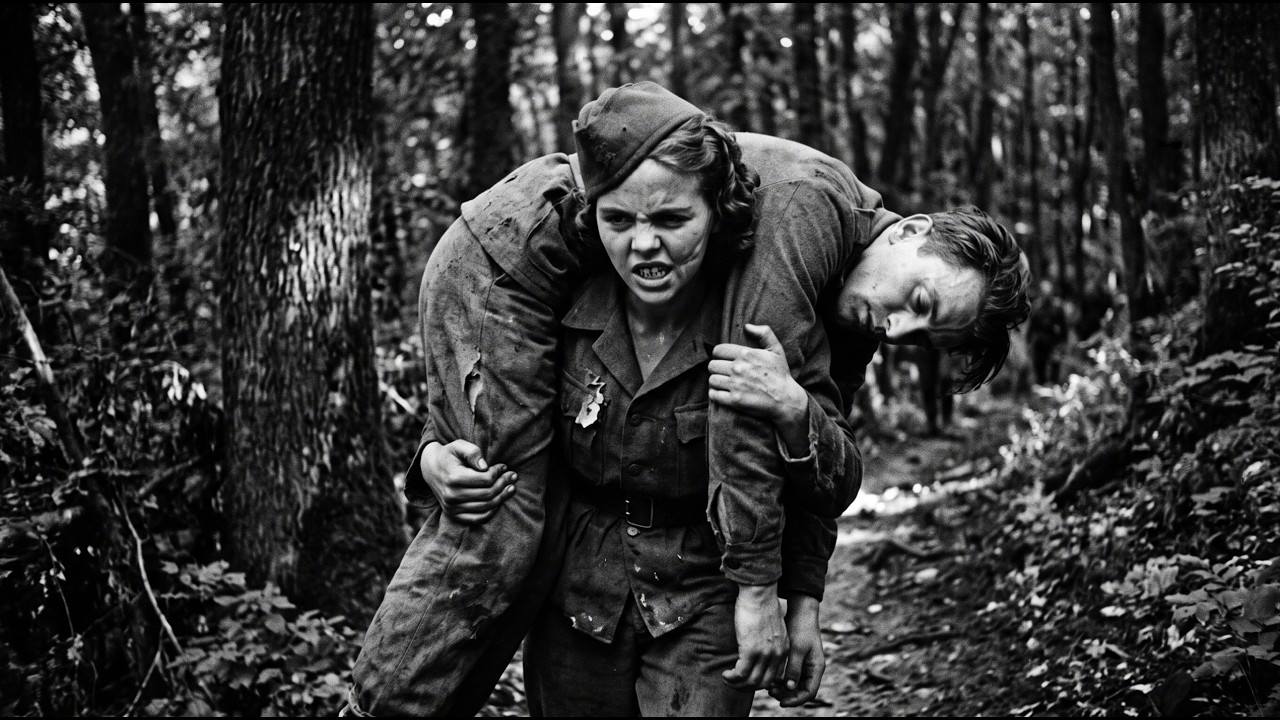
What no one disputes is what she did next. She was taken to a secret partisan hospital hidden in the Kočevski Rog forests, one of the underground medical sanctuaries the resistance kept from the occupiers. When she could stand again, she returned to her war. A commemorative record of her service says that nurse Albina cared more about the wounded than about herself.
She served through 1944 in the hills of Žumberak, then returned to White Carniola, treating, carrying, enduring—an 18-year-old with the scars of a veteran, doing work that broke grown professionals—until the war in Europe ended in May 1945. Yugoslavia awarded her the Partisan Star medal, third class. She married, worked, and lived a long life in Slovenia as an ordinary citizen with an extraordinary face until January 24, 2001. She got something many of her comrades never did.
She was allowed to grow old. Two thousand kilometers to the east, the other photograph was waiting to be taken. Roza Georgiyevna Shanina was born on April 3, 1924, in Yedma, a village set among the forests of northern Russia, one of seven children in a collective farm family. Her first notable act tells you everything about the rest of her life.
At age 14, wanting an education her village could not provide, she left home against her parents’ wishes and walked roughly 200 kilometers through the taiga to reach the railway alone, in order to attend school. Two hundred kilometers on foot through the forest at age 14. She trained as a kindergarten teacher in Arkhangelsk. By 1941, she was working with young children and supporting herself.
Then Germany invaded, and the war reached her family. Her brother Mikhail was killed in December 1941 during the siege of Leningrad. Other brothers would follow before the war’s end. Roza went to the enlistment office and asked to be sent to the front.
They refused. She came back. They refused again. She kept returning until the system gave in to her demands.
In April 1944, she arrived at the front with the 184th Rifle Division and soon commanded a platoon of female snipers on the Third Belorussian Front, at age 19. The record she built there made her famous in her lifetime. In her first weeks, she was honored for actions near Vitebsk, becoming the first woman on the front—and according to most accounts, the first female soldier anywhere in the Soviet forces—to receive the Order of Glory, third class. She received the second class in September of that year.
The Medal for Courage came in December. War records credited her with 59 enemy soldiers killed. Allied newspapers, once her story spread beyond the lines, called her “the unseen terror of East Prussia. ” Soviet newspapers published her photograph—the one with the braids and the smile—and made her a propaganda face for female snipers.
This is where most accounts of Roza Shanina’s story stop: at the numbers and the nickname. But Roza left behind something almost no soldier of her kind did, and it changes everything. She kept a diary. Keeping a diary at the front was prohibited.
She wrote anyway, in stolen moments, and entrusted the pages to a war correspondent named Pyotr Molchanov, who kept them for 20 years and published them in 1965. The young woman in those pages is not the propaganda image. She writes about exhaustion, about grief for friends who no longer exist. She writes about loneliness, about wanting to be loved, about music and ordinary evenings, about the life she intended to live afterward—perhaps at university, perhaps raising children.
She writes about doubt, and she writes one line that has outlived her by eight decades: that the essence of her happiness was fighting for the happiness of others. Her commanders said her most dangerous trait was her patience. Her diary says the most human thing about her was that she never stopped wanting the war to end. She kept requesting more dangerous missions.
She repeatedly demanded permission to fight in the front-line trenches instead of the safer sniper positions in the rear. Records state she pushed this request as far as it could go. In December 1944, she was wounded in the shoulder. She returned to her unit within weeks, in time for the great winter offensive toward East Prussia—the first German soil the Red Army reached.
The fighting there was as brutal as any battle of the war. On January 27, 1945, two soldiers found Roza in the snow, critically wounded in the chest by shell fragments. She had been hit while shielding a wounded artillery officer with her body. Surgeons tried to save her on January 28, 1945.
She died. She was 20 years old. The war she had fought since her teens had only 101 days left. Her comrades buried her on a riverbank under a spreading pear tree.
Place the two stories side by side, and they stop being just two viral photographs. They become a single mirror. Albina and Roza never met. They fought a thousand miles apart, in different armies, in different languages, in different roles.
One worked to save lives. The other ended them. Yet the parallels are almost frightening. Both were village girls from poor, large families.
Both were teenagers when invasion tore their worlds apart. Both lost parts of their families, or their bodies, to the same enemy. Both fought a second, quieter war against their own ranks for the right to be taken seriously—the nurse who cried because they would not give her a rifle, and the sniper who wrote letters and petitions because they tried to keep her safe. Both were part of a reality that history books took decades to acknowledge.
Around 100,000 women served with the Yugoslav partisans. Nearly 800,000 women served in the Soviet armed forces. Nurses, couriers, radio operators, pilots, drivers, snipers. Entire armies ran on their labor.
For half a century after the victory parades, most of their names went unrecorded. The two stories also teach something else, perhaps the most important thing. We know Albina through her medals and her scars—the official record of what institutions decided to honor. We know Roza through her forbidden diary—the private record of what a 20-year-old woman actually felt at four in the morning.
The medal tells you the institution noticed. The diary tells you the price. The diary is why neither woman can honestly be turned into a recruiting poster. Roza was brave, and Roza was lonely.
Albina was fearless in the record, and she was 18 and in agony in the photograph. Both things are true at once. Any version of history that keeps only the brave half is not remembering them. It is using them.
Their stories are not an argument that war makes heroes. They are proof that some people keep choosing to protect others even after war has stripped away their safety and their families—and in one case, a face, and in the other, a future. Look at the images again. The girl with the bandaged head is Albina Mali, three days past her 18th birthday, wounded for the third time, who wanted to fight, who returned to the war that did this to her, and who lived to be 75.
The girl with the braids and the smile is Roza Shanina, who walked 200 kilometers through a forest at 14 for an education, who wrote in her secret diary that her happiness was the happiness of others, and who died at 20 under a pear tree in East Prussia, shielding a wounded man with her body. The internet has shown these faces before. The stories were always the missing part.