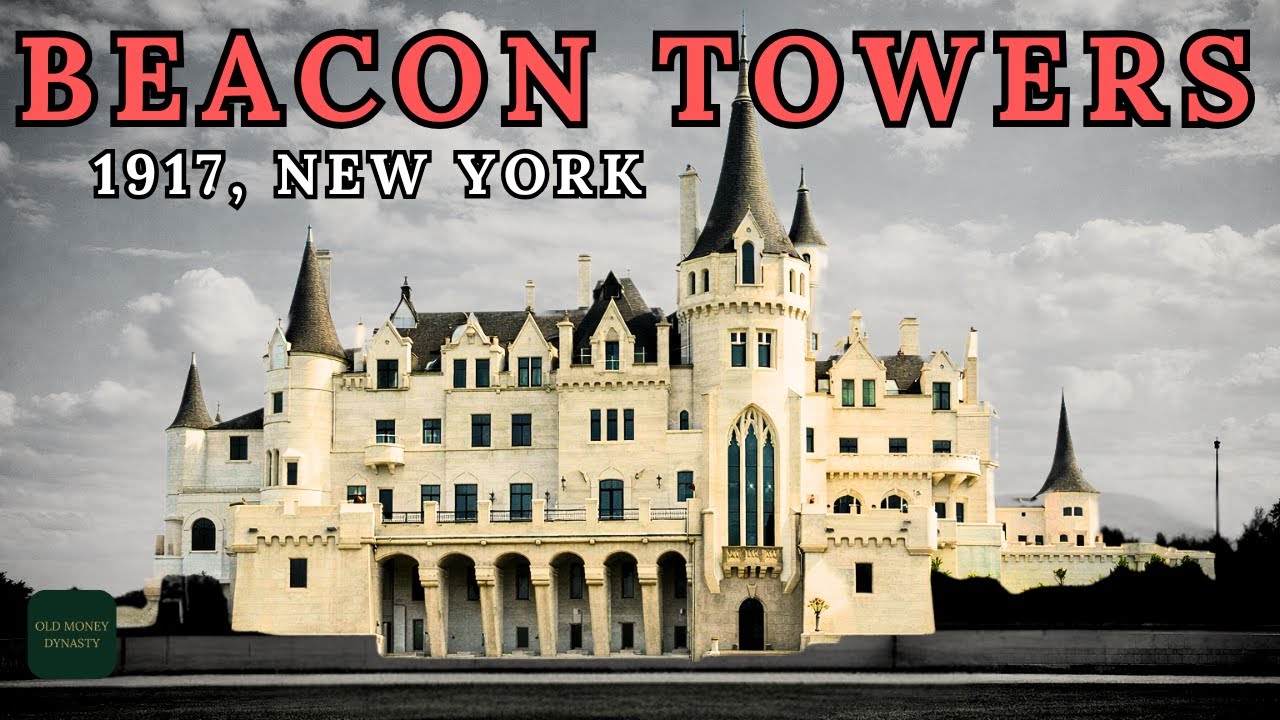
Alva Vanderbilt Belmont once stood at the water’s edge on the northern tip of Long Island and watched workers raise a white medieval castle from the shoreline. Beacon Towers was completed in 1918, built as a fortress for women’s suffrage and dedicated to Joan of Arc, the warrior saint whose statue occupied the entrance hall. The castle stood for only 27 years before it was demolished in 1945, but in that brief span it passed from a suffragette stronghold to a Hearst family retreat to literary legend. Most scholars believe it inspired the mansion in F.
Scott Fitzgerald’s *The Great Gatsby*, written just across the bay. Alva was born in Mobile, Alabama, in 1853, the daughter of a cotton merchant. The family fled north during the Civil War, and her mother ran a boarding house to support them. Alva never forgot the humiliation of that reduced circumstances.
She learned early that money was the only protection that mattered, and she used it ruthlessly during her lifetime. Her marriage to William Kissam Vanderbilt, grandson of the railroad tycoon, gave her access to one of America’s largest fortunes. She used it immediately to commission architects and build extraordinary homes. Richard Morris Hunt designed her mansion at 660 Fifth Avenue, a French Gothic chateau completed in 1882.
A costume ball so extravagant that even the formidable Mrs. Astor attended forced society to acknowledge the Vanderbilts. Marble House in Newport followed in 1892, its interiors costing more than the construction itself. A friend once observed that Alva loved nothing better than to be knee-deep in mortar, and the comment was not an exaggeration.
By 1895, she had overseen some of the most ambitious private residences in America and had become one of the first female members of the American Institute of Architects. Her marriage, however, was failing. William had been unfaithful for years. In a step virtually unheard of among the elite, Alva sued for divorce in March 1895.
The court ruled in her favor, awarding custody of the three children, leaving Marble House hers outright, and providing an annuity of $100,000 per year plus a settlement reported at over $10 million. Within ten months she remarried. Her second husband, Oliver Hazard Perry Belmont, was charming and devoted. When he died of an infected appendectomy in 1908 at age 49, Alva was freed from marriage for the first time in her adult life, and she turned her attention to a cause that would define her final decades.
By the time she built Beacon Towers, Alva had devoted herself to women’s suffrage. She had founded the Political Equality Association in 1909, paid to relocate the National American Woman Suffrage Association headquarters to New York, funded two years of its rent, and established eleven suffrage settlement houses across Manhattan, Brooklyn, the Bronx, and Long Island. Beginning in 1910 she worked to integrate the movement, funding a black branch of her association with prominent African-American club women including Sarah Garnet and Frances Reynolds Keyser, and opening a suffrage settlement house in Harlem. Beacon Towers became the permanent home of her weekend retreats, where women traveled from across the country to strategize, debate tactics, and organize.
Alva’s approach was militant. She had observed the English suffragettes in London in 1909 and was deeply impressed by their willingness to court arrest and generate publicity through confrontation. In January 1917 she organized the first picketing ever to take place at the White House. When suffragists were arrested and imprisoned, she paid their bail.
After the so-called Night of Terror at Occoquan Workhouse, she chaired a mass meeting in Washington and honored the imprisoned women with silver pins engraved “Jailed for Freedom. ”
The statue of Joan of Arc arrived before the castle was finished. It was a birthday gift from Oliver, life-sized, sculpted by the French artist Prosper d’Épinay. Once installed, it became the centerpiece of the castle, positioned where every visitor would encounter it upon entering.
Vincent Aderente, a muralist trained under Edwin Blashfield, painted scenes from Joan’s life across the castle walls. Female visitors most often recalled the enormous painting on the main staircase depicting Joan burning at the stake, the determined face of the heroine gazing down at anyone ascending to the upper floors. The message was unmistakable: this was a house dedicated to women who refused to surrender. The 19th Amendment was ratified on August 18, 1920.
For Alva the victory was personal, but maintaining the castle proved exhausting. Beacon Towers required a household staff costing $25,000 per year. In 1924 she purchased the adjacent lighthouse property for $100,000 in a bid for privacy from tourists and curious neighbors, but it was not enough. By 1925, in her 70s, Alva closed Beacon Towers, sailed for France, and spent her remaining years at the Château d’Œuf, a genuine medieval castle near her daughter Consuelo.
Alva Vanderbilt Belmont died in Paris on January 26, 1933, at age 80. Her funeral was held at St. Thomas Episcopal Church in New York, and in accordance with her wishes, all the pallbearers were women. In the fall of 1922, F.
Scott Fitzgerald arrived on Long Island with his wife, infant daughter, and a rented Rolls-Royce, renting a modest house at 6 Gateway Drive in Great Neck for $300 a month. He attended the legendary parties of his neighbors, watched everything, and drank too much. By day he worked in a room above the garage. There, looking out at the manicured lawns of his wealthy neighbors, Fitzgerald began writing *The Great Gatsby*, completing the first three chapters before leaving Long Island.
The geography of the novel took shape directly from what he observed. Great Neck became West Egg, the territory of new money. Across Manhasset Bay, Sands Point became East Egg, home of old money, Protestant, reserved, secure in its position, and contemptuous of those who were not. Fitzgerald described Gatsby’s mansion as “a factual imitation of some Hôtel de Ville in Normandy, with a tower on one side, spanking new under a thin beard of raw ivy, and a marble swimming pool and more than forty acres of lawn.
” Literary scholars have debated which real estate inspired this description, but Beacon Towers matched it more closely than any other estate. Alva Belmont’s creation stood at the far end of Sands Point, its pale towers visible from across the water. The French Gothic design echoed the Hôtel de Ville reference. The dominant tower anchored the composition exactly as Fitzgerald described.
The structure was barely four years old when Fitzgerald arrived. And like Gatsby’s mansion, it stood at the edge of the bay, a declaration of ambition that no amount of money could fully satisfy. Fitzgerald left Long Island in the spring of 1924 and finished the novel on the Riviera. It was published in April 1925 to respectful reviews but disappointing sales.
He died in Hollywood in 1940, largely forgotten, believing himself a failure. William Randolph Hearst wrote a check for $400,000 in 1927 and acquired the grandest estate on Long Island as a present for his wife, Millicent. Hearst, 64, was at the height of his power. His newspaper empire stretched from coast to coast, and his appetite for acquisition was legendary.
He renamed the property St. Joan’s, keeping the name Alva had given it even as he transformed everything else. Hearst himself rarely visited, and contemporary accounts suggest he may never have lived there at all. The estate belonged to Millicent, who was effectively separated from her husband, who lived openly with the actress Marion Davies in California.
The transformation began with the roof, which was raised by several feet. Dormer windows appeared along every elevation. The windows were enlarged, the entryway remodeled. The interior fell to French & Company, the prestigious New York firm that specialized in period rooms for wealthy Americans.
Hearst’s vast inventory of European art and architectural salvage filled sixteen rebuilt rooms, five from France, six from Britain, including oak-paneled chambers salvaged from Hamilton Palace in Scotland and rooms dating to the 16th century. Suits of armor lined the great hall. A 15th-century carved oak figure of a saint stood watch. The effect was less residence than museum.
A movie theater was added. Most of the Joan of Arc murals Alva had commissioned were removed, all but one disappearing during the renovation, replaced with decorations grander and older and more expensive, but carrying none of the personal meaning Alva had embedded in every brushstroke. The renovations were complete by 1933. That summer, 2,000 guests filled the stone courtyard of St.
Joan’s for a dinner dance that would become the most extravagant gathering in the estate’s brief history. Ethel Barrymore was there. Winston Churchill attended. Hollywood sent its representatives, the publishing world sent its editors.
Dancing continued past midnight, champagne flowed freely. Outside the walls, America was enduring its fourth year of economic catastrophe, with unemployment at 25%, banks failing by the thousands, and bread lines stretching around city blocks. The gathering at St. Joan’s existed in a bubble, insulated from the suffering that defined daily life for millions of Americans.
The unraveling began four years later. In 1937, the two corporations controlling Hearst’s media empire found themselves $126 million in debt. A court-mandated reorganization followed, and Hearst, who had spent 50 years building the largest media operation in America, was reduced to the status of an employee. His salary was slashed to $500,000 per year, his annual dividend of $700,000 eliminated entirely.
The art sales began almost immediately. By 1941, 20,000 items from various Hearst properties had been put up for sale, including the oak paneling from Hamilton Palace, the Beauvais tapestries, and the paintings by Sir Joshua Reynolds that had filled St. Joan’s. That same year, Orson Welles released *Citizen Kane*, a film about a newspaper magnate who builds a vast estate filled with art only to die alone, clearly based on Hearst.
The publisher used what remained of his influence to suppress the film, but the damage was done. The following year, Hearst surrendered St. Joan’s to the bank. He could no longer afford to maintain a property he rarely visited.
Millicent moved to Southampton. The bank tried to find a buyer, but no one wanted a hundred-room Gothic fantasy on the tip of Long Island. The property sat empty. Hearst died in Beverly Hills in 1951 at age 88.
Millicent was not at his side. In 1945, the wrecking crews arrived at Sands Point. The bank had tried for three years to find a buyer. A realtor finally purchased the property to subdivide it, and the land was worth more as building lots than the structure was worth as a home.
The demolition cost $10,000. The structure had stood for 27 years, less than three decades separating its completion from its obliteration. No one with any connection to the building’s history stepped forward to save it. Eight houses rose on the cleared land, arranged along a new street called Sands Point Road.
Six of those houses remain today. The gate house survived, converted now into a private residence, its lookout tower with the tolling clock still standing. In the woods beyond the modern houses, sections of the old garden walls persist, along with the ruins of the garage and fragments of old towers, broken and overgrown. The lighthouse that gave Beacon Towers its name still stands as well, its beacon dark but its structure intact.
In 2004, the co-founder of Arizona Iced Tea purchased a two-acre plot of the original estate and built a 30-room château-inspired mansion on the site, completed in 2007, echoing the medieval fantasy Alva had pursued nearly a century earlier. The most enduring remnant is not physical. In 2013, director Baz Luhrmann released his adaptation of *The Great Gatsby*. Before filming, his production team visited Sands Point to study photographs of Beacon Towers, and production designer Catherine Martin explained the connection, saying there was something that gave it the feel of a fairy tale castle.
Luhrmann referenced that quality deliberately, and the film’s mansion shares the same cluster of turrets, the same arched windows, the same cream-colored facade that Beacon Towers once displayed. One current resident of the former estate told reporters he watched the film twice because he could not believe the resemblance. The novel itself has never stopped selling. Published in 1925 to disappointing initial sales, it languished for years before finding its audience.
By the centennial of its publication in 2025, *The Great Gatsby* had sold tens of millions of copies and secured its place among the essential American novels. Alva Belmont’s legacy proved equally durable. The 19th Amendment she fought for remains the law of the land. The Joan of Arc statue that once stood in her castle now resides at the Belmont-Paul Women’s Equality National Monument in Washington.
The building is gone, the woman who built it is gone, the man who transformed it is gone, and the novelist who immortalized it died believing he had failed. But what they created together, in ways none of them intended, persists.