On December 31, 2020, Coca-Cola quietly ended a product that had survived for 57 years despite decades of dwindling sales. The drink was Tab, a diet soda that had once dominated the category yet spent nearly 40 years with market share so small that grocery chains barely stocked it. Executives could have discontinued it at any moment, but the company kept the bottling lines running to satisfy a small, devoted group of drinkers who called themselves Tabaholics. The strangest part of Tab’s story, however, is not its slow-rolling end.
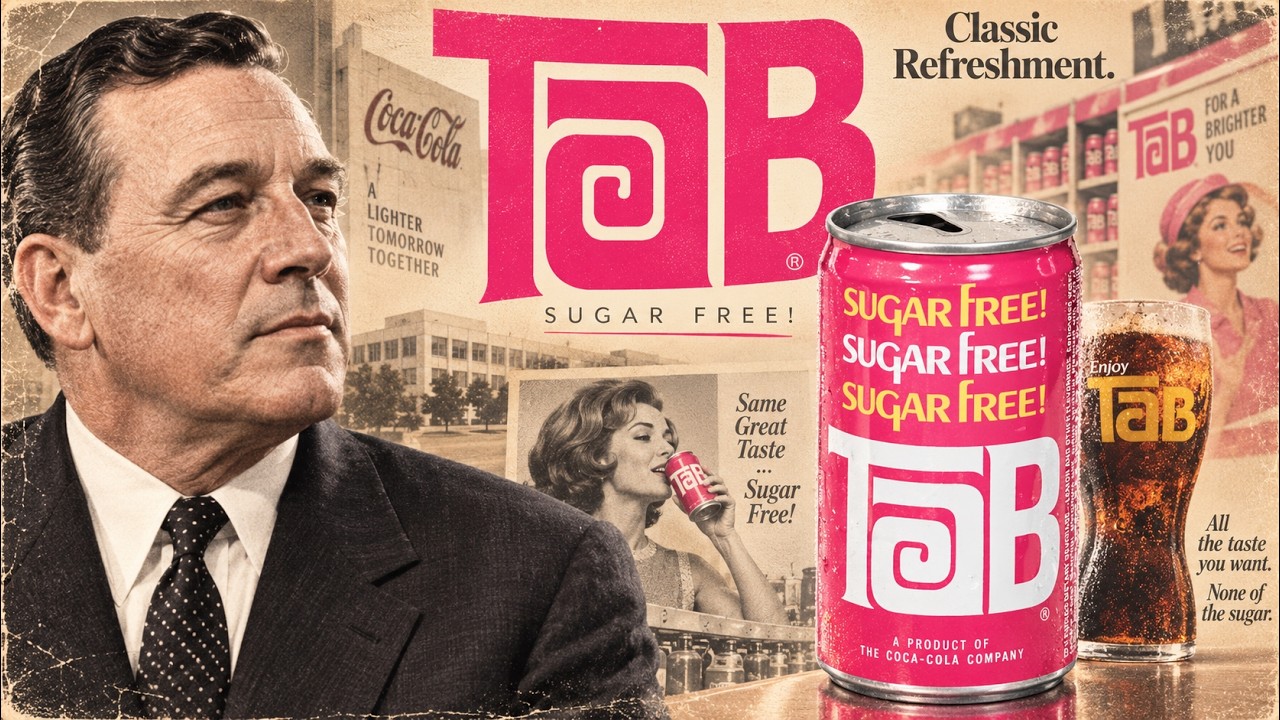
It is what happened in 1982, the same year Tab reached its highest sales ever. That year, Coca-Cola released a new diet cola built specifically to replace it. Tab’s legacy, in the end, was that of a company creating the most successful product to ever kill its own creation. The story begins in Atlanta, Georgia, in 1963.
By the early 1960s, the post-war boom had stocked American kitchens with processed food, packaged snacks, and soda by the case. For the first time, doctors, magazines, and dinner table conversation across the country were treating excess weight as a national health concern rather than a private matter. A new category of soft drink emerged in response. Nocal, a sugar-free ginger ale, appeared in 1952, aimed narrowly at diabetics, and remained a niche product.
Royal Crown Cola moved further in 1954, introducing Dietright, and by 1962 had taken it national, marketing it not as a medical product but as a lifestyle choice for anyone watching their weight. That product sold well, and it exposed an uncomfortable gap inside the largest soft drink company in the world: Coca-Cola had no diet soda of its own. This was not a small company missing a trend. Coca-Cola had defined the soft drink industry for 70 years, yet it watched a competitor a fraction of its size open a category for which it had no answer.
Every case of Dietright sold was a case Coca-Cola could not compete against. The response was a corporate decision made at scale. Coca-Cola’s R&D division was assigned a mandate: build a diet cola that could compete directly with Dietright and close a two-year head start. Before the formula came the name.
In a move no beverage company had made before, Coca-Cola ran the naming problem through a computer, sifting through roughly 185,000 possible names. The survivor was short, sharp, and easy to remember: TAB. It doubled as a pun on keeping tabs on your weight and fit on a can in four clean letters. Tab launched in 1963 as Coca-Cola’s first diet drink in nearly eight decades of existence.
Its sweetness came from cyclamate, an artificial sweetener blended with a smaller amount of saccharine to mimic sugar’s texture without the calories. The formula lasted exactly six years. In 1969, the U. S.
government banned cyclamate outright after animal studies linked it to bladder tumors in lab rats. Coca-Cola reformulated Tab almost overnight, shifting to saccharine as the sole sweetener, which carried a distinctive bitter aftertaste that came to define the drink for a generation. Packaging gave Tab its identity. Every major soda in the early 1960s wore some variation of red, white, or glass-bottle green.
Tab’s can was pink—a bright, saturated, impossible-to-miss pink with bold block letters. On a shelf crowded with red Coca-Cola, blue Pepsi, and muted grocery-store soda palettes, the pink can announced from ten feet away that this was not a regular soda. It was a decision built for a shopper actively choosing not to reach for the red can next to it. Tab was never sold as a bargain.
It launched priced in line with Coca-Cola’s flagship cola, noticeably above the no-name diet sodas crowding drugstore shelves. Coca-Cola wasn’t trying to win on price; it was selling a premium built on restraint. The product was aimed at women watching their weight, a demographic Coca-Cola’s own research had identified as underserved. Early advertising featured slim silhouettes, calorie counts printed boldly on the can, and copy built around control rather than refreshment.
The fourth pillar of Tab’s success was an inheritance. Dietright had to build its retail presence from nothing—one bottler, one grocery chain, one regional market at a time. Tab never did. From its launch, it moved through the exact same bottling plants, delivery trucks, and shelf-space agreements that had carried Coca-Cola into nearly every corner store in America for two generations.
No rival diet soda could match that reach on day one. By the early 1970s, Tab wasn’t just competing with Dietright; in most American grocery stores, it was the only name in the diet aisle that mattered. In 1964, the first national print ads kept the message simple: a can, a number of calories, and a woman who looked like she’d never needed to think about either. By the 1970s, the defining tagline was unmistakable: “A beautiful drink for beautiful people.
” The campaign ran across print and television, built around outdoor scenes, pool parties, and tennis courts, where every person on screen was thin, tan, and holding a pink can. Tab wasn’t selling refreshment; it was selling membership in a category of person. The 1980s pushed the idea further with slogans like “Tab’s got sass” and “Body by Tab,” pairing the product with slim women in leotards and swimsuits, lifted directly from the aerobics boom sweeping the country. Coca-Cola made one attempt to widen the audience to men, but it didn’t take.
Nearly two decades of advertising built exclusively around women had made Tab’s identity almost impossible to reverse. What the advertising built, the numbers backed up. Tab climbed steadily through the 1970s, and by 1982 it was the bestselling diet soft drink in the United States—the diet cola every other diet cola was measured against. The achievement carried weight because of what it took to get there: a forced reformulation in 1969, and a cancer scare in the early 1970s that put a warning label on the can, the same kind of label the government put on cigarettes.
A soda carrying a cancer warning on its own packaging should have been a dying brand. Instead, it kept climbing. Tab’s cultural reach outlasted its sales peak. In 1985, the film “Back to the Future” placed the drink in front of a new audience.
A teenager from 1985, thrown back to a diner in 1955, asks for a Tab, only to be told he’ll have to order something that actually exists yet. It was a throwaway joke about a soda so ordinary in 1985 that its absence in 1955 barely needed explaining. Tab, by then, was part of the cultural furniture. 1982, the year Tab reached the top of its category, was also the last year it would ever be Coca-Cola’s most important answer to the question of what a diet cola should be.
Executives had spent two decades watching Tab build a loyal, almost exclusively female customer base. Internal research kept surfacing the same pattern: men weren’t buying it, and one attempt to widen the pitch in the late 1970s had gone nowhere. The company concluded that Tab’s brand identity was so tightly wound around dieting women that it could never reach everyone else. If Coca-Cola wanted a diet cola that appealed broadly, it would have to build a new one from scratch.
In 1982, the same year Tab reached its peak, Coca-Cola launched Diet Coke. Unlike Tab, it carried the company’s flagship name directly on the can. Where Tab had been marketed as a dieter’s soda, Diet Coke was positioned as a naturally lighter version of the drink Americans already loved, with low calories almost an afterthought. Coca-Cola’s leadership framed the reasoning as expansion, not replacement, but the market didn’t see two separate products.
It saw one company quietly announcing which diet cola it was actually betting on. The customer response arrived almost immediately, showing up first in Coca-Cola’s own checkbook. The same year Diet Coke launched, the company stopped putting meaningful advertising money behind Tab. Two decades of national campaigns simply stopped.
Retailers noticed the shift faster than shoppers did. Shelf space that had once been split between the two diet colas began tilting toward the can with the Coca-Cola name on it. Within a few years, Diet Coke had overtaken Tab in nearly every market where the two competed head-to-head. Coca-Cola did try to fight back with the one lever it had left: the formula.
In 1984, the company removed saccharine from Tab entirely, replacing it with aspartame, branded as NutraSweet. It solved real problems—no more bitter aftertaste, no more cancer warning stamped on the can—but it did nothing to reverse the momentum Diet Coke had already built with two years of national advertising and the Coca-Cola name behind it. Some longtime Tab drinkers noticed the missing saccharine bite immediately and weren’t sure they liked the change. What followed wasn’t a dramatic collapse.
Tab’s decline through the 1980s and 1990s was a slow, steady erosion of shelf space and market share inside a company that never stopped making the product. By the 1990s and into the 2000s, Tab’s market share had fallen to a level industry trackers barely bothered to report separately—a rounding error next to Diet Coke and later Coke Zero. Yet the bottling lines kept running. Coca-Cola never issued a formal decision to kill Tab during those decades.
It simply kept producing a shrinking, low-priority product for a devoted audience called the Tabaholics, who sent letters and petitions to headquarters every time a rumor of discontinuation surfaced. The formal end came in October 2020, folded into a broader announcement about Coca-Cola reshaping its entire portfolio during a global pandemic. The company confirmed it was discontinuing Tab alongside several other legacy brands as part of an effort to focus resources on its highest-growth products. There was no dramatic press conference, just a corporate statement and a list of names.
Production continued through the rest of the year, then stopped. The final cans rolled off the line before December 31, 2020. No plant-closure ceremony marked it. Fifty-seven years of production simply ended.
The pink cans already on shelves kept selling until they ran out. Then there were no more. Tab never got a comeback. No small independent bottler bought the rights, revived the original glass bottle, or relaunched it to nostalgic press coverage.
Coca-Cola still owns the name, the formula, and the pink can, and has shown no public plans to bring it back to American shelves. The one place a shopper can still legally buy a can of Tab is South Africa, where Coca-Cola has continued limited production years after pulling the product from the country that invented it. Instead, Tab got a sustained fan campaign with no company involvement. A group calling itself the Save Tab Soda Committee has kept the brand’s absence in front of the public by nearly every means available to people with no marketing budget and no manufacturing rights.
They’ve collected thousands of petition signatures, organized coordinated call-in days to flood Coca-Cola’s phone lines, paid for billboards in Atlanta, Coca-Cola’s own hometown, mailed handwritten birthday cards to mark the anniversary of Tab’s 1963 launch, and even sponsored a pink race car to keep the name circulating somewhere executives might see it. For the drinkers who still miss it, the loyalty was never really about nostalgia in the abstract. It was about a specific taste nothing else on the market ever fully replaced: the sharp, faintly bitter bite that saccharine gave the original formula. A flavor some longtime fans describe missing more than they expected to when Coca-Cola switched Tab to aspartame in 1984, and a flavor that no can of Diet Coke or Coke Zero Sugar was ever going to reproduce.
There is no single bottling plant to point to. Tab was never made in a dedicated facility. It moved through the same shared Coca-Cola bottling network that carried the company’s flagship cola for generations, sharing lines, trucks, and warehouses with dozens of other products. The plants that once ran Tab through their lines are in most cases still standing, still running, just making something else now.
The most telling detail comes from Coca-Cola itself. In public statements about the discontinuation, executives made an admission that would have sounded almost unthinkable in 1982 at the height of Tab’s success: without Tab, they said, there would be no Diet Coke and no Coke Zero Sugar either. The company that quietly starved Tab of advertising dollars, then let it fade for nearly four decades, was on the record crediting it as the direct ancestor of the two diet colas that replaced it. Tab was never beaten by an outside rival.
It wasn’t undercut on price, out-marketed by a scrappier competitor, or caught flat-footed by a health trend it never saw coming. It did almost everything right for almost 20 years, absorbed hit after hit from its own government’s health regulations, and kept climbing right up to the top of its entire category. Then the same company that built it built something better, gave that product its own name, and let the original quietly run out the clock for the better part of four decades rather than say the word discontinued out loud.