When the source material strips away the horses, hats, and ceremonial spoons, the British monarchy resembles a factory with a single production line. The product is a human being legally permitted to sit on a specific chair. Everything else exists to protect that line. When a part breaks, the machine does not cry into a handkerchief. It walks to the shelf, finds the nearest piece with the same bolt pattern, and resumes production before the funeral flowers wilt.
That is the condensed version of the story most people carry in their heads. Her fiancé died, so they gave her his brother. The phrase is harsh. It has survived for 130 years because it allows us to feel morally superior to the Victorian era without reading a single page about any of its men.
But look at what that sentence quietly deletes. It deletes a girl born into the poorest branch of the royal family, whose parents fled the country to avoid creditors. She watched strangers price her mother’s furniture and decided, in the depths of that humiliation, never to allow anyone to put her in that position again. It also deletes the woman who read the machine more accurately than the men hired to run it.
The third deletion is the part nobody believes on first hearing. The marriage was successful. Not in the clattering-teeth, separate-wings sense that marked dynastic arrangements, but enough to produce a pile of letters so tender that historians who first read them could not reconcile the paper with the photographs. These were two people who could not say the words out loud, so they spent four decades writing them instead, exchanging evidence across a building either could have crossed on foot in ninety seconds.
Let us do this properly, slowly, with the proof.
An impoverished princess with a title that did not open doors. A dead prince whom history never treated fairly. A naval officer with a beard, a broken heart, and an emotional vocabulary no larger than a ship’s mooring rope. And a pond in Richmond where the whole thing finally ended up.
Neither participant planned to make a love story. The two who found themselves inside one would have denied it at the time in identical, embarrassed, clipped terms.
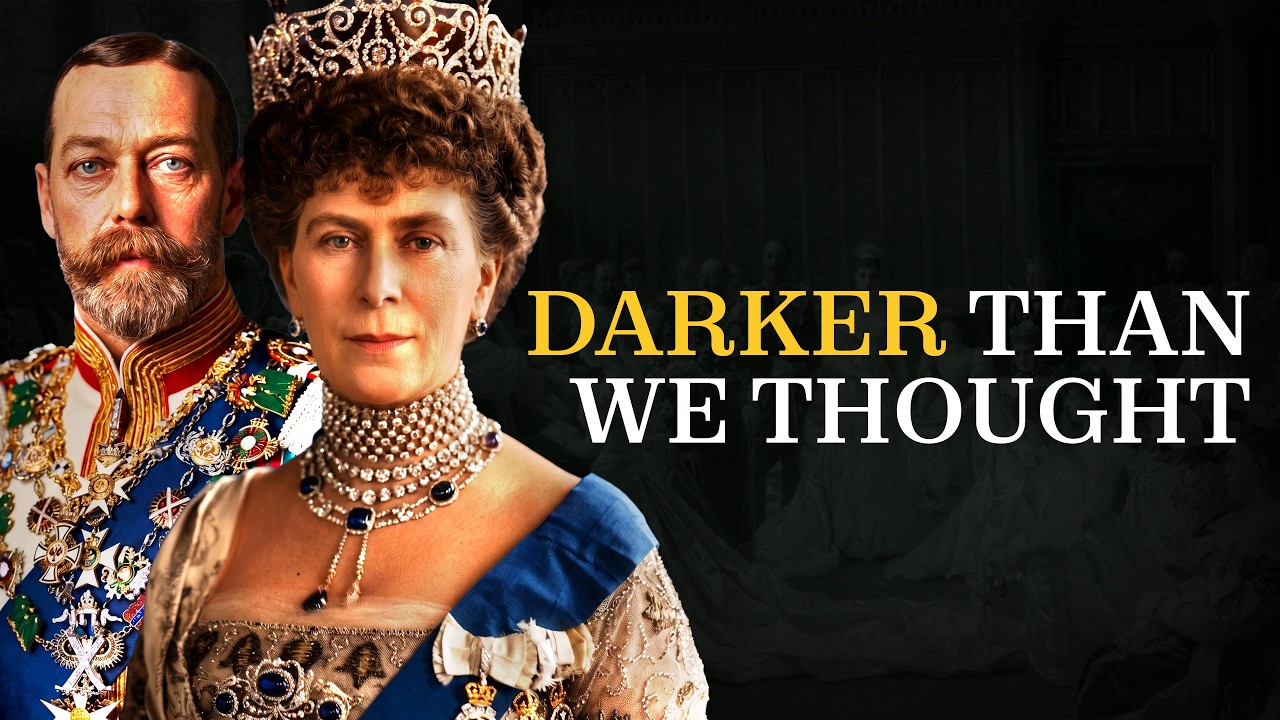
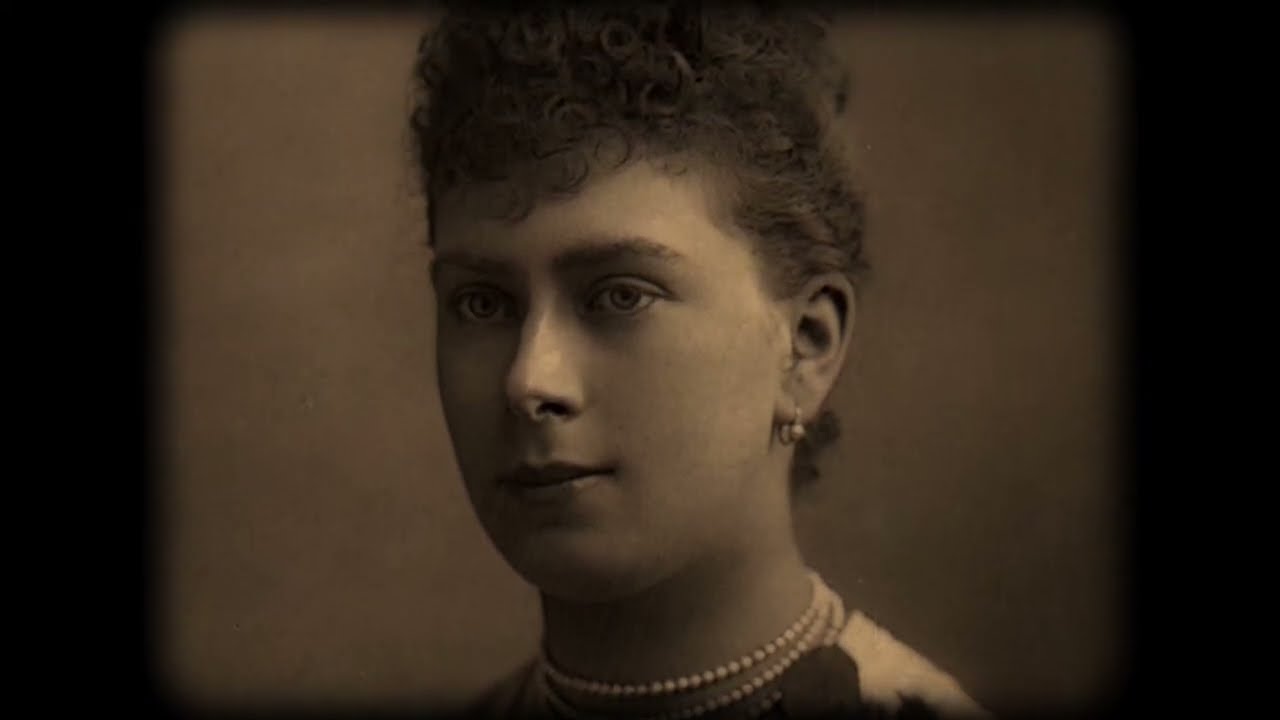
Princess Victoria Mary of Teck, known to everyone who loved her as May, arrived in 1867 with a lineage that looked imposing from across the ballroom but collapsed entirely upon inspection. Her mother supplied the noble blood. Princess Mary Adelaide of Cambridge counted King George III as a grandfather and Queen Victoria as a cousin. Within the closed world of nineteenth-century royalty, that was the equivalent of being related to the owner of God’s house. No one argued with that half of the record.
Francis, Duke of Teck, destroyed the other half. He came from a morganatic marriage between Duke Alexander of Württemberg and a Hungarian noblewoman named Claudine Rhédey von Kis-Rhéde. The word morganatic governed everything about his daughter’s future. These marriages were a legal compromise for monarchs who married beneath their rank. The marriage was recognized. The affection was recognized. The children were recognized. But the inheritance evaporated the moment it happened.
Francis married a woman he loved, renounced any right to the Württemberg succession, and passed that wreckage to his daughter. May entered the world with the title Her Serene Highness instead of Her Royal Highness. One adjective made the difference. In the late Victorian court, that adjective functioned as a wall topped with broken glass. Everyone who mattered knew exactly where she stood. The phrase used to describe people in her position was two words: poor relation.
To understand everything that followed, you must feel how cruel that ranking system was. Rank dictated who you married. Marriage dictated your entire economic future. A girl whose father had been excluded from a German succession would not, under normal circumstances, receive an offer to sit on a throne.
The Teck family lived among the royals, dressed like them, and sat at the dinner table permanently and visibly below them. Everyone behaved with extreme politeness about it. That kind of politeness hurts more than rudeness. Rudeness at least acknowledges that something is happening.
Now add money to the equation, or rather its complete and spectacular absence. Princess Mary Adelaide was one of the most beloved royals in Britain. The public adored her so much they called her Fat Mary to her face and behind her back. She accepted it with the calm of a woman who understood that public affection works as a currency. What she could not do, under any circumstances known to man, bank, or parliament, was stick to a budget.
Kensington Palace and the White House in Richmond were run as lavish operations under her direction. The income was £5,000 a year. Every account of that household describes the same pattern: a hostess ordering supplies as though the annual income were a suggestion rather than a limit, and tradesmen extending credit because the granddaughter of George III could surely not default on them.
She could. By 1883, the family owed around £70,000. Do the math because it produces the most useful number in this entire story. Fourteen years of the family’s total income had already been spent, gone, and turned into debts owed to men whose patience and politeness were running out.
There was one obvious solution, and her name appeared on coins. The Teck family approached Queen Victoria as a cousin and asked her to erase a problem she could have erased with a signature and a conversation with the Treasury. Victoria examined the amount, looked at the request from a relative she genuinely loved, and refused outright.
So the Teck family fled. Less politely: the granddaughter of George III dismantled her home, auctioned her possessions for cash, and escaped her creditors into exile on the continent. The family stayed in Florence from 1883 to 1885 while London chewed the scandal at dinner parties and enjoyed it thoroughly.
May turned sixteen inside that exile. Her adolescence taught her exactly what happens to people who lose control of their circumstances. It taught her by making her watch what happened to her mother in public, before an audience of everyone she had ever met. Court gossip does not leave a scar. But strangers appraising your mother’s furniture leaves a scar that never fully heals. Every decision this woman made over the next seventy years stems from those two years abroad.
Exile refined her. Under her governess, Madame Bricka, May did what bookish teenagers with no social calendar and no money do: she read everything she could find. She absorbed European art and learned enough Italian to use it. By the time the Teck family limped back to Britain, the girl who left as a confused royal highness had developed an intellectual curiosity that was almost abnormal among the British royals of her generation.
The deeper change had nothing to do with paintings. The scandal planted something permanent in her core: a fear of instability that never loosened its grip, an obsession with order that would define her identity for seven decades, and a conviction that duty was not an annoying obligation but the only reliable roof over anyone’s head. Chaos, in her direct experience, described what happened to families who followed their feelings and hoped for the best.
May returned home controlled, watchful, and very quiet. Everyone in London interpreted that quietness as weakness, filed her away as harmless, and moved on to more entertaining topics. That mistake would be repeated by intelligent people throughout her life. At least one of them ended up on the throne partly because of it.
Meanwhile, at the top of the pyramid, the old woman was having an inventory problem. Queen Victoria needed a wife for her grandson, the heir presumptive. Foreign princesses brought foreign alliances tied to the wedding carriage like tin cans. Victoria wanted a British-born girl, raised inside the system, who knew its rules and needed no lessons from anyone.
The shortlist was embarrassingly short. British princesses of the right age barely existed. The search pushed Victoria toward branches of the family she would normally have ignored. So the most powerful woman on earth came to inspect the ramshackle, indebted, recently fled Teck family and the silent girl standing in the middle of it.
Her assessment survives in her own handwriting. In her diary, Victoria judged May to be strong-willed, sensible, and perfectly well brought up. That sounds like faint praise until you remember what the job actually required. No one was running a beauty contest. The Queen wanted to anchor the future king. She concluded that this poor relation from the wrong branch of the family possessed the stiffest spine available in the entire British Isles.
The morganatic marriage problem, the Serene Highness problem, and the £70,000 problem all became negotiable with a single decision. Character had triumphed over lineage in a direct confrontation. An institution built entirely on the accident of birth had quietly admitted that birth had failed it and something else would have to fill the gap.
Which brings us to the young man everyone wanted to anchor.
Prince Albert Victor, Duke of Clarence and Avondale, known within the family as Eddy, arrived as the eldest son of the Prince and Princess of Wales and second in line to the throne. He is also arguably the most defamed man in modern British royal history. The demolition of Eddy’s reputation deserves a close look because the mechanism that produced it reveals as much about the historians as it does about the prince.
Mid-century biographers struck first and hard. Harold Nicolson and James Pope-Hennessy, both working from the private contempt of courtiers who knew the family, presented a prince described as idle, indifferent, and intellectually vacant. That verdict hardened with terrifying speed. Later writers piled on weight until nothing underneath could breathe.
In 1994, Theo Aronson presented claims of Eddy’s dissipation and traced the circumstantial threads linking his name to the Cleveland Street scandal of 1889. A homosexual scandal that shook London attached itself to the prince largely through association and rumor rather than anything resembling evidence. Nothing was proven. Nothing needed to be. By that time, Eddy existed only as a punchline.
Modern scholarship has moved strongly in the opposite direction. Jane Ridley warns against believing the caricature of Eddy as an empty young man lacking any sense of purpose. She points directly to the mechanism that made it: the accounts supporting that image came overwhelmingly from courtiers who preferred his younger brother. Assembling a man’s biography exclusively from interviews with people who wanted his job and eventually got it tends to produce a certain result.
Would Eddy have become a strong king? Probably not. No one claims otherwise. The only point on which all sources across all eras agree concerns his family’s assessment of him as a weak vessel requiring a strong, capable wife to manage him and keep the succession stable from behind him.
Read that assessment again because it contains something the traditional narrative always ignores. May did not enter this story as decoration. She entered it as structural support. The selectors looked at their heir, looked at the approaching century, and concluded that a poor, over-educated, deeply shy girl from a morganatic branch represented the strongest material they could find anywhere.
The proposal came in early December 1891 inside a country house owned by neither family. The Tecks arrived as guests at Luton Hoo, a lavish estate belonging to Madame de Falbe, wife of the Danish ambassador. That arrangement summarizes the entire Teck life better than any biography could in a full chapter: magnificent surroundings, none of it theirs, all of it borrowed from someone with more money and fewer creditors.
Eddy proposed during the visit. May accepted. For her family, that acceptance sounded like a bank vault opening. Every calculation of the previous decade flipped within a single afternoon. The daughter of a morganatic duke, the Serene Highness with the auctioned furniture, would now become Queen of the United Kingdom.
For May, the calculation was different and much colder. Duty accomplished, the value her upbringing had trained her to regard as the highest available, came attached to permanent, unshakeable security. The very commodity that had been ripped from her at sixteen. No one auctions the possessions of a future queen.
The wedding date was set for February 27, 1892. The trousseau was ordered. The machine had found its part and fitted it. For the first time in years, the whole apparatus looked like it might run smoothly into the new century.
She had seven weeks.
In the early days of 1892, influenza swept through Britain as part of the pandemic history records as the Russian flu. It moved through the country the way such things did before medicine could do anything beyond watching and taking notes. No one had a defense. It hit rich houses as fast as poor ones, one of the very few respects in which the nineteenth century treated everyone equally.
Eddy caught it at Sandringham, the family home in Norfolk. The inflammation settled in his chest and turned into pneumonia. No treatment worth mentioning existed anywhere in 1892. No antibiotics, no oxygen, nothing in the entire medical arsenal but warmth, nursing, brandy, and the collective will of a family standing around a January bed in Norfolk watching a young man drown inside his own lungs.
He died on January 14, surrounded by his family and his fiancée in the room. The country went into mourning on a scale that astonished the palace itself. The stability of the succession arrangement, settled two weeks earlier, evaporated. The machine began doing what machines do: recalculating before the body had left the house.
May fell into a category with no name and no protocol. Not a widow, since the wedding had not happened. Not a princess of royal blood. Nothing had changed at all about her status as a Serene Highness from a poor branch of a poor family. Her future as queen consort evaporated in seven weeks. The institution returned her, with great sympathy, to the margins she had spent her life trying to escape, now carrying the additional burden of being permanently and publicly tragic.
Her wedding clothes went into storage.
February came. The wedding date passed with the entire family in black. Somewhere in a wardrobe sat thousands of pounds of dresses for a woman who no longer had anywhere to wear any of them.
Most accounts rush past this gap to get to the exciting part. Let us pause inside it instead.
May was twenty-four. For about seven weeks, she had occupied the most envied position in Britain. Then, without warning, she became an object of national pity. Pity does not marry you. It does not fix your family’s finances. It does not restore anyone’s furniture. What pity buys you is a seat at the far end of the table with an excellent view of everyone else’s life.
No one recorded what she thought during those months. Her actions remain the testimony. They do not describe a young woman who surrendered and retreated into a dark room with a portrait and a bottle of smelling salts. She stayed close, very close, inside a family enduring its deepest crisis in a generation, and made herself useful within it.
That decision is what the famous sentence erased. No one gave her anything in 1892 because there was nothing to give. The person who kept her inside the building where giving might eventually happen was the person with no right to live there.
The replacement heir found no pleasure at all in his promotion.
Prince George, Duke of York, had built his entire life on the perfectly logical assumption that the throne belonged to someone else. Naval training shaped him into a rough, seasoned, routine-obsessed officer who was happiest aboard a ship with a clear chain of command and a schedule pinned to the wall. The Royal Navy took boys and returned them as men with upright posture, punctuality, and no ability whatsoever to discuss their inner lives. The process worked on George completely.
He also adored his elder brother. This reading requires no emotional invention. It appears consistently across every literary source. George worshipped Eddy. Eddy’s death broke him more deeply than anything else he ever experienced, including decades later the world war and the collapse of half the monarchies of Europe.
Then comes the detail every dramatic account drops, the one that turns him from a plot device back into a human being. Months before Eddy died, George had proposed to his cousin, Princess Mary of Edinburgh, known in the family as Missy. Missy’s mother opposed the match. Missy refused him.
Consider the actual state of this man in early 1892. Rejected by the woman he chose for himself. Robbed of the brother he loved. Handed a job he never wanted and was never trained for. Then offered his dead brother’s fiancée as an obvious administrative solution to a problem he had no part in creating.
Every account agrees he hesitated. The length of that hesitation appears clearly in the calendar. Eddy died in January 1892. George did not propose until April of the following year. That leaves fifteen months with no explanation from anyone pushing the transferred-bride story. Fifteen months is not a transfer. Fifteen months describes two broken people mourning the same man, slowly and with no useful guidance from anyone around them, trying to figure out what they might become to each other.
Around them, the senior women of the family went to work. Here the story stops being a romance and starts resembling a knife fight conducted in drawing rooms while tea was served.

Queen Victoria operated on pure engineering logic. She had already assessed May and concluded the girl possessed exactly the character required of a future queen. Eddy’s death did not change that assessment by one degree because the specifications had not changed. Only the man had changed. Removing a qualified candidate because of a change in personnel struck the Queen as waste, and her nature could not tolerate waste of any kind.
Princess Mary Adelaide moved on pure fear. May’s engagement had rescued the family from ruin. Eddy’s death threatened to return them directly to it. She worked to keep May within George’s orbit with the persistence of a woman who had already survived one financial scandal and had no intention of surviving a second.
Hugo Vickers, when he published Pope-Hennessy’s raw interview notes in 2018, revealed how calculated that campaign was. There was no diplomacy involved. The resistance came from exactly one direction, and it carried a great deal of hostility.
Princess Alexandra had buried her eldest son and felt no enthusiasm whatsoever for handing over her second. She viewed the entire arrangement as a betrayal of Eddy’s memory disguised as household management. Her possessiveness of George was legendary, suffocating, and entirely sincere. Whatever she did during those fifteen months, she did as a mother whose child had died in January while the family discussed redirecting his fiancée before the following spring.
There is no villain in this part. That is precisely what makes the story worth telling properly. Victoria defended an institution. Mary Adelaide defended her family from bailiffs. Alexandra defended her dead son’s memory against people she had known her entire life. The two young people at the center defended each other from a grief neither had the vocabulary to express aloud.
On April 29, 1893, in the garden of East Sheen Lodge, the home of George’s sister the Duchess of Fife, they walked together beside a pond. George proposed. She accepted.
Anyone who reads that acceptance as passivity is ignoring the twenty-six years that preceded it. This woman had watched her mother’s possessions auctioned to strangers. She had lived through two years of exile. She had spent her adolescence learning exactly what happens to families who lose their status. Then she lost a throne to a virus in seven weeks. Her answer that evening required no direction from anyone.
The engagement formalized something that had already grown between them over fifteen months of shared mourning. They had lost the same person. They had spent a year in the same rooms watching the same family fall apart and slowly reassemble. In a court where no one ever discussed feelings, familiarity did the work that words could not.
It is doubtful either would have called it love in April 1893, given that neither could pronounce the word under torture. But something existed regardless. The letters would eventually prove it beyond any doubt.
The press reaction congealed in a thoroughly English way. Some commentators reached for Tudor history, noting the similarity to Catherine of Aragon, who was married to Henry VIII after the death of his brother Arthur. That is exactly the kind of comparison that sounds learned in clubs but settles nothing at all. Anyone making that comparison had also deliberately skipped over how that particular marriage ended.
Behind the raised eyebrows, the national mood leaned heavily toward relief. Britain had spent fifteen months watching its succession wobble like a badly loaded shelf. The public wanted the thing fixed and an heir produced on schedule. If the mechanism looked slightly unseemly from certain angles, so did most of the unwritten constitution. Relief always trumps propriety in a frightened country.
Here, in the summer of 1893, the story we all inherited was written into the record. Handed down and repeated through generations as a piece detached from one structure and fitted into another. That frame has survived and outlived all the evidence produced since because it is tidy and because it satisfies the people who repeat it.
What that frame ignores is a young woman who understood exactly how fragile her position was, read the politics of that court more accurately than most of the men paid to manage it, and navigated an institutional crisis to return to the destination she had lost. She did not stumble into her second engagement. She steered herself into it.
The wedding took place at the Chapel Royal, St James’s Palace. The venue carried a message written in stone and stained glass: Victoria had married Albert in that same chapel in 1840. The palace organized the day as a deliberate, public national celebration because royal popularity was a live political issue in the 1890s, and a good wedding buys more public goodwill than ten years of dutiful ribbon-cutting.
London disappeared under decoration. Crowds lined the route to watch the procession leave Buckingham Palace. The full Victorian pageantry machine turned out for a bride whose family had been financially disgraced and hiding in Italy ten years earlier.
Ten bridesmaids accompanied her, including George’s sisters Princess Victoria and Princess Maud of Wales. A new trousseau was commissioned for the occasion. Even the fabric carried specific politics. The silk was woven in Spitalfields to support the struggling British textile industry. Her dress performed its duty like everything else in her life. She would have approved entirely of that arrangement. She supported anything with a function and objected to almost everything else.
She entered the church as Her Serene Highness Princess Victoria Mary of Teck, the poor relation, the granddaughter of a morganatic marriage, the daughter of a woman who once owed £70,000 to London tradesmen and left the country rather than pay them. She exited as Duchess of York and the undisputed future wife of the King of the United Kingdom.
No one in that building expected the marriage to produce happiness. Least of all the two people standing at the front of it.
Look at the photographs and you will immediately understand the loveless-marriage legend. George and Mary stand side by side across four decades of official portraits with all the warmth of two municipal statues placed near each other by an unimaginative parks committee. No smiles anywhere. No touching. No leaning. No visible awareness that the other person exists in the same county.
Those photographs built a reputation that proved impossible to change because they look exactly like evidence of a purely administrative marriage. For eighty years, everyone treated them that way.
Both husband and wife emerged from childhoods broken in the clinical sense regarding the expression of emotion in a room containing another human being. The Royal Navy shaped George’s character and then returned him to a mother whose affection arrived at fire-hose pressure. Between those two forces, he reached adulthood without a practical method for saying anything kind to anyone’s face.
May’s damage came from a different direction and produced an identical result. She grew up under her mother’s domineering personality and then was crushed by the family’s public humiliation. That taught her steadiness, silence, and correctness. Her shyness ran so deep that strangers often mistook her stillness for coldness. Eventually the entire country did the same.
Two people, then, sharing one identical flaw. Neither could say what they felt. So they wrote it instead, constantly, across days and months of separation while he served at sea and she waited at home. Then the separation ended and they kept writing anyway, exchanging letters within the same palace, across a building either could have crossed on foot in ninety seconds.
What accumulated in the archives over forty years reads as correspondence between two people completely different from those in the photographs.
George, writing to his wife after their marriage: “In fact there is nothing I cannot tell you except that I love you more than anybody in the world, and this I cannot tell you myself. So I write it to relieve my feelings.”
Read that once for the sentiment. Read it again for the diagnosis. The man has described his own condition with a clarity most therapists would envy. He knows exactly what he feels. He knows equally well that his tongue will not produce those words. Instead of letting the feeling die unspoken inside him, he reaches for the alternative and writes it down, sends it down the corridor.
Relief is the word he chose. Writing it released something that had nowhere else to go.
He returned to the same subject in another letter: “Thank God we understand each other, and I think it really unnecessary for me to tell you how deeply, deeply I love you, my dear, and I feel it grows stronger every time I see you.”
Thank God we understand each other. Six words containing their entire marriage. They were two people with the same emotional disability. Neither ever had to explain that disability to the other or apologize for a silence the other shared completely. No one else in either family understood that. Alexandra certainly did not. Mary Adelaide would have found the whole arrangement incomprehensible.
May suffered from the same barrier and knew it and ached over it. She wrote to George lamenting her stiffness, apologizing for her inability to be more expressive, begging forgiveness in ink for a coldness she never felt and could not stop performing in front of him. The woman who would become the most austere queen in British history spent her private hours writing letters about how much she wished she could show what she felt.
No clause in the British constitution requires a duke and duchess to exchange love letters inside their own home.
If the letters provide the private evidence, the colonial tour provides the public version. In 1901, the couple endured months of travel, ceremony, heat, crowds, and continuous performance. That is the precise test that reveals whether a royal marriage works as a partnership or merely as a seating arrangement.
May had been trained for this her entire life without knowing it. She performed brilliantly before crowds on the other side of the world who had no particular reason to admire a shy Englishwoman with upright posture and a reputation for saying little.
George wrote to his father, the new king. Pride overflowed from his words. Everyone had admired her, he reported, which pleased him greatly. He hoped Edward VII would feel as proud of his daughter-in-law as George felt of his wife.
Then he wrote to May directly and abandoned all reserve entirely, telling her the tour would never have succeeded without her, that he loved her with all his heart and soul, and that he thanked God every day for such a wife.
This from a man who could not say “you look nice across the breakfast table.”
Somewhere between a pond in Richmond and a ship in the southern hemisphere, an arrangement engineered by three anxious women to fill a gap in the succession produced the one thing the machine cannot manufacture and never thinks to ask for. He did not merely need her presence for appearances. He depended on her completely and admitted it in writing. For a Victorian naval officer, that approaches open-heart surgery performed without anesthetic.
Now we come to the awkward part, which involves admitting that everything the public believed about this woman for fifty years came from writers working on commission.
Start with the authorized era. John Gore’s book King George V: A Personal Memoir appeared in 1941. Harold Nicolson’s King George V: His Life and Reign followed in 1952. Both arrived as royal commissions in the fullest sense. Nicolson received instructions not to go into personalities, a very polite way of asking a biographer to leave the humans out of his book about humans.
What he produced was clean, cautious, and thoroughly laundered. George appears as the dutiful sailor king. May appears as the model of silent royal duty. The awkward transferred-fiancé matter was polished into a triumph of constitutional duty over private tragedy, with every splinter removed by hand before publication.
There was no lie in it, exactly. It simply refused to tell the reader anything a living person might recognize as true.
James Pope-Hennessy broke that surface in 1959. His official biography Queen Mary brought real psychological depth to a subject treated for decades as a piece of furniture. For the first time, a serious writer asked what this woman actually contained. However, what he concluded kept her passive. Pope-Hennessy tended to read May as a victim, a product of her mother’s ambition and the royal machine’s requirements, acted upon rather than acting.
Which brings us to 2018 and the finest act of historical sabotage in modern royal studies. Hugo Vickers published The Quest for Queen Mary. What he printed was better than a biography because it printed the raw material beneath one: Pope-Hennessy’s unexpurgated notes, taken during the 1950s from people who had been in those rooms, never intended to appear in that state.
The notes describe a royal court driven by ambitions, calculations, and silent betrayals. They present the Teck family’s pursuit of a royal marriage with a clarity no official author would have permitted. May never appears as a naive girl lost in a royal transaction. She was fully aware of the stakes at every step.
Jane Ridley pushed this reading to its limit in her 2021 biography George V: Never a Dull Moment. Ridley rejects entirely the idea that May was passed around like chattel. She reframes the entire sequence around May’s intelligence and will, arguing that May accepted Eddy because she understood her duty and wanted the security the crown offered. When Eddy died, she refused to sit in the shadows waiting to be redirected. She actively participated in the courtship that followed.
Anne Edwards had gestured at the same reading in 1984 in her book Matriarch. What emerges from Edwards and Ridley together carries no sentimentality. It carries a seasoned woman. May exploited the only advantage available to her: that unattractive reputation for sobriety. She turned it into a weapon. She made herself the obvious correct answer to Queen Victoria’s problem. She converted the court’s low expectations into the instrument of her survival.
Underestimating yourself is only a weakness if you fail to notice you are doing it.
Her fiancé died, so they gave her his brother. A good sentence that implies evasion. It has outlived 130 years of scholarship because pitying a woman costs you nothing while understanding her requires spending an afternoon in the library. No one chooses the library.
That sentence lives on comfort, not evidence. Every serious historian of the past forty years has been quietly dismantling it while the public kept repeating it at dinner parties.
But the girl inside that sentence grew up watching strangers carry her mother’s furniture out of the house. She returned from Italian exile speaking better Italian than anyone at court, convinced that order alone separates a person from the abyss. She ranked below almost everyone she knew within a system that reminded her daily. Yet the Queen of England chose her for strength of character that no one else in the country could supply.
When a virus in a Norfolk winter stole the throne from her, she refused to retreat into manufactured grief. She stayed. She proved useful. She endured fifteen months of a mother-in-law who could not bear the sight of her. She walked out of the Chapel Royal in July 1893 carrying everything she had lost in January 1892.
That marriage, the cold, loveless one everyone understands perfectly from the photographs, became one of the greatest emotional partnerships in the history of the institution. Two people who could not say one tender word aloud built forty years of paper.
He wrote that he loved her more than anyone in the world and could not tell her himself, so he wrote it to relieve his feelings. She replied by apologizing for a stiffness she despised in herself. Neither ever fixed that flaw. Neither ever needed to.
That is the story. Not a girl passed between brothers like house keys. A bankrupt royal highness who read the machine more accurately than the men operating it and turned herself into the one part the machine could not function without.
The letters proving it still exist, sitting in the Royal Archives at Windsor with access restrictions, quoted secondhand by every historian who has tried to explain what these two people meant to each other. That is why Pope-Hennessy, Nicolson, and Ridley carry the acknowledgment line instead of the man who actually wrote the words.
Everyone who sneered at the letters over dinner is dust. Everyone who called her a pawn published his books and died. The paper remains, outlasting them all.