It was late at night, five days after the Watergate break-in, and Martha Mitchell was alone in a hotel room in Newport Beach, California. Her husband had already flown back to Washington. She had a telephone and a newspaper, and in the newspaper was a photograph of a man she recognized.
The man was James McCord, arrested inside the Democratic National Committee headquarters. He had worked for her husband’s reelection campaign.
She picked up the phone and called Helen Thomas at UPI. She spoke fast. She said she would leave John Mitchell if he did not get out of the dirty business of politics. Then Thomas heard Martha’s voice change. Two words, “Get away,” and the line went dead.
When Thomas called back, the hotel operator said only that Mrs. Mitchell was indisposed. In the room behind that word, a cabinet wife was being held against her will. Her phone was ripped from the wall. Her hand would soon need stitches. Her arm would soon take a needle she did not ask for.
Martha Mitchell had been the most famous political spouse in America. She was a Time cover subject and the most sought-after Republican speaker after the president himself. What the country did not know was that the same voice that made her a celebrity had made her a threat.
Because Martha Mitchell had been listening. She understood what Watergate was before almost anyone with a title or a badge was willing to say it out loud.
This is the story of a marriage built on access and destroyed by truth. From a cotton broker’s house in Pine Bluff, Arkansas, to the center of the Nixon White House, through confinement, gaslighting, abandonment, and a death at 57 that arrived before the country finished deciding whether to believe her.
Martha Elizabeth Beall was born on September 2nd, 1918 in Pine Bluff, Arkansas. She was the only child of George Beall, a cotton broker, and Airy Ferguson Beall, a speech and drama teacher.
The father gave her proximity to the rhythms of Southern commerce. The mother gave her something else entirely. Airy Beall taught her daughter how to hold attention, how to project, how to walk into a space and make the space aware of her.
In a small Arkansas city in the 1920s and ’30s, these were the tools a girl could carry. There was no family fortune to inherit and no last name that opened doors on its own. What Martha Beall had was voice.
She graduated from Pine Bluff High School in 1937. She attended Stephens College in Missouri, then the University of Arkansas, and ultimately received a bachelor’s degree in history from the University of Miami.
After college, she worked at the Pine Bluff Arsenal during the war years. Then she moved to Washington. That move was the hinge. Pine Bluff had made her. Washington would use her.
In Washington, she met Clyde Jennings Jr. They married in 1946 and had a son, Clyde J. Jennings. The marriage dissolved quietly, and they divorced in 1957.
On December 30th, 1957, she married John Newton Mitchell. He was a New York attorney, 44 years old, born in Detroit on September 15th, 1913. He had built a reputation as a man who understood power not as spectacle, but as infrastructure.
He was quiet where Martha was loud. He was controlled where she was spontaneous. He absorbed pressure. She radiated it.
They had a daughter together, Martha Elizabeth Mitchell Jr., called Marty. For a time, the marriage worked the way such marriages are supposed to work.
Then John Mitchell’s law firm merged with another firm. The other firm belonged to a man named Richard Nixon.
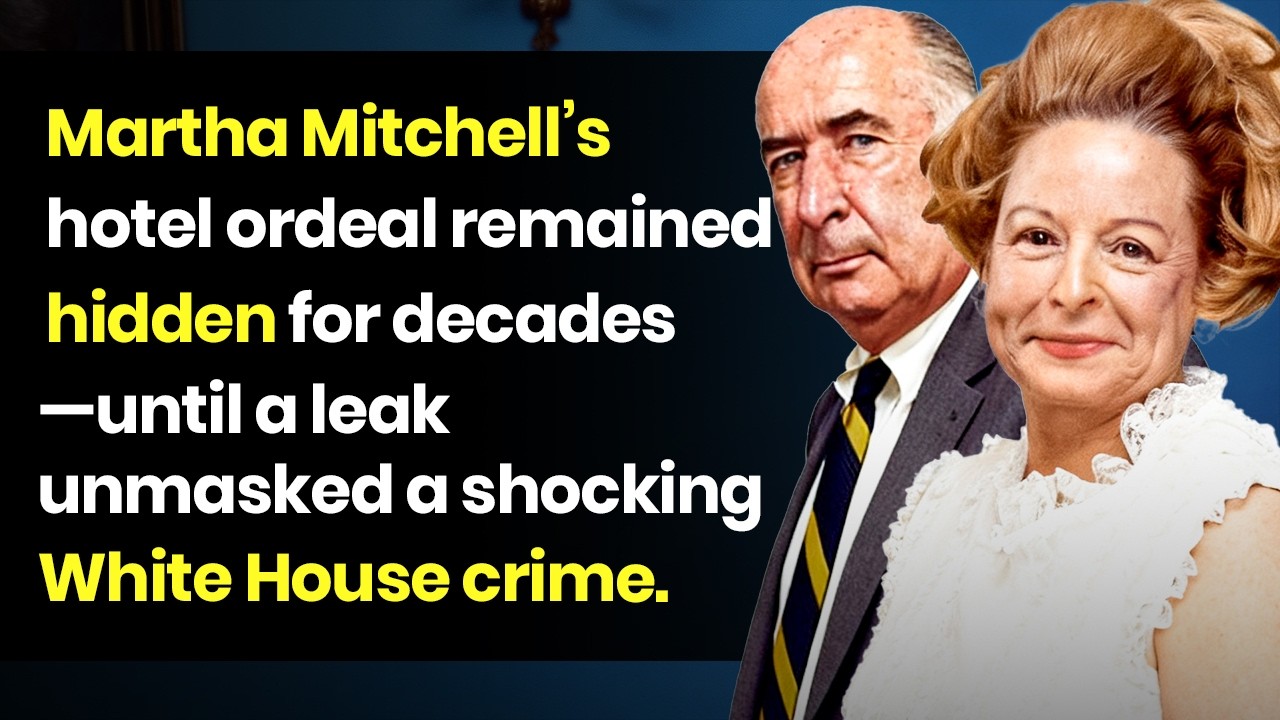
Mitchell managed Nixon’s 1968 presidential campaign. When Nixon won, he appointed Mitchell Attorney General of the United States. Martha Mitchell was now the wife of the Attorney General.
The expectation for a cabinet wife in 1969 was, in essence, decorative silence. You attended the events. You smiled at the dinners. You did not make news. Martha Mitchell violated every one of those rules within months.
She called reporters late at night and gave them quotes that made front pages. She offered opinions on Vietnam, on protesters, on liberal senators, on the press itself. She was loud and Southern and blonde and funny and impossible to ignore.
The Republican Party discovered she was useful. She was the most in-demand Republican speaker in the country after the president himself. In November of 1970, she appeared on the cover of Time magazine.
The New York Times called her the most talked-about, most talkative woman in Washington.
But Martha had a habit that went beyond social chattiness. She listened in on her husband’s calls. She overheard fragments of conversations that were never meant for her, and she found those fragments too interesting to keep to herself.
John was furious each time it happened. He understood that his wife possessed the one thing no one in their circle could afford to have loose: access without discipline.
Her drinking became part of the narrative that men around her used to manage her. By the early 1970s, people inside the Nixon orbit had begun to describe her not just as talkative, but as unstable.
In early 1972, John Mitchell resigned as Attorney General. He left to run the Committee to Re-elect the President. The move placed him closer than ever to the planning of political activities that would soon become criminal.
Martha, as his wife, was closer, too. She was in the house. She was on the phone. She was hearing things.
Then, on the night of June 17th, 1972, five men were arrested inside the headquarters of the Democratic National Committee at the Watergate complex.
Martha and John were in Newport Beach, California at the time. John received the call about the arrest. He told Martha it was nothing. He flew back to Washington.
Martha was left behind in the hotel. She read the newspapers. She watched the coverage. Then she saw a face she recognized.
James McCord was not a stranger to the Mitchells’ world. He was connected to the very campaign her husband was running.
Martha understood, with a clarity that would take the rest of the country more than two years to reach, that the break-in was not a rogue operation. It was connected to her husband. It was connected to the president.
She picked up the phone and called Helen Thomas. She told Thomas she would leave her husband if he did not get out of the dirty business of politics. Then Martha’s voice changed. Thomas heard her say two words. “Get away.” The line went dead.
Martha’s own account described the following sequence. After her call was interrupted, Steven King ripped the telephone cord from the wall. She said he threw her to the floor. She said he kicked her.

She said she was held in the hotel room for more than 24 hours without being permitted to leave. At one point, she tried to escape and put her hand through a glass door, cutting it badly enough to require stitches.
She said five men held her down while a doctor was brought in, and that the doctor injected her with a tranquilizer against her will. She said no visitors were allowed into the room except the doctor.
James McCord later said publicly that Martha had been basically kidnapped. Steven King denied the allegations. He was never charged with any crime related to the incident.
No criminal investigation into Martha’s confinement was ever conducted.
When Martha resurfaced, she was bruised. She told reporters, “I’m black and blue. They don’t want me to talk.” She showed the stitches on her hand.
The response from the Nixon administration was not to address Martha’s allegations directly. It was to change the category of person she occupied in the public imagination.
The chattiness became mania. The drinking became dysfunction. The late-night calls became evidence of instability. The indiscretion became delusion.
Helen Thomas later reflected that the story received attention mostly on the women’s pages of newspapers. The women’s pages, not the front page. Not the political desk.
The effect was cumulative and devastating. Martha was not silenced once, in one room, on one night. She was silenced continuously through a sustained campaign of credibility destruction.
And yet, Martha kept talking.
She was trying to tell the public what she knew about Watergate while simultaneously trying to protect her husband from becoming the fall guy for the president. She wanted the truth out, and she wanted her marriage intact.
Through the second half of 1972, the Watergate story grew in public view, but it grew without Martha at its center. She had been the first person in the Nixon orbit to publicly connect the break-in to the campaign. That distinction earned her nothing.
In January of 1973, the trial of the Watergate burglars began. In February of 1973, the Senate voted to establish the Watergate Committee. The investigation was now institutional.
In September of 1973, John Mitchell left Martha. He did so, according to available accounts, without financial support.
Martha was 55 years old. She had a daughter. She had a reputation that had been methodically dismantled. And she had no money.
Through 1973 and into 1974, the Watergate investigation consumed the Nixon presidency. On August 9th, 1974, Richard Nixon resigned the presidency of the United States.
Martha Mitchell watched all of it. She was vindicated in the broadest sense. The thing she had said was happening was, in fact, happening.

But vindication is a strange gift when it arrives after everything else has been taken. Being right, in Martha Mitchell’s case, was not a rescue. It was an inventory of what being right had cost.
In early 1974, Martha briefly took a job as a television host on the CBS show Panorama. The role lasted only a week.
John Mitchell was indicted. In January of 1975, he was convicted of conspiracy, obstruction of justice, and perjury for his role in the Watergate cover-up. He was the highest-ranking official to be convicted in the scandal.
Martha did not have time to watch the full arc of John’s punishment. She had been diagnosed with multiple myeloma, a cancer of the bone marrow.
On May 31st, 1976, Martha Mitchell died in New York. She was 57 years old.
Her funeral was held in Pine Bluff, Arkansas. Among the flowers at the service, there was one anonymous arrangement. It carried no name and no return address. It said only this: Martha was right.
Those three words hung over the casket of a woman who had spent the last four years of her life trying to get someone to believe her.
John Mitchell entered the federal prison system in June of 1977. He served 19 months. He was released in January of 1979.
John Newton Mitchell died on November 9th, 1988 in Washington, D.C. He was 75 years old. His obituaries focused on Watergate and his conviction.
The deeper vindication of Martha Mitchell accumulated across decades. In 1988, the psychologist Brendan Maher articulated what he called the Martha Mitchell effect, the clinical error of dismissing a patient’s seemingly improbable claims as delusional when those claims are in fact true.
In 2022, Starz premiered Gaslit, a dramatic series centering the untold story of Martha Mitchell’s role in exposing Watergate. Julia Roberts played Martha. Sean Penn played John.
That same year, Netflix released The Martha Mitchell Effect, a documentary short that drew on archival footage and Martha’s own words. The film was nominated for the Academy Award for Best Documentary Short Film at the 2023 ceremony.
In Pine Bluff, Arkansas, her childhood home operates as the Martha Mitchell House, a museum with exhibits about her life and the Watergate scandal. A section of highway carries her name.
At her funeral in Pine Bluff, someone sent flowers with no name. The arrangement spelled out three words.
They were true when she was alive. They were true in the California hotel room when the phone was ripped from the wall and a needle was pushed into her arm.
The only thing that changed between the moment Martha Mitchell first said what she knew and the moment those flowers arrived at her casket was that by then, everyone else knew it, too.
Martha was right.