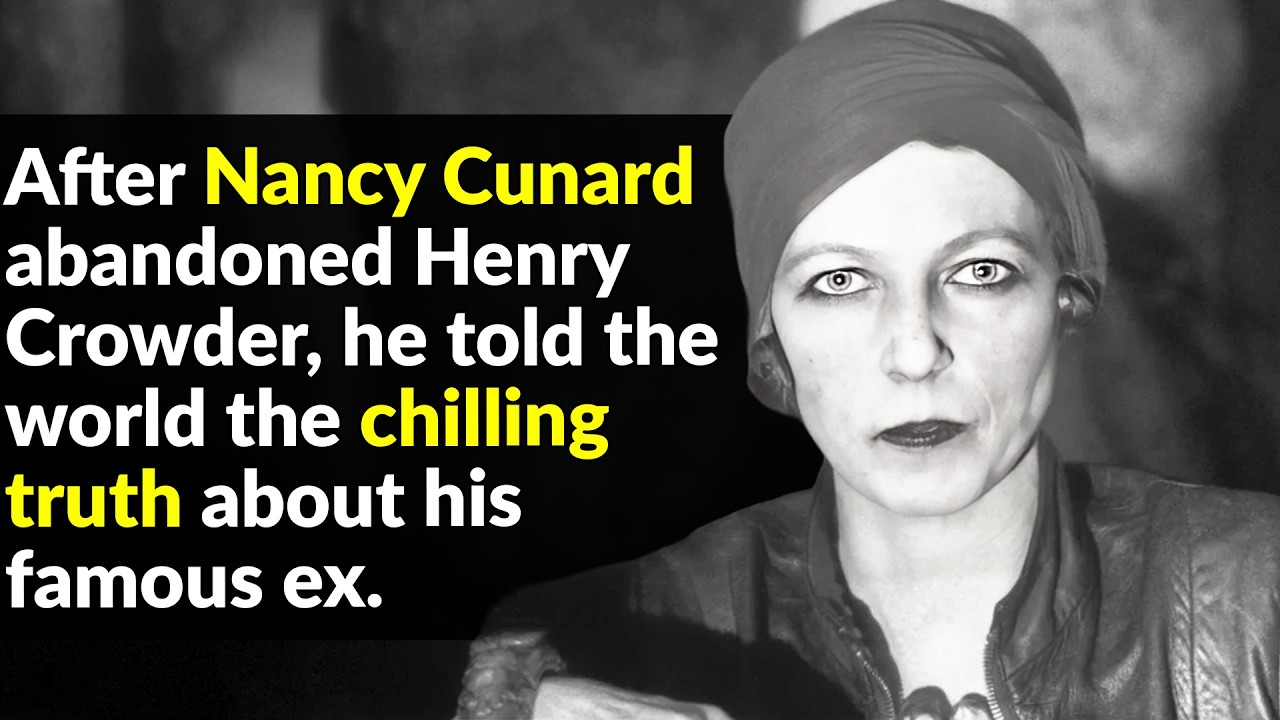
After Nancy Cunard abandoned Henry Crowder, he laid the world bare with the truth about his notorious former lover. Nancy had been breathtakingly beautiful, one of the richest heiresses in England, the darling of European high society, and a true queen of rebellion in the Jazz Age. Yet despite her enchantingly bright beginnings, her end was one of the most tragic in history. On the surface, Nancy had everything from the moment she was born.
Born in 1896, she was the daughter of Sir Bache Cunard, heir to the famous luxury shipping line, and Lady Maud, a society hostess prized for her elegance and intelligence. Behind closed doors, however, the family guarded their darkest secrets. In truth, Nancy’s mother loathed everything about childbirth and child-rearing, and she only bore her single daughter because she believed it was her duty. As a result, Nancy grew up mostly neglected, gifted but desperately lonely, and raised largely by the household servants.
There were deeper problems in the family as well. Nancy’s parents had entered a marriage of pure convenience, and Sir Bache, a sporting man, had almost nothing in common with his cultured, refined wife. Rumors even circulated that Maud had been carrying on an affair with the novelist George Moore, and that Nancy was in fact their illegitimate child. Most historians dismiss the idea that Moore was her father, since his relationship with her mother likely never became physical, and Moore was known to be intensely private.
Still, as Nancy grew, her bond with Moore deepened. He became one of the few father figures she knew, especially after her parents separated in 1911. That closeness, however, came with a deep betrayal of trust. From the time Nancy was a small child, Moore stepped far over the line with her.
He boasted about his romantic conquests besides her mother, once bragging that he would set aside the wisest books to talk to the most foolish women. That remark lodged itself in a troubling pattern between them, and Nancy, who had never learned a healthy sense of boundaries or affection, was left wounded by it. If there was one thing Nancy’s mother cared about in raising her daughter, it was making her appear beautiful. From childhood, Maud ordered the servants to dress Nancy up like a figure in a painting, whether a Velázquez or an Édouard Manet, and then present her for amusement.
And Maud was thrilled when Nancy grew into one of the most gorgeous women in England. She was tall and slender, with soft blonde hair and striking blue eyes set off by high cheekbones. Yet her extraordinary beauty, combined with her troubled childhood, would pull her into far greater trouble. George Moore began begging the teenage Nancy to undress for him, and ultimately she did.
In a way, that was the beginning of the end. Around that time, Nancy became entangled with the notorious socialite Lady Diana Manners, who was fond of chloroform abuse and helped found the Corvus group, a circle of young, privileged, scandal-prone British aristocrats. They delighted in all-night parties that stretched twenty-four hours and skinny-dipping in the Adriatic. But soon that was no longer enough for Nancy.
Nancy had always felt suffocated by her mother’s perfect parties and extravagant dresses. Now she began voicing her rebellion openly. Once, she attended a formal event wearing only a black evening coat over a white underslip, instead of a proper shirt and trousers. Her mother was stunned and tried to steer Nancy away from the dangerous bohemian figures she preferred.
But Nancy’s new streak of defiance, which would remain with her for the rest of her life, was set in steel. Desperate to escape her mother’s grip, Nancy moved into a studio flat near Bloomsbury with her friend, the artist and model Iris Tree. Bloomsbury was then a thriving hub of liberal culture in London, and Nancy soon surrounded herself with a circle of artists who commonly gathered at the Eiffel Tower restaurant, which she called her spiritual sanctuary. Beneath all that bohemian charm, however, a curse was beginning to settle over her.
Iris Tree described that chapter of their friendship as full of drink, mockery, and moral decay. Nancy, who had always been the first woman to catch every eye in any room, started taking lovers among the artists and writers around her. Men and women, famous and unknown, she could seduce nearly anyone whenever she chose. According to one New York biographer, this socialite drew the attention of the future King Edward VII, though she rebuffed his advances.
She also carried on an affair with the literary giant T. S. Eliot, who was married and a devout Catholic. Eliot was deeply embarrassed by their short relationship, and only a few ever learned of it.
In a later letter, Nancy smirked, “Yes, I knew Eliot. I knew him very well. ”
For many, this might have been a passing whim. For Nancy, it was becoming something far darker.
She was walking a dangerous road with no way out. In 1914, with the outbreak of the First World War, many of Nancy’s friends and loved ones left for the front, and many never returned. In the middle of the fighting, Nancy met one of the great loves of her life, a man named Peter, whom she brought to Attlee. Peter had a brightness and optimism that balanced her despair, and the two fell into a passionate romance that lasted only five days before he returned to duty.
A few weeks before Armistice Day and the end of the war, Nancy learned that Peter had been killed in battle. She sank into a devastating grief. Most of her biographers believed she never truly got over losing him. Her carefully built paradise was crumbling around her, so she made a disastrous decision.
In 1916, Nancy did something that shocked even her closest friends. She entered into a conventional marriage. The groom was the handsome Australian cricket player Sidney Fairbairn, who seemed to have come from nowhere. Even her mother asked if she was sure she wanted to go through with it.
Nancy replied, “I have given my word, and I must. ”
It did not end well. After an odd wedding on November 15, at which Nancy’s mother insisted on showering the guests with silver coins, Nancy and her new husband settled into a small house and attempted to live respectably. The marriage lasted only twelve months.
Once Nancy realized she had no hope in conventional circles, she refused to return to her mother’s house after the separation and sank back into bohemian life. Yet even as she tried to recapture the past, troubling signs of her tragic end were already emerging. In 1919, she fell victim to the Spanish flu that swept through postwar Europe. Though she survived, she suffered its effects for years afterward.
Newspaper clippings from the time also mentioned her struggles with bronchitis, which was worsened by her heavy smoking. She was still young and striking, but time was beginning to show on her. Even worse, some of her friends began to abandon her. Some former or would-be lovers in New York grew bitter.
After she ignored the poet Richard Aldington, he lashed back with an unforgettable insult, calling her a lascivious octopus. But Nancy could be cruel too. Another man wrote that he believed she took personal pleasure in hearing that a man infatuated with her might kill himself over her. In 1920, for reasons historians still cannot confirm, possibly because she never wanted children, Nancy underwent a hysterectomy at just twenty-four years old.
But a mistake during the surgery or her recovery nearly killed her, and this already frail socialite faced a long, painful healing process. The operation was so severe that many believed Nancy began her addiction to drugs and alcohol in its aftermath. Not coincidentally, it was around this time that Nancy began showing signs of a fractured relationship with her exhausted body. Her chronic asthma was quickly turning into a lung tumor, and she constantly battled anemia.
But when worried doctors begged her to curb her bad habits, she refused, remarking once that one should not have to feel one’s body. Nancy had no time to stop, anyway. She was not just an inspiration for artists; she was an essential part of their work. Along with writing her own poetry, in 1928 she founded the Hours Press, which soon helped publish some of the most prominent modernists, including Ezra Pound and Samuel Beckett.
That same year brought an even bigger change. In 1928, Nancy began a relationship with the African American jazz musician Henry Crowder. He may have been the only companion for whom she felt emotions rivaling those she had for her lost love, Peter Broughton Adderley. Nancy had always adored the freedom and excess of jazz, and Crowder seemed to embody all of it.
Though he was married, they carried on a love affair that lasted nearly a decade. It came at a heavy price. The very idea of one of Europe’s wealthiest white women dating a married Black jazz player was shocking and unacceptable to many in the old, conservative circles of New York. But no one was angrier than her mother, who threatened to have Crowder deported.
For Nancy, that only fueled her defiance. Crowder became the center of her life, and Nancy later admitted, “Henry made me. ” He played a crucial role in awakening her to the prejudice Black people faced and to the fledgling civil rights movement. Nancy quickly became one of the most passionate voices for equality in her social sphere.
In 1934, she worked with her Black artist friends, including Langston Hughes and Zora Neale Hurston, to publish an anthology centered on their work. Her relationship with Crowder also coincided with her fascination with African art, especially African jewelry. Because of that fascination, Nancy began wearing massive bracelets of wood, bone, and ivory that stretched from her wrists to her elbows. Like all her relationships, hers with Crowder was volatile, full of quarrels and reconciliations.
It was said that Nancy used her bracelets as weapons during their fierce fights. A friend once saw Crowder on the street with bruises on his arms. When asked about them, he replied, “Just the work of bracelets. ”
In many ways, Nancy was at the height of her influence, but she was also at the bottom of her despair, and she was hiding a great secret.
When her anthology was published, it sold poorly, which mattered little given the Cunard fortune. But in the wake of her relationship with Crowder, Nancy’s family had nearly disowned her and cut off their wealth. In the meantime, she had funded the book with her own money. So, although the press did not know it, Nancy was broke and without a strong support network.
And sadly, she was about to need support more than ever. Nancy took her standing as a public figure seriously. Over the following decades, especially with the outbreak of the Spanish Civil War and then the Second World War, she devoted herself entirely to an anti-fascist, often anarchist way of life, and she succeeded in making herself an enemy of the government. She was arrested by the authorities countless times, but each experience only hardened her resolve against injustice.
She was not invincible, though. As she approached middle age, she kept the beauty that had always drawn men and women to her, but she was starting to lose her rebellious outlook on love and affection. She and Crowder drifted apart, and she began dating men decades younger than herself, only to suffer insecurity and heartbreak when they left her. As it turned out, these turbulent stretches may have been the first signs of an impending mental collapse.
In 1956, when Nancy reached sixty, she underwent a terrifying transformation. She had always distrusted the authorities since the start of her long career as a radical activist, but now she began to display a kind of persecution mania toward anyone in uniform, getting into repeated brawls with police officers wherever she went. During those years, her behavior grew stranger and wilder. Stories spread of her stumbling out of an Italian café after a night of heavy drinking with two cigarettes stuffed up her nose, then throwing tomatoes at stray dogs.
Other tales claimed that when she sat on a train and a conductor asked for her ticket, she defiantly ate it. Then came a catastrophic climax. By then Nancy had settled in Spain, where she loved to criticize the head of state, Francisco Franco, in public. That made her an easy target for violence by Spanish officials.
In 1960, Spain expelled her permanently after yet another confrontation with its authorities. That was the start of her true downward spiral. Even after being expelled, Nancy still had much to lose. She had just started a relationship with the silversmith and artist Thomas Cass Morales, who was twenty-seven years old, but she was forced to leave him and return to London.
The change did her no good. While in London, Nancy surpassed even her usual erratic behavior. One story tells of a nighttime taxi ride home after what was likely hours of drinking. She got into an argument with the driver and ended up using a flamethrower from the Spanish Civil War to set his car on fire.
But as always, the greatest harm Nancy did was to herself. Her friends noticed she was exhausted and eating less than usual. She had never been fond of food or any physical need, and her anemia and asthma worsened with age. With little left to her name and her mind rapidly deteriorating, Nancy decided she had to see an old friend, the novelist and screenwriter Anthony Thorne, even though it was midnight and Thorne was out of town.
When she arrived, his wife, Hume, opened the door to find that Nancy had lost all her luggage and money before getting into yet another fight with a taxi driver, who now demanded Hume pay the fare. Throughout that long night, Hume claimed, Nancy seemed barely connected to reality. She began eating a sandwich from a paper bag, then threw its wrapper into the Thornes’ unlit fireplace, and tried to toss a precious ashtray in after it. Later, she burned what little belongings she had left.
The next day of Nancy’s life was a fog. She left the Thorne house early, wearing whatever African necklaces and bracelets she had left. As she wandered the city, she got into yet another fight with a police officer, then threw her shoe at the judge during her court appearance. For ten days, no one could find Nancy, once one of the most famous women in the world.
When her family finally located her, they made a heartbreaking and controversial decision. Nancy’s mental collapse had been looming for months, even years, but now it was undeniable to almost everyone who knew her. Finally, on the advice of a doctor, but against his own conscience, her cousin Victor Cunard agreed to commit Nancy to a mental institution and declare her insane. To this day, her mental illness is an essential part of her story.
Yet the true story may be very different. After she entered the asylum, a strange miracle occurred. At first, Nancy suffered from a disconnect from reality, writing illogical letters to some of her friends that showed barely coherent thoughts in which she blamed her fascist enemies. But within days her condition improved, which made a diagnosis of acute psychosis unlikely.
That did not mean everything was fine for Nancy. Instead, it pointed to a more troubling truth. Though Nancy continued to blame Franco’s Spain and everything it had done for her asylum stay, her own friends believed something more dangerous. They felt her mental collapse came from her serious problems with alcohol, and that if she stopped drinking, she would improve dramatically.
But once she was released, having regained some of her weight and health, she went straight back to heavy drinking and little food. Then one of the last tragedies of her life arrived. Throughout her time in the asylum, Nancy had remained attached to her younger lover, Thomas Cass Morales, writing, “I want him here with me, as close as possible to me forever. ” But even that dream dissolved.
When she met him again, they quickly discovered they were incompatible and separated shortly afterward in July 1961. It was the last significant relationship of Nancy’s life, but not the most painful. Perhaps her former lover Henry Crowder had made her, but he also betrayed her cruelly. He wrote a biting, brilliant memoir that delved into the details of their relationship, attacking Nancy, describing her as an ignorant, angry alcoholic who constantly cheated on her husband and then bragged about her betrayals in front of him.
After separating from Morales, Nancy’s health deteriorated rapidly. She struggled to sleep and suffered a series of falls that left her barely able to walk. Unfortunately, that did not stop her from completely ignoring the pain. She somehow found ways to take transatlantic flights or drag herself upstairs in agonizing scenes that lasted for hours.
Amid her declining health, Nancy kept pushing her friends away. She would accept their hospitality and invitations to stay with them, but soon she would find ways to sabotage herself and leave. At the same time, she often felt that they had abandoned or hurt her. Shortly before her death, she accused an old friend and former lover of sending a spy into her hotel room, when he had only sent a doctor.
A doctor, it later turned out, that she desperately needed. On March 13, a few days after her sixty-ninth birthday, Paris police found Nancy unconscious in the street after she tried to walk through the city even though her body was in no state to move. Even when she regained consciousness shortly after being taken to the hospital, she did not know her own name. Confused, she asked the medics for wine, which they refused to bring her, and then she fell into a coma shortly after.
She died penniless and alone in a hospital oxygen tent. At that point, she weighed only twenty-six kilograms, and one final tragedy was still on its way to her. Though she had once been a dazzling society lady, her funeral was quiet and orderly.
None of her remaining family attended, and only a few old friends came to pay their respects.