In the summer of 1941, a Soviet general was taken to Lubyanka prison and beaten with rubber rods until his ribs broke. He signed a confession that named other commanders as conspirators. Those men were arrested, and most of them were executed. Two months later, the same man was brought before Joseph Stalin, given command of an army, and sent to the front.
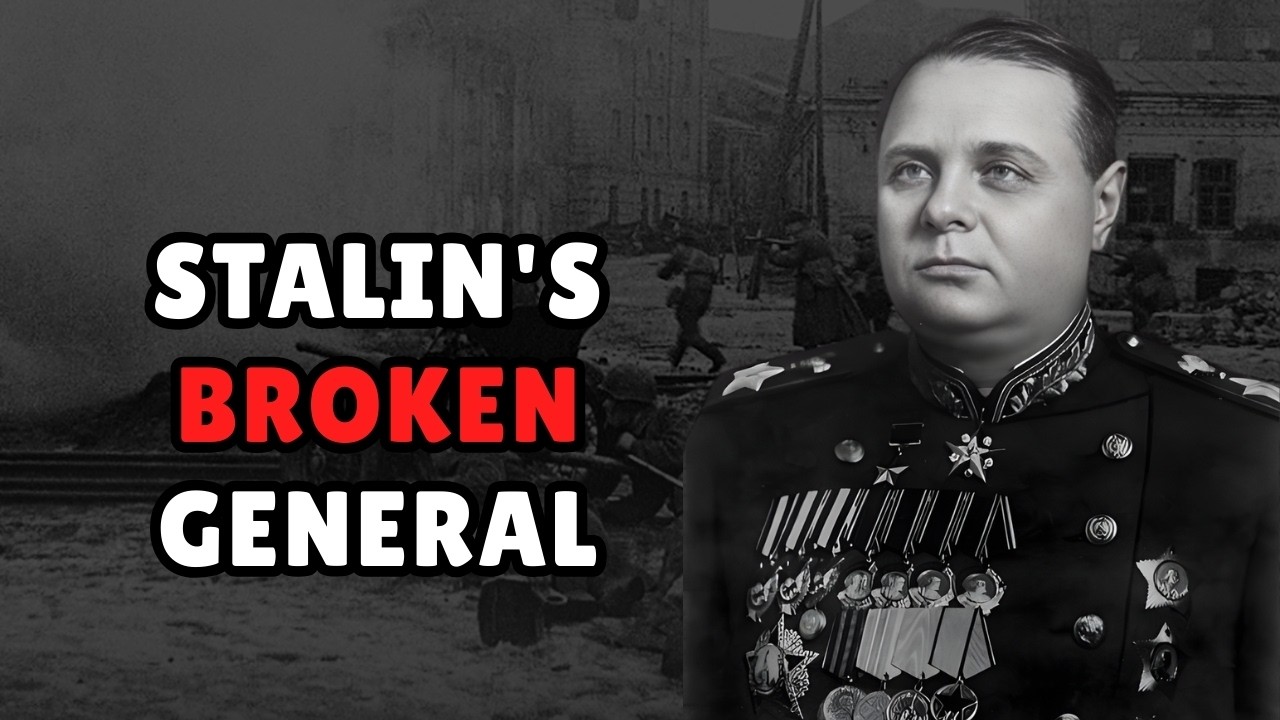
This is the story of Kirill Meretskov, the general Stalin broke—and what he did after. Meretskov was born on June 7th, 1897, in the village of Nazaryevo in Ryazan Governorate, a small settlement southeast of Moscow of no particular distinction. His family were peasants. There was no money and no prospect of any.
At 12 years old, he left for the city and went to work in a factory. He was not yet a teenager when he began working to survive. In August 1917, he joined the Bolsheviks. He was 20 years old.
He fought in the Civil War and served as chief of staff of a regiment, then a division. He was not a charismatic figure or a theorist. He was a capable, hard-working officer who rose through the ranks on the strength of his results. In 1921, he graduated from the Military Academy in Moscow.
He spent the next 15 years working his way up through commands, steadily, without drama. By 1936, he was competent enough that Stalin sent him to Spain. The Spanish Civil War had become, in part, a Soviet military laboratory. Meretskov went under a pseudonym: General Pavlovich.
He watched what a modern, mechanized German force could do, and he came home. In 1939, he was appointed commander of the Leningrad Military District. On November 30th, 1939, the Soviet Union invaded Finland. Stalin had demanded territorial concessions.
The Finns refused. Stalin assumed it would be over in weeks. Meretskov commanded the initial operation. It was a catastrophe.
The Mannerheim Line, the Finnish defensive system, had been underestimated in every respect. Soviet intelligence was wrong. The troop strength sent was insufficient. The tactics were wrong.
The terrain was wrong. Five rifle divisions attacked a fortified line through frozen forest. They were beaten back. The world watched a massive Soviet army fail to defeat a small Nordic nation.
Command was taken from Meretskov in December 1939. He was given a second chance. Heavily reinforced with heavy artillery and additional men, his 7th Army was tasked with breaching the Mannerheim Line in February 1940. This time, it worked.
The artillery broke the Finnish positions. The Soviet forces pushed through. Less than 2 weeks after the ceasefire, on March 21st, 1940, Meretskov was awarded the title Hero of the Soviet Union. He was promoted to Army General.
He was made Deputy Commissar of Defense. From August 1940 to January 1941, he was Chief of the General Staff of the entire Red Army, the highest military planning post in the Soviet Union. Then, on January 14th, 1941, Stalin dismissed him. Ten days later, Stalin saw him at the Bolshoi Theater and said, in front of witnesses: “You are courageous, capable, but without principles, spineless.
You want to be nice, but you should have a plan instead, and adhere to it strictly. ”
Meretskov said nothing. He was assigned as a Deputy Commissar. He waited to be useful again.
He did not have to wait long. On June 22nd, 1941, Germany invaded the Soviet Union. Meretskov was appointed permanent advisor to Stavka, the Soviet Supreme Command, on the first day of the invasion. On June 23rd, one day later, the NKVD arrested him.
The charge was membership in an alleged anti-Soviet military conspiracy. The case file was later destroyed. The exact reasons remain unknown. His close friendship with General Dmitri Pavlov, the commander of the Western Front, who had been arrested and would be shot, is considered a likely factor.
For the next two months, he was beaten with rubber rods in Lubyanka prison. His ribs were broken by the interrogator, Boris Rodos, a man whose job it was to extract confessions from Soviet generals. He signed. The confession named other commanders as part of the same conspiracy.
Those men were arrested. Most of them were executed. One group was shot near Kuybyshev on October 28th, 1941. Another group was executed on February 23rd, 1942.
Meretskov signed the papers. The other men died. In September 1941, Meretskov was released. Nikita Khrushchev, who saw him afterwards, later recalled: “Before his arrest, Meretskov had been a strapping young general, very strong and impressive-looking.
After his release, he was a shadow of his former self. He had lost so much weight, he could hardly speak. ”
He was presented to Stalin in full army dress. Before that meeting, he passed the police chief Vsevolod Merkulov, a man he had known socially.
He told Merkulov that their friendship was over. Then he walked in to see Stalin. Stalin gave him command of the 7th Separate Army and sent him to the front. By September 1941, Leningrad was surrounded.
German and Finnish forces had cut every supply route to the city. More than 2. 5 million people were trapped inside. The temperature was dropping.
The food was running out. The Germans did not intend to storm the city. They intended to starve it. Meretskov, two months out of Lubyanka, was given the Fourth Army and sent to stop the German advance east of Leningrad.
The Germans had captured Tikhvin, a critical rail junction east of the city, on November 8th. If they held it and linked up with the Finns to the north, the last supply route to Leningrad across Lake Ladoga would be severed entirely. Meretskov’s Fourth Army, together with two neighboring armies, counterattacked through the snow and forest. On December 10th, 1941, they recaptured Tikhvin.
It was the first major Soviet success of the entire war. Stavka ordered Meretskov to form a new command, the Volkhov Front, and push further. The goal was to break the siege entirely. What followed was two years of some of the worst fighting of the entire Eastern Front—not decisive armored battles, but grinding infantry combat through frozen swamps and dense forest against a German Army Group that was well dug in and not moving.
Every few months, a new offensive. Every offensive, heavy casualties. The siege held. In January 1942, Meretskov launched the Lyuban Offensive, a deep thrust aimed at encircling the German forces south of Leningrad.
The advance stalled. The Second Shock Army pushed too far ahead and by March was nearly encircled itself. Meretskov had recommended General Andrey Vlasov to command it. Vlasov arrived in April.
By June 1942, the Second Shock Army was cut off, out of ammunition, and starving in the forests. Vlasov ordered a breakout. Most of his men died in the attempt. Vlasov himself was captured and went on to collaborate with the Germans, commanding a force that fought on the Nazi side.
The disaster of the Second Shock Army was a catastrophe Meretskov bore partial responsibility for. He had planned the operation. He had recommended Vlasov. His post-war memoirs placed all blame on Vlasov.
He kept his command. He kept fighting. By late 1942, the situation had clarified into a single, brutal geographic fact: 16 kilometers. That was the distance separating Meretskov’s Volkhov Front, fighting from the east, from the Leningrad Front trapped inside the city.
Sixteen kilometers of German fortification, built up and reinforced over more than a year. The Germans had been sitting in those positions since September 1941. Every attempt to cross it had failed. In January 1943, Meretskov and Leningrad Front commander Leonid Govorov were given a new plan: Operation Iskra, Operation Spark.
The Leningrad Front would attack from inside the city, pushing east. The Volkhov Front would push west. They would meet in the middle and crack the bottleneck open. More than 300,000 Soviet troops and over 4,000 artillery pieces were committed.
On January 12th, 1943, the offensive began. The fighting was ferocious. The German fortifications had been built over 16 months. The terrain—frozen swamp, dense forest, the elevated Sinyavino Heights—was as much an obstacle as the enemy.
For six days, the two fronts fought toward each other. On January 18th, 1943, at 9:30 in the morning, patrols of the 372nd Rifle Division of Meretskov’s Volkhov Front linked up with troops of the 123rd Rifle Brigade of the Leningrad Front near Workers’ Settlement Number 1, east of Schlüsselburg. The siege was broken. Georgy Zhukov, who was at an observation post that morning, later wrote: “I witnessed the joy with which soldiers of the fronts that had broken the siege rushed towards each other.
Ignoring the enemy artillery shells arriving from the direction of the Sinyavino Heights, the soldiers firmly and fraternally embraced each other. ”
The corridor was only 11 kilometers wide. The Germans would shell it for another year. The full siege would not lift until January 27th, 1944.
But food could reach Leningrad by land for the first time in almost 17 months. History does not give Meretskov the credit it gives Zhukov. Operation Iskra is not what most people think of when they think of the Eastern Front. But in the city that had been eating wallpaper paste and sawdust bread for 16 months, the trains arriving through that corridor were not a footnote.
They were everything. In February 1944, Meretskov was transferred to the Karelian Front in the far north. He had been at Leningrad for 2. 5 years.
In October 1944, his forces conducted the Petsamo-Kirkenes Offensive, a rapid assault that drove the Germans out of the Petsamo nickel region and into Norway. For these campaigns, Meretskov was promoted to Marshal of the Soviet Union. He had gone from Lubyanka prison to Marshal of the Soviet Union in 3. 5 years.
In April 1945, with Germany nearly finished, Stalin transferred Meretskov to the Far East. He was given command of the First Far East Front, the main striking force for the planned invasion of Japanese-held Manchuria. On August 9th, 1945, three days after Hiroshima, the Soviet Union declared war on Japan, and Meretskov’s front crossed the border. The Japanese Kwantung Army in Manchuria was one million men strong and had been fortifying its positions for years.
Military planners estimated the campaign could take months. Meretskov’s front advanced over 300 kilometers into Manchuria in the first week. The Kwantung Army’s resistance collapsed. On August 19th, ten days after the invasion began, the Japanese command transmitted a surrender order to its field units.
The campaign that had been expected to last through the autumn was over. He had fought in Spain under a false name. He had failed in Finland and been given a second chance. He had been tortured in Lubyanka and sent back to the front.
He had broken the siege of Leningrad and crossed the mountains into Manchuria. He was 48 years old. After the war, Meretskov commanded military districts. He became Inspector General of the Ministry of Defense.
He wrote his memoirs as Soviet marshals did. He died on December 30th, 1968, at the age of 71. His ashes were placed in the Kremlin wall. He held the Hero of the Soviet Union.
He held the Marshal’s Stars. He held the Order of Lenin and the Order of Victory, the highest military decoration in the Soviet system. None of that is the thing that stays with you when you look at his life. That is what it meant to survive Stalin.
Not the prison, not the torture, not the moment you signed the paper. The part that came after.