In 1747, five years after the Spanish had failed to invade Georgia, a clergyman named Thomas Bosomworth married Mary Musgrove, a half-Creek interpreter who had gained considerable influence among the Creek Indians. Their marriage set the stage for a plot that came close to destroying the English colony entirely. The background to the crisis was slavery. Georgia had originally forbidden the practice, largely due to the efforts of the trustees who governed the colony.
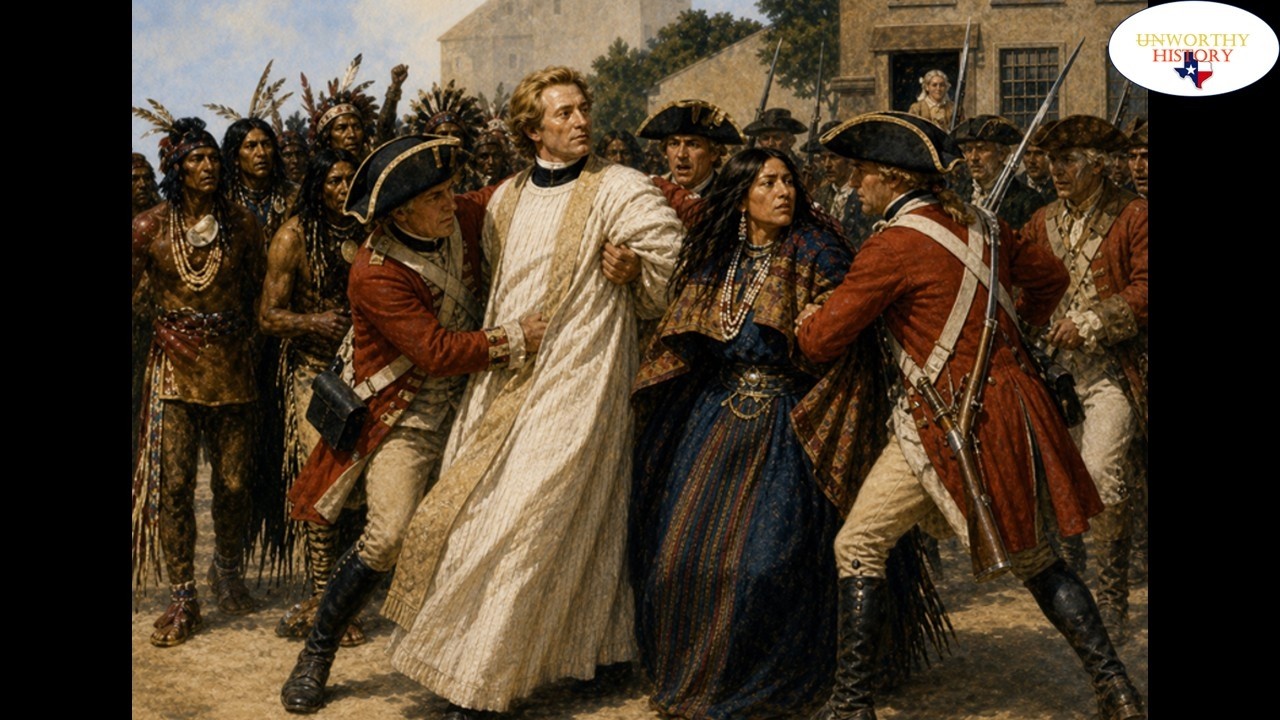
For years the colonists had complained about these restrictions, and in 1749 Georgian colonists had to send 170 men. However, even this show of force was not enough to stop what happened next. When the delegation arrived in Savannah on July 20, Bosomworth marched in wearing his canonical robes, with his wife at his side, followed by the Indian kings and chiefs in order of rank. The sight struck terror into the town’s inhabitants.
The militia met the group in the parade ground with fifteencannon, but the official reception did nothing to calm the situation once negotiations began. Bosomworth was ordered to withdraw, and the Indian chiefs were required to declare their intentions in coming in such a large body without being summoned. The warriors answered that Mary would speak for them. They had heard she was to be taken captive over the great waters, and they hadcome to find out why they were to lose their queen.
They insisted they meant no harm and asked for their arms to be returned. Their guns were given back, but strict orders were issued to deny them ammunition until the council could see more clearly into their designs. The following day, after private conferences with Mary, the Indians marched through the streets in a tumultuous manner, showing a clear hostile temper. With every man in town forced to mount guard, the women and children were terrified, expecting at any moment to be murdered and scalped.
A false rumor spread that President Stephens had been scalped with a tomahawk, and the officers had great difficulty restraining the troops from firing on the Indians. Realizing that Bosomworth and his wife were the driving force behind the scheme, the president ordered Bosomworth to be seized and closely confined. Mary, his queen, became frantic with rage. She ordered all white persons to depart from her territories, cursed Oglethorpe and his fraudulent treaties, and stamping her foot on the earth swore that the entire globe should know the ground she stood upon was her own.
Finding that no peaceful agreement could be made while the Indians were under her influence, the president secretly arrested Mary and placed her in confinement with her husband. This step was considered necessary before any reasonable terms of negotiation could be heard. With the royal family secured, the presidents employed interpreters to entertain the warriors in the most friendly manner and explain the wicked designs of Bosomworth and his wife. A feast was prepared for the chiefs and leading warriors.
They were told that Bosomworth had accumulated debts he could not pay and that he wanted not only their lands but also a large share of the king’s presents intended for the Indians. The presentation reminded them that these lands were their common property, freely given to the king, and that King George had ordered the president to defend their rights. This policy worked for a time. Many chiefs, convinced that Bosomworth had deceived them, declared they would no longer be governed by his advice.
Even Malachi, the leader of the lower Creeks and a pretended relation of Mary, seemed satisfied, particularly when he heard the king had sent valuable presents. When asked why he acknowledged Mary as the empress of the Creek nation and resigned his power to a despicable old woman, Malachi replied that the whole nation acknowledged her as their queen and that none but she or her family could distribute the royal presents, as had been done before. This answer revealed the Bosomworths’ design to take control of the royal bounty. To show the Indians he had the power to distribute gifts himself, the president took on the task and immediately dismissed them due to the growing expenses of the colony and the hardships people endured in keeping guard day and night.
Malachi, described by the Indians as having a fickle and variable temper likened to the winds, then asked to see the Bosomworths. On gaining admission, he was again drawn over to support their claims. While the Indians were gathered to receive their share of the royal gifts, Malachi stood up with a frowning countenance and in violent agitation delivered a speech full of dangerous insinuations and threats. He declared that Mary had possessed the country before General Oglethorpe, that all the lands belonged to her as queen and head of the Creeks, and that she had 3,000 warriors behind her, every one of whom would raise the hatchet in defense of her claim.
He then pulled a paper from his pocket and delivered it to the presidents in confirmation of his words. The document was clearly the production of Bosomworth, revealing his ambitious views and wicked intrigues. Its preamble carried the names of Indian kings from towns in the upper and lower Creeks, though only two of those named were present. The paper styled Mary as rightful princess of the whole nation, invested with full power to settle all public affairs and causes relating to land with King George.
After the paper was read in council, the members were struck with astonishment. Malachi, perceiving their uneasiness, begged to have it back, declaring he did not know it was a bad talk and promising to return it to the person from whom he had received it. Now it became essential to remove the impression Malachi’s speech had made on the Indians. The presidents gathered them together and adopted a bold and decided tone.
They explained that when Oglethorpe first arrived, Mary, then the wife of John Musgrove, was living in a small hut at Yamacraw and appeared in a poor, ragged condition, neglected and despised by the Creeks. It was Oglethorpe who employed her as an interpreter, richly clothed her, and made her a woman of consequence. The presidents went on to say that the people of Georgia had respected her until she married Bosomworth, but from that time she proved a liar and deceiver. She was in fact no relation of Malachi, but the daughter of a white man and an Indian woman of no note.
The lands of Georgia were not treated with her, but with the old and wise leaders of the Creek nation, who voluntarily surrendered their territories to the king. They accused Mary, at her husband’s instigation, of filling the Indians with wild fantasies and groundless jealousies in order to ferment mischief and break their alliance with their best friends. At this, the Indians desired him to stop and put an end to the contest. They declared that their eyes were now opened and they could see through the insidious design of Bosomworth.
Though he wanted to break the chain of friendship, they were determined to hold it fast, and they begged that all might smoke the pipe of peace. Pipes and rum were brought, and the two sides joined hand in hand, drinking and smoking together in friendship. The royal presents were distributed, with the most disaffected and influential receiving the largest share. Even Malachi seemed fully satisfied.
The Indians in general, seeing the poverty and insignificance of the Bosomworths and their inability to supply their wants, appeared determined to break off all connection with them. Just as the crisis seemed to be resolving, Mary, drunk with liquor and disappointed in her royal views, rushed in among them like a fury. She told the presidents that these were her people and that he had no business with them. The president calmly advised her to retire to her lodgings and forbear from poisoning the minds of the Indians, or he would order her into confinement again.
Mary turned to Malachi in great rage and repeated what the president had said. Malachi started from his seat, seized his arms, called on the rest to follow his example, and dared any man to touch the queen. In an instant the whole house was filled with tumult. Every Indian had his tomahawk in his hands, and the president and council expected nothing but instant death.
Captain Jones, who commanded the guard, interposed and ordered the Indians to immediately surrender their arms. Courage alone was not enough; great prudence was needed to avoid coming to extremities. Reluctantly, the Indians submitted. Mary was conveyed to a private room and placed under guard, with all communication with the Indians denied during their stay in Savannah.
Her husband was sent for to reason with him, but he became outrageously abusive. Defying every argument, he remained stubborn and protested he would stand forth in vindication of his wife’s right to the last extremity, and that the province of Georgia would soon feel the weight of her power and vengeance. The council, finding that fair means were useless, removed him from the way of the Indians until they were gone. With the two leaders secured, the only task left was to persuade the Indians to leave town.
A young warrior named Captain Alec, who had distinguished himself in exposing Bosomworth’s intrigues to his tribe, was afraid to accompany Malachi and set out among the first. The rest followed in different parties, and the inhabitants, tired out with constant duty and harassed by frequent alarms, were at last happily relieved. It is striking evidence of the weakness of the colonists and their fear of Indian retaliation that after this ordeal the provincial authorities did not dare to molest either Bosomworth or his wife. The official reason for their pardon was said to be the intercession of Adam Bosomworth, a brother of the culprit, and a letter from Thomas himself acknowledging his wife’s title to be groundless and craving forgiveness on the plea of her remorse and past services.
But the real cause was undoubtedly a dread of the consequences that might ensue. In 1751, the restless intriguer revived his claim. It was litigated in the English courts for many years and at length partially decided in his favor. However, a man named Levy, claiming a portion of the lands by previous purchase from Bosomworth, instituted a new suit which, after Levy died not long afterward, was never legally settled.
This account comes from “History of Georgia from Its Earliest Settlement to the Present Time,” written by Timothy Shay Arthur and William Henry Carpenter and published in 1852. It is the fourth episode in a series on Georgia history drawn from that same book. In previous episodes, the story covered how slavery was first banned in Georgia and by 1747 permitted, and how the uprising led by Reverend Thomas Bosomworth through his half-Creek wife Mary Musgrove represented one of the first Creek challenges to American settlers in the region. While they recruited a large number of warriors and marched into Savannah, they never made an actual attack.
None of the settlers were killed in this uprising, although Malachi did kill some livestock belonging to a settler who had not supported the Creeks in their demonstration. The incident stands as a remarkable early example of the tensions between the growing colony and the Creek nation, and of how close that tension came to open bloodshed.