In October 1982, Coca-Cola made a decision that would quietly dismantle one of its most successful brands. Tab, the company’s own diet soda, had dominated the American diet drink market for nearly two decades. It held 4% of the entire U. S.
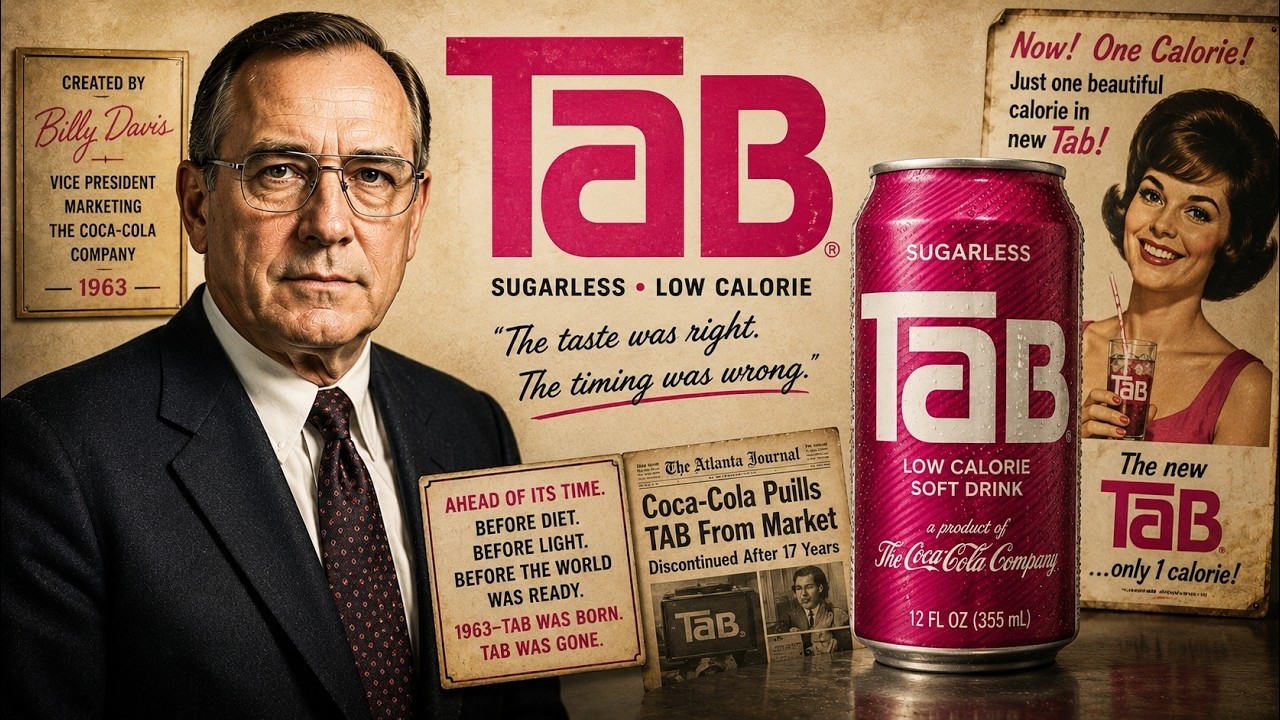
soft drink market—regular and diet combined—and 40 million Americans reached for its pink can every week. Then Coca-Cola launched Diet Coke, a competing product aimed directly at Tab’s loyal drinkers. Within 18 months, Tab lost the top position it had built since 1963 and never regained it. Tab’s story began in Atlanta in 1963, born from a simple fear.
Coca-Cola executives refused to put the word “diet” on a can of Coca-Cola, worried it would suggest the original formula was somehow flawed. That refusal led to Project Alpha, a secret initiative to create the best-tasting diet cola ever made and market it under a completely separate name. A computer generated over 185,000 four-letter words, and after filtering for pronunciation, trademarks, and conflicts, one name survived: Tab. A play on “keep tabs on your weight,” it was styled as TaB, with a lowercase “a” that made the brand instantly recognizable.
The formula used a combination of cyclamate and saccharin, producing a sharp, slightly citrusy cola that tasted distinct from anything else in the diet category. The original glass bottle featured a ribbed texture. The label was red and white. The slogan was direct: “How can one calorie taste so good?
” The product was positioned not as a compromise but as a choice, priced the same as Coca-Cola Classic and marketed to health-conscious women through publications like Mademoiselle and Ladies Home Journal. By 1967, Tab had overtaken Diet Rite to become the best-selling diet soda in America. It was available in every Coca-Cola vending machine in the country, a distribution advantage no competitor could match. The brand expanded to seven flavors in the late 1970s, and its marketing shifted to the memorable campaign, “Tab, the beautiful drink for beautiful people.
” By 1980, Tab was the most popular diet soda in the world. In 1982, it still held 4% of the entire American soft drink market. But the cultural moment was shifting. Diet Pepsi was growing, and Coca-Cola’s research showed that male consumers gravitated toward products with familiar names.
In October 1982, Coca-Cola launched Diet Coke, a separate product with a different flavor base, positioned to compete directly with Diet Pepsi. The company’s internal logic held that Tab and Diet Coke could coexist by targeting different drinkers. That logic proved catastrophically wrong. Diet Coke absorbed the marketing budget, advertising support, and promotional energy that had built Tab’s cultural presence through the 1970s.
By the end of 1983, Diet Coke had captured 17% of the diet soda market. Tab’s advertising essentially disappeared overnight. In May 1984, Coca-Cola released NutraSweet in Tab’s formula, replacing part of the saccharin. Loyal drinkers noticed immediately.
Letters poured into Atlanta. The sharp, slightly austere saccharin profile that defined Tab had been softened, and some long-time consumers left for good. The saccharin warning label—mandated by Congress in 1977—added another layer of pressure. Every can carried a cancer warning for decades, associating the pink can with cigarette packaging in the public mind.
By 2001, Tab held less than 1% of the U. S. soft drink market. When asked about its future, Coca-Cola’s chairman and CEO Douglas Daft said, “We want to make sure those who want Tab get Tab.
It shows that you care. ” It was the language of someone managing an exit, not a revival. In 2005, Coca-Cola introduced Coke Zero, giving the company three diet colas in distribution. Tab received no marketing support whatsoever.
Its availability quietly contracted to selected markets, primarily Florida, parts of New York, and areas of the Southeast where a dedicated base of drinkers remained. In 2018, a supply disruption temporarily removed Tab from several remaining markets. The reaction from its remaining drinkers, who called themselves “Tabaholics,” was disproportionate to the product’s commercial size. Consumers stocked up.
Online communities coordinated searches across cities. Petitions circulated. Coca-Cola issued a public statement confirming Tab was not being discontinued. The company did not explain why a brand with 0.
1% of the diet soda market warranted a public statement. On October 16, 2020, during the pandemic-driven disruption of supply chains, Coca-Cola announced that Tab production would end on December 31, 2020. The 57-year run ended in three paragraphs of corporate communication. No ceremony, no final campaign, no acknowledgment beyond one quote from a group director.
Carrie Cop, group director of Diet Coke at Coca-Cola, said, “Without Tab, we wouldn’t have Diet Coke or Coke Zero Sugar. Tab did its job. ” The last cans were shipped. The shelves were filled with something else.
On the same day the discontinuation was announced, a group of drinkers began organizing. Calling themselves the Save Tab Soda Committee, they built a website, wrote physical letters to Coca-Cola executives in Atlanta, submitted petitions, and held small demonstrations at company facilities. They argued that Tab’s consumer base, however small in percentage, represented a level of per-capita devotion that standard portfolio metrics could not measure. As of 2025, Coca-Cola has not responded with any commitment to revive the brand.
Tab’s trademark remains in Coca-Cola’s possession. There is no licensing agreement, no craft revival, and no regional bottler producing it under a sublicense. The formula sits in company archives. Vintage Tab cans and the original ribbed glass bottles now sell on eBay and at antique markets, with pristine early cans fetching between $15 and $60.
Sealed cases from the final 2020 production runs circulate among collectors at prices that would have seemed absurd for a soda three decades ago. The pink can has proven more durable in memory than in commerce. Film and television productions set in the 1970s and early 1980s still seek out genuine Tab cans for period authenticity. Production designers have noted there is no substitute that looks the same on screen.
The can encapsulates a specific cultural intersection of feminism, fitness culture, consumer independence, and American optimism that no replica has matched. The formula itself has never been successfully reproduced since production ceased. The deeper irony is structural. Tab was created because Coca-Cola refused to put the word “diet” on its flagship brand.
That fear built a separate identity, a separate community, and a separate culture that lasted nearly six decades. When the company finally launched Diet Coke in 1982, the structural reason for Tab’s existence disappeared. Tab did not fail. The problem it was designed to solve was simply assigned to a product with a better name, by the same company, in the same building, using many of the same resources.
Tab survived the cyclamate ban of 1969. It survived the saccharin warning labels. It survived the launch of Diet Coke and the complete removal of its advertising budget. It survived Coke Zero.
It survived two decades of shrinking availability and a 2018 supply disruption that could have ended it quietly. It survived because a specific group of American drinkers, primarily women, had found something in the pink can that the market kept telling them they no longer needed. Tab lasted 57 years, not because Coca-Cola kept it alive, but because its drinkers did. The Save Tab Soda Committee understood this.
They understood it well enough to keep writing letters to a company that, as of 2025, has not written back. The pink can is gone from production, but in kitchens across Florida and New York, there remains a specific shelf in the refrigerator reserved for something that no longer exists.