On the morning of July 24, 1944, a Japanese colonel on a small Pacific island sent a telegram to Tokyo. He reported that his men had repelled 100 American landing boats, that the beach had held, and that the Americans had retreated. In reality, every boat he saw was empty. While his 9,000 troops stood ready on the southern beaches, 15,000 U.
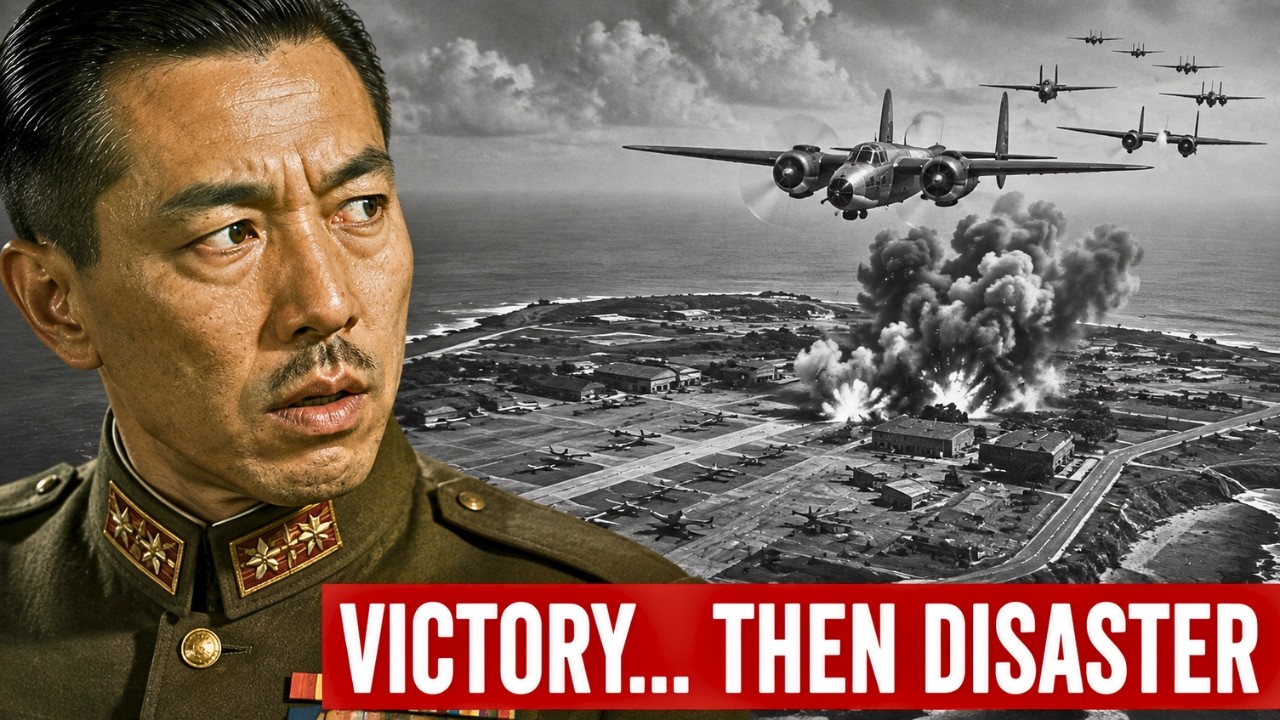
S. Marines were already coming ashore three miles to the north. That colonel, Kiyochi Ogata, had spent months preparing the most obvious landing site on Tinian Island. He built fortifications, laid mines, and aimed machine guns at the beach his training told him the Americans would hit.
He was a competent officer following every professional rule of warfare. His mistake was being too correct. The Americans landed elsewhere, on two narrow beaches so unpromising that Ogata never even armed them. The reason those 15,000 Marines survived instead of dying on the wrong beach was a U.
S. Navy admiral who was twice ordered to stop planning the operation that saved them. This is the story of Rear Admiral Harry Wilbur Hill, a man whose name never made it into the most famous accounts of the war. In March 1944, Colonel Ogata arrived on Tinian, a 39-square-mile island of black volcanic rock and sugar cane fields, almost entirely surrounded by cliffs dropping directly into the sea.
His regiment had spent years fighting in Manchuria, learning continental warfare in villages and mountains. Now they were on a coral island the size of Manhattan, and everything they knew about war was about to become useless. The heat broke them first. Men who had wintered in wool arrived in their wool uniforms and lost weight they would never regain.
Ogata, a 51-year-old career officer and 1913 graduate of the Imperial Military Academy, was not sentimental about any of it. He was a professional in every sense the Imperial Army used the word, and he understood his career would likely end on this island. Not because he expected defeat, but because he expected death. By spring 1944, no Japanese officer of his rank believed the war could still be won.
They had watched the Americans take Tarawa in November and Kwajalein in February. They knew the Marianas were next. It was not a question of if, but when. Ogata’s mission was not to win, but to make the Americans pay for every yard, to buy time, and to bleed them so badly across so many islands that the war might become politically impossible in Washington before it was lost militarily.
That strategy required men like Ogata to do their jobs perfectly, to build proper defenses and force the Americans into the worst possible terrain. Ogata would do his job perfectly. That was the problem. He walked the coastline with his staff, studied maps, tides, winds, and beaches with the eyes of a man who knew his answer would decide whether his regiment lived or died.
On the southwest coast he found Sunharon, a working port with wide sandy beaches, sufficient water depth for transport ships, and enough beachhead space behind the sand to move an army inland. It was the only place on the entire island that could support a serious amphibious landing. Every rule he had learned pointed to the same spot. He circled Sunharon on his map.
The north coast was a wall of coral 30 feet high in places. The east coast was worse. The west coast above the port was cut by two narrow gaps in the cliffs, 30 yards of sand here, 120 yards there. Nothing larger than a fishing boat could land at either, and even then, the coral cliffs above the waterline would prevent any vehicle from moving inland.
He crossed them off. He did what any competent officer would do. He built the correct defense for the correct threat at the correct location. Over the next four months, his men moved concrete in the Pacific heat.
They poured concrete fortifications along the ridges above Sunharon Bay, cut firing positions into the cliffs on both sides of the harbor entrance, planted mines in the shallows, strung barbed wire in the surf, and aimed machine guns at the coconut groves behind the beach so that any infantryman stepping off a landing boat would face three angles of fire before his second step. By July, 9,000 Japanese troops were on Tinian, 5,000 army and 4,000 navy, with Ogata in command of the army forces. Three thousand miles east, in Hawaii, the Americans were making their own calculations. By the summer of 1944, the Pacific war had reached a scale that was difficult to absorb.
The Navy had lost more men in the previous 12 months than in the entire 20 years between the world wars. Every subsequent landing was expected to be more costly than the last. Tarawa was a shock. Saipan was a slaughter.
No one in Pearl Harbor was naive about what Tinian would cost if done wrong. Ten thousand Marines could die on the wrong beach. That was not speculation. It was a realistic estimate based on what happened at Tarawa in November 1943, where the 2nd Marine Division landed on a beach that intelligence had misjudged.
Landing craft grounded 400 yards from shore, and Marines waded chest-deep water while Japanese machine guns fired from pillboxes. The naval bombardment failed to hit its targets. Three thousand American casualties in the first 24 hours. In June 1944, two men bent over a table in a quiet room.
One was Vice Admiral Richmond Kelly Turner, 59, the senior amphibious commander in the U. S. Navy, the man who had led his ships to Guadalcanal, Tarawa, Kwajalein, and Eniwetok. His men called him Terrible Turner, not because he was cruel to the enemy, but because he had no patience for anyone wasting his time.
The other was Rear Admiral Harry Wilbur Hill, 54, from Oakland, California, a quieter, slower-speaking officer, the type who read a map twice before saying anything and then said less than he thought. Washington had already decided the war would be won from this island. From Tinian alone, a new bomber called the B-29 Superfortress could fly in a straight line to Tokyo, 1,500 miles, without refueling. Every city in the Japanese home islands would be within range of American bombers for the first time in the war.
The island had to be taken, which meant Marines had to get there, which meant someone in that room had to decide where they would land. Turner’s finger was on the map, but not on Sunharon. He pointed to two narrow strips of beach on the northeast side of the island, the Yellow Beaches. His argument was strong.
The Yellow Beaches were on the opposite side of the island from Sunharon. They offered the Marines a chance to surprise the main defenses and sweep them from behind. It was a professional plan from a professional officer. Hill listened without interrupting.
When Turner finished, Hill leaned over the map and pointed to the northwest coast, two narrow gaps in the cliffs, one 60 yards wide, the other 120 yards. Nearly undefended. He asked Turner what he knew about the Yellow Beaches. Turner told him the Yellow Beaches were mined, had underwater obstacles, fortified pillboxes at the approaches, and trenches dug behind the shoreline.
The Japanese had surveyed them and reached the same conclusion as Turner: they were a potential landing site. That was exactly why they were prepared for them. Hill said quietly that perhaps the Japanese had not surveyed those two gaps. The beaches in the northwest were so narrow that any competent staff officer would never plan a landing there.
That was the point. If no one planned for it, no one defended it. If no one defended it, Marines could walk ashore. Turner did not raise his voice.
He told Hill the beaches were not wide enough to support a landing force, that they could not be supplied from the rear, that an operation of this size, two full divisions, 40,000 men, could not move through 60 yards of sand. He told him the answer was the Yellow Beaches and ordered him to stop planning anything else. Hill did not argue. He nodded, folded his notes, and returned to his ship.
That evening, aboard his flagship, he did something he did not tell Turner about. He formed a second planning team, small, working from a separate office, focused only on the impossible beaches on the northwest coast of Tinian. A team that did not officially exist. A team that, if Turner discovered its work, would end Harry Hill’s career in the U.
S. Navy. Hill formed the team anyway because he could not let the map go. The numbers always came back to the same result.
If the Marines landed at Sunharon, they would land in a fortress. If they landed at the Yellow Beaches, they would land in a prepared killing zone. If they landed at the White Beaches, they would land where no one was waiting for them. The only thing standing between 15,000 U.
S. Marines and the beaches that would save their lives was a direct order from the most powerful amphibious commander in the U. S. Navy forbidding him to plan for it.
Three thousand miles away, Colonel Ogata walked the beach above Sunharon in the last light of the Pacific evening. He inspected the concrete of his newest fortification. He inspected the barbed wire. He nodded to the men.
He climbed the hill and looked across the water toward the horizon, thinking about the answer he had given. He was a good officer. He was a careful officer. He had done his job.
He was also the last man on Tinian who would ever discover that he had been wrong. The second planning team met at night in a small cabin aboard Hill’s flagship behind a door that stayed closed. Four or five officers, their names never fully written down. What they were doing violated the spirit of a direct order from the most powerful amphibious commander in the U.
S. Navy. They knew it. They did it anyway.
Every evening, after the official work of the day was done, these men brought out different maps, two thin strips of sand on the northwest coast of Tinian, 60 yards and 120 yards. They worked the problem the way engineers work a problem with no obvious answer. How do you land 40,000 men across 60 yards of coral? How do you feed them once they are ashore?
How do you get vehicles up a steep 8-foot rock ledge? They did not have the answers. They had questions. Hill had promised himself that when he brought this plan back to Turner, he would not bring opinions.
He would bring numbers. To get the numbers, he needed men in the water. Men who could go to those beaches in the dark, put their hands on the coral, count the rocks, measure the depth of the reef, look for mines the Japanese had planted, and come back alive. The men he needed were in a unit most Americans had never heard of in the summer of 1944: the Amphibious Reconnaissance Battalion of the V Amphibious Corps, commanded by Major James Logan Jones, a 30-year-old Marine who had been running amphibious reconnaissance missions since 1942.
His men were the first Americans to set foot on Apamama during the Gilbert campaign. They had reconnoitered Roi-Namur before the Marines landed at Kwajalein. What they did could not be taught in a school, because the school had not been invented yet. They were the school.
On July 3, Jones received a warning order. On July 9, the day Saipan was declared secure, he received his mission from Lieutenant General Holland Smith himself: reconnoiter Tinian’s beaches, all of them, and report what could accommodate a landing force. Jones chose two companies for the mission. Company A, commanded by Captain Mervyn Silverthorn Jr.
, 25, was assigned the Yellow Beach with a Navy underwater demolition team led by Lieutenant Commander Draper Kauffman, 33, the man who would eventually be called the father of the frogmen. Company B, commanded by First Lieutenant Leo Shinn, was assigned the White Beaches with Underwater Demolition Team 7, led by Lieutenant Richard Burke. Shinn, Burke, and the men who followed them into the water on the night of July 10 would determine whether Hill had an argument to bring to Turner. They boarded the high-speed transports Gilmer and Stringham at last light.
The channel between Saipan and Tinian was only three and a half miles wide. On a clear night, a man on the deck of the Gilmer could see Tinian’s cliffs rising from the dark on the other side of the water. At 8:30 p. m.
, the rubber boats hit the water. No lights, no talk above a whisper, no radios. The men paddled with muffled oars, sitting low in the black boats on the black water. Shinn’s men headed for White Beach 1, the 60-yard strip, the smaller of the two.
They were about 500 yards out when the current took them. The channel current that night was stronger than anyone had been briefed to expect. The men pulled hard, but the boat did not respond. Every stroke that should have pushed them toward the beach was canceled by the water beneath them.
They could not fight harder without making noise, and they could not make noise. Above them on the coral cliffs, Japanese sentries walked a patrol route they had walked every night for months. Shinn made his decision. Turn around.
The men reversed their oars. The boat drifted back into the channel. The mission at White 1 was over before it began. At the same time, a second team was heading for White Beach 2, the 120-yard stretch of coral, the larger of the two.
Despite the difficulties, they pushed through the current and reached the beach. They came out of the water onto the wet sand, staying low, weapons on their backs, and began sweeping the beach for their measurements. When they realized they were on the wrong beach, the current had pushed them north. They were on White Beach 1, the beach the other team had failed to reach.
There was time for a quick visual survey, a few notes, and a rough idea of the sand and the coral ledge behind it. With the first hints of dawn in the eastern sky, they had to leave. They returned to the water and headed toward the destroyer. By the time both boats were recovered aboard the Gilmer, the light of July 11 was already showing on the horizon.
They had almost nothing: no depth measurements, no mine survey, no confirmation of the reef, no answer Hill could take to Turner to say, this is why the White Beaches will work. The mission ended there, and the plan ended with it. Hill did not wait. He ordered them back the next night.
Ten men from Company A of the Reconnaissance Battalion, working with the Navy swimmers of Team 7. This time they would not use paddle boats. This time they would swim. They went into the water on the night of July 11 in swim trunks and canvas shoes, faces greased, waterproof boards strapped to their chests to record their measurements.
They swam side by side, low in the water, breathing quietly, crossing the distance between the destroyer and the reef with a slow, careful crawl, men who knew that any splash could end their lives. They reached the reef line. They spread out. They began taking measurements.
The water at the reef was shallower than they had been told. They recorded the depth. They ran their hands over the coral checking for mines. They looked for the man-made obstacles the Japanese had placed at Tarawa, at Kwajalein, and at every other beach the Marines had faced in the Pacific.
They found nothing. Above them on the cliff, a Japanese sentry began his patrol. They heard his footsteps before they saw him, boots on coral, 20 feet above their heads, then a voice, another voice, two men talking in Japanese, quietly, unhurriedly, the tone of two men who had walked this cliff every night for months and did not expect to find anything. The Americans in the water held their positions.
Grease and salt water on their faces, coral scraping their palms where they gripped the reef, 20 feet of space between them and the enemy. Neither Japanese soldier looked down. They walked along the cliff. They talked.
They walked back. They moved away. The Americans waited in the water another minute, then two, then went back to work. They finished the survey, swam back, and climbed aboard the Gilmer as the eastern sky began to change.
The report came in the next morning. No mines, no man-made obstacles. Adequate water depth at the reef. The reef itself could be crossed if the amphibious tractors were fitted with ramps.
Small ramps. Something that could be folded down onto the coral ledge and allow a Sherman tank to climb straight out of the surf. Hill read the report, then read it again, then took it to Turner. Turner was on his flagship.
Hill came aboard with the report in his hand. He placed it on the table. He explained what had been done and what had been found. He showed that Turner’s objection, the objection about the reef and the ledge, could be answered with a piece of welded steel.
He watched Turner read it. He waited. Turner set the report aside. He looked at Hill and ordered him to stop.
It was not a suggestion, not a request for further study. It was a direct order, in the language the Navy uses for direct orders, to end all planning for the White Beach immediately and issue the final plan for Sunharon. The matter was closed. Hill did not return to his flagship.
By mid-morning on the 12th, he was ashore on Saipan. He got into a jeep and drove until he found Holland Smith, “Howlin’ Mad” Smith, 62, the commander of all ground forces for the operation. A Marine of the old school, Smith had been in favor of the White Beaches from the beginning. Hill told him what had happened.
Smith listened. He agreed. He told Hill what Hill already knew. He could support the plan.
He could defend it. He could put his name on it. But he could not override the fleet commander on the matter of where troops landed. That authority belonged to one man, and that man had just said no.
So Hill did what a subordinate officer in the U. S. Navy in 1944 was not supposed to do. He went over Turner’s head.
He sent a direct message to Admiral Raymond Ames Spruance, 57, commander of the Fifth Fleet, victor of Midway two years earlier, the man above Turner, the only officer in the Pacific theater with the authority to override the amphibious commander’s decision in mid-mission. Hill’s message said there was a disagreement among senior commanders over the landing beaches on Tinian, that the disagreement had reached a point where the entire operation was at risk, and that the matter had to be settled. He signed his name to the message. He knew what that signature meant.
If Spruance sided with Turner, that message would follow him for the rest of his life. Every senior officer would know that Harry Hill had gone around his fleet commander in the middle of a combat operation. He would stay a rear admiral. He would finish the war.
But he would never lead another operation, never be trusted with another decision, and his career, in the sense that careers end in the Navy, would be over. He sent the message anyway. The reply came within hours. Spruance called a meeting.
Every senior officer involved in the Tinian operation was summoned to his flagship on the afternoon of July 12. Turner, Hill, Smith, Schmidt, all of them. No one was told the subject of the meeting. No one needed to know.
They walked into the wardroom one by one and sat around a long table. The hum of the ship’s engines vibrated through the deck plates. Someone closed the door. Spruance sat at the head of the table.
He did what the Navy has always done when a decision matters. He asked for recommendations, starting from the bottom of the room. The youngest officer present spoke first. “The White Beaches,” he said.
The next officer spoke. “The White Beaches. ” One by one, up the table, every officer in that room gave the same answer. No one knew what the officer above him would say.
No one knew what the man across from him had decided. They spoke in the order the Navy had trained them to speak, and each voice added the same two words to the record. One officer who was in that room later wrote about the silence in it. He said you could hear the ship, no conversation, no papers, just the ship, the low steady vibration of the engines traveling through the wood of the table into the hands of the men who were about to watch the most powerful amphibious commander in the U.
S. Navy be told by everyone under his command that he was wrong. The list moved up the table. Turner was the last man.
The room went quiet. Turner looked at the map. He looked at the officers who had just spoken. He looked at Spruance.
He said quietly that he preferred the White Beaches. No one spoke. No one moved. Turner would write years after the war, in a letter, that he had always intended to land on the White Beaches, that his earlier objections were simply part of an overall process of eliminating other alternatives, and that the reconnaissance confirmed what he had been thinking all along.
Whether that is true is not something history can prove. What history can prove is what Harry Hill wrote in his own papers, papers now held by the Naval History and Heritage Command in Washington. Hill did not write about that meeting in anger. He wrote about it with precision.
He documented every rejection, every order to stop, every meeting in which the White Beach argument was made and refused. He kept the record the way a man keeps a record when he wants history to have the full picture. Because Hill knew something the official narrative would never mention. The plan that would save 15,000 American lives was not approved because it was the best plan.
It was approved because one man refused to let it die. The men who returned to the Gilmer that morning had done something no reconnaissance team had ever done in the Pacific war. They swam to a Japanese-held beach. They put their hands on a defended coral reef.
They listened to enemy soldiers talk less than 20 feet above their heads and made no sound. They came back with the numbers. The senior enlisted man leading that swim, whose name appears in the post-operations report and almost nowhere else, had spent 11 years in the Navy and trained under Kauffman in the early demolition experiments off the Florida coast in 1943. He was not a specialist.
He was not an officer. By the standards of the war he was fighting, he was an ordinary man doing an extraordinary job. He had a wife in Norfolk and two children he had not seen since October. He would be among the first men on White Beach 2 fourteen days later, riding the third amphibious vehicle in the first wave, standing behind the driver, watching the coral ledge he had swum to two weeks earlier emerge ahead of him in broad daylight.
He would survive. Some of the men who were in the water that night would not survive. Draper Kauffman went on from Tinian to lead underwater demolition operations at Iwo Jima and Okinawa, ending the war as one of the most decorated officers of his rank in the Navy. He eventually retired as a rear admiral, and when he died in 1979, the year the destroyer USS Harry W.
Hill entered service, they called him the father of the Navy SEALs, not because he was, but because everything the SEALs became traces its roots to what his men did in the waters off Kwajalein, Saipan, and Tinian. Richard Burke commanded underwater demolition units for the rest of the Pacific war and survived. Leo Shinn lived to be an old man. Mervyn Silverthorn Jr.
served in Korea and Vietnam. James Logan Jones survived the war and became a legend in Marine reconnaissance. His son, James Logan Jones II, grew up to become a four-star general in the Marine Corps and National Security Advisor to the President of the United States. None of the men who swam to White Beach 2 that night knew any of this yet.
All they knew was that they had to write a report, and that the report would be delivered to a rear admiral on a command ship somewhere. The rear admiral would do what rear admirals usually do. They dried off. They ate.
They slept for a few hours. They did not know that everything they had risked their lives for was about to be ordered stopped twice. On July 20, the official order came down. The White Beaches.
The landing was set for July 24. Four days later, on Tinian, three and a half miles across the channel, Colonel Ogata inspected the barbed wire above Sunharon Bay in the last daylight. His men had finished building their newest fortification. The cement was dry.
The guns were in place. The mines were in the water. He knew nothing about the meeting aboard Spruance’s flagship. He knew nothing about the swimmers who had spent two nights on his cliffs.
He knew nothing about the welders on the other side of the channel cutting metal ramps. He looked at the water toward the horizon. He believed his defenses were ready. He had four days to be proven wrong.
At 3:30 a. m. on July 24, 1944, the transport ships of Task Force 52 were already moving in the dark. Three and a half miles of water separated Saipan from Tinian, one of the shortest distances between ships and shore in the entire history of amphibious warfare.
On the decks, thousands of Marines of the 4th Division waited in the damp ocean air, packs on their backs, rifles over their legs, the sound of ship engines vibrating through the steel plates under their feet. They had been watching Tinian across the channel for weeks, watching the smoke rise, watching the bombardment tear the coast day after day for nearly two weeks. Now it was time to move, but they were not all heading north. At 3:30, 22 landing craft detached from the main force and turned south.
The 2nd Marine Division, commanded by Major General Thomas Watson, was not heading for the White Beaches. They were heading for Sunharon, for the harbor Colonel Ogata had spent four months preparing to defend. The men in those boats knew exactly what they were doing. They knew they were a diversion.
They knew Ogata’s guns were waiting for them on the ridges above the beach. They knew the entire purpose of what they were about to do was to be seen, to be shot at, to draw fire away from the men landing on the other side of the island. On the ridges above the beach, Ogata heard the sound of engines before he saw the boats. He raised his binoculars and saw exactly what he had prepared for: American landing craft heading for his beach, exactly where he had expected them.
Four months of work. Every yard of wire, every ton of concrete, every gun aimed, every mine planted, every position dug into the coral. All of it was about to do exactly what it was designed to do. He gave the order to open fire.
Every gun on the southern coast of Tinian turned toward the water. Three 6-inch coastal guns hidden in caves above the harbor opened fire at 7:47 a. m. The battleship USS Colorado was two miles offshore providing fire support.
The first shell hit her superstructure. The second hit her deck. The third hit her lower hull, near the waterline. By the end of the bombardment, Colorado had taken 22 direct hits.
Forty-three men were killed on her decks. The destroyer USS Norman Scott saw what was happening to the Colorado. Her captain, Commander Seymour Owens, made a decision that took about four seconds and ended his life. He steered the Norman Scott directly between the Colorado and the Japanese guns to draw their fire.
The Norman Scott took six shells within seconds. Commander Owens was killed on the bridge, along with 19 of his crew. That deception cost more American lives in 20 minutes than the entire northern landing would cost on the first day. The deception worked.
On the ridges above Sunharon, Ogata watched through his binoculars as the 22 American landing craft slowed, then stopped, then turned around. They retreated back into the smoke of the naval bombardment. He watched them leave. He lowered his binoculars.
He believed what he was seeing. He had a report to write. Three miles to the north, at that same moment, the 4th Marine Division was reaching the White Beaches. The first amphibious vehicles crossed the reef just before 8 a.
m. The metal ramps that the men of the reconnaissance battalion had risked their lives to prove could work dropped onto the coral ledges. Sherman tanks came out of the surf onto Tinian. On White Beach 2, three amphibious vehicles hit an unmarked minefield.
All three were destroyed. A jeep was lost with them. Marines died in the water. Sixty yards of sand on White Beach 1, 120 yards on White Beach 2.
Not enough room to deploy a company properly, let alone a full division. Yet the amphibious vehicles kept coming, wave after wave, in formations so tight that drivers could see vehicles ahead and behind them at the same time. Marines came off, pushed forward, and secured the beach. More Marines followed, then artillery, then tanks.
By 8:20 a. m. , the entire 2nd Battalion of the 24th Marines was ashore. By dusk, 15,614 Marines and sailors were on Tinian soil.
The beachhead was a mile and a half wide. Sometime in the middle of that morning, while the Marines were pushing inland from the northern beaches, Colonel Ogata sat in his command post above Sunharon Bay and wrote a telegram to Tokyo. He wrote that his forces had repelled 100 American landing craft. He wrote that the beaches at Sunharon had held.
He wrote that the Americans had retreated. He signed the telegram and sent it. It moved through the Japanese military communications network, up through Marianas command, to Imperial General Headquarters in Tokyo. Staff officers in the War Ministry read the report and considered it a victory.
By the time the message reached Tokyo, the 4th Marine Division had already advanced a mile into Tinian. Ogata discovered the truth that evening. Runners came from the north. His communications had been largely destroyed by the naval bombardment.
He was trying to piece together the picture through men arriving on foot. American forces on the northwest coast, beaches he had never fortified, beaches he had never reported to Tokyo as possible landing sites, beaches he had crossed off his map in March when he was still new to the island. He finally understood what had happened. He, the most experienced staff officer in the Imperial Army, had been outmaneuvered, not by 15,000 Marines, not by the naval bombardment, not by the tanks or artillery or landing ramps.
He had been outmaneuvered by a map and by an American admiral whose name he would never know, whose only meaningful decision in this entire war was to look at that map and see what no one else was prepared to see. Ogata did what a professional Japanese officer of his generation had been trained to do. He launched a counterattack. He gathered what he had left, infantry from the 50th Regiment, naval forces from Kakiuta’s command, light tanks from the 18th Regiment, everything he could assemble by midafternoon.
He would hit the Marines at night in the dark before they could dig in, before the artillery arrived, before the men who had landed in daylight had time to become an organized army. Military doctrine said it might work. The Marines were waiting for him. Antitank guns were set behind the perimeter.
Machine guns were pre-aimed at every avenue of approach. On Saipan, three and a half miles across the channel, 13 American artillery batteries had already registered coordinates on every possible attack route. At 2 a. m.
on July 25, the Japanese came. They came in three separate columns, infantry with fixed bayonets, naval forces behind them, five light tanks leading one of the attacks. Every man in that attack was from Ogata’s elite, veterans of Manchuria, survivors of years of fighting on the Asian mainland. Most of the Marines holding that perimeter on the night of July 24 were in their twenties.
Some were younger. They had come out of the water 12 hours earlier and spent the afternoon digging. They had eaten cold rations and drunk water from cans that had sat in the sun on the beach since dawn. They listened to their sergeants describe what a Japanese banzai attack sounded like.
Most had never heard one. Most had never fired a rifle at another human being. By midnight they were all shaking, not from fear, but from the cold of their wet clothes that had not dried, from adrenaline that had been running for 18 hours without a stop, from the sound of light firing coming out of the dark in the direction they knew the Japanese were massing, and from the knowledge that the first light they would see would probably be the muzzle flash of a rifle. At 1:30 a.
m. the light firing stopped. Then the veterans knew. The sergeants who had learned from three landing operations what silence meant at 1:30 a.
m. on a beach. The silence meant they were coming. The word went down the line without shouting.
Fingers moved to triggers. The men on the antitank guns stopped smoking. The gunners on the machine guns tightened their belts. The Marines waited.
They heard the tanks first, then the footfalls, then the voices, Japanese voices, officers shouting orders, NCOs repeating them behind them, the sound of men working themselves up for an attack some of them, at least, knew would end their lives. Then the shapes came out of the dark. The Marines held their fire until they could see faces. Then they opened fire.
The men who were on that perimeter that night would not remember most of what happened for the rest of their lives. They would remember pieces: a rifle jamming, a friend two positions down going quiet, the sound of a tank shell hitting metal at close range, the smell of gunpowder and blood and sugar cane burning behind them where a Japanese shell had hit a fuel drum. They would not remember everything. They would remember enough.
They would remember for the rest of their lives that moment when the sky began to gray in the east and they looked across the ground in front of them and saw what they had done. The antitank guns tore the tanks apart at close range. The machine guns harvested the infantry in the open ground in front of the perimeter. The artillery from Saipan fell on preregistered coordinates and shattered the columns.
The Marines fired until smoke rose from the muzzles of their rifles, and then they kept firing. The sun rose on July 25, and 1,241 Japanese soldiers lay dead in front of the Marine positions. The counterattack that was supposed to save Tinian had instead ended its existence as a fighting force. Ogata had wasted his best troops in a single night.
The rest of the battle took seven more days. The 2nd Marine Division came ashore on the 25th through the same White Beaches. Two divisions now advanced southward down the island, through sugar cane fields, through coral caves, through the concrete fortifications Ogata had built to face the sea, taken from behind because the Marines had come from the wrong direction. On the 30th, the 4th Marine Division entered Sunharon, the town Ogata had spent four months turning into a fortress.
The firing ports he had cut through the coconut groves, the pillboxes, the gun positions in the cliffs above the harbor, every one of them faced the water. The Marines came at them from behind. On the morning of August 1, Ogata had only the cliffs at the southern tip of the island and the men willing to die with him. He led the final resistance himself.
He was killed on August 1, 1944. The island was declared secure the same day. American losses: 290 Marines and sailors killed, 1,515 wounded. Japanese losses: 5,745 killed.
When the guns fell silent, Holland Smith stood on the coral of Tinian and looked at what his men had done. He wrote the words that would stick to this battle for all of history: the most perfect amphibious operation of the Pacific war. Harry Hill’s name was not in that sentence. Navy construction battalions came ashore before the firing stopped.
Bulldozers cut their way through the sugar cane fields where the Japanese had died. Coral gravel was poured over the ground. Concrete roads where there had been jungle trails, and six runways, each more than two miles long, were cut into the flat coral of the island Harry Hill had fought to take the right way. They called it North Field, the largest bomber base in the world at that moment in history.
In November 1944, the first B-29 Superfortresses took off from Tinian and flew north toward Japan. They kept flying through the winter and through the spring of 1945. At 2:45 a. m.
on August 6, 1945, a B-29 called the Enola Gay lifted off from North Field, flew north over the Pacific, and began its journey to Hiroshima. Three days later, another B-29 took off from the same runway and headed for Nagasaki. The war ended nine days after that. None of that runway would have existed without those two beaches.
None of those missions would have happened without the men who took that island. And none of it, not the landing, not the runway, not anything that followed, would have happened if Admiral Harry Wilbur Hill had accepted the answer he was given and stopped asking questions. Turner received his fourth star. Hill went on to Iwo Jima and Okinawa, commanding the largest amphibious force ever assembled in the Pacific.
He ended the war as one of the most accomplished amphibious commanders the U. S. Navy ever produced. From 1950 to 1952, he served as superintendent of the United States Naval Academy at Annapolis, shaping the next generation of officers the way his generation had been shaped, by teaching them the price of making the right decision when the wrong decision was much easier.
He retired as a vice admiral. He died in Annapolis in 1971 at age 81 and was buried in the Naval Academy cemetery, a short distance from the classrooms he once ran. In 1979, eight years after his death, the U. S.
Navy commissioned a destroyer and named it the USS Harry W. Hill. The ship served for 23 years. There is no statue on Tinian with his name.
There is no memorial at the place where those two beaches changed the course of the war. Even today, if you search his name, you will find almost nothing. If your father served in the Pacific, or came home on a ship from the Marianas, or ever mentioned Tinian at the dinner table or in the yard on a summer evening, he was carrying something the official records never documented. He knew the decisions that made the difference.
He knew which officers he would have followed into the water without hesitation, and which he would not have. He knew the name of the man who was in the landing boat next to him. Some of those men came home and talked about it once, maybe twice. They mentioned a detail, a moment on the beach at dawn.
Most of them never did. The official history of Tinian is nine days and a set of casualty numbers. The real history lies in the men who were there, and the only place those stories still exist is in the memory of those who understood what happened on those two narrow strips of sand.