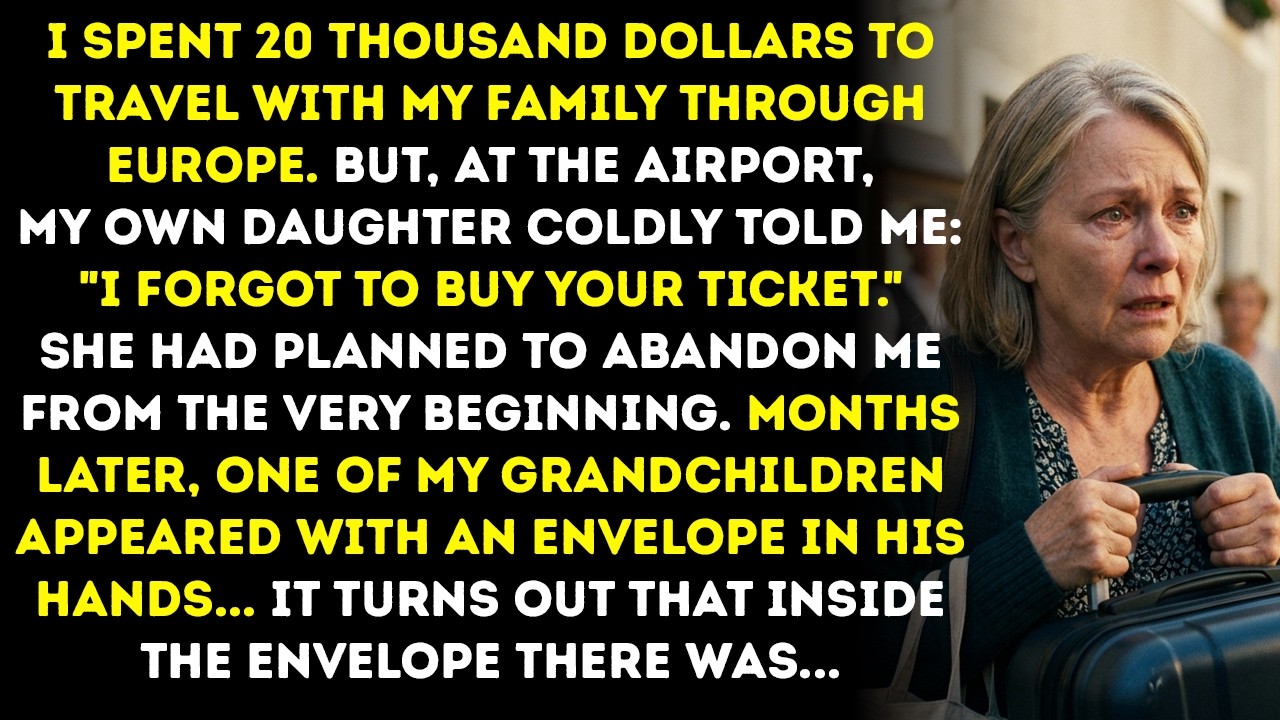
At 76 years old, I spent $20,000 of my life savings to make a dream come true—traveling through Europe with my daughter and grandchildren. But when I arrived at O’Hare with my suitcase in hand and my heart full of hope, my daughter looked at me coldly and said she had forgotten to buy my ticket. Right there, under the harsh fluorescent lights of the terminal, I understood that my own daughter had never intended to take me along. My name is Margaret Hayes.
I’m a retired nurse, a widow, and I live alone in a modest apartment in a working-class neighborhood in Chicago. The walls are peeling a little, and the living room window looks out onto a street where bus engines rumble past constantly. It’s not much, but it’s mine—every piece of furniture carries a memory from the fifty years I spent building a life with my own hands. I started nursing at nineteen at a public hospital on the South Side.
Back then, we didn’t have all the technology they have now. We healed with our presence, with whispered words of comfort in the middle of the night. I loved that work. I loved holding the hand of someone who was afraid of dying alone.
I married Richard when I was twenty-two. He was a long-haul truck driver, a good man, but the highway took him too soon. He died in a crash on Interstate 90 when our youngest, Emily, was barely seven. Suddenly, I was alone with three children and endless shifts at the hospital.
Caroline, the oldest, took on responsibilities no kid should have to carry. She watched her siblings, made dinner, checked homework. I could see resentment growing in her eyes, like a weed I couldn’t pull because I simply didn’t have the time. Jonathan and Emily grew up and moved away—Jonathan to Seattle, where he became an engineer, Emily to Austin after she got married.
They call on birthdays and at Christmas, brief polite calls asking about my health. I tell them everything is fine, even when it isn’t. White lies are sometimes necessary so you don’t worry the ones who are far away. But Caroline stayed.
She married Gregory, a real estate developer, and they built a comfortable life in an exclusive gated community on the North Shore. They had two kids, Ethan and Ava, my grandchildren. Caroline was always the closest geographically, but emotionally there was a wall between us made of silences and short answers. For years, I tried to get closer.
I’d bring her apple pies, offer to help with the kids, but she always had an excuse to cut visits short. I’d ride the city bus home, staring out the window, trying not to think about that coldness that never seemed to melt. I’d saved every spare penny from my nursing career. No luxuries, no vacations except a few days at a cousin’s cabin in Wisconsin.
But I kept a secret dream locked in my chest—to see Europe. Ever since I was a little girl, I’d looked at photos of the Eiffel Tower all lit up, gondolas gliding through the canals of Venice, the Colosseum standing against the blue sky. It seemed like a world from another planet, so far from my reality that I barely dared to dream of it. Six months ago, everything started.
Caroline called me on a Sunday afternoon, her voice strangely upbeat. She was planning a family tour of Europe—three weeks, Paris, Rome, Barcelona, London, five-star hotels, guided tours. My heart raced when she invited me to go with them. “Mom, you’ve always dreamed of seeing Europe, right?
Well, the time has come. I want you to come with us. It’ll be unforgettable. ”
I could barely answer through my tears.
But then came the detail that changed everything. The trip would cost about $20,000 per person. She knew I had no way to pay for that—or so I thought. “Mom, you have those savings, don’t you?
It would be beautiful if you could use that money to make your dream come true. And think of the kids. They would love to have their grandmother on this trip. ”
Her words were sweet, almost sickly sweet, and I wanted so badly to believe them.
I wanted to believe my daughter was finally tearing down that wall. I spent days thinking about it. Twenty thousand dollars was everything I had—every night shift, every Thanksgiving I worked, every sacrifice of fifty years. It was my safety net, my cushion for old age.
Spending it meant leaving myself vulnerable. But the desire to be close to Caroline and my grandchildren was stronger than any financial fear. I called her after a week. My voice shook when I said yes.
She seemed genuinely happy, or at least I wanted to believe that. “That’s wonderful, Mom. You won’t regret this. I’ll take care of everything—flights, hotels, every detail.
All you need to do is pack and show up at the airport. ”
The next day, I went to the bank. Sitting in a hard plastic chair, I felt a pit in my stomach. When I authorized the wire transfer, I watched fifty years of hard work vanish into digital zeros that traveled instantly into my daughter’s account.
Over the next few months, Caroline kept calling with updates. “I booked the hotel in Paris, Mom. It’s right near the Eiffel Tower. The Louvre tickets are confirmed.
” Every call fed my excitement. I bought a new suitcase, the first real piece of luggage I’d owned. I bought two simple dresses, a light coat, comfortable walking shoes. I watched videos of the places we’d visit, picturing myself walking hand-in-hand with Ethan and Ava, finally creating those grandmotherly memories.
I also bought a small notebook with a faux leather cover. I wanted to record every moment, save subway tickets, glue in restaurant napkins. It would be my travel journal, a keepsake of what I imagined would be the most important experience of my life. But the weeks went by, and Caroline’s calls got shorter.
She seemed distracted, answering my questions vaguely. When I asked for specifics—flight times, hotel names—she said she’d email everything. The email never came. I pushed my worry aside.
She was overwhelmed, I told myself. I didn’t want to be the annoying mother. A week before the trip, I got a text from her. It was blunt.
“Mom, meet us at O’Hare on the 15th at 2:00 PM. Terminal 5. Don’t be late. ” Not a single affectionate word.
But I brushed it off. I was too radiant to let little things ruin my joy. In the final days, I barely slept. I checked my suitcase dozens of times.
I exchanged what was left after bills into five hundred euros. I called Jonathan and Emily to tell them about the trip. They seemed happy but concerned. “Are you sure everything is okay with this trip?
Did Caroline show you the tickets? ” Jonathan asked. Emily was more direct: “Mom, Caroline was never one to do generous things like this. Doesn’t that sudden invitation seem weird to you?
”
I pushed their doubts away. My daughter had changed, I told myself. She was finally bringing me into her life. The night before the trip, I didn’t sleep a wink.
In the morning, I showered, fixed my hair, put on some soft lipstick. I wore a light blue dress I’d bought for the occasion. I looked in the mirror and didn’t recognize myself. There was a spark in my eyes I hadn’t seen in years.
I left the house at 11:00, three hours early. I took a cab to O’Hare. The airport was packed—families, couples, groups of friends. I watched it all with a goofy smile, feeling part of that universe of travelers.
I got to Terminal 5 at 1:15 and sat on a bench near the departure screens. Fifteen minutes passed. Thirty. Forty-five.
The clock hit 2:00 and I started to worry. I called Caroline; it went to voicemail. I texted her. “Honey, I’m here.
Where are you guys? ” The messages sat undelivered. Gregory’s phone was off too. My heart beat faster, no longer from excitement but from dread rising in my throat.
At 2:30, I finally saw them. Caroline walked through the terminal with Gregory beside her. Behind them, Ethan and Ava dragged their designer suitcases. They were all dressed impeccably, like models from a travel magazine.
I jumped up waving, relief flooding my chest. But when Caroline saw me, her expression wasn’t joy. It was shame. She walked over slowly while Gregory and the kids hung back.
My daughter stopped in front of me, avoiding my eyes, playing with the strap of her designer purse. “Hello, Mom,” she said in a flat, emotionless voice. “Oh, honey, thank God. I thought something happened.
But now we can check in, right? What airline are we flying? ”
Caroline bit her lip. When her eyes finally met mine, I saw nothing but calculated coldness.
“Mom, I need to tell you something. ”
“What is it, honey? Was there a problem with the flights? ”
She took a deep breath like she was ready to jump off a cliff.
“Mom, I forgot to buy your ticket. ”
The words hung there. I took a few seconds to process. “Forgot?
How could you forget? I wired you $20,000 months ago. That money was exactly for that—to buy all the tickets. ”
Caroline shrugged.
“Yeah, it slipped my mind. I used the money for our tickets, the hotels, everything. There wasn’t enough left over for yours. And now there’s no time to buy it.
Last-minute tickets are way too expensive. ”
The ground dropped out from under me. “Caroline, are you messing with me? Please tell me this is a joke.
”
“It’s not a joke, Mom. I really forgot. We have to board now. We can’t miss our flight.
”
Gregory stepped forward, putting his hand on her shoulder as if shielding her from me. “Margaret, we really need to go. The flight won’t wait. But when we get back, we can sit down and talk about this calmly.
”
“Talk about this? You’re walking away with my $20,000, all the money I saved over fifty years of work, and leaving me here like an abandoned dog? ”
Ethan and Ava stared at their phones, oblivious or pretending to be. Caroline sighed impatiently, like I was a toddler throwing a tantrum.
“Mom, don’t make a scene. You’re overreacting. It’s not the end of the world. It’s just a vacation.
”
“Just a vacation? Twenty thousand dollars, Caroline. It was everything I had. ”
“Look, we really need to go now.
When I get back, we’ll talk. Maybe I can pay you back some of the money. I don’t know. We’ll see.
”
Some of the money. Like it was a loan she might partially repay. I watched my daughter turn her back and walk toward the security checkpoint. Gregory and the kids followed without looking back.
I just stood there, holding onto my brand-new suitcase, wearing the light blue dress I’d picked with such care. Around me, the airport carried on—flight announcements, babies crying, couples kissing goodbye. Life was moving forward for everyone except me. I dragged myself back to the bench and collapsed.
My purse hit the floor, spilling sunglasses I’d never wear in Paris, lip balm bought for the London winds, and the little notebook with my travel plans. On the first page, in my neatest handwriting: “My dream vacation, May 2024. ” It looked so naive now. I slammed it shut and clutched it to my chest.
The tears came, silent at first, then sobs that shook my whole body. I didn’t care who saw. I sat there for what felt like hours. An airport worker asked if I was okay.
I shook my head, unable to speak. When I finally pulled myself together, I opened my banking app. My account balance was $350. That was all that was left.
I took a cab home. The driver tried small talk; I answered in single syllables. When I got home, it was almost dark. I dropped my suitcase in the hallway, lay on the couch fully dressed, and stared at the ceiling.
Twenty thousand dollars. I could have remodeled the apartment. I could have paid for the dental work I’d been putting off. I could have kept it for emergencies.
But I’d chosen to spend it on a trip—for Caroline, Gregory, Ethan, and Ava. Right then, they were probably settling into their seats, sipping champagne on my dime. The anger blended with grief. How could I have been so gullible?
The red flags were everywhere—the shortening calls, the refusal to share details, the way she changed the subject whenever I mentioned my ticket. I’d ignored all of it because I wanted desperately to believe my daughter finally loved me. In the following days, I didn’t leave the apartment. I didn’t answer when Jonathan and Emily called.
I let their calls go to voicemail and deleted the messages without listening. I didn’t want pity. I didn’t want “I told you so. ” I spent my days in a numb haze, staring out the window at people living normal lives.
At night, I replayed every conversation. She never said “we’re going. ” It was always “we’ll go,” subtly leaving me out. She never mentioned my ticket.
There was no misunderstanding. She knew from the beginning. The invitation was just an excuse to take my money. A week later, Jonathan showed up at my door, unannounced, having flown in from Seattle.
When I saw him standing there with that worried look, I broke down. He hugged me in the hallway and let me cry into his shoulder like I hadn’t cried since Richard died. Over coffee, I told him everything. “I’m going to sue Caroline, Mom.
That’s fraud. She manipulated you into stealing your money. ”
“No, honey. I don’t want lawsuits.
I just want her to give me my money back. ”
“But is she going to give it back? Do you really believe that? ”
I didn’t answer, because I didn’t know.
Emily came too. She cried with me, held my hands, said all the right things. But deep in her eyes, I saw an old ache, the resentment she’d carried since childhood. I’d worked so much, been gone so often, that even the children who loved me carried wounds that never fully healed.
After they left, the weeks ticked by. Caroline came back from her trip but never reached out. Not a single text. It was like I didn’t exist.
I tried messaging her a few times. “Honey, we need to talk. Are you at least going to give back a portion of the money? ” They all sat on read with no reply.
In September, I finally got a message. It was brief and freezing. “Mom, I have no way to pay you back right now. We spent everything on the trip.
Maybe next year if we have a surplus. Harassing me about it won’t do any good. ”
There was no apology, no guilt, not even concern about how I was surviving. Just a notice that my loss was permanent and I had to deal with it.
I started having trouble sleeping. I’d lie awake replaying my life—fifty years of busting my back, night shifts, missed school plays, birthdays spent in the hospital ward. Was it my fault? Was Caroline’s coldness the result of my absence?
But even accepting my share of the blame, I couldn’t justify what she did. No childhood trauma justifies stealing $20,000 from your elderly mother. No resentment makes it okay to abandon her at an airport after promising the trip of a lifetime. By October, the bills got harder to pay.
My refrigerator died. The repair guy quoted $400 with no guarantee it would hold up. A new one cost $1,200—money I didn’t have. I borrowed a Styrofoam cooler from a neighbor and started buying ice every day.
It was inconvenient, but it worked. I adapted. I survived. In November, I started getting chest pains.
Sharp spikes that knocked the wind out of me. I knew I should see a doctor, but cardiology exams were expensive and Medicare wouldn’t cover everything right away. I decided to wait. If it was serious, it would be serious with or without a diagnosis.
I was playing Russian roulette with my health, but I saw no other option. Some nights the pain was so intense I was sure it was a heart attack. I’d lie in bed alone in the dark, thinking maybe this was the night. Maybe my body was giving up.
But morning always came. December arrived with bitter Chicago cold. My apartment had terrible heating; the radiator clanked more than it warmed. I spent my days wrapped in blankets.
On the 15th of December, exactly seven months after the airport, I got an unexpected text from Ethan, my oldest grandson. He was seventeen now. The message read: “Grandma, can I come visit you? ”
I stared at the words.
Ethan had never come to visit me on his own. I replied, “Of course, sweetheart. When do you want to come by? ” “Tomorrow.
That works. ”
The next day, I tidied the apartment. I walked to the corner store and spent fifteen dollars I shouldn’t have on soda and chocolate chip cookies. I wanted to offer my grandson something, even if his mother had robbed and abandoned me.
Ethan showed up at 3:00. I was taken aback by how much he’d grown—tall, lanky, practically a man. He walked in timidly, looking around like he’d never been there before. He probably hadn’t.
“Hey, Grandma,” he said, his voice cracking between deep and squeaky. “Hello, my dear. Have a seat. Would you like a soda?
”
We sat at the kitchen table in awkward silence. He fidgeted with his can, then finally spoke. “Grandma, I came over because I need to tell you something. ”
“What is it, sweetheart?
”
“I know what my mom did. I know about the money, about the trip, about all of it. ”
My heart skipped a beat. “I overheard her talking to my dad a few days before the trip.
She was on the phone, and she said she finally scammed that cash out of you, that she could finally go on her dream vacation without it hurting her bank account. ”
Every word felt like a stab wound. So it was premeditated. It wasn’t a lapse in memory.
It was a deliberate scheme from day one. “I didn’t know what to do,” he went on, tears welling up. “I’m just a kid. I had no way to warn you.
And my mom, she’s my mom. I was terrified that if I told you, it would destroy the family. ”
“You’re not to blame for anything, Ethan. It’s not your job to fix the mistakes of adults.
”
“But I feel so guilty. The entire trip, I couldn’t enjoy a single second. While my mom was posing in front of the Eiffel Tower, all I could think about was you back here alone. And the worst part is, she doesn’t even care.
She came back and acts like nothing happened. ”
Ethan started crying then. I pulled him into a hug. He was tall, but he still fit in my arms.
He was still my little grandson who needed comforting. When he calmed down, he wiped his face and looked at me with fierce determination. “Grandma, I brought you something. ”
He pulled an envelope from his pocket, white and a little crumpled.
I opened it with shaking hands. Inside was cash—twenties and fifties, neatly stacked. “Ethan, what is this? ”
“It’s money I saved up.
I work as an IT tutor at an after-school program, teaching kids Excel and PowerPoint. It doesn’t pay much, but I saved every penny for the last six months. It’s $1,500. ”
“Oh my god, Ethan.
I can’t take this. ”
“Please, Grandma, take it. I know it’s nowhere near $20,000, but it’s what I scraped together. I want you to buy a new fridge.
I saw the Styrofoam cooler in the kitchen. Nobody deserves to live like that. ”
The tears I’d been holding back for months finally broke loose—not tears of grief or rage, but gratitude. This seventeen-year-old boy, who barely knew me, had done more for me than his mother ever had.
We talked for hours after that. He told me about school, his plans to major in computer science, how suffocating the superficial North Shore lifestyle could be. Before he left, he hugged me tight. “Grandma, I’m going to keep working and saving.
Every month I’ll bring you a little something. Don’t tell my mom. She can’t know I’m coming here. But I’m not going to abandon you.
I promise. ”
After he left, I sat holding that envelope for a long time. It wasn’t the money that mattered—it was what the gesture meant. I wasn’t completely alone.
There was still goodness in the world. The next day, I bought a refurbished refrigerator for $450. With the leftover money, I bought real groceries—meat, fresh fruit, vegetables. I hadn’t eaten like that in months.
Ethan started visiting regularly, always bringing whatever money he’d saved. I stashed away every cent, promising myself I’d give it back with interest for his college tuition. As the months passed, I began to rebuild my life. It wasn’t the same life, but it was a life.
I woke up, brewed my coffee, sometimes even smiled when the sunlight hit the window just right. Jonathan and Emily stepped up too. Jonathan called weekly and flew in when he could. Emily started sending $200 a month.
It was pocket change to them but made a world of difference to me—being able to refill a prescription without stress, replace a burnt-out bulb without second-guessing. As for Caroline, I never heard from her again. She blocked me on all social media. I had ceased to exist to her.
There were still nights when the anger flared. I’d imagine confronting her, imagining lawsuits where a judge forced her to pay back every dime. But they were empty fantasies. What really helped was accepting that those $20,000 were gone forever.
I had to grieve it like mourning a death—denial, anger, bargaining, depression, acceptance. It took the better part of a year, but I got there. In May, exactly a year after the airport nightmare, Ethan called. “Grandma, Ava and I want to do something.
Can we pick you up tomorrow morning? ”
The next day, both grandchildren showed up in an Uber. Ava was fifteen now, a shy teenager who looked at me with a mix of curiosity and guilt. They refused to tell me where we were going.
“It’s a surprise. ”
We drove about forty minutes and pulled up to a building near Lincoln Park. Ethan helped me out, and the three of us walked in. We rode the elevator to the fifth floor.
When the apartment door swung open, I saw Jonathan and Emily inside, smiling. The apartment was small but incredibly cozy, with huge windows and natural light. It was furnished simply but completely. “Welcome to your new home,” Jonathan said.
“What do you mean, my new home? ”
Emily took my hands. “Mom, Ethan told us everything Caroline did. Jonathan and I pooled our savings, Ethan and Ava chipped in what they had, and we covered the deposit and first months’ rent.
We’re renting, but it’s infinitely better. Elevator, good security, close to everything. And we’re going to split the rent. You’ll never go without anything again.
”
I looked around, struggling to process it all. A kitchen with stainless steel appliances, a plush couch, a soft mattress, a bathroom with working hot water. “I don’t deserve all of this,” I choked out. “Yes, you do,” Ava said, speaking up for the first time.
“My mom did a horrible thing to you. Even though she’s my mom, I know what she did was sick. ”
“We can’t undo what she did, but we can try to make things better,” Ethan added. “And Grandma, there’s one more thing.
We started a GoFundMe online, sharing your story. We didn’t use real names, don’t worry. People were incredibly moved. We’ve raised almost $5,000 so far.
It’s not $20,000, but it’s something. ”
I collapsed right there in the middle of my new living room, surrounded by the family who truly loved me. For the first time in over a year, I felt like maybe, just maybe, things were going to be okay. Moving day was a breeze.
I didn’t have much to bring—clothes, keepsakes, photographs. The rest stayed behind, like I was leaving that entire dark chapter behind. Over the next few months, I settled into a new routine. I woke up early to watch the sunrise through the picture window.
I brewed strong coffee, no more watered-down nonsense. I read the morning paper on the little balcony. Tiny luxuries that had been ripped away from me were back. Jonathan installed a ring camera and bought me a new smartphone with security apps.
Emily signed me up for senior water aerobics at the YMCA. I went three times a week and, for the first time in decades, made new friends—people my age with their own stories of loss and starting over. Six months after I moved in, Ethan showed up with news. “Grandma, Ava and I are going to live with our dad for a while.
He’s separating from my mom. ”
Gregory and Caroline were getting divorced. According to Ethan, it was a nasty battle. Gregory had caught Caroline having an affair with one of his business partners.
The irony didn’t escape me—the woman who robbed her own mother to fund a luxury lifestyle had blown up her marriage out of greed and betrayal. “What about your mom? How is she doing? ” I asked, surprised I still cared.
“She’s not doing great. She lost big in the settlement. The house has to be sold. She’s going to have to get a real job, something she’s never done in her life.
”
“Do you still talk to her? ”
“Sometimes. But it’s not the same. The way she treated you—we’re never going to forget that.
”
More than a year passed. My life settled into a peaceful rhythm. It wasn’t the life I pictured at seventy-eight, but it was a good life. Kids who showed up for me, loving grandchildren, friends at the Y, a beautiful apartment.
The wounds had scarred over. They left marks, but they’d stopped bleeding. One Tuesday afternoon, I got a call from an unknown number. I almost let it ring, but something told me to answer.
“Caroline. ”
“Mom. ” Her voice sounded small and broken. “I know I have no right to call you.
I know what I did was unforgivable. But I really need some help. ”
I stayed silent. “I lost everything in the divorce.
I’m living in a tiny cramped apartment, barely able to keep the lights on. I have nothing left, Mom. I know I don’t deserve this. But you’re my mother.
Could you… could you loan me some money? ”
The silence stretched between us. I thought about everything I could say.
I could scream, remind her of every agonizing second of pain she’d caused. I could hang up and block her. I could laugh at the irony. But I didn’t do any of that.
“Caroline, I don’t have any money to lend you. You took every last dime I had, remember? But I’m going to tell you something. When you were on top of the world, living in your luxury house and taking lavish vacations on my dime, you treated me like garbage.
You used me and threw me away. Now that you’ve hit rock bottom, you come crawling back to the mother you betrayed. Do you want to know what I learned these last two years? Family isn’t just the people who share your bloodline.
It’s the people who show up for you when you need them. And you made the choice not to be my family. Now you’re going to have to learn how to stand on your own two feet, exactly like I had to. ”
“Margaret, please.
”
“No, Caroline. Please doesn’t work anymore. You made your bed. Now you have to lie in it.
I hope you find your way, and I hope you learn how to be a decent human being. But that’s a journey you’ll have to take without me. ”
I hung up. My hands were shaking, not from weakness but pure adrenaline.
For the first time in my life, I had drawn a hard boundary. For the first time, I had chosen myself. That night, I sat on the balcony. The Chicago skyline was clear, and I could actually see stars.
I thought about the young nurse I used to be, the single mother who fought tooth and nail, the widow who worked her fingers to the bone, the old woman scammed by her own flesh and blood, and finally, the woman I’d learned to become. Someone who knew her worth and refused to accept less. Life had taken a lot from me. Twenty thousand dollars, yes, but also my illusions and the image I held of my oldest daughter.
In exchange, it gave me clarity. It gave me real relationships with Jonathan, Emily, Ethan, and Ava. It gave me back my dignity. I made a quiet promise to myself.
I would never again be the Margaret who bends over backward and sacrifices herself past reason, praying it will earn her love. I would never again settle for emotional crumbs from someone who should be laying out a banquet. I would just be Margaret—a seventy-eight-year-old woman with a lot of living left to do, wisdom to share, and love to give. The $20,000 is gone, just like the daughter I always thought I had.
But in its place, I gained something cash can never buy. Self-respect, genuine human connection, and the peace of knowing that, no matter what happens, I am enough. I always was.