On a bright London morning in the spring of 1959, Kay Kendall lay in a private room at the London Clinic, surrounded by flowers she was told were get-well gifts from admirers. At 32, she was still breathtakingly beautiful, her auburn hair spread across the pillow, her famous cheekbones casting soft shadows. She was laughing, as she so often did, with that uncontained, slightly scandalous laugh that everyone who ever shared a room with her remembered for the rest of their lives. Her husband sat beside her, holding her hand.
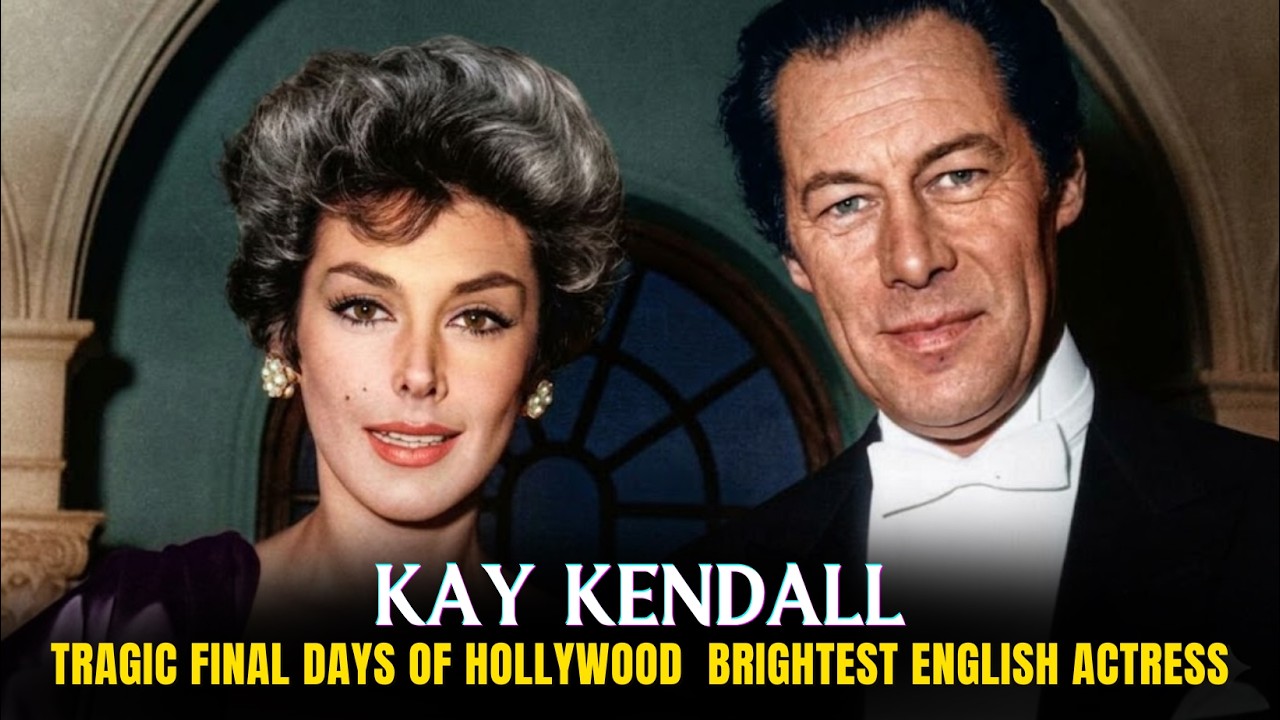
Rex Harrison, one of the most celebrated actors alive, was smiling too. That was what she needed from him, and it was what he had promised: the smile, always the smile, never the truth. Rex Harrison knew something his wife did not. He had known it for two years, carrying it every single day through film sets, dinner parties, and quiet Sunday mornings.
Kay was dying. She had been dying since before they married. The doctors had told him she would not see another birthday, and she had no idea. Kay Kendall was born Justine Kay Kendall McCarthy on May 21, 1927, in Withernsea, a small seaside town on the East Yorkshire coast.
She came from show business the hard way: cold dressing rooms in provincial theaters, a suitcase that never got properly unpacked, applause one night and empty seats the next. Her grandmother was Marie Kendall, a celebrated Edwardian music hall comedian. Her father, Terry, was a song and dance man, and her mother, Gladys, had been a dancer before marriage redirected her entirely. Kay grew up watching performers from the wings.
She understood early that performance was not something separate from life; it was how you navigated life. She was the eldest of three sisters, and from childhood she was clearly something particular, not just striking, with enormous dark eyes and a quality of alertness that made whoever she was talking to feel like the only person in the room. Her timing was instinctive in a way that cannot be trained into a person. The family moved to London when she was a young teenager, and her training became formal.
By 15 she was already working, taking small parts in touring revues and chorus lines, the grinding entry level of British entertainment in the mid-1940s. The early years of her professional life were a long series of near misses. Her first credited appearance came in 1944 in “Fiddlers Three,” a wartime musical comedy. She was 17.
Even in those brief moments, the camera found her, and something registered: a quality of mischief, of barely contained energy. More films followed, including “London Town” in 1946, a lavish musical that became one of the most notorious box office disasters in British film history. Then came several years of near invisibility: small television work, radio, the occasional supporting role in films nobody now remembers. She was living in a London flat on very little money, auditioning constantly, being passed over constantly, doing it all with a public face of breezy confidence.
Those who knew her during this period describe a woman who seemed almost constitutionally opposed to self-pity. If a part went to someone else, Kay would make a joke about it, usually at her own expense, and move on. The film that changed everything was released in 1953. It was called “Genevieve,” a modest British comedy about two couples and their vintage cars competing in the London to Brighton Run.
Kay was cast as Rosalind, the dizzy trumpet-playing girlfriend of one of the male leads. She was given one scene in particular that altered the course of her life: her character, slightly drunk at a party, picks up a trumpet and begins to play appallingly, with total physical commitment and the expression of a woman who believes she is giving a Royal Albert Hall recital. The scene runs perhaps 90 seconds, and it remains one of the funniest pieces of physical comedy in British film history. When “Genevieve” was released, the reviews were warm all round, but Kay’s notices were something else entirely.
Critics who had never previously mentioned her name were reaching for superlatives. Dilys Powell of The Sunday Times singled her out in terms that stopped the industry cold. Overnight, Kay Kendall was a star, not a promising newcomer, but a full, unambiguous, blazing star. She was 26 years old and had been working for 11 years to get there.
What followed confirmed everything and then exceeded it: “Doctor in the House” in 1954, “Simon and Laura” in 1955, and then, in 1955, “The Constant Husband,” a gentle comedy filmed in London. Her co-star was Rex Harrison. Rex Harrison at that point in his career was at a peculiar crossroads. He was enormously talented and enormously difficult, famous for both in roughly equal measure.
He had been married twice and carried the shadow of a genuine scandal: the suicide of actress Carole Landis in 1948, a woman he had been having an affair with. He was not, by any reasonable assessment, a man who expected to fall completely in love on the set of a light comedy. But Kay Kendall was unlike anyone he had encountered. She was quick, restless, and completely without pretension in an industry built almost entirely on pretension.
Rex fell completely and somewhat helplessly. Kay was more measured. She had watched enough of the world to know that a man like Rex Harrison required careful handling. What happened instead was that they became genuinely close friends first.
The laughter between them was real and specific, that particular frequency two people find together. They finished each other’s jokes. The romance grew from that foundation. By 1956, they were inseparable.
Rex left his second wife, Lilli Palmer. Kay Kendall and Rex Harrison became the most talked about couple in the English-speaking entertainment world. They married in June 1957 in a small New York ceremony. Kay wore gray.
What neither of them said publicly, what in fact only two people in the world knew at that moment, was that this marriage had begun under the shadow of a secret so devastating it seems almost impossible it was kept at all. It had started in 1956, before the wedding, when Kay had begun to feel not quite right. Nothing dramatic at first: fatigue that seemed disproportionate to her workload, a pallor her makeup couldn’t fully cover. She dismissed the symptoms, but they persisted.
Eventually, at the urging of friends, she went to a doctor. The results were not what anyone had hoped. Kay Kendall had myeloid leukemia. In 1956, this was not a diagnosis that came with options.
There was no treatment that could cure it. The doctors estimated she had perhaps two to four years. She was 29 years old. What Kay did next is perhaps the most startling part of everything that follows.
She made a decision. She decided she did not want to know precisely how long she had, and she was not going to spend whatever time remained being treated as someone who was dying. She wanted to live fully, loudly, in the present tense. And then she told Rex.
Not because she wanted his pity, but because she was falling genuinely in love with him, and she believed he had the right to know what he was falling in love with. She told him everything: the diagnosis, the prognosis, her intention to keep it from everyone else. And then she asked him something no person should ever have to be asked. She asked him to marry her anyway, to live with her as though everything were normal, and to never, under any circumstances, let her see the knowledge of her death in his eyes.
Rex Harrison said yes. He agreed to love a woman he knew he was going to lose, to perform happiness every single day, knowing exactly how it ended, and to be the sole keeper of the most terrible knowledge imaginable. He quietly approached Kay’s doctors and made arrangements to stay fully informed about every stage of her condition. He consulted specialists and monitored every medication change.
Nobody knew. Not Kay’s family, not their closest friends, not the journalists, not co-stars or directors or studio executives. Just Rex and the doctors. Between 1957 and 1959, by every external measure, these were the best years of Kay Kendall’s life.
“Les Girls” in 1957 paired her with Gene Kelly in an MGM musical that gave her the Hollywood showcase her talent had always warranted. She was luminous in it, funny and touching in the same breath. The reviews were the best of her career. Her name was now spoken alongside the great comic actresses of Hollywood’s golden era.
She and Rex moved between London and Hollywood with ease. Their social life was extraordinary: dinners with Noël Coward, weekends with the Oliviers. Kay was the center of every room. And through all of it, Rex smiled his careful smile and held her hand and watched her with a quality of attention that stored details: the specific pitch of her laugh, the way she held a cigarette, the gesture with her hands when she was making a point.
He was memorizing her. There was one other person beyond the doctors who came to know. Lilli Palmer, Rex’s former wife, became aware of Kay’s condition at some point during this period. Rather than responding as a discarded wife might reasonably respond, Palmer acted with remarkable grace.
She maintained a genuine friendship with both Rex and Kay during these years and did not use what she knew. Kay knew nothing of any of this. The only hint she ever gave came in a remark recorded by a friend, casual and offhand, in which Kay said she intended to enjoy herself completely and without reservation, because you simply never knew how long any of it lasted. She laughed after she said it.
She usually did. By 1958, the symptoms Kay was managing with medication had become harder to conceal. She tired more easily. She was thinner than she should have been.
Rex, watching this daily, was giving the performance of his life, not Higgins in “My Fair Lady,” but the performance of a man who does not know, every morning at the breakfast table, every taxi ride to a film set, every social occasion where someone asked how Kay was looking. He gave interviews during this period in which he spoke about Kay with an openness unusual for him. He spoke about her as though she were the most genuinely surprising thing that had ever happened to him, as though he still could not quite believe his luck. He knew exactly how his luck was going to turn.
In 1958, Kay was cast in “Once More with Feeling,” a romantic comedy filming in London and Paris. It was a sharp, funny role that suited her precisely, and nobody on set knew what Rex knew. There is something almost physically painful about the footage from this period: Kay Kendall in 1958, in the last full year of her life, at the absolute height of her powers, so completely present on screen, so entirely herself, and in every frame you can see the thing Rex Harrison spent two years protecting: the complete, unguarded aliveness of someone who does not know she is running out of time. In early 1959, Kay’s condition deteriorated faster than even the most cautious predictions had allowed for.
She was admitted to the London Clinic. Rex told her it was for tests, for monitoring, for a rest she clearly needed. Kay held court from her hospital bed with a wit that made the nurses genuinely look forward to their shifts on her ward. She complained about the food with considerable inventiveness.
Rex visited every day and made her laugh. Friends came and went. The room was at times almost festive. She wrote letters from the hospital.
Several have survived, and they are remarkable: funny, affectionate, detailed in their complaints about the wallpaper and one particular nurse, and the inexcusable selection of reading material available. Not a word of fear. Not a sentence that reads like a farewell. Whether Kay Kendall in those final months suspected the truth will never be fully known.
Some who were close to her believe she did, and that what she had given Rex was not simply permission to keep a secret, but permission to let her go without the formality of saying it out loud. Others believe she truly did not know. We cannot know. Rex knew, and when asked in later years, he would not say.
He had made a promise, and he was not the kind of man who broke the promises that mattered. On September 6, 1959, Kay Kendall died at the London Clinic. She was 32 years old. Rex was at her bedside, and he had been there through the night.
The end, when it came, was quiet. The announcement reached the press that afternoon, and the response was immediate and genuinely stunned. This was not the death of a fading name. Kay Kendall was at the height of her fame, and the grief that followed was real and entirely unprepared, because nobody had known she was ill.
The shock was total. Tributes came from every direction, from Hollywood, from the British studios, from directors and co-stars and journalists. None of them could say the full story, because none of them knew it. The diagnosis.
The secret. The two years of Rex Harrison performing normalcy while carrying knowledge that would have destroyed most people outright. Rex gave almost no public comment in the immediate aftermath. He left London shortly after the funeral, and those who saw him during the weeks that followed described him as unrecognizable from the Rex Harrison they knew.
The wit was gone. The charm was gone. He was, by every account, devastated in a way that went beyond the ordinary language of grief. The secret came out gradually over the months and years that followed.
Rex spoke about it carefully, in fragments, in interviews where the right question was asked at the right moment. But what he said was always consistent. He had loved her. He had made a promise.
He had kept it. He did not regret it. He would do it again. In one interview, quoted many times since, he said that carrying the secret had been the hardest thing he had ever done in his life, and also, in some way he found difficult to put into words, the most important.
He said that loving someone enough to protect them from the worst thing was the fullest expression of love he had ever managed, and that Kay had understood him, perhaps, more clearly than he had understood himself. He said he thought about her every day. Kay was buried at Hampstead Parish Church in London. The ceremony was attended by the people who had known and loved her.
Rex went on. He had to. “My Fair Lady” opened on Broadway and ran for years. The film version came in 1964 and won him the Academy Award for Best Actor.
He married again, and again, and again. None of those marriages, by the honest testimony of people close to Rex in his later years, came near what he had with Kay. In his autobiography, published in 1974, Rex wrote about Kay with a lack of his characteristic deflection that is striking on the page. He wrote about the trumpet scene in “Genevieve” as though he had watched it recently.
He wrote about her laugh. He described the morning she died with a brevity more devastating than any amount of detail could have been. He wrote that she had been the love of his life. Kay Kendall made a handful of films: “Genevieve,” “Doctor in the House,” “The Constant Husband,” “Les Girls,” “Once More with Feeling.
” The window between “Genevieve” in 1953 and her death in 1959 is six years, six years in which she went from near forgotten to irreplaceable. She had the quality that cannot be manufactured: the ability to make you feel, watching her, that you were seeing an actual person rather than a performance of one. Her comedy came from genuine warmth, from real self-knowledge, from an understanding of human frailty that she had earned the hard way and chosen to find funny rather than despairing. The choice she made in full possession of information that would have sent most of us into the dark, to turn her face toward the light and keep it there until the very end, is what echoes longest when you sit with her story.
Rex Harrison died on June 2, 1990, in New York. He was 82 years old. He had been married six times and won every professional honor his industry could offer. On his death, the tributes spoke of the roles that had made him a legend.
And those who had known him longest spoke also of the woman he had loved and lost, the laughing, unstoppable, irreplaceable Kay Kendall. They said what Rex had said himself, quietly, across 30 years of careful interviews: she had been the love of his life. He had kept his promise.