The most expensive-looking effect in Ridley Scott’s 1985 fantasy film Legend cost almost nothing at all. The glowing fairy that darts through the trees was a tiny bulb moved on a length of fine fishing line. Scott has since enjoyed revealing the trick, noting that the same shot today would be sent to a visual effects vendor and returned with a large invoice attached. That handmade approach defined the entire production.
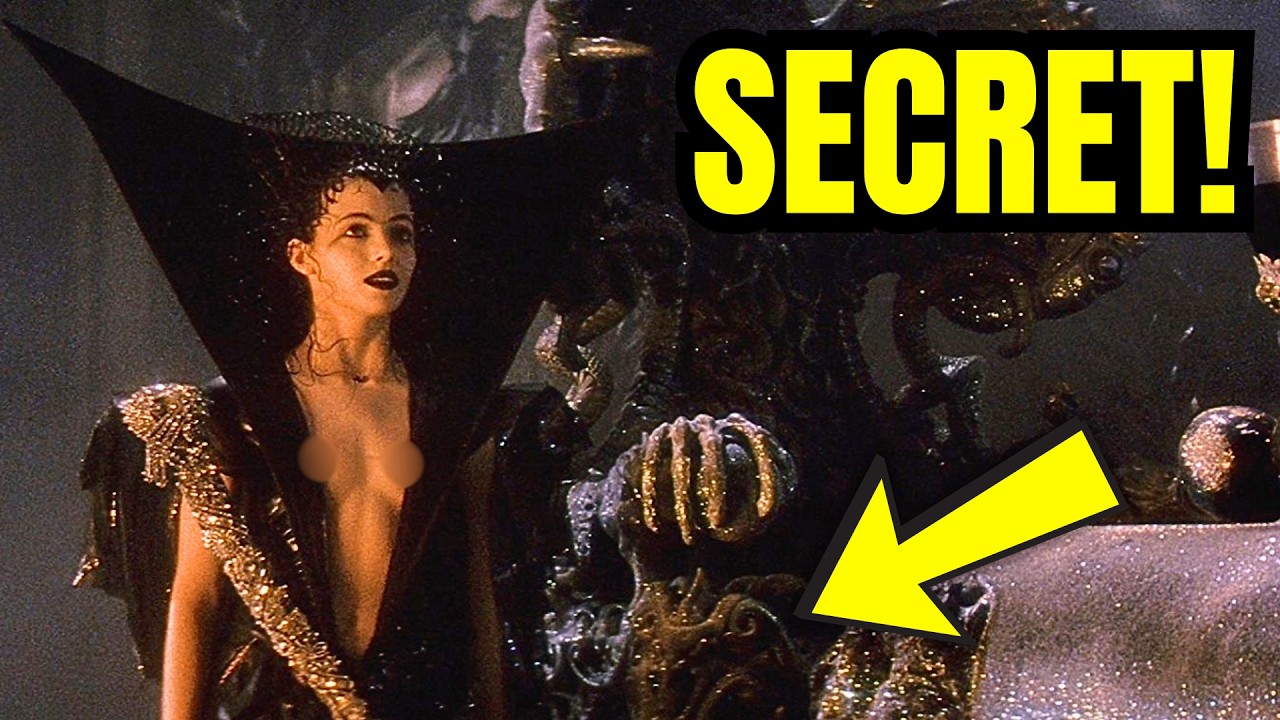
Scott, coming off Blade Runner, deliberately commissioned an original fairy story with no source novel or ancient myth attached. Screenwriter William Hjortsberg based his hero on the Green Man, the leaf-covered woodland figure carved into British churches for centuries, and built the rest of the tale around him, including unicorns, a princess, a magic sword, and an endless winter. The film’s forest was constructed entirely inside the 007 stage at Pinewood Studios, then the largest sound stage in the world. Plaster, Styrofoam, and real branches formed the trunks, with several tons of plastic leaves attached by hand.
Shredded duck feathers were released into the air to simulate drifting pollen, and enormous movable reflective panels made the woodland appear to stretch for hundreds of meters beyond its actual limits. The panels caused one unintended problem: hundreds of pigeons brought onto the set kept flying straight into them. Mia Sara won the role of Princess Lily after reading half a poem for Scott, who reportedly felt an immediate creative connection and said that was all he needed. She was 16 by the time filming wrapped, carrying a feature for the first time.
Tom Cruise, cast as the forest-raised Jack, built his performance around physicality, crouching instead of sitting and moving like someone unaccustomed to human rooms. The villain, Darkness, took shape through a long casting search. Scott first considered Peter O’Toole but dropped the idea because the actor was too thin and pale for a figure meant to feel physically overwhelming. He found Tim Curry while looking for someone to play the swamp hag, and the actor’s stage training and physical discipline convinced Scott immediately.
The design was then pushed further: polished deep-red skin, a massive muscular silhouette, and horns so large they read as architecture. Curry fought a plan to cover his eyes with contact lenses, arguing that audiences would have nothing to read if no living part of his face remained visible. He won the argument, and his uncovered eyes became the reason the character registers as a person rather than a puppet. Each day, becoming Darkness took about five and a half hours of prosthetic application, and the horns required constant redesign to keep the weight from straining his neck.
The production suffered a devastating setback on June 27, 1984, with roughly 11 days of filming left. A fire started during the lunch break in the 007 stage, gas cylinders exploded, and the entire artificial woodland was destroyed within the hour. The roof collapsed on the largest sound stage in the world. Two workers were treated for burns and shock.
Scott lost only three days of shooting, rebuilt the single section of forest still needed, and reportedly left Pinewood to play tennis while the fire was still being extinguished. One of the film’s most celebrated sequences required no prosthetics at all. The dance between Lily and a figure made of shadow was performed by dancer Liz Gilbert inside a costume built by Charles Noad, with choreography staged by Arlene Phillips. The black dress functioned as a character, letting Lily dance with a version of herself before she steps into that version.
Behind the scenes, the goblin called Blix was based on a surprising reference. Alice Playten, a Broadway veteran playing Darkness’s chief henchman, suggested modeling the character on Keith Richards. Scott sketched the idea, Bottin’s workshop pushed it into fairy-tale grotesque, and the origin became nearly invisible. On set one day, Curry told Playten he felt like they already knew each other without understanding why; when she revealed the inspiration, he laughed for a very long time.
The film’s unicorns were played by white horses brought from Spain, but their vocalizations came from recordings of humpback whales. Scott wanted the creatures to feel closer to gods than to animals, and whale song carried the right emotional weight without being quickly identifiable. The choice also quietly borrowed the association of endangered wonder that whale recordings had carried since the early 1970s. Jerry Goldsmith spent months writing a full orchestral score, composing to a 140-minute work print and tying his music to specific cuts and gestures in the film.
That version never reached American cinemas. Universal replaced the entire score with electronic music from Tangerine Dream, the band that had scored Risky Business, the film that made Cruise a star. The American release became a different experience underneath identical footage, with the same shots carrying different emotional meanings under the two very different soundtracks. The film also went through severe cutting before release.
Scott’s preferred version ran 113 minutes, but a poor preview screening, with audience members laughing and talking through the film, led to further trims. The European release ran 93 minutes, and the American version was cut to 89. Much of what was removed were quiet scenes and connective conversations, prompting critics to call the film thin and difficult to care about. Legend opened at number one in America with $4.
2 million in its first weekend, then stopped. It finished with roughly $23. 5 million worldwide against a budget of about $25 million, a clear commercial loss. Reviews were dismissive of the story, pacing, and Cruise, with most praise going to Curry and the design work.
The film’s reputation recovered over roughly 15 years through home video and television. A lost 113-minute preview cut with Goldsmith’s score resurfaced in 2000 as an answer print struck from the negative, and it was reconstructed and released on DVD in 2002 as the director’s cut. That longer version changed the project’s reputation dramatically. The craftsmanship behind the film was recognized at the highest level.
Rob Bottin and Peter Robb-King earned an Academy Award nomination for best makeup for the 1987 ceremony, following the delayed American release. BAFTA nominated the same pair, along with Noad for costume design and Nick Allder and Peter Voysey for visual effects. Alex Thomson won the British Society of Cinematographers award for his photography. Bottin, still in his mid-20s and coming off work on John Carpenter’s The Thing, ran a makeup operation that produced more than 600 prosthetic pieces over a 60-day shoot.
Every piece was destroyed as it came off each evening and rebuilt fresh for the next morning, requiring a system that operated like a small manufacturing plant. Underwater shots were the rare exception to the fully controlled indoor production. The crew traveled to Silver Springs in Florida for the clarity of its water, and Cruise performed his own swimming scenes. Alligators were reportedly in the vicinity of the filming area throughout, a detail that changes how the calm, soft-lit sequence feels.
The fire destroyed the original forest sets, the score was split across two continents, and the film was cut repeatedly before audiences saw it. Each surviving version carries a slightly different idea of the fairy tale Scott was trying to make, and the argument between them has continued for four decades.