In late July 1777, during British General John Burgoyne’s invasion of New York from Canada, a Loyalist family in Argyle, Washington County, was massacred inside their own home by a group of Wendat (Huron) warriors led by a chief named Le Loup, whose name means “the wolf. ” The family had remained on their farm, trusting Burgoyne’s written promise that Indigenous forces fighting alongside the British would not attack Loyalists. John Allen and his family were having lunch with three enslaved people owned by his father-in-law when Le Loup and his warriors, who had been watching them, burst in. All nine people in the house were killed: John Allen, his wife, her sister, their three children, and the three enslaved workers.
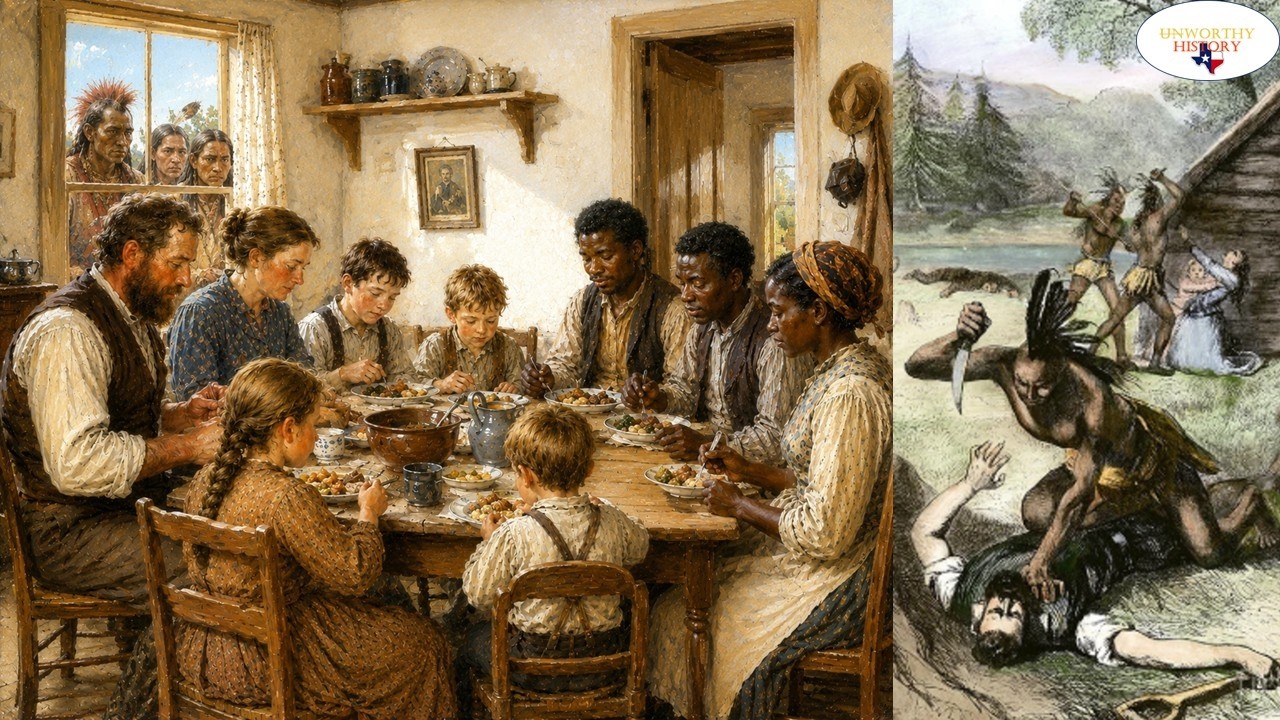
Their scalps were removed, and the home was looted. No witnesses survived to describe the attack, but the table left in the middle of the room and scattered signs suggested the family had risen in confusion when the killers entered. A slave sent by the father-in-law, Mr. Gilmer, after a younger sister failed to return from an errand, ran back in terror shouting that the young woman and the entire household were dead.
At the house, nine bloody bodies lay on the floor, all of them alive and healthy that morning. The massacre came amid the wider struggles of Burgoyne’s campaign. British forces had retaken Fort Ticonderoga, while American Patriots tried to hold Fort Edward. Burgoyne’s army moved slowly and painfully through rough terrain, clearing giant tree trunks from narrow waterways and building more than forty bridges and long corduroy roads.
Soldiers carried roughly sixty pounds of equipment each. Supplies ran critically short, and swarms of biting insects added to the misery. One naturalist who had traveled through the same region described the tiny “puncheon” flies, nearly invisible but far worse than larger mosquitoes, as drawing blood relentlessly. At Fort Anne, a sharp engagement took place between British forces under Lieutenant Colonel Hill and Americans under Colonel Long.
After the Americans ran out of ammunition, they were forced to retreat, but not before burning the fort. British accounts credited a war cry from Indigenous fighters for the American withdrawal, but the Americans had actually exhausted their ammunition; witnesses later said that if they had been well supplied, they might have won a significant victory. Facing severe shortages, Burgoyne decided on an expedition to Bennington, a plan strongly urged by Philip Schuyler. The goal was to capture a large stockpile of supplies gathered near Bennington.
Burgoyne, confident in claims that Loyalists in the region greatly outnumbered Patriots and would rally once a British force appeared, sent Lieutenant Colonel Baum with about six hundred Hessians, Canadians, Loyalists, and Indigenous fighters. The expedition ended in disaster for the British cause. Across the campaign, Burgoyne proved unable to control the Indigenous warriors he had been encouraged to enlist. Despite strict orders and promises of obedience made by Le Loup at a council and war feast on the riverbank, small groups continually roamed the woods, spreading terror among settlements.
Both Patriots and Loyalists became victims, and Burgoyne’s written protections were largely ignored. Redcoats and civilians alike fled before the raiders, who were seen as driven by a thirst for blood and considered taking a scalp a greater achievement than taking a prisoner. At first, British officers tended to overlook these atrocities. When frightened Loyalists rushed to General Fraser to report the slaughter of an entire family, he replied: “It is a conquered country, and we must wink at these things.
” The remark damaged the reputation of that unfortunate general. Before the Allen massacre, small groups of warriors had been seen wandering near Fort Edward. The suspicious signs, along with knowledge of Burgoyne’s proximity, pushed American forces to fall back and drove Patriot families along the river to prepare for flight toward Albany. Roads filled with desperate refugees: men leading young children, women clutching infants, overloaded horses carrying two or even three riders, and wagons piled with hastily gathered furniture.
One contemporary description compared the chaos to poetic accounts of crowds fleeing toward the gates of Rome. The Allen family was closely tied to the wider circle around Jane McCrea, whose life is the subject of David Wilson’s 1853 book “The Life of Jane McCrea,” from which this account is drawn. Jane McCrea lived nearby and held Loyalist sympathies because her fiancé had joined Burgoyne’s British forces. The massacre at the Allen home occurred on the same day Jane McCrea arrived at the house of Peter Veal at noon, July 26, and it helped spread panic through the region.
John Allen and his brother-in-law Mr. Gilmer were both Loyalists, though neither was known for partisan zeal. They had stayed to tend their herds and gather their crops while their Patriot neighbors fled, leaving ripe grain to rot in the fields. According to some accounts, despite their political leanings and Burgoyne’s promise of protection, they had serious fears of the Indigenous warriors and planned to move to a safer home once the harvest was finished.
Some historians wrongly claimed Allen was already packing to leave for Albany when Le Loup and his band appeared; in fact, he had spent most of that day working in his fields, helped by three enslaved people belonging to his father-in-law. After the massacre, Gilmer’s family fled in terror, moving from one forest to another through the night, hoping to reach the garrison at Fort Edward without being noticed. News of the slaughter spread fear everywhere. Patriots in New Perth, now known as Salem, gathered at night inside makeshift fortifications with their wives and children, while Loyalists flooded into the English camp, protesting and demanding the protection they had been promised.
The British were largely responsible for these killings because they had enlisted Le Loup’s Wendat band to fight for them. Instead of only fighting rebel Americans, the warriors killed an entire Loyalist family. The massacre likely pushed more Americans to support the Revolution, and even those who remained loyal to the Crown, like the Allen family, could be brutally murdered in their own homes by warriors the British had recruited.
The final known outcome presented in the source is the massacre itself and the wave of fear and anger it spread across the region during Burgoyne’s campaign.