In October 1979, Coca-Cola aired a commercial that would become one of the most beloved in American advertising history: a weary, limping football star trudging through a stadium tunnel, a nervous young boy offering him a bottle of Coke, and the player tossing his jersey to the kid with the line, “Hey kid, catch this. ” The ad made “Mean Joe” Greene a household name, softening the image of one of the most feared defenders in NFL history. But behind the 60-second spot was a story the broadcast never showed—one involving dozens of bottles of Coca-Cola, a grueling three-day shoot, and a quiet Christmas gesture that had nothing to do with advertising. Charles Edward Greene grew up in Temple, Texas, and by the time he joined the Pittsburgh Steelers in 1969 as the first overall pick, he already carried a nickname that told opponents everything they needed to know: “Mean Joe.
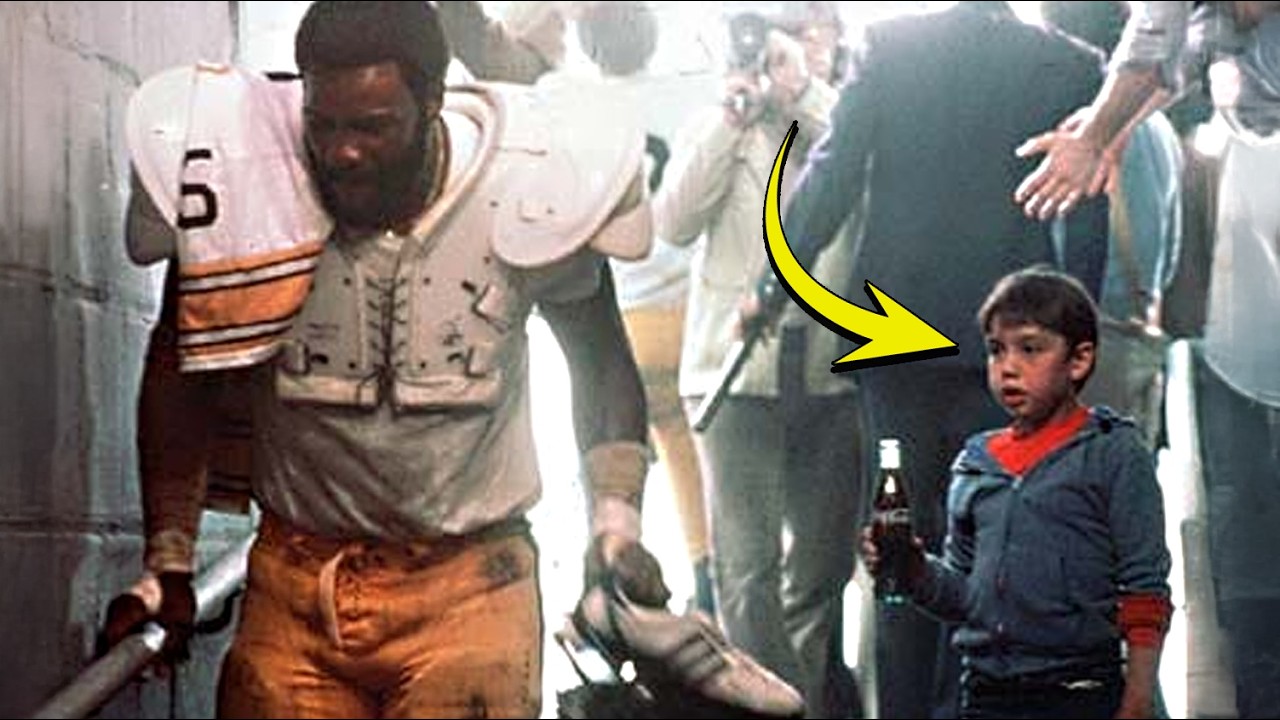
” It was a reputation earned on the field, where his physical intensity sometimes terrified even his own teammates. Over the next decade, he anchored the legendary “Steel Curtain” defense, one of the most dominant units in football history, helping lead a formerly struggling franchise to four Super Bowl titles in six seasons. He was named the NFL’s Defensive Player of the Year twice. By his own later admission, that fear followed him everywhere, even off the field.
Adults felt intimidated by him, and small children were afraid to be anywhere near him. By 1979, Coca-Cola was losing ground to Pepsi, whose younger, bolder advertising was chipping away at the company’s dominance of the soft drink market. The team at the McCann Erickson advertising agency came up with a simple but striking idea: take the most intimidating figure in professional sports and show America what happens when ordinary kindness breaks through all that toughness. They considered other stars, including Terry Bradshaw, Tony Dorsett, and Roger Staubach, before settling on the one name that fit the concept perfectly: the most terrifying man in football, Mean Joe Greene.
Actor Tommy Okon, then nine years old, was cast as the boy in the commercial. What audiences never knew was that the shoot did not take half a day as Coca-Cola had initially told Greene. Instead, the production company built a full fake stadium tunnel inside an old high school football stadium in the New York suburbs because the original location did not match what the concept required. What was supposed to be a quick, simple advertisement stretched into three full days of filming.
At the center of every take was a professional athlete genuinely suffering from a real knee injury from the football season, forced to gulp down an entire bottle of Coca-Cola again and again until the director got the shot he wanted. Greene later estimated he drank nearly twenty full 16-ounce bottles of Coke over those three days, on demand, take after take. He joked decades later that the hardest part was not the acting but what came after every take: the burping and the constant need to find a bathroom. The commercial finally aired on October 1, 1979, during Major League Baseball playoff coverage, not the Super Bowl.
It started slowly at first, but a few months later, something remarkable and entirely unexpected happened. Greene’s real team, the Pittsburgh Steelers, reached Super Bowl XIV. When the commercial aired again during that game, the timing was perfect. Millions of Americans watched the real Mean Joe Greene in his team uniform on the same day they saw his commercial character tossing his jersey to a boy.
Pittsburgh won that game too, capturing its fourth title in six years. The “Steel Curtain” dynasty and the catchphrase “Hey kid, catch this” became permanently linked in the nation’s memory. The reaction was astonishing, with Coca-Cola receiving tens of thousands of letters from viewers moved by the 60 seconds in a way that surprised even the people who made it. The company repeated the concept in other countries with other athletes, but none matched the accidental magic of the Steelers defensive lineman and a nine-year-old boy in a rebuilt high school tunnel.
Greene said the response changed his life overnight. Children who once ran from him in the street began running toward him. Adults who had crossed to the other side of the sidewalk started offering him Cokes to reenact the moment. Almost unintentionally, he became one of the most beloved figures on American television.
But there is a quieter detail that almost nobody knew. The jersey used in the commercial was a prop owned by the production company. When the cameras stopped and the crew packed up, no one let the nine-year-old keep it. Years later, Okon said he never knew exactly what happened to that jersey, whether Greene took it back or the studio reclaimed it as its own property.
It did not matter to the story. What mattered was what happened next, months later, at Christmas. A package arrived at the Okon family home. Inside was a real Pittsburgh Steelers game jersey with Joe Greene’s number 75, signed and accompanied by a short handwritten note addressed personally to Tommy.
No one from Coca-Cola had asked Greene to send it. There was no second commercial being filmed, no press release, no photographer waiting to capture the moment for another advertising campaign. Just a football player quietly correcting a small wrong that had bothered him, on his own time and with his own money, expecting nothing in return. Tommy Okon still keeps that jersey to this day.
The gesture marked the beginning of a friendship that lasted for the rest of their lives. Greene and Okon stayed in touch for decades through phone calls, texts, and occasional in-person meetings at events celebrating the commercial that had brought them together. In 2009, they were honored together at Heinz Field in Pittsburgh, with Okon’s family watching from the stands as their names flashed on the giant scoreboard. In 2017, nearly forty years after they first stood together in that rebuilt high school tunnel, the two met again at a stadium in Texas to reenact the commercial for a television special honoring the greatest Super Bowl ads ever made.
Okon, who went on to become a husband, a father of four, and a business owner in New York, later said Greene had become one of his oldest friends, someone who remained present in his life year after year, just as that Christmas gift had suggested from the start. Greene’s wife, Agnes, offered a simple observation years later: the commercial changed her husband. Not his talent and not his ferocity on the football field, which needed no fixing. Rather, the rest of his personality changed.
Seeing how many children suddenly looked at him with admiration made him want to be worthy of that admiration. He embraced the role, appearing on children’s programs and working to be exactly the kind of man that nine-year-old in the commercial had believed he was from the beginning, even before he had earned that belief. In 2014, the Steelers retired Joe Greene’s number 75 in a halftime ceremony at Heinz Field, a fitting close to a career marked by ferocity on the field and, unexpectedly, grace off it. But for those who remember the Christmas package arriving at a nine-year-old’s doorstep, the real ending of this story is not in a jersey hanging from the stadium rafters.
It is in a signed jersey kept in a drawer in New York, still held by that man to this day, proof that the toughest man in football kept a promise no one ever asked him to make. The commercial gave America a story about kindness breaking through toughness. But it never showed the quieter, unscripted version of that story that happened after the cameras left, which was, in its own way, far more real than anything broadcast on television.