Harriet Tubman stood barely five feet tall. Yet her life’s work made her a giant of American history. Born into slavery in Dorchester County, Maryland, she escaped to freedom in 1849 and then made it her mission to lead others out of bondage. Over roughly a decade, she guided hundreds of enslaved people northward along the Underground Railroad, earning the legendary nickname “Moses.
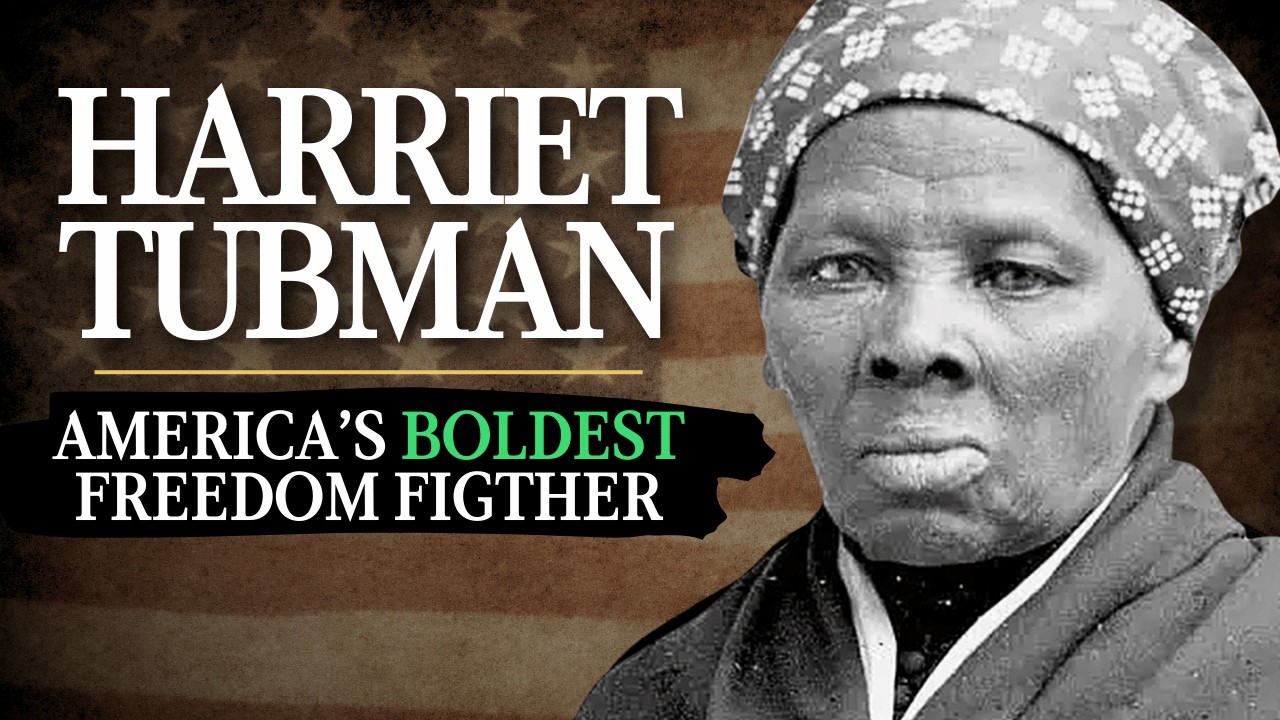
”
Her early life was marked by hardship. Born Araminta Ross, she was hired out as a child to care for a baby, where she slept on the floor and was frequently whipped. By age twelve, she was working in the fields. In her teens, a cruel accident changed her forever.
When an enslaved man tried to escape a supervisor, the man threw a heavy metal weight at the fleeing worker. It struck Tubman in the head, fracturing her skull and leaving her with a deep wound that would cause sudden, uncontrollable sleeping spells for the rest of her life. In 1844, she married John Tubman, a free Black man. But Maryland law did not recognize their union as legally binding, and because lineage to an enslaved mother determined status, she remained in bondage.
When her enslaver died in 1849, she feared her family would be sold to settle his debts. That fear drove her to flee. In September 1849, she escaped, traveling through Delaware into Pennsylvania, where she found work and safety in Philadelphia. After reaching freedom, Tubman did not stop there.
She made a conscious decision to return south and help others escape, beginning with her own family. Her first mission brought her sister-in-law and two children to safety in Baltimore. In December 1851, she made her first trip under the organized care of the Underground Railroad, guiding a group of eleven escapees, including her brother William Henry Ross and his fiancée Catherine, all the way to Canada. She called Canada “Canaan” and the Niagara River “Jordan.
”
Over the following years, she established a pattern: at least one trip south each year, often two, bringing groups of no fewer than ten people to freedom. Her routes always ran through Wilmington and Philadelphia, where trusted contacts sheltered her groups. She worked on foot, traveled at night, and preferred late fall or winter, when the longer darkness and quieter countryside made escape safer. To enforce discipline among frightened travelers, she carried a pistol.
When one exhausted man threatened to turn back, she reportedly pointed the gun at his head and said, “Move or die. ”
Throughout her missions, she used every tactic available to evade capture. On one occasion, when she spotted a former enslaver in a train station, she picked up a newspaper and pretended to read it. Because everyone believed she was illiterate, no one suspected her.
One time, near her home in Maryland, she wore a large sunbonnet and carried two live chickens by tied legs. When a former master approached, she yanked the cord, and the flapping, squawking birds created a noisy distraction that kept attention away from her face. Her reputation grew with every successful mission, and so did the bounty on her head, eventually reaching between $12,000 and $14,000, an enormous sum in that era. She never kept records and always took back roads.
She did not hesitate to change plans, either. Once, she ordered her group to stop and take a different route for no apparent reason. They later learned that lawmen were lying in wait on their original path. In 1857, she returned to Maryland to bring her aging parents to St.
Catharines, Ontario, where many of her siblings already lived. Her father had been freed in 1840; her mother had been purchased for $20 in 1855. The family settled in Canada under the shadow of what she called the British lion, but winter there proved too harsh. In 1858, after a supporter, Senator William Seward of New York, offered to sell her a home in Auburn, New York, she moved her parents there.
In April 1858, Tubman met the fiery abolitionist John Brown in Boston. She believed a recurring dream had foretold their meeting, and she shared his frustration with moderates who would not take direct action against slavery. Brown paid her $25 in gold to recruit men for his planned raid and called her “General Tubman. ” She promoted his cause widely, but illness kept her bedridden in New Bedford on the day of his disastrous raid on Harpers Ferry in October 1859.
Still, his execution in December strengthened her conviction that the time to fight slavery had urgently arrived. In April 1860, Tubman risked her life in Troy, New York, after federal officials arrested Charles Nalle, an escaped enslaved man from Virginia. As marshals led him from a commissioner’s office, the petite woman in a shawl grabbed him and pulled him free, despite being beaten with police batons. A crowd helped Nalle reach a waiting boat on the Hudson River.
After authorities recaptured him, Tubman again signaled the rescuers, who stormed the building and freed him a second time. Newspapers credited the crowd of rescuers, but many acknowledged that the bulk of the credit belonged to the small woman under the shawl. By late 1860, Tubman had completed her final Underground Railroad mission, rescuing a couple and their two children from Dorchester County and delivering them to Canada. With war looming, she turned her energy to the Union cause.
She served informally with Union forces at Fort Monroe in Virginia, where escaped enslaved people gathered by the hundreds. Then, at the request of Massachusetts Governor John Andrew, she accompanied Union troops to the Sea Islands of South Carolina. There she labored as a nurse and cook, relying on her knowledge of medicinal roots. She also supervised the construction of a laundry house for escaped people.
But her role expanded. In 1863, she was authorized to organize scouts to map the interior of Confederate territory, reporting her intelligence to Union commanders. Her information helped the Union take Jacksonville, Florida, and proved vital in the raid on the Combahee River in June 1863. During that operation, she guided Union gunboats past Confederate torpedoes and to specific points along the shore where more than 750 enslaved people were waiting to be rescued.
Despite her crucial contributions, official military records omitted her name, setting the stage for decades of struggle over recognition and pay. After the war, Tubman faced bitter realities. Traveling home by train through New Jersey, four men forcibly removed her from her seat and threw her into a baggage car when she refused to give up her place. In Auburn, she opened her home to aging former slaves, the poor, and the neglected.
She also embraced the cause of women’s suffrage, speaking alongside leading suffragists and being introduced by Susan B. Anthony at a state convention in 1904 as a living legend. There she delivered one of her most famous lines: “I was conductor of the Underground Railroad for eight years, and I can say what most conductors can’t say — I never ran my train off the track, and I never lost a passenger. ”
In 1869, she married Nelson Charles Davis, a young Black Union veteran who had once been enslaved in North Carolina.
They lived together in Auburn for nearly twenty years until his death in 1888. Their finances were strained, and Tubman was once tricked by two con men who chloroformed her and stole her savings in a bogus gold scheme. She recovered, but the loss was heavy. She also faced persistent difficulty obtaining a federal pension for her wartime service.
Though she served as nurse, spy, and scout and never received a regular salary, Congress finally granted her a widow’s pension of $8 a month in 1892, after her husband’s death. In 1899, after decades of lobbying, that amount was raised to $20 a month. Tubman remained active into old age. She bought land in Auburn at auction for $1,450 to establish a charitable home for needy and neglected African Americans.
In 1908, a building named the Harriet Tubman Home was dedicated on donated property. She died of pneumonia on March 10, 1913, surrounded by family, and was buried with full military honors at Fort Hill Cemetery in Auburn. Her legacy continued to grow. In 1914, a bronze plaque honoring her was unveiled in Auburn, with Booker T.
Washington delivering the keynote address. Today, her image appears on postage stamps, and dozens of schools and public buildings carry her name. In 2019, the film “Harriet” brought her story to a new generation. In 2016, the Obama administration announced plans to place her portrait on the $20 bill, though the change has yet to be finalized.
In 2023, the U. S. Mint began shipping coins bearing her likeness: a $5 gold piece, a $1 silver coin, and a half dollar. Harriet Tubman saw herself as an instrument of God, and her words still inspire action: “If you are tired, keep going.
If you are afraid, keep going. If you are hungry, keep going. If you want to taste freedom, keep going.
”