In the autumn of 1934, the Great Depression had tightened its grip on rural Vermont. For the residents of Harwick Valley, a small settlement tucked between the Green Mountains, hardship was nothing new. The land was rugged, the winters were brutal, and self-sufficiency was a way of life.
It was into this world that Millicent Abernathy arrived. A 52-year-old widow from Burlington, she had recently lost her husband, Victor, to a sudden heart attack. After 29 years of a practical, childless marriage, she found herself alone with a modest inheritance and a house she could no longer afford.
When she learned that a small cabin in Harwick Valley was for sale at a price she could manage, it seemed like divine providence. The property was being sold through the county after being abandoned by its previous owner. The county clerk, a thin man named Frederick Aprintis, processed the sale with routine efficiency.
“Good deal, very good deal,” he said, avoiding her eyes. He claimed the previous occupant, a woman named Sophia Simmons, had left without a forwarding address. He discouraged Millicent from viewing the property first, insisting the roads were bad and the price was too good to wait.
Millicent spent most of her inheritance on the deed. She consoled herself with thoughts of a simpler life, a garden, maybe some chickens, and a fresh start away from the pitying looks and painful memories of Burlington.
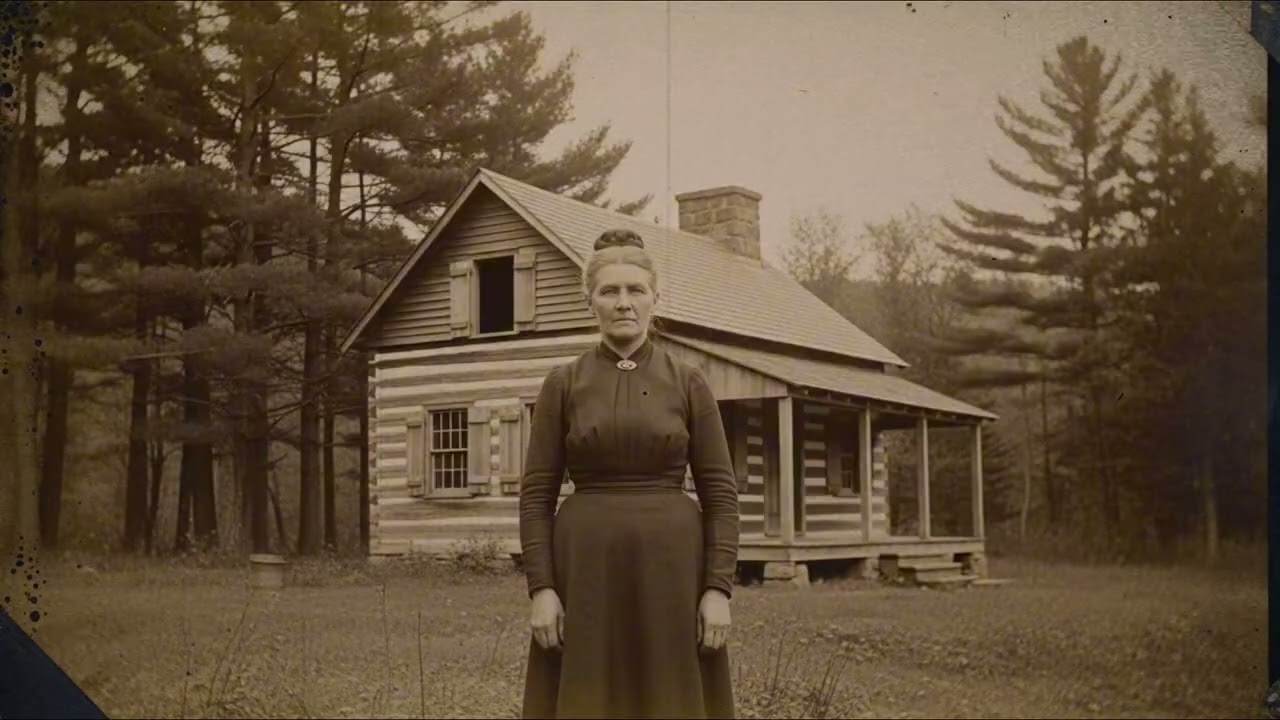
On a crisp October morning, she arrived at her new property in a borrowed truck driven by her late husband’s cousin, Augustus Abernathy. The last mile was a rough dirt road that seemed determined to shake the old vehicle apart. The cabin stood in a small clearing, surrounded by tall pines and old maples glowing with autumn colors. It was smaller than she expected, a simple log structure with a stone chimney and shuttered windows.
But something was wrong. A thin wisp of smoke rose from the chimney.
“There’s someone inside,” Augustus stated flatly, keeping his hands on the wheel.
“Impossible,” Millicent replied, though uncertainty crept into her voice. “The place is mine now. The papers are signed.”
The shutters were freshly oiled. The small garden had been recently tended. A neat stack of split firewood was lined up against the side of the house. Millicent knocked on the door. No answer. She tried the handle, found it unlocked, and pushed the door open.
Inside, a fire crackled in the stone hearth. A rough wooden table sat in the center of the room with a single chair. A narrow bed was neatly made with a patchwork quilt. Dried herbs hung from the rafters. Jars of preserved food and unknown substances lined the shelves. The cabin was clearly inhabited, but eerily empty.
On the table lay an open journal, a pen resting across the page as if the writer had just stepped away. Millicent read the flowing handwriting: “The birds were silent today, not a good sign. The forest holds its breath when strangers approach. The barriers must be reinforced before…” The entry ended mid-sentence.
Augustus refused to enter further. “This isn’t abandoned, Millicent. Someone lives here. That man from the county sold you a property that’s occupied.”
As they turned to leave, they heard a faint sound. Rhythmic knocking coming from somewhere beneath the floorboards. Millicent whispered that it was just the wind, but the air was perfectly still. Augustus was already halfway back to the truck.
They drove to the small settlement of Harwick Valley and found Sheriff Ezekiel Harper in his office. He listened to their story with an expression that shifted from polite interest to something harder to read.
“The cabin up Stillwater Creek?” he asked. “Sophia Simmons’ place. It was never abandoned.”
Sheriff Harper explained that Frederick Aprintis had no right to sell the property. The land belonged to the Simmons family, and Sophia was still alive and living there. The sheriff noted that Aprintis had a long-standing grudge against Sophia, blaming her for the death of his brother, Vernon, back in 1904.
“Vernon tried to court her,” Harper said. “He ended up dead at the bottom of a ravine a month later. Frederick never forgave her.”
The sheriff advised Millicent to find lodging elsewhere while he sorted things out. She had spent nearly everything she owned on the cabin. She had nowhere else to go. He arranged a room for her at the Widow Packard’s boarding house.
Before they left, Harper offered a warning: “If you come across Sophia Simmons, be respectful. And whatever you do, don’t mention the deed to her home or try to claim it. Mountain folk hold their land fiercely.”
At dinner that evening, Millicent met the other boarders. A traveling salesman named Finch, a retired professor named E.M.T. Blackwood, and a quiet young woman named Ruth Bennett. When Mrs. Packard mentioned that Millicent had bought the Simmons cabin, the reaction was immediate.
“The witch’s cabin?” Finch asked. “Why in the world would you want that place?”
Professor Blackwood dismissed the superstitions, calling Sophia a knowledgeable herbalist. But Ruth Bennett spoke softly about how the birds went silent when Sophia walked through the woods, and how animals watched her as if waiting for orders.
Later that night, Professor Blackwood knocked on Millicent’s door. He handed her a leather-bound book he had written on the folk practices of the Green Mountains. He had marked relevant passages about Harwick Valley.
“Sophia Simmons is many things, Mrs. Abernathy,” he said, “but she is not the monster town gossip makes her out to be. She is a woman who values her seclusion and her independence, and she is deeply tied to that cabin and the land it stands on.”
Sleep was elusive. Millicent dreamed of a cabin with windows like watching eyes, a circular pattern carved into wooden floors, and a fire that burned without consuming its fuel.
In the morning, Sheriff Harper had news. Frederick Aprintis admitted to selling the property but insisted he had the legal right. Sophia Simmons had not paid property taxes in three years, so the land had reverted to the county. The sale was technically legal.
But Sophia was missing. No one had seen her in at least a week. She had no family left, and few in the valley would offer her shelter. The sheriff noted that Sophia would never leave a fire unattended. Something was wrong.
“I’m hinting that something is not right,” Harper said. “Sophia is missing. Her cabin shows signs of recent habitation, but no signs of packing or planned departure. And suddenly you appear with a deed to property that wasn’t supposed to be available.”
He advised Millicent to leave the circular mark she had seen carved into the floor alone. “Some protections are best left undisturbed, whether or not you believe in them.”
A man named Jedediah Stone drove Millicent back to the cabin with her belongings. He was a man of few words, but he offered practical advice about the coming winter. He also warned her: “If you hear anything unusual at night, don’t investigate. Stay inside, keep the fire burning, and wait for morning.”
That afternoon, Millicent explored her new home. She found dozens of glass jars on the shelves, each labeled in the same flowing handwriting she had seen in the journal. Some contained preserved foods. Others held dried herbs, powders, and liquids of various colors. Some contained things she couldn’t identify: twisted roots, small bones, feathers, stones, and what appeared to be dried insects.
She found a second journal hidden between logs in the woodpile. This one was older, its leather cover cracked and faded. The earliest entries dated back to 1902. Most were ordinary records of weather, harvests, and local events. But interspersed were passages of a different nature: descriptions of rituals performed at certain phases of the moon, records of dreams filled with symbolic imagery, and references to “the watchers” and “those who wait behind the circle.”
One entry from October 12, 1903, caught her attention: “Vernon Brentis came again today. His persistence is wearisome. I have made clear that my path is necessarily solitary, not by choice. What we keep at bay here cannot be left unguarded, not even for the comfort of companionship.”
Another entry from January 2, 1904: “Vernon is missing. The town blames me, though no one dares say it to my face. Frederick’s eyes carry both accusation and fear. If they only knew what truly dwells in the depths of the forest, they would thank me for the protection I provide instead of whispering about curses and revenge.”
The implications were disturbing. Sophia had warned Vernon of a danger in the woods. He ignored the warning and died. But what was the veil? What were the “other hands” that could reach through when it thinned? And what was the work that Sophia performed that must never stop?
The circular patterns carved into the floor and bed frame took on new significance. They were not mere decoration but symbols with purpose and intent.
As evening approached, Millicent lit the fire and prepared for another night. She moved the bed so that the circle carved into its frame aligned with the larger circle under the table. Whether from genuine belief or a desperate desire for any possible protection, she found the arrangement comforting.
The knocking began before she even extinguished the lamp. “Knock, knock, knock. Pause. Knock, knock, knock.” It was coming from beneath the floorboards, specifically from the point where the two circles now intersected. The rhythm accelerated, becoming more urgent. The floorboards began to vibrate.
At the window, Millicent saw the trees themselves moving, not swaying in the wind but rippling in a rhythm that matched the knocking. Then a high-pitched howl rose from the forest, carrying a note of hunger and desolation.
The whispering began again, but this time it was multiplied, as if dozens of voices were speaking at the edge of hearing. The words were unintelligible, but the tone conveyed urgency and anticipation.
Then, to her horror, a response came from directly beneath the floorboards: “Let us in. The circle weakens. Let us in.”
A crack appeared in one of the floorboards directly above the center of the circle. In desperation, Millicent grabbed the journal and flipped through the pages, searching for anything that explained what was happening. Near the end, she found an entry that made her blood run cold:
“The barrier weakens in my absence. Three days is the longest I dare to be away. After that, the symbols must be renewed with blood freely given, or what lies below will find a way through. This is the burden of the Simmons women, maintaining the seal our ancestors crafted to keep the door closed, the door that should never have been opened.”

Blood freely given. Millicent looked at the crack in the floor, which was visibly widening. Without conscious thought, she reached for the kitchen knife on the table. But then she noticed something else: a small glass vial hanging from one of the rafters, half hidden among the dried herbs. It contained a dark liquid that might have been blood.
With trembling hands, Millicent retrieved the vial. The glass was warm to the touch. She pulled out the stopper, releasing a coppery scent that confirmed her suspicion. The crack in the floor had widened enough for her to see darkness below, not the expected dirt or stone foundation, but a void of absolute blackness from which an intense cold emanated.
Acting on instinct rather than rational thought, Millicent poured the contents of the vial into the widening crack. The liquid seemed to hang in the air for a moment before being suddenly sucked downward, as if swallowed by the void. A sound like a gasp came from beneath the floorboards, followed by a hiss that might have been anger or pain.
The pressure on the floorboards ceased. The vibration stopped. The crack stopped spreading. From somewhere deep below the cabin came a sound like a massive door being slammed shut, a deep resonant boom that Millicent felt in her bones rather than heard with her ears. The fire returned to normal. The whispering stopped.
Millicent collapsed onto the edge of the bed, her legs unable to support her weight. She had faced something supernatural, or she was losing her mind. The evidence before her, the cracked floorboard, the empty vial, suggested the former.
She dreamed of circles within circles, of symbols that moved and changed when not directly observed, of a door in the earth and what waited behind it, patient, hungry, ancient, and beyond measure. She dreamed of Sophia Simmons, her silver hair flowing like water, her hands weaving patterns in the air that left trails of light.
When she woke, the sun was streaming through the cabin windows. She had slept through the night and into the late morning. The fire had burned down to embers. The lamp had consumed its oil and gone out.
But the floorboard was intact. No crack, no splinters, no evidence that anything had happened at all. The empty vial sat on the table, its stopper beside it. And the bed was still aligned with the circle under the table, though Millicent was certain she had not moved it.
She needed answers. She needed to find Sophia Simmons. She walked to town and found Professor Blackwood at the small café attached to the general store. She told him everything: the knocking, the scratching, the figure in the moonlight, the voices, the cracked floorboard that had somehow repaired itself by morning, the vial of blood she had poured into the widening fissure.
Blackwood listened with grave attention. Then he told her the story.
In 1796, seven families settled the valley along Stillwater Creek. Among them was Abraham Simmons, a man with knowledge of certain esoteric practices he had brought from the old world. The winter of 1796-1797 was brutally harsh. Food was scarce. Tensions rose. People reported strange behaviors: speaking in languages they had never learned, sleepwalking toward the forest, dreaming of an entity that promised abundance in exchange for sacrifice.
By spring, three of the original families had vanished completely. Their cabins stood empty, their possessions left behind as if they had simply walked away. The following winter, two more families disappeared. The survivors reported hearing voices beneath the frozen ground, knocking that prevented sleep, shapes moving between the trees in the darkness.
By the third winter, only the Simmons family remained. Abraham Simmons concluded that the settlers had unknowingly built their community above something ancient, something that had been dormant until human presence awakened it. Something that fed on human life and consciousness, drawing people into the depths of the earth through their dreams and desires.
Unable to defeat the entity directly, Abraham created a seal, a barrier reinforced by symbolic patterns and consecrated with his own blood. He built his cabin directly over the main point of entry, where the barrier between this world and what lay below was thinnest. He bound his family to maintain that seal for as long as necessary.
The responsibility had passed through generations of Simmons women, each trained by her predecessor in the rituals and knowledge required to keep the barrier intact. The blood that renewed the seal had to come from the guardian, freely given. It was a burden that could only be passed through death or voluntary acceptance.
“If what you say is true,” Millicent said, “then Sophia’s disappearance puts everyone at risk. The seal must be maintained, or what lies below will break through.”
“Yes,” Blackwood agreed. “And that makes her absence all the more concerning. Sophia would never abandon her duty voluntarily, not for any length of time. Something must have prevented her from returning.”
“Or someone,” Millicent said slowly, a terrible suspicion forming in her mind. “I bought that cabin from Frederick Aprintis, the brother of the man mentioned in Sophia’s journal, the man who died in the woods after courting her. According to Sheriff Harper, Frederick has held a grudge against Sophia for decades, believing she was somehow responsible for his brother’s death. What if Frederick did more than just sell me a haunted cabin? What if he removed Sophia deliberately, knowing what would happen if the seal was left untended?”
Blackwood’s face darkened. “It’s a disturbing possibility, but not an implausible one. Frederick Aprintis has spent his life in these mountains. He must know the stories, even if he doesn’t believe their literal truth. And revenge is a powerful motivator.”
“We need to find Sophia,” Millicent stated firmly. “Or at least discover what happened to her.”
The vial Millicent had used was likely a reserve supply Sophia kept for emergencies. It would strengthen the barrier temporarily, but without regular renewal, it would fail. Blackwood estimated they had a few days at most.
They returned to the cabin as the sun was setting. Blackwood examined the circular patterns carved into the floor with scholarly intensity. He noted that they appeared older than European settlement in the valley, blending elements of indigenous symbolism with something else he had never encountered.

As darkness fell, they decided to investigate the small stone structure at the edge of the clearing. The one with the woven branch barrier and strange talismans. Blackwood believed it might be a secondary containment or a repository of knowledge too dangerous to keep in the cabin itself.
As they approached, the raven Millicent had seen before appeared again. It landed on the woven barrier, and its weight caused the branches to part, creating an opening large enough for a person to pass through. The raven stepped deliberately through the opening and disappeared into the darkness beyond.
Inside, the structure was unexpectedly spacious. The room was circular, with shelves lining the walls holding books, jars, boxes, and objects Millicent couldn’t identify. The floor was hard-packed earth with an intricate circular pattern carved into it, more complex than those in the cabin.
A raven perched on a small table in the center of the space, beside a shallow stone basin filled with water. The water was perfectly still, reflecting the lantern light like a mirror. The raven dipped its beak into the water three times, then flew to a perch near the ceiling.
Images began to form in the water. Millicent saw Sophia Simmons, younger than the figure she had glimpsed at the forest’s edge, working at a table in the cabin. She was measuring something from a jar into a small vial, the same vial Millicent had found hanging from the rafters.
The scene shifted. Sophia was outside the cabin, kneeling before the stone structure, pressing her hands against its walls as if listening for something inside. Her expression was worried, perhaps fearful.
The scene shifted again. Frederick Aprintis was watching the cabin from behind the trees, his face twisted with hatred. In his hands, he held a document, a deed.
Another scene: Sophia confronting Frederick in what appeared to be his office. They exchanged words, Sophia’s panic growing. Frederick smiled, a cold smile that never reached his eyes.
A final scene: Sophia preparing to leave the cabin, hastily packing a small bag. As she moved toward the door, a shadow fell across the threshold. A human silhouette, but elongated and with proportions that were somehow wrong. Sophia turned, her face showing shock, then grim determination. She reached for something on a shelf, and the image faded.
“She was lured away,” Millicent whispered. “Frederick arranged it somehow.”
“Not Frederick directly,” Blackwood corrected, his voice tense. “He couldn’t approach the cabin himself, not with the protections Sophia has in place. But he could create circumstances that forced her to leave. The deed, the threat of legal action. He needed to get her off the property, to make her vulnerable.”
A new image formed in the basin: a small stone building half-hidden under dense brush, built into the side of a hill. It looked like a root cellar or storage shed.
“I know that place,” Blackwood said suddenly. “It’s on the old Aprintis property, three miles west of town. A storage cellar from the original farm.”
The water rippled, and the image changed to show the interior of the cellar. There, lying on the dirt floor, was an elderly woman with silver hair spread around her like a fan. Sophia Simmons, unconscious or worse, her skin pale in the dim light filtering through a small opening near the ceiling.
“She’s alive,” Millicent gasped, relief flooding through her. “We have to help her.”
“Yes,” Blackwood agreed. “But we must be careful. If Frederick is behind this, he won’t have left her unguarded. And there is the matter of the seal. It must be maintained until Sophia can resume her duties.”
As if in response to his words, the water in the basin began to move on its own, swirling clockwise until it formed a small vortex in the center. From it emerged a thin silver needle, its point sharp and deadly.
“Blood freely given,” Millicent murmured, remembering the journal entry.
“Mrs. Abernathy, you can’t be thinking of this,” Blackwood protested.
“What choice do we have?” Millicent countered. “The vial I found is empty. The seal is weakening. Sophia cannot tend to it while imprisoned.”
“This is not your burden,” Blackwood insisted.
“I came here looking for a purpose,” Millicent corrected him. “All my life, others have defined me: daughter, wife, widow. Perhaps this is why I was led here, to this cabin at this time. Perhaps there are no coincidences.”