Jacqueline de Ribes, who died on December 30, 2025, in Switzerland at the age of 96, spent roughly 50 years as a muse, collaborator, and quiet co-creator to the greatest couturiers of her age.
She cut patterns on her attic floor, employed a young Valentino as her sketch artist before he had a label, co-designed evening dresses for Emilio Pucci, and anonymously wrote a fashion column for Marie Claire under a pseudonym because it was considered unseemly for an aristocrat to work.
At 53, after the death of her conservative father-in-law removed the final constraint, she launched her own fashion label. The debut collection was presented in the Paris home of Yves Saint Laurent himself.
She signed an exclusive contract with Saks Fifth Avenue, grossed $3 million annually, and dressed Joan Collins, Nancy Reagan, Cher, and Raquel Welch. In the same year she finally crossed from beloved muse to designer in her own right, Town & Country named her the most stylish woman in the world.
Jacqueline Bonnin de la Bonninière de Beaumont was born on July 14th, 1929, in Paris. Her father, Comte Jean de Beaumont, was a fighter pilot and a long-serving vice president of the International Olympic Committee. Her mother, Paule de Réveaud de la Raffinière, was a socialite and literary translator who rendered Hemingway and Tennessee Williams into French.
Her relationship with her mother was strained and cold. Paul regularly mocked her daughter's physical features, particularly her long, distinctive nose.
"My mother kissed me just once in my childhood," Jacqueline later reflected. "I had the feeling always of being insecure. So, I was always bumping my soul and my head."
The specific wound of maternal rejection produced in Jacqueline an insecurity so deep that it became the engine of the relentless self-creation that defined her life.
When the Nazis occupied France, Jacqueline and her siblings were sent to Hendaye, near the Spanish border. Their family residence was requisitioned by the Gestapo, and their Scottish nanny was seized and sent to a forced labor camp.
Jacqueline later recounted hearing the sounds of torture from the occupied mansion. In 1943, the family was moved to a chateau occupied by German officers until American soldiers liberated it in 1945.
A pivotal moment came when her uncle, the avant-garde art patron Count Etienne de Beaumont, took his teenage niece to meet Christian Dior, who had just opened his couture salon in 1947.
The wartime childhood gave Jacqueline an understanding of the fragility of civilized life. The woman who had heard the sounds of torture through the walls of her childhood home understood that beauty was not trivial, but essential.
In 1947, Jacqueline met Edouard de Ribes, a war hero and banker, at a luncheon in Saint-Jean-de-Luz. He later recalled, "I saw this gazelle and immediately fell in love."
They married on January 30th, 1948, when Jacqueline was 19. Her father-in-law, the conservative Comte Jean de Ribes, described the bride as a cross between a Russian princess and a girl of the Folies Bergère.
The family was installed in a wing of the Grand Hôtel de la Bienfaisance on the right bank. Into this monument of conservatism, Jacqueline brought what Sotheby's described as fresh air with her very special brand of refined yet modern elegance and glamour.
The specific constraint that the marriage imposed was the constraint that would define the next 35 years. De Ribes was not only not expected to work, but working on anything but philanthropic pursuits was actually frowned upon.
"Throughout my life I was told that I could not pursue a career," she told Architectural Digest. "Yet I always worked. I sought an outlet for my creative expression."
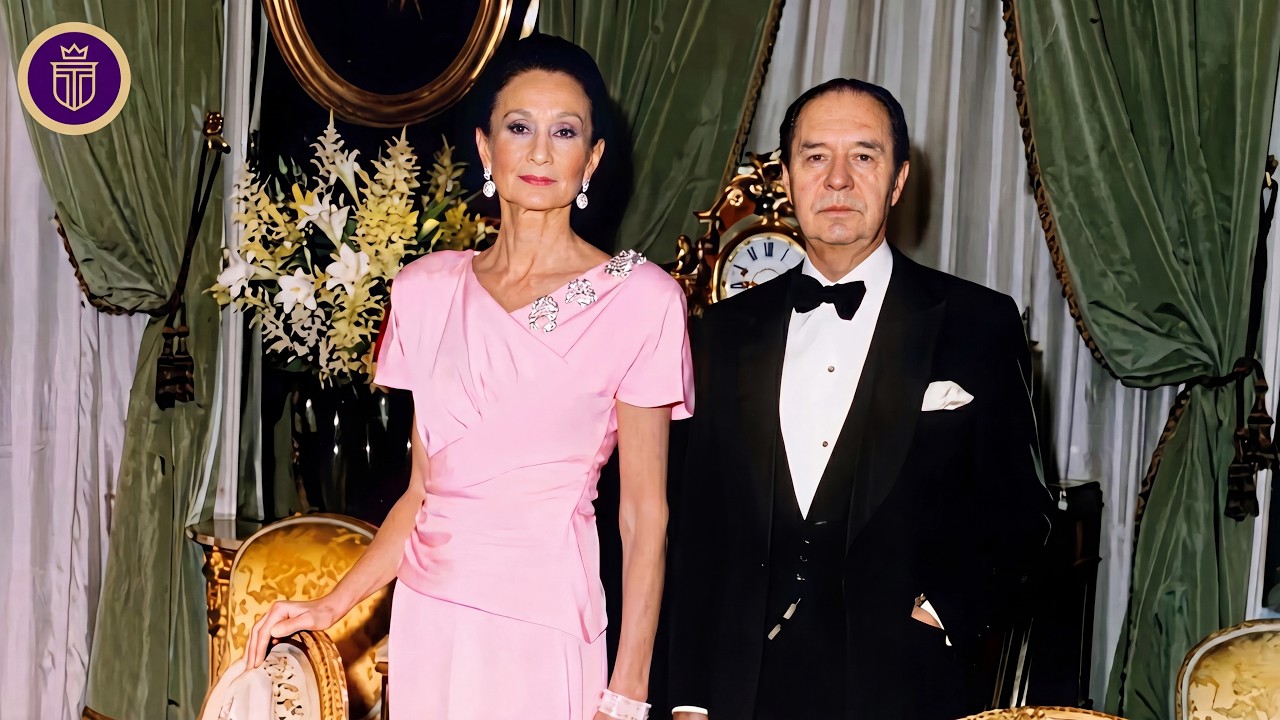
The outlets she found were the anonymous fashion column, the attic pattern cutting, and the disguised collaborations with couturiers.
The decisive turning point came in the early 1950s during a visit to New York for the April in Paris Ball at the Waldorf Astoria. Diana Vreeland, then fashion editor of Harper's Bazaar, spotted her across the room and immediately arranged a photo shoot with Richard Avedon.
Vreeland stripped away Jacqueline's attempts at conventional glamour, pulling off false eyelashes, combing out her carefully curled hair, and braiding it simply.
"Diana Vreeland helped me be authentic," de Ribes later said. "She taught me confidence, and the picture became famous."
The photograph was published in Life magazine and in Avedon's landmark anthology Observations in 1959 with commentary by Truman Capote, who compared de Ribes, Babe Paley, Marella Agnelli, and Gloria Vanderbilt to a gathering of swans.
Avedon himself praised her perfect nose, noting, "I feel sorry for near beauties with small noses."
By 1956, she was named to the International Best Dressed List, and in 1962, she was inducted into the Hall of Fame. Yves Saint Laurent called her an ivory unicorn. Valentino compared her to Nefertiti.
In 1955, de Ribes employed designer Oleg Cassini to produce custom gowns, but the designs were her own, cut on the attic floor of her Paris home. Because she could not draw, she hired a young Italian artist from the Jean Dessès studio to sketch the designs. His name was Valentino.
Three years later, Valentino opened his own couture house, and Jacqueline became one of his most celebrated clients.
Around the same time, Emilio Pucci spotted her skiing in Saint Anton, dressed entirely in pink. This led to a collaboration in which Jacqueline designed evening dresses for Pucci. Pucci called her Giraffina, baby giraffe, and predicted she could fill Christian Dior's shoes if she so chose.
She also began anonymously writing a fashion column for French Marie Claire under a pseudonym because it was unseemly for an aristocrat to write professionally.
Her relationships with the great couture houses were never those of a passive client. Designers placed their drapers, cutters, and fitters at her disposal out of genuine professional respect.
She routinely commissioned alterations so extensive that when Marc Bohan finally asked, "Is it mine?" her answer, officially, captured the entire dynamic of a woman whose creative intelligence was operating at the level of a creative director, but whose social position required her to pretend she was merely a customer.
When fashion alone could not contain her creative energy, de Ribes channeled it into other arts. In 1958, she produced the first play at the new Récamier theater.
After the Marquis de Cuevas died in 1961, she took over management of his celebrated International Ballet, producing a version of Prokofiev's Cinderella featuring the 17-year-old Geraldine Chaplin. She worked 15-hour days managing the company until she dissolved it three years later for lack of resources.
In the early 1970s, she co-produced television programs based on Luigi Barzini's The Italians and co-produced Eurovision variety shows benefiting UNICEF featuring Marlon Brando, Richard Burton, and Elizabeth Taylor.
Italian director Luchino Visconti considered casting her as the Duchesse de Guermantes in his planned Proust adaptation, a role she accepted before the project collapsed when Visconti fell ill.

One of the most illuminating aspects of de Ribes' approach to fashion was her radical refusal to wear any look straight off the runway.
"Very early on, before it was generally done, I like to mix my ensembles," she said.
She was an early pioneer of combining pieces from different designers, pairing a jacket from one house with trousers from another, mixing couture with market finds.
She went further. She would cut up and cannibalize her own haute couture gowns to create elaborate fancy dress ball costumes, treating a Balenciaga or a Saint Laurent not as a sacred relic, but as raw material for further creation.
Late in life she laughed at being compared to a disc jockey. "Whatever I pick up, I can turn into something else. It can come from the market of Saint Tropez or from my grandmother or be haute couture. Modern artists do things like that."
Her jewelry approach was identical. She acquired a 19th century Victorian diamond and pearl tiara and wore it at a lavish ball in 1973. Then she dismantled it, wearing one element as a brooch, and eventually re-imagining all three fleur-de-lis motifs as a composite brooch.
The death of her conservative father-in-law in 1982 appears to have been the decisive catalyst. With the final major family constraint removed, de Ribes announced to close friends, including Pierre Bergé and Yves Saint Laurent, her intention to launch a fashion label.
"Not my family or close friends," she said of the doubters. "Nobody in the fashion world doubted me. Not my fitters at the couture house. For years they had said, 'Wait and see. I will one day go off on my own.'"
Her first collection debuted in 1983, presented in the Paris home of Yves Saint Laurent. Saint Laurent attended the show alongside Valentino and Emanuel Ungaro, all applauding.
The collection was ready-to-wear, but infused with couture sensibility. Glamorous evening gowns, floor-length silhouettes, structured jackets trimmed in velvet, bold patterns balanced by restraint.
After the debut, she signed an exclusive three-year contract with Saks Fifth Avenue. By 1985 the label was grossing $3 million annually and carried in over 40 stores across the United States.
Her clientele read like a roster of 1980s glamour: Joan Collins, who wore de Ribes for her 1985 wedding, Nancy Reagan, Cher, Raquel Welch, Barbara Walters, Danielle Steel, Baroness von Thyssen, and Marie-Hélène de Rothschild.
Her style influenced the costume design of Dynasty, and Collins was reportedly encouraged to channel de Ribes for her role as Alexis Carrington.
Her signature was a distinctive, elongated column-like silhouette suited to her tall frame with dramatic details, a cascading back, an exquisite twist at the shoulder that transformed a restrained front view into a revelation from behind.
Silk georgette was a favored material chosen for its ability to convey ethereal lightness. She favored asymmetry, draping, and the controlled deployment of volume.
"Style is what makes you different," she said. "It is your own stamp, a message about yourself."
In 1986, the Japanese cosmetics conglomerate Kanebo acquired a minority stake in her company. The relationship quickly soured when Kanebo began requesting changes to proportions and designs for the Japanese market.

De Ribes resisted. The partnership deteriorated.
Then came the health crisis. She developed debilitating back pain and underwent a hemilaminectomy in 1994, surgery to remove part of a vertebra and relieve nerve compression, which left her unable to walk for three years.
She also received a diagnosis of celiac disease. Unable to manage a fashion house from a hospital bed, she dissolved the company in 1995.
The label had run for 12 years. Its closure was not a failure, but a forced ending imposed by illness on a career that had already produced a body of work significant enough to justify the museum exhibition that came 20 years later.
In 2015, the Costume Institute at the Metropolitan Museum of Art mounted "Jacqueline de Ribes: The Art of Style." The show drew nearly 195,000 visitors and featured approximately 60 ensembles of haute couture and ready-to-wear from her personal archive spanning 1962 to the present.
Harold Koda wrote, "A close study of de Ribes' life of creative expression yields illuminating insights into her strategies of style. Her approach to dress as a statement of individuality can be seen as a kind of performance art."
In 1999, Jean Paul Gaultier dedicated his spring-summer couture collection to her, naming it "Divine Jacqueline" as a tribute to the quintessence of Parisian elegance.
On July 14th, 2010, her 81st birthday, President Nicolas Sarkozy decorated her as Chevalier of the Legion d'honneur at the Élysée Palace. Valentino, present at the ceremony, offered his tribute: "Jacqueline is the last queen of Paris."
De Ribes was as serious about ecological and humanitarian causes as about fashion. As early as 1974 in the Balearic Islands, she advocated for the preservation of natural beauty.
She orchestrated an international campaign to save the Mediterranean island of Espalmador, a migratory bird refuge, successfully campaigning for its classification as a nature reserve.
She was deeply committed to UNICEF, co-producing fundraising television events reaching international audiences. In the 1980s she received the Women of Achievement Award alongside Bette Davis and Anne Getty.
Her husband Edouard predeceased her in 2013 at 90 after more than 60 years of marriage.
Jacqueline de Ribes died on December 30th, 2025, at 96.
The title that opened her obituaries, "The Most Stylish Woman in the World Who Spent 50 Years as Someone Else's Muse," contains a profound irony, because de Ribes was never simply a muse.
She was a designer, a producer, a writer, a strategist, and a creative director who lacked a formal title or institutional structure.
"Elegance is not a question of money," she once said. "It is a question of education."
The woman whose mother kissed her once in her childhood and mocked her nose spent 80 years proving, through the specific medium of personal style and then through the specific medium of professional design, that the nose was perfect. That the face was extraordinary. And that the creative intelligence behind both was as significant as anything the couturiers she had spent 50 years collaborating with had ever produced.
The Met confirmed it. Gaultier confirmed it. Valentino, who had been her sketch artist before he was Valentino, confirmed it.
The deeper story of Jacqueline de Ribes is the story of what creative intelligence does when it is denied institutional expression. It finds other channels. It operates in disguise. It produces work under other people's names.
And when the constraint is finally lifted, the intelligence emerges with an accumulated force that decades of suppression have only intensified.