In the late afternoon of July 12, 1864, a small wagon party stopped at Little Box Elder Creek in what is now central Wyoming. Nineteen-year-old Fanny Kelly was among them. Within minutes, the group was attacked by a large force of Lakota warriors. Four men were killed. Fanny, another woman, and two children were taken captive.
The attack did not end the horror. It began it. Fanny Kelly would spend the next five months in captivity, enduring a journey that no book or letter would ever fully describe.
The story began months earlier, on a spring morning in Geneva, Kansas. On May 17, 1864, Fanny, her husband Josiah, and a small group set out for the gold fields of Idaho. They traveled with high hopes. Fanny later wrote of their "pleasant anticipations of a romantic and delightful journey across the plains."
Riding with them was a little girl named Mary, Fanny's sister's daughter, adopted by the Kellys. Two hired hands, Frank and Andy, also traveled with the party. They were Black men seeking wage work far from the slave south.
By early July, the Kelly party had joined another family. Sarah Larammer, her husband Noah, and their eight-year-old son Frank traveled alongside them. The combined group had two wagons, seven adults, and two children.
The Oregon Trail in 1864 was no longer a wilderness route. It was rutted, dusty, and busy. Oxen made 15 to 20 miles on a good day. The Kelly-Larammer party moved slowly, loaded with everything two families would need to build a life two thousand miles away.
The overland guide sold in 1864 recommended traveling in parties of at least 50 armed men. The Kelly-Larammer group had at most six men capable of firing a weapon. They knew the risk. They went anyway.
The war party that found them was not one band. It was three moving together: Oglala, Miniconjou, and Hunkpapa Lakota. Fanny later estimated about 250 warriors, led by an Oglala war chief she called Otawa.
From the Lakota perspective, Otawa was not a villain. He was defending hunting grounds. General Alfred Sully's columns were already burning camps and killing families to the north. The wagons kept coming. The treaties kept breaking.
When the riders first appeared, the immigrants had a choice. They could circle the wagons and prepare for a fight they would likely lose. Or they could try to talk. Josiah Kelly chose to talk.
The warriors slowed and came in. For ten to twenty minutes, the two groups stood in a terrible pantomime of peace. Warriors examined the wagons. Immigrants offered tobacco. Fanny handed out food with shaking hands.
She remembered thinking, "If we are kind enough, if we are generous enough, this will end well." She was betting her family's life on courtesy.
The warriors were waiting for the men to relax. They waited for Josiah and Andy to wander off toward the trees for firewood. They waited for the rifles to be out of reach. When the last piece slid into place, the parley ended.
Nobody was looking. That is the phrase every surviving account uses.
The volley of rifles and arrows took perhaps two seconds to fire. Reverend Sharp fell. Noah Larammer fell. Frank the hired hand fell. A rider who arrived a moment later, a stranger whose name history did not keep, also fell. Four men dead in the grass.
Josiah Kelly saw it all. He and Andy were 70 or 80 yards away, watching through brush. Two men with rifles against 250. If Josiah moved, he died. If he shouted, he died and gave nothing to anyone. He stayed. He watched.
The warriors then turned to the wagons. Trunks were dragged out and broken open. Feather beds were ripped apart. Flour sacks were slashed. What they could not carry off, they destroyed.
Fanny later wrote in her own uneven spelling: "Flour sacks and feather beds ripped open and all emptied out on the ground… trunks and boxes thrown out of the wagons and broken open and robbed and what they could not carry off destroyed."
The looting took at least an hour. Four men still lay in the grass. Nobody covered them. They would lie there until the next morning, when a wagon train found them and dug four graves on the west side of the creek.
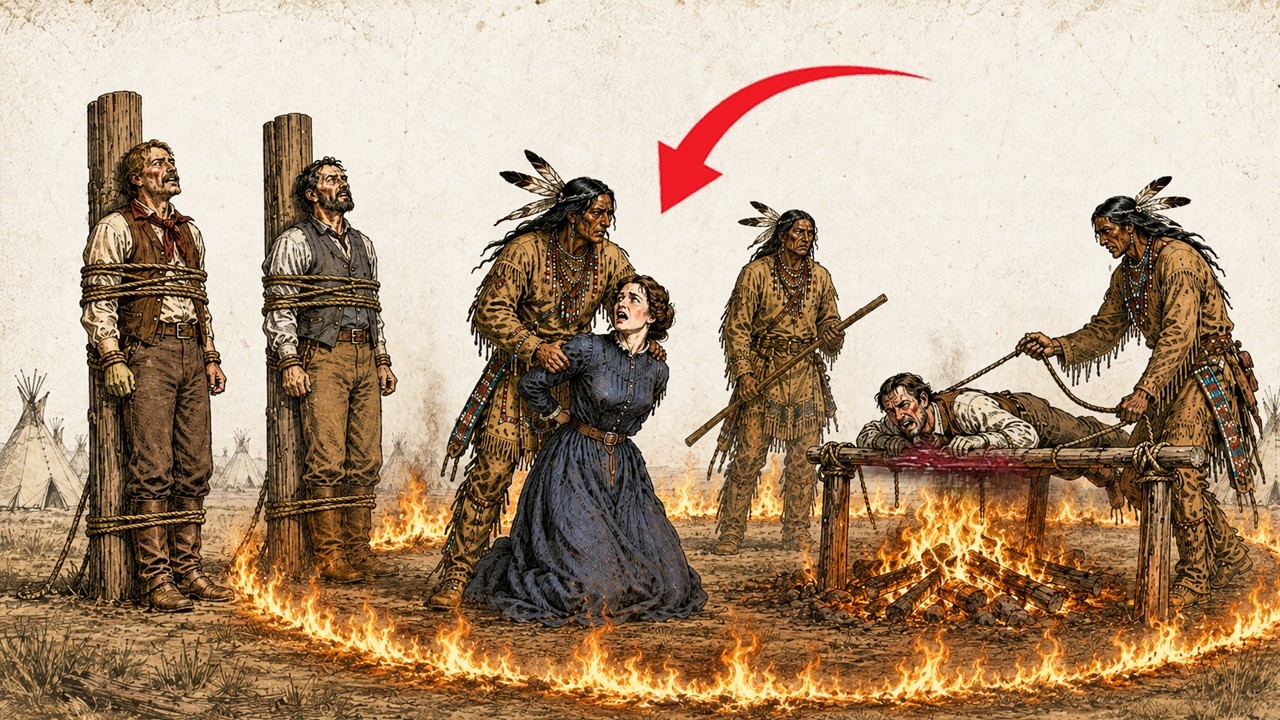
Then the warriors turned to the four still alive. Fanny, Sarah Larammer, little Mary, and Sarah's eight-year-old son Frank. Two women, two children.
Fanny was lifted onto a pony. Mary was picked up. Sarah was put on a pony. Frank was lifted onto another. The children were crying. The warriors were yelling. The men who loved them were lying dead ten yards away.
The direction of travel changed everything. The wagons had been going west. Idaho was west. Prosperity was west. The warriors turned the captives north, into Lakota country.

On that first evening, they rode maybe ten or fifteen miles. Fanny understood almost none of the conversations around her. But she understood that decisions were being made about her life, and none of the people making them cared what she thought.
For Sarah Larammer and her son Frank, the first nights were the whole story. After two nights, they simply disappeared. Fanny later described them as having escaped, aided "by a friendly Indian in the band." Someone who did not agree with what was happening.
That single fact complicates the popular version of the story. It suggests the war party was not a single mind. Among the 250 men, at least one thought this was wrong.
Fanny did not escape. Her captivity was about to become something worse. She was given, sold, transferred, or claimed by a chief in the band who was, in her own description, in his 70s. Later accounts would use the phrase "trophy bride."
A 19-year-old woman, married two months before her capture to a man she loved, now lived in the lodge of a man three times her age. She performed the domestic labor of a wife she had not chosen to become. She would not name most of what happened in that lodge. But she made sure, through the careful placement of the word "coercion," that anyone reading closely would understand.
While Fanny moved with the band, General Sully's columns were sweeping the northern plains. The band holding Fanny ran. They made forced marches through August heat and September cold. Fanny was on foot or on pony, learning every ridge and creek in a country she was not supposed to survive.
Sully's expedition later reported: "Whilst on the expedition, we ascertained that Mrs. Fanny Kelly was a prisoner of the Indians that we were then engaged against."
The army knew she was there. The army was still shooting. Fanny Kelly was being hunted by both sides.
And then came the day Fanny nearly did not survive. A brother-in-law of the chief who held her lost a horse. He decided, in a rage that was not quite about the horse, that the white woman would pay for it. He drew his bow and aimed at her heart.
Fanny later wrote: "His brother-in-law, enraged at his arrogance, drew his bow and aimed his arrow at my heart, determined to have satisfaction for the loss of his horse. When a young Blackfoot, whose name was Jumping Bear, saved me from the approaching doom by adroitly snatching the bow from the savage and hurling it to the earth."
Jumping Bear did not just save Fanny's life. He publicly humiliated another warrior over the life of a captive white woman. Nobody has ever fully explained why. Fanny herself did not know. But she remembered his name. She wrote it into her book.

Fanny's captivity lasted five months. She was taken on July 12. She was delivered back to United States authorities in December. One hundred fifty days.
Meanwhile, Sarah Larammer and her son Frank had made it back to the Deer Creek Trading Post after only two nights. Same attack. Same wagons. Same afternoon. Utterly different lives afterward.
And Mary, the little girl, Fanny's sister's daughter, never came home. Mary tried to escape. A warrior caught her and killed her. Fanny wrote about it obliquely, briefly, with a grief that pressed through the paragraphs on either side. She had promised her sister she would keep the child safe. She had failed.
What ended Fanny's captivity was not a rescue. There was no cavalry charge. There was no daring escape. It was diplomacy. Sihasapa Lakota emissaries saw in Fanny a hostage whose safe delivery could earn favor with the United States.
She was ransomed from the Hunkpapa band that then held her. In late 1864, she was handed over to General Alfred Sully at a fort along the Missouri, most likely Fort Pierre.
Somewhere in those final weeks, Fanny obtained information about a planned attack on a frontier post. Numbers. Timing. Enough to matter. When she reached United States lines, she gave it. The garrison was forewarned. The attack did not go as planned. Lives were saved.
Congress later voted Fanny Kelly $5,000 for her role in saving that fort. It was an unmistakable admission that a 19-year-old woman had done a piece of intelligence work that changed the outcome of a battle.
Josiah, the husband who had watched from the brush, was still alive. He had made it to Deer Creek. He had spent five months not knowing whether Fanny was dead or alive. When she came off the trail at the fort, he was waiting.
In 1871, seven years after the attack, Fanny published "Narrative of My Captivity Among the Sioux Indians." It became a bestseller. In its worst passages, it fed the mythology of the hostile savage. In its best passages, it named Jumping Bear. It described the friendly Lakota who helped Sarah escape.
Modern historians have noted that Fanny's narrative remains cloudy and confused. The band identities in her book do not quite align. The Lakota voices in the story survive almost entirely through her pen, filtered through a 19th century audience that wanted a particular kind of villain.
The men who killed her companions were not less real for being defenders of a country under invasion. The friendly Lakota who saved her were not exceptions to their people. They were their people.
Fanny Kelly died in 1904. She was 19 years old when she was taken, standing at a creek in Wyoming with tobacco in her hands, betting her family's life on the goodwill of strangers. She lived another 40 years.
She did not save her adopted daughter. She did save a fort. She wrote the name Jumping Bear into the record, so that no future reader could pretend the Lakota were a single mind.
Set against the high hopes of that Kansas morning, the arc of her life is not a captivity narrative. It is a testimony.