On April 9, 1937, a man in Bucharest received an official notice that contained no sentence, no accusation, and no explanation. It simply stated that from that date forward, he was no longer a prince of Romania, no longer a member of the royal family, and no longer entitled to use the name he had carried since birth at Peleș Castle in 1903. From that morning, Prince Nicholas of Romania became Nicholas Brana—a name with no lineage, no history, and no palace attached to it. At 33 years old, he had served as a regent of the country, governed in the name of a child king, and given up a career in the British Royal Navy to come home and serve his family.
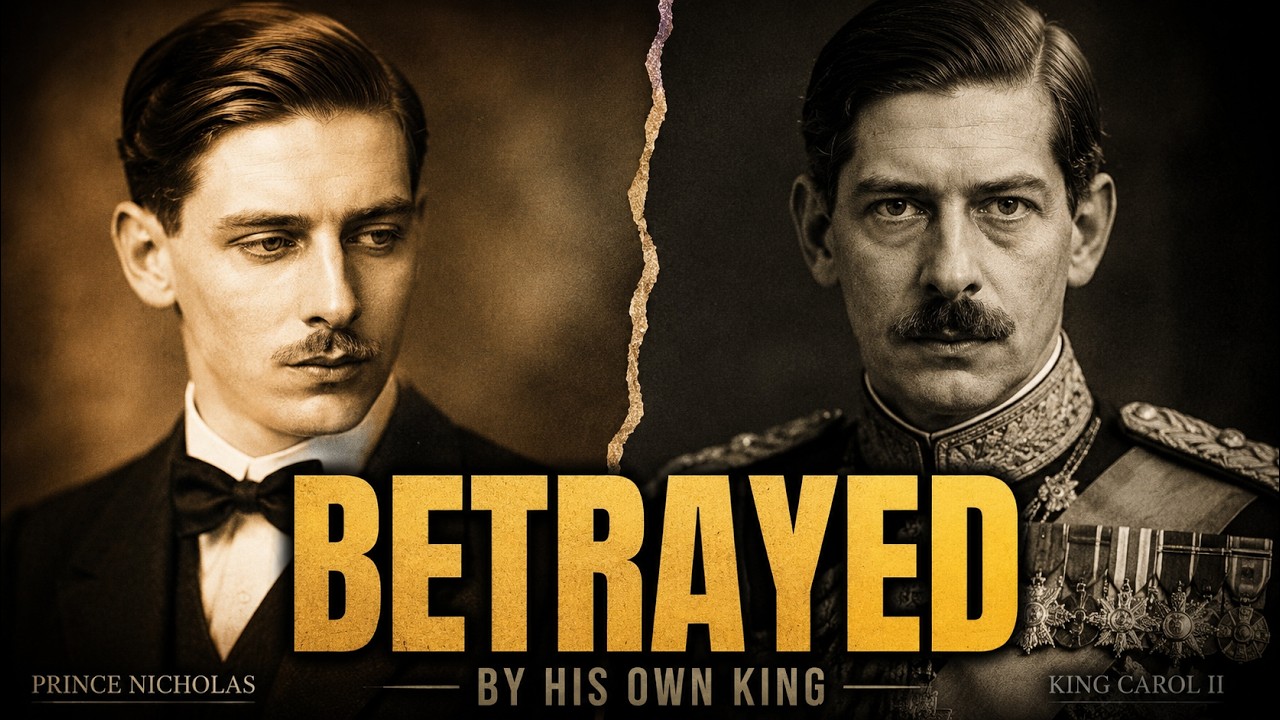
The reason on paper was his marriage to a woman named Ioana, a ceremony that had taken place six years earlier. But the paper did not mention that his older brother, King Carol II, had broken the same rule twice—and had kept not only his name but his throne. The answer to how only one brother lost everything begins in 1903, when Nicholas was born as the second son of King Ferdinand I of Romania and Queen Marie, herself a granddaughter of Queen Victoria. While his older brother Carol was brilliant, reckless, and publicly dramatic, Nicholas was described by those who knew him as warm, direct, and comfortable in his own skin.
What he wanted was the sea, not the throne. Nicholas pursued a commission in the British Royal Navy and built a life in England. When King Ferdinand died on July 20, 1927, Carol had already renounced his succession rights two years earlier and gone into exile with his mistress. With Carol’s five-year-old son Michael as the legal heir, a Regency Council was formed, and Nicholas was asked to serve.
He was 23 years old, in the middle of a naval career he had worked hard to build, but the request was an expectation, not a negotiation. Nicholas came home and served on the Regency Council alongside Patriarch Miron Cristea and court official Gheorghe Buzdugan. Unofficially considered the first-ranking regent, he attended sessions, signed documents, and represented the monarchy at public functions for three years. Then, in June 1930, Carol’s plane landed at Băneasa Airfield, and the crowds went wild.
Nicholas welcomed his brother, helped facilitate his return, and later described himself as genuinely relieved. The Regency was over, and he believed he had earned the right to live his life on his own terms. After Carol took the throne, Nicholas fell in love with Ioana Dumitrescu Doletti, a woman born in Bucharest in 1910, the daughter of a landowner from the village of Tohani. She had been briefly married to a politician before a divorce in 1925.
Nicholas knew that Romanian law required members of the royal family to obtain the king’s consent before marrying, and he knew Ioana’s status as a divorced commoner would make that consent difficult. He went to Carol, who told his brother he understood the position and suggested a way around it: marry quietly, don’t ask permission first, and he would accept the marriage afterward as a done fact. Nicholas trusted him. Carol had himself run away at 19 to marry a woman his family did not approve of, and had renounced his throne rather than give up the woman he loved.
On November 7, 1931, Nicholas and Ioana were married at Tohani in a real ceremony with a real marriage certificate. Nicholas was 28 years old and, for once, was doing something for himself. The retribution came within days. Carol did not quietly absorb the marriage.
He summoned Nicholas, demanded the union be kept secret, and ordered the registration struck from official records. When Nicholas refused, Carol consulted legal experts and began building a case. Queen Marie watched the situation unfold and wrote in her diary that she believed Nicholas had asked for permission, that Carol had essentially promised to allow it, and that Carol was now using the arrangement against him. She recorded what was happening but could not stop it.
On December 7, 1931, exactly one month after the wedding, a Bucharest County Court ruled that the marriage violated royal family regulations and the Romanian Constitution. Nicholas was ordered to renounce his wife. He refused. The next six years were not quiet.
Nicholas contested the court ruling, corresponded with legal authorities, and repeatedly refused to sign any document renouncing the marriage. He told anyone who would listen that he held a copy of the marriage certificate and that his union with Ioana was legally valid. Carol consulted lawyers, lobbied the Bucharest court, and applied institutional pressure. Nicholas did not move.
On April 9, 1937, the Crown Council voted to strip Nicholas of his royal rank and prerogatives. The official account states that the marriage had been declared void by a Romanian court, that Nicholas had violated the rules of the royal family, and that when he refused to comply, the council applied existing law. The decision was constitutional. The historical record shows a different pattern when it came to Carol II.
In 1918, Carol had secretly married a commoner named Zizi Lambrino at Odessa, despite a constitutional rule forbidding the Crown Prince from marrying a Romanian citizen. That marriage was annulled by the Supreme Court in 1919, but Carol kept his title, his place in the succession, and everything else. He then spent years in an open relationship with mistress Elena Lupescu, a liaison so public that Italian newspapers photographed them together in Milan in 1925, forcing his formal renunciation of the throne. Carol eventually married Lupescu in 1947, and she was given the title Princess Elena of Hohenzollern.
Two brothers, two relationships with women outside the expected rank, radically different outcomes. Historians have noted, and Carol’s biographer Paul Quinlan documented, that Carol himself had suggested Nicholas proceed without formal consent, that he had implied acceptance, and that Queen Marie’s own diary confirms he had almost promised Nicholas he would allow the marriage. The April 1937 decree went beyond removing Nicholas’s titles. It gave him a new name: Nicholas Brana.
Brana was not a royal name or a dynastic name. It was a name that said he had no history there, belonged to no house, and left no record. Nicholas left Romania, first for Spain, then settled in Lausanne, Switzerland. He had no royal income of his own, though Carol arranged a monthly allowance.
He carried his marriage certificate in private and never stopped calling Ioana his wife. In 1938, one year after the decree, Nicholas was permitted to return to Romania for exactly one occasion: his mother Queen Marie was dying. He stood at her funeral, as the only one of her children who had been formally removed from the family, then mourned and left. Carol II of Romania died in Estoril, Portugal, on April 4, 1953, an exiled king at the end of a life that had consumed everyone around it.
Most of the family stayed away from the funeral. Nicholas came. He was 50 years old, living in Switzerland, and had been permitted since 1942 to use the name Hohenzollern, at least a lineage if not a country. He stood at Carol’s graveside and later said: “I came because I felt it was my duty.
Although I hated Carol more than I ever hated anyone in my life, he was my brother and my king. ”
Ioana died on February 19, 1963, in Lausanne. They had been together for more than 30 years and had no children. Nicholas married again in 1967, quietly, to a Brazilian woman named Maria Theresa Lisboa Figueira de Melo.
He died on June 9, 1978, in Madrid at the age of 74 and was buried beside Ioana in a Christian cemetery in Prilly, Switzerland. He never returned to Romania. The communists had abolished the monarchy in 1947, and there was nothing left to return to. In March 2024, 46 years after his death, Princess Margareta, custodian of the Romanian crown, announced that the remains of Nicholas and Ioana would be brought home from Switzerland and reburied at the Royal Archbishopric Cathedral in Curtea de Argeș, beside the kings.
The decree of 1937 lasted 87 years, and then it did not.