In New Jersey during the 1920s, a man received a weekly payment for an unusual arrangement. Through lawyers, he was secretly paid $35 per week on the condition that he stop using his real name, adopt a pseudonym, and disappear behind it. The name he had been given at birth was among the most famous on Earth, printed on light bulbs, photographs, and film cameras, a name schoolchildren learned as a synonym for genius. The father who built that fame had decided his son was such an embarrassment that hiding him was worth the money.
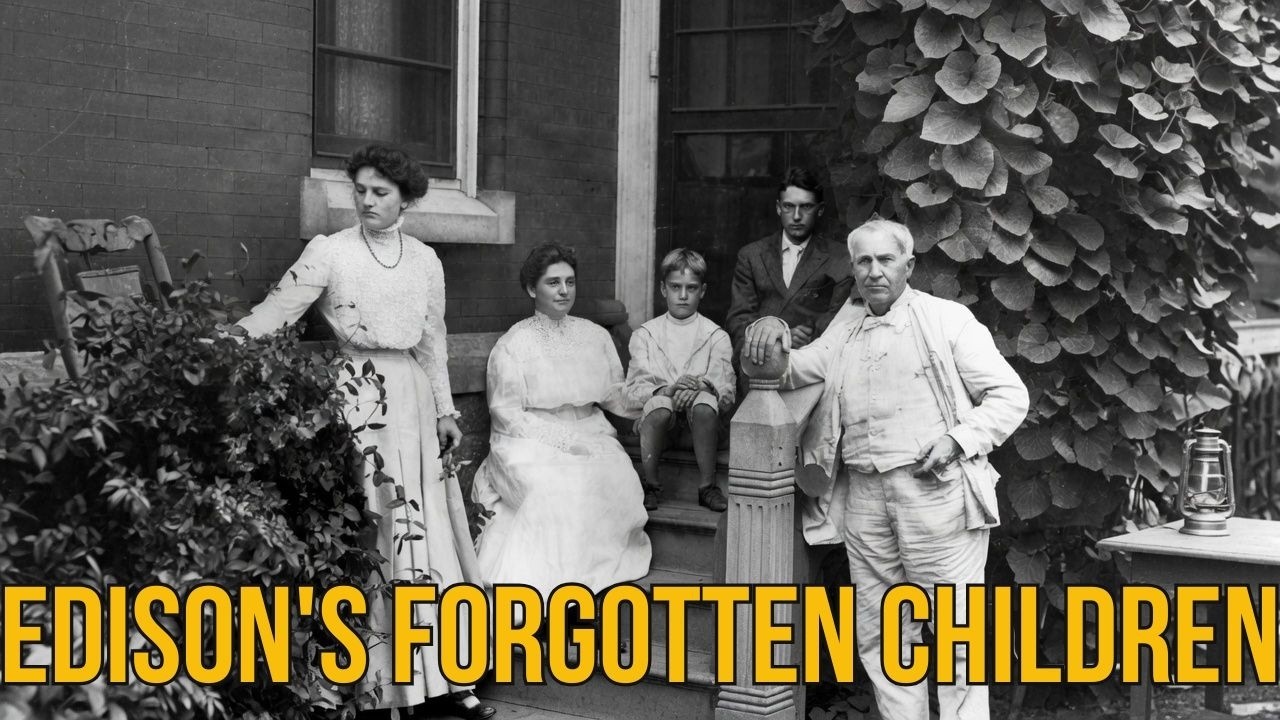
That son was Thomas Alva Edison Jr. , and his story is just one of six. The great inventor, the genius of Menlo Park, the man who lit the world, had six children, three from one wife and three from another. For the children of his first marriage, the shadow of their father’s name proved devastating.
For the children of his second marriage, the same name became a foundation for achievement. The same father, the same name, radically different fates. The story of the first family begins in the early 1870s. In 1871, Thomas Edison married Mary Stilwell, a teenage employee who was only 16 while he was 24.
Inventions soon flowed from him, and children quickly followed. Daughter Marion arrived in 1873, son Thomas Jr. in 1876, and son William in 1878. Three children in five years, born into a household revolving around a man becoming the most famous inventor in the world.
Edison showed affection in his own way, naming his first two children with nicknames drawn from Morse code. Daughter Marion was called Dot, and younger brother Thomas Jr. was called Dash. A telegraph operator turned inventor had stamped his identity on his children like a signature.
But even that affection was expressed through his work. The children were not simply Marion and Thomas. They were symbols from the machine that consumed his attention. That machine, the laboratory, the invention, the relentless drive, always came first.
Edison was rarely home. He worked 18 or 20 hours a day, slept in his laboratory, and treated food and rest as interruptions. By the testimony of those who knew him honestly, including his own family, he was an absent father, sometimes physically present but distracted, absorbed in the next problem. His children grew up with a legendary father and an empty chair at the dinner table.
Their mother Mary struggled under the weight of her life. Married as a teenager, she had three children before turning 25, wife to a man who was never really present. She was often ill and often alone, managing the household in the shadow of a husband whose fame grew while her world shrank. The first family was quietly unhappy long before disaster struck.
In 1884, Mary Edison died at just 29. The exact cause was not definitively established, described at the time in vague medical language. Marion was 11, Thomas Jr. was 8, and William was 6.
Three young children, motherless, with a father who did not know how to raise them and had no time to learn. In the difficult period immediately after Mary’s death, young Marion briefly grew close to her grieving father. For a short time, they were almost alone together. She later remembered that period as nearly the only time she truly felt his presence.
The child who finally captured her father’s attention did so under the worst circumstances. It did not last. In 1886, Edison remarried. His choice was Mina Miller, 20 years old, barely older than the daughter who had just begun to feel close to him.
Mina became stepmother to three grieving children who had recently lost their own mother. The second marriage quietly divided the children into two groups. On one side, the first family, Marion, Thomas Jr. , and William, the children of the deceased first wife, increasingly treated like a forgotten chapter.
On the other, a new marriage, a young capable wife, and soon new children. Two families under one great name. Mina Miller Edison was intelligent, composed, and organized. She took charge of the household in a way the fragile Mary never could.
She half-seriously called herself the household manager, and she and Edison began building their own family. Madeleine arrived in 1888, Charles in 1890, and baby Theodore in 1898, when Edison was 51. Three new children were born into stability at the elegant Glenmont estate, under a mother who ran things firmly, and a father who, while still absent, was now an established giant rather than a struggling striver. The first three children were increasingly marginalized.
Marion’s wound was the clearest. She had just begun to feel close to her father, then a young stepmother barely older than herself took over the household. Tension between Marion and Mina was immediate and lasting. Feeling displaced and replaced, Marion was effectively sent away as a teenager, dispatched to Europe, set apart from the new family forming at home.
While traveling in Europe, Marion contracted smallpox, a serious and disfiguring disease that could be fatal. She spent nearly seven weeks seriously ill in a foreign country. During that ordeal, she received only two letters from her famous father. Two letters.
The man whose name was synonymous with communication, the telegraph, the phonograph, the machines that let people reach across distances, did not trouble himself to communicate with his sick daughter. Smallpox left marks on her face. Neglect left deeper ones. The sons fared no better, and expectations were heavier.
They were expected to become something, to carry the Edison name, to be little Thomas Edisons. Thomas Jr. , nicknamed Dash, carried the heaviest name of all. In his youth, he lent his famous name to a series of business ventures, from a lamp to a project extracting electricity from ocean waves, to a plan to convert steel into iron.
They all failed. He simply did not have his father’s talent. Worse, he was surrounded by people eager to exploit his famous name. Thomas Jr.
effectively began selling his name. He allowed it to be used for products his father considered degrading, including a fake medical device called the Magno-Electric Vitalizer, the kind of fraudulent remedy the real Edison despised. The great inventor, champion of genuine science, saw his name printed on quack medicine. Edison was angry and ashamed, and his response was the cold business action of a man thinking like an engineer, even toward his son.
He agreed to pay Thomas Jr. a weekly allowance on the condition that he stop using the Edison name entirely. Take a pseudonym, be someone else. And so Dash, the little boy nicknamed in Morse code, the namesake, the heir, spent periods of his adult life living under an assumed name, a paid ghost erased from his own identity to protect his father’s brand.
This is the man the story began with. This is what was being bought for 35 dollars a week. The disappearance of a son. Then there was William, the youngest of the first family.
He tried as well. He studied science briefly at Yale, served in World War I, tinkered with things, ran an auto repair shop, even designed new spark plugs, searching for that inventive spark supposedly in his blood. But he and his father simply did not get along. Edison’s judgment of William was among the most damaging things a father ever said about a child.
He complained that William had brought a blush of shame to his cheek more than once. Shame. That was the word the giant chose. Not worry, not disappointment.
Shame. William drifted through business failures and ended up raising chickens on a farm in New Jersey, a world away from the empire of light his father built. The father looked at his three eldest children, the orphans, the ones raised amid the chaos of his rise, and saw mostly failure, embarrassment, and disappointment. He called one scientifically illiterate.
He was ashamed of another. Two letters in seven weeks to the third. These children were shaped by his absence, by a dead mother, a distracted father, and a home that never taught them to stand on their own. They were handed the heaviest name in America without any of the tools to carry it.
Then they were judged harshly for collapsing under that weight. The giant helped break them, then was ashamed of their brokenness. Meanwhile, in the same household, the second family was raised under very different conditions, with a strong mother in charge, stability, and a father aging into a national icon. Some of these children would find their way out of the shadow into real light.
The ends of the first three children came during the 1930s, and the endings were as lonely as the beginnings. Thomas Jr. ‘s decline was the slowest and saddest. Living under a pseudonym, paid by his father to be someone else, a man whose identity had been erased by a weekly contract, he sank over the years into severe depression and alcoholism.
Alcohol and despair fed each other. His health, never strong, collapsed under a life spent as a disappointment to the most famous man in America. There were flashes of better purpose. Late in life, he found modest, honest work within the Edison organization, conducting agricultural and chemical experiments, small genuine contributions, the kind of quiet usefulness that might have healed him if it had come 30 years earlier.
But it was too late, and the damage was too deep. In 1935, Thomas Alva Edison Jr. died at age 59. Some accounts point to the effects of alcoholism.
There were persistent hints that the end was suicide, a life that simply ended. Either way, the fact remains. The boy nicknamed in Morse code, supposed to carry the greatest name in invention, died a broken man who had been barred for years from using that name. Only two years later, William followed.
The youngest of the first family, the one who brought shame to his father, the would-be inventor who ended up raising chickens in New Jersey. He never deeply reconciled with his father. The gulf remained, disappointment on one side, resentment on the other. In 1937, William Leslie Edison died at 58, in poor health, having lived his life on the margins of a family that barely made room for him.
Between 1935 and 1937, both sons from Edison’s first marriage died before reaching 60. Both lived and died in the shadow. Both tried, in their stumbling ways, to be like Edison, and the giant himself found them lacking. Edison had died in 1931, spared from burying his sons, but he had already passed his judgments on them in life.
Those judgments, shame, embarrassment, illiteracy, were the tattoos they carried to their early graves. And Marion, Dot, the daughter who had smallpox alone in Europe with only two letters from home, faded quietly and for the longest. She built her entire adult life in exile, staying in Europe, away from the American family that had cast her out. She married a German army officer and settled in Germany, then lived through World War I as an American married to an enemy nation.
Caught on the wrong side of history, isolated from her homeland during the years her country was at war with her adoptive one, her marriage eventually ended in divorce. For decades, she remained an ocean away, an exiled daughter who chose to live apart, having learned early that there was no place for her beside her father. She returned home very late. In her final years, Marion came back to the United States, then an old woman, the last living link to the first Edison family, the little girl called Dot, carrying in her body the marks of a life lived in distance.
Among Edison’s six children, Marion lived the longest. She died in 1965, outliving her father by 34 years and her two younger brothers by three decades. The child who received the least from him lived the longest without him. She had more years than any of them to remember the two letters, the young stepmother, the ship to Europe, and the father who was always, always somewhere else.
Now the story turns. While the first family was collapsing into lonely graves, the second family was doing something remarkable. They were stepping out of the shadow. Charles, born in 1890, the middle son of the second marriage, did not collapse under the Edison name.
He grew into it. He took over management of the sprawling Edison business empire when his aging father stepped back, then went somewhere no Edison child had gone in public life. Charles Edison became Governor of New Jersey. Before that, he served as Secretary of the Navy in Washington under President Franklin Roosevelt, helping direct American naval power on the eve of World War II.
The contrast is stark. In one family, in one generation, one son was paid to hide his name in shame. Another son put the same name on the door of the governor’s office. Theodore, the youngest son, born in 1898 when Edison was 51, came closest to what an Edison was supposed to be, a real inventor and scientist.
He earned a degree in physics from MIT, rigorous scientific education his older half-brothers never approached. Over his lifetime, he accumulated nearly 80 patents of his own. Not borrowed fame, not a name printed on fake devices, but real, documented invention. Why did the same name and the same absent genius father destroy three children and lift the other three?
The answer is almost blunt. The first family grew up in chaos. A fragile teenage mother who died young, and a father in the midst of his obsessive rise with no time and no stability to offer. The second family grew up in order.
A strong, capable mother managing the household efficiently, stable wealth, and a father who, though still absent, was now a towering icon with nothing left to prove. The children did not succeed or fail because of their names. They succeeded or failed because of the foundations laid beneath them before they took their first steps. The giant’s shadow was the same.
What differed was whether anyone had built them something solid to stand on. There was a sixth child, the eldest of the second family. Among Thomas Edison’s six children, she may have had the sharpest mind, and for that very reason her story reveals the shadow’s final cruelty. Her name was Madeleine, born in 1888, first child of Mina Miller.
Edison had a special nickname for her too. Tootsie. By all accounts, Madeleine was strong, quick-witted, articulate, socially bold, and genuinely brilliant. If Theodore inherited the scientific spark and Charles inherited the drive for power, Madeleine seemingly inherited her father’s raw intelligence, pure and clear.
Many who knew the family believed she was the smartest of her generation. But Madeleine was born female in the wrong decade, into a world with no place for a woman like Edison in the laboratory. Her brothers could attend MIT, run empires, earn physics degrees, pursue patents. Madeleine could not, not for lack of intelligence, but because the era had already decided a daughter’s role.
The mind most like Edison’s in that generation was barred from the arena that created the family name. So she did what a brilliant and restless woman could do in her era. She challenged its limits. She married a man named John Eyre Sloane and had four sons.
Those four boys mattered enormously. They were the grandchildren who carried Edison’s direct legacy into the coming generations. But Madeleine did not retreat into domestic life. Decades later, in 1938, she did something bold for a woman of her time and position.
She ran for the United States Congress. She lost. But consider what it meant. The daughter denied the laboratory refused to be denied the public arena.
She sought at least some arena of her own. Her tragedy was not poverty or addiction or exile like her half-siblings. It was more subtle, and in its own way no less telling. She was proof that the shadow falls not only through neglect.
Sometimes it falls through sheer circumstance, through the time and place of your birth. Even the golden second family, even the beloved eldest daughter, could be quietly denied her full inheritance by forces her father’s fame could not change. The second family’s fates contradict the first almost unbearably. They lived.
The first family died young, Thomas Jr. at 59, William at 58. The second family endured. Marion, the only survivor of the first family, lived until 1965.
Madeleine and Charles both lived until 1969, into their late seventies and near their eighties. Theodore, the youngest of all, the MIT physicist, lived until 1992, dying at 94. Born in 1898 while his father was still inventing, he lived to see the age of computers and the space shuttle. He was the last surviving child of Thomas Edison for over two decades.
The children raised in a stable environment did not simply achieve more. They also lasted longer. A solid foundation in childhood seemed to guarantee not just success but years. Yet if you trace the lineage one step further, a final quiet sorrow awaits the six children.
For all the fame, the empire, the immortal name, the direct Edison line did not multiply into a great dynasty. Several of the children had no children at all. Marion had no surviving children. Thomas Jr.
had none. William had one son. The future of Edison’s actual descendants narrowed sharply, passing effectively through Madeleine’s four sons and little else. The man whose name would cover the entire modern world, from power companies to record labels to film studios for a century, left behind a strikingly thin thread of true descendants.
The name spread everywhere. The bloodline nearly died out. Lay them all side by side. The first family, children of chaos.
Marion Dot, the little girl who briefly had her father, then lost him to a stepmother her own age, smallpox alone in Europe, two letters, a German marriage, war on the losing side, divorce, decades of exile, then the strange mercy of the longest life. She died in 1965. Thomas Dash Jr. , the namesake who could not carry the name.
Failed ventures. His identity tied to quackery. Paid by his father to become someone else. Sinking into depression and alcoholism.
Died in 1935 at 59. A man erased from his own name. William, the would-be inventor who brought shame, ending among chickens on a New Jersey farm, outcast and unreconciled, died in 1937 at 58 on the family’s margins. The second family, children of stability.
Madeleine Tootsie, the brightest mind of her generation, denied science because of her sex and era, who raised the four sons who carried the Edison legacy, who ran for Congress when the laboratory was refused her, died in 1969. Charles, Governor of New Jersey, Secretary of the Navy, steward of the empire. He put the Edison name on the statehouse door while his half-brother was being paid to take it off his own. Died in 1969.
Theodore, MIT physicist, holder of nearly 80 patents, the only son who truly earned the title of inventor, and the last to die, in 1992 at 94. The pattern is clear. This is not a story of a name that was a blessing or a curse. It is the story of that name landing on children given wildly different conditions for carrying it.
The three raised amid Edison’s rise, neglected orphans burdened with America’s heaviest title and no means to bear it, were crushed by it. The three raised under a mother who ran the household like an institution mostly rose with it. The same shadow, but different ground beneath their feet. There is a deeper, more painful truth buried in the aftermath, about the giant himself.
Thomas Edison was unquestionably one of the most productive humans in history. Over a thousand patents, the phonograph, the practical light bulb, motion pictures, the industrial research laboratory itself, the way the modern world invents things. But the very qualities that made him a giant, absolute obsession, total immersion in work, treating everything including people as problems to be managed or improved, were the same qualities that made him a disastrous father to at least half his children. He could see how to light a city.
He could not see, or would not stop to see, his daughter dying of smallpox in a letter, or his son drowning under the weight of his own name. He sought to improve the entire world, but he never improved his own dinner table, and three of his children paid for that with their entire lives. This is not a criticism from comfortable modern hindsight. It is written plainly in his words and actions.
Terrible shame. Scientific illiteracy. A contract paying a son to disappear. Two letters in seven weeks.
The giant himself told us what he thought of the children who did not achieve greatness. History usually prefers to look at the light bulb instead. Return once more to that man in New Jersey paid 35 dollars a week not to be himself. That image captures the entire story.
A son paid to erase his name, the most famous name in America, because the father who built that fame was ashamed of him. Everything else in this story flows from that arrangement. The absence, the neglect, the two families, the unequal shadow, the lonely graves, and the governor’s mansion standing in the same bloodline. This is what Edison’s six children demand of us.
We tell the story of genius as though it were free, as though a man could give the world light and moving pictures and recorded sound, as though the giving cost nothing but his long hours. It is rarely free. Such enormous greatness is usually paid for by the people closest to it. The wife who married at 16 and died at 29.
The daughter sent across the ocean. The son who lost his life to drink, a name he was never taught to carry. Edison’s monument is everywhere around you. Every time you flip a switch, his children are a hidden footnote to that monument, a human cost buried where the books do not look.
The second family teaches the harshest lesson. It would be comfortable to believe the shadow was simply too big to see past, that no son of a giant could flourish, that the tragedy was inevitable. But Charles, Theodore, and Madeleine proved otherwise. Escape was possible.
Children could grow up beside that great name and become governors, physicists, and strong women. The difference was never the size of the father’s fame. The difference was whether the child had been given a solid foundation, a stable home, a present parent, firm ground before being asked to stand in the shadow. The first three were given the shadow and nothing to stand on.
The other three were given the same shadow and ground beneath their feet. That is the whole difference between a life that rises and a life that is swallowed. The tragedy of Marion, Thomas Jr. , and William was not fate.
It was neglect. And neglect is a choice, a choice Thomas Edison made again and again while he was busy choosing the world instead. One final image. Theodore Edison, the youngest son, the MIT physicist, lived until 1992, into great age in a world radically transformed by his father’s inventions.
He spent much of his later life quietly defending the environment, working to protect open land and natural spaces. The son of the man who did more than almost anyone to electrify and mechanize the planet spent his final decades trying to preserve the quiet, unlit, undeveloped world, as if one of Edison’s children was finally trying to protect what his father’s genius had helped transform. The giant lit the world, and in the long shadow he cast, six children spent their lives learning, each in their own way, the price of that light. Three were consumed by it.
Three found their way out. And all of them, from the exiled daughter in Europe to the forest-protecting physicist, spent their years answering the same question every child of the great must eventually face. Not how to become as great as a father, but how to find enough sunlight to live. Some never found it.
And that, more than any invention, is the true measure of the man.