In November 1977, a young woman brought her boyfriend home to Althorp for a shooting weekend. Her boyfriend was the Prince of Wales. But somewhere in a ploughed field near Nobottle Wood, she introduced him to her 16-year-old sister. That sister was Diana.
Three years later, on the morning after the engagement was announced, she told a newspaper reporter exactly who was responsible. The words she chose were: “I introduced them. I’m Cupid.”
He was hers first. She lit the fuse herself. And she would live long enough to fly to Paris in the dark and bring her sister’s body home.
This is the story of Lady Sarah Spencer, the woman Charles loved before Diana.
The House Her Mother Left
Sarah Spencer was 12 years old in the year her mother packed a bag in Norfolk and did not come back. Born on March 19, 1955, at Park House on the Sandringham estate, her address is the first thing to understand about her. It explains why almost nothing in this story is ordinary.
Park House belonged to the Queen. The Spencers rented it from her estate. The family lived there because the Crown allowed it, in a 10-bedroom house close enough to the big house that the Spencer children and the royal children were neighbours before any of them could read.
Her full name was Elizabeth Sarah Lavinia Spencer. Her godmother was Queen Elizabeth, the Queen Mother. Her maternal grandmother, Ruth Roche, Baroness Fermoy, was a lady-in-waiting and close friend to that same Queen Mother. Her brother Charles, born nine years after her, would be a godson of Queen Elizabeth II.
The Spencers were not a family that entered the royal orbit by marriage. They already stood inside it, holding the coats. Her father was Edward John Spencer, known in the family as Johnny, then Viscount Althorp and heir to the earldom of Spencer. Her mother was Frances Ruth Burke Roche of the Fermoy family. It was a perfect marriage by every measure that counted in the 1950s.
Sarah was the eldest surviving child. Jane came in February 1957. Then on January 12, 1960, a boy named John was born and died within about 10 hours. Diana was born on July 1, 1961. Charles arrived in May 1964.
The house Sarah grew up in had produced an heir who lived as long as a working day, then two more daughters, and only then the son the estate required. Four surviving children in nine years. One dead infant in 1960. Two daughters before him, two children after. A house rented from a monarch. A seat in Northamptonshire standing since 1508, waiting one generation.
That is the pressure inside the walls of Park House. And Sarah was the eldest daughter in it.
In 1967, when Sarah was 12, Frances left. She left for Peter Shand Kydd, heir to a wallpaper fortune, whom she had met the previous year. She went to London and took the two youngest children with her for a time. At Christmas that year, her husband refused to let them return with her.
What followed is the most brutal chapter in the entire Spencer family record. The divorce came in 1969. Custody of all four children was granted to their father. It was granted partly because Ruth, Lady Fermoy, went to court and testified against her own daughter. The children’s grandmother helped strip them from their mother.
There are accounts of why Frances left, and they must be taken as claims, not proven facts. Biographer Penny Junor wrote that Johnny was violent and that Frances felt she and the children would be safer outside the home. Diana’s own memory, told years later and repeated endlessly since, was of seeing her father slap her mother’s face and hiding behind the door while her mother cried. Neither claim has ever been verified. Both have haunted the family for half a century.
What is not in dispute is what the separation did to the house. Charles Spencer has described the aftermath in blunt terms. He and Diana, the two youngest, clung to each other and were often left in that empty house while the older sisters were at school. He said Diana would wait at the door, hoping.
That is the position Sarah occupied. She was not the child left waiting at the door. She was the child old enough to understand exactly what had happened and old enough to be kept away from it. She was 12 when her mother left, still a schoolgirl when the court decided, and away at boarding school during most of both events.
Here the record does something the film must be honest about. Sarah Spencer has never given a personal account of any of it. Not of 1967, not of the custody case, not of her grandmother’s testimony. In nearly 70 years, she has never described in any formal record what it felt like to be the eldest Spencer child in the year the family came apart.
All that is known of her feelings in that period is inference, and inference is not evidence. What can be known is what she did next. What she did next was behave for a decade like a girl who had decided no one would control her again. She drank alcohol at school and said so later. She ran a house at 19 and collected the rent herself. She met the heir to the throne and told a magazine exactly what she thought of him.
But before all that, there was a boarding school in Kent and a bottle chosen for a very specific reason.
The Girl the Staff Couldn’t Smell
She drank vodka at boarding school for one reason, and she stated it out loud years later: the staff couldn’t smell it. Her education followed the pattern every Spencer daughter followed. First Riddlesworth Hall in Norfolk, a preparatory school for young girls. Then West Heath, a girls’ boarding school near Sevenoaks in Kent, which Jane attended after her, then Diana after her.
Three sisters, one school, one set of teachers who watched all three pass through in turn. How Sarah left West Heath is the first real fork in her story, and both versions are in circulation.
The tidy version, the one in standard references, is that she left at 16 after passing O-levels and went to work in London. Clean, unremarkable, an ordinary departure for a girl of her class. The other version comes from a newspaper investigation published on July 20, 2003, which stated plainly that she was expelled from West Heath for drinking vodka, and that by that time she was touching nothing stronger than Coke.
That is one source, a tabloid one, and it should be classified as such. But it has been repeated for more than 20 years. And in October 2025, her brother referred in passing during a podcast to her being expelled from school. When the current Earl Spencer treats something as fact about his sister, it stops being gossip and becomes family memory.
What is not in doubt is her own account of the drinking, because she gave it herself. Asked about her school days, she said she would drink anything. Whisky, Cointreau, gin, sherry, and often vodka, she said, because the staff couldn’t smell it. That sentence encapsulates her entire personality. There is no shame in it and no apology. It is a technical explanation, delivered with delight, of how she solved a problem.
A schoolgirl in Kent worked out which drink left no trace, and years later told a journalist about it because he asked and because she saw no reason to lie. The year of the expulsion is not recorded anywhere. Nor is the incident itself. Nothing from the school remains in the records at all.
That silence deserves noting because it is the first of many places in this story where the record simply stops, where the temptation to fill the gap with something dramatic is strong. The gap should not be filled.
Her next step is documented and striking for a girl of her background. She moved to London at about 19 and started working. Her own description of that period survives, given to a biographer years later. She said that by 19 she was living in London and working at a very good job. Her father owned a house that she managed, and she had tenants. She took the money from them. Not an estate agency. Not an agent. Her.
A viscount’s daughter, 19 years old in London in 1974, managing a property, renting rooms, chasing rents, paying bills. Her social class did not encourage that. Girls like Sarah Spencer were expected to take a cookery course, work briefly for a family friend, then marry. She was running a house and describing it decades later with evident pride.
One detail from that period no screenwriter could invent. In the late 1970s, Sarah shared a flat in Chelsea, and her younger sister Diana worked for her as a cleaner. Diana was paid the same wages as the other daily women. The future Princess of Wales was cleaning her older sister’s floors for an hourly rate, and Sarah, as ever, saw nothing strange in it at all.
That is the domestic dynamic on which the rest of this story rests. Sarah was nine years older than Charles and six years older than Diana, and to all practical purposes she was the adult among the siblings long before any of them were adults. She had the flat. She had the job. She had the tenants and the confidence and the vocabulary. Diana had a bucket.
Much has been written about what Sarah did for a living in those years, and almost all of it is invention. She has been described as an estate agent, a secretary, as working for a famous firm. None of it appears in any reliable record. The only thing the records support is what she said herself. She ran her father’s house. She collected the rents.
By the summer of 1977, she was 22. She had left school early, and one account says she left in disgrace. She had a documented history of teenage drinking and was perfectly willing to talk about it. She was managing a property in London. She was funny. She was reckless. She had red hair, and she entirely lacked the instinct for self-preservation that her class usually instilled in its daughters before they turned 12.
In other words, she was the young woman least suited to be introduced to the heir to the throne. And in June 1977, at a house party during Royal Ascot, that is exactly what happened. The first words the heir to the throne ever said to her were not about the weather.
“Do You Suffer from Anorexia?”
The first thing the heir to the throne ever said to her was a question about her body. Why he asked it goes back to the two years before that party, because a great deal changed in the Spencer family between 1975 and 1977. Almost none of it was good.
On June 9, 1975, Sarah’s grandfather, Albert Spencer, the 7th Earl Spencer, died. Her father succeeded to the earldom the same day. The children’s titles changed with his. The Honourable Sarah Spencer, 20 years old, became Lady Sarah Spencer. And the family left Park House and the Sandringham estate for Althorp in Northamptonshire.
Althorp is not a house in the sense Park House was. It is the Spencers’ family seat, standing since 1508, with about 90 rooms set in a 550-acre park, reached through the village of Great Brington. It came with tenants, agents, staff, a parish church at its gates, and five centuries of obligations. Sarah moved from a rented house on the Queen’s estate to all of that in 1975, aged 20.
Then on July 14, 1976, her father remarried and did not tell his children. Raine, Countess Dartmouth, was the only daughter of novelist Barbara Cartland from her first marriage. The relationship with Johnny Spencer had begun in 1973. The wedding took place at a London register office. None of his four children were invited. None were told. They read about it in the newspapers.
And Sarah, the eldest daughter, was the one who confirmed to the press that they had not been invited. That single act tells you everything about her place in the family. She was 21. She was the older sister. And when her father publicly insulted his children, she was the one who spoke about it formally.
Meanwhile, in the same period, illness arrived. Sarah suffered from anorexia nervosa in her early twenties. This is documented. The most detailed account exists in only one place: a newspaper article from 2003. It must be treated as the only source that exists. According to that account, she had just come out of an intense relationship with Gerald Grosvenor, later the 6th Duke of Westminster, which had driven her into depression and anorexia. The article said her weight dropped to under six stone, about 38 kilograms. Within weeks of meeting Charles, she entered a clinic for eating disorders.
Under six stone means under 84 pounds. For a woman described in the press of the time as slim, that is a hospitalisation number. Her own words about it survive from the following year, and they are blunt and unsparing. She said she broke up with her boyfriend and then simply stopped eating. She would play with two pieces of lettuce, and if she forced herself to eat a meal, she would vomit it immediately.
There is much the record does not contain here, and the gaps matter. There is no date for the diagnosis. No name for the clinic. No duration of stay and no date of recovery. No statement from her about the illness at any time after 1978. It is one contemporary disclosure and one retrospective reconstruction written a quarter of a century later. Everything else is silence.
So this is the young woman who walked into a party at Windsor Castle during Royal Ascot in June 1977. She was 22, recently and seriously ill, publicly humiliated by her father’s marriage, intelligent, funny, spontaneous, and interesting in a way the polished girls around her were not. Prince Andrew introduced them. His older brother was 28, turning 29 that November.
The first thing Charles said to her, according to biographer Sarah Bradford, was a question. “Do you suffer from anorexia?”
Whatever that exchange was, it was not a conventional beginning. He asked, on meeting, about the illness her entire world knew she had, and the record does not preserve her reply. What the record does preserve is his opinion of her afterwards. His reasons for liking her are documented too. Bradford records that Charles enjoyed Sarah’s vitality and her daring sense of humour and that they laughed together. Tina Brown, writing later, described what Sarah got out of the relationship in equally clear terms. She enjoyed being escorted everywhere by him and enjoyed the glittering invitations to Windsor and Balmoral.
So there were two people, each getting something. He got a woman who said unexpected things and did not flinch when he was rude. She got the most dazzling season of her life. By the end of that summer, she was photographed beside him at polo matches. By the following February, she would be with him on a mountain in Switzerland.
For nearly nine months, from mid-1977 to spring 1978, Lady Sarah Spencer was the most watched young woman in Britain and the front-runner in the only race the British press cared about. She was also, unknown to anyone including herself, five months away from taking him home to meet her family.
A Suitcase for One Weekend
A single weekend at Windsor required riding clothes for the morning, a day dress for lunch, a skirt for tea, and a long dress for dinner. That inventory is not a historian’s reconstruction. It is Sarah Spencer herself, in her own voice, and it is the most valuable thing she ever said because no other woman of that generation of royal friends ever left a description of the machinery from the inside.
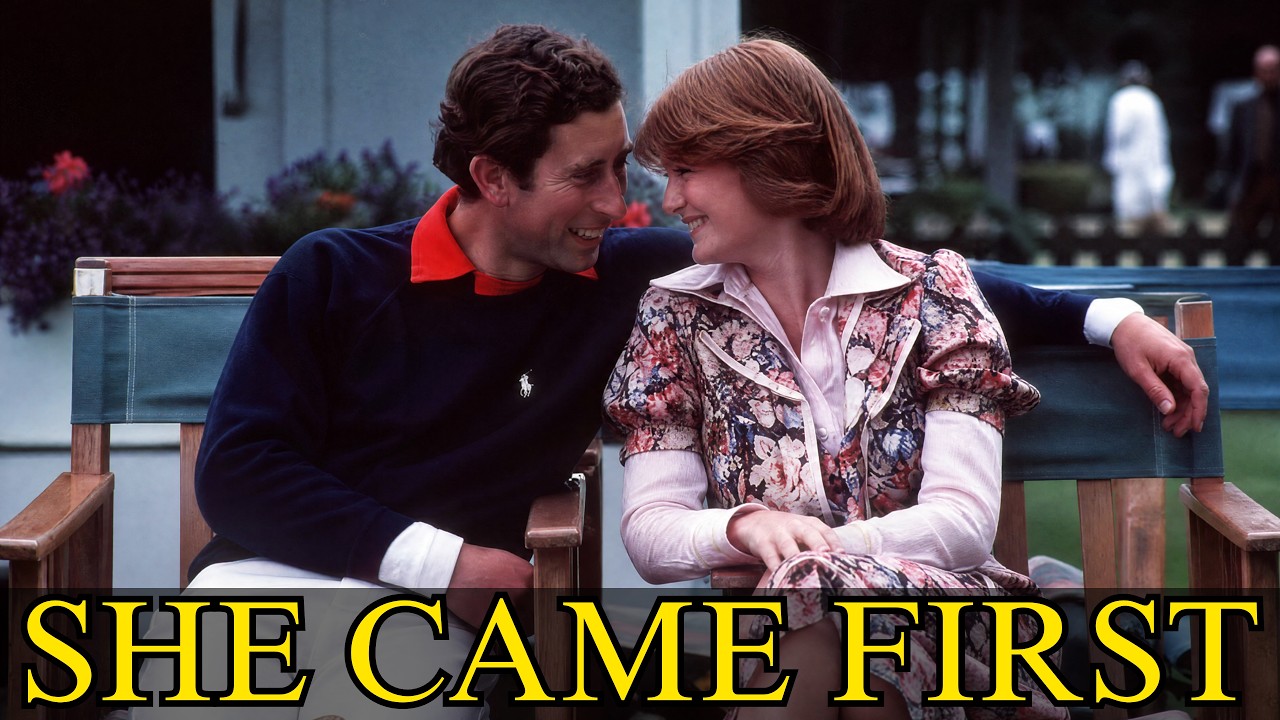
The season began in mid-June 1977 at a house party during Royal Ascot. Within weeks, the photographers had her. There she is in June of that year at the Guards Polo Club in Windsor Great Park. Charles stands beside her in riding clothes, both squinting slightly in the sun. There she is again in the garden later that summer. The pictures are not intimate. They are the standard product of a standard arrangement, which was that the Prince of Wales played polo on summer afternoons and any young woman he was dating stood at the rail and was photographed doing so.
What she did with her season was unusual. She was observant. Then she described it. She said he made his own dates, and she was careful to correct the other common belief, that the asking was done for him through third parties. He did it himself. She said a weekend at Windsor Castle required a full suitcase. Then she listed the contents, morning to night: riding clothes, day dress, skirt, long dress. And she said, almost in passing, that she always called him “Sir.” Always, she said.
This was a young woman who hid vodka from her boarding school teachers, confirmed to the press that her father had excluded his children from his wedding, and cheerfully admitted to dating thousands of men. And she called the man she was dating “Sir.”
That detail should stop the audience because it is the precise point where romance meets the royal institution. It contains the reason those relationships so rarely became marriages. It was not just a boyfriend who happened to be royal. It was the Crown in riding boots, and every woman who approached it had to handle that fact in her own way. Sarah’s way was one syllable of deference she never dropped.
The season had a shape and a calendar. Polo through the summer, theatre in London, a round of country house parties through the autumn, and the great weekend circuits of that world, where the same families took turns visiting each other’s houses for shooting, dining, and marrying. An invitation to Balmoral from the Queen herself, which in that house was not merely a social gesture but a signal. Invitations to Windsor, and in February 1978, a skiing holiday at Klosters in Switzerland.
The scale of what she had entered was national. She was 22. He was 28, heir to the throne, unmarried, under national pressure to change that. His name had been linked in one contemporary count to about 20 women within a decade. The British press had formed its first real royal rota around him, assigning reporters on expenses whose only job was to determine which of these women would become queen.
And in June 1977, for the first time, the pack settled on Spencer. They settled on her for a reason that had nothing to do with romance. On paper, there was no young woman in England better placed. Her family had lived on the Queen’s own estates for years. Her grandmother had served the Queen Mother. Her godmother was the Queen Mother. There was no gap between the Spencers and the Crown for anyone to jump.
The difficulty at the heart of this relationship is something the record allows you to state but not to resolve. Nothing in the records suggests he was in love with her. The published accounts describe amusement rather than passion. He enjoyed her wit. She made him laugh. She enjoyed being escorted by him and accepting the invitations. Time magazine, in its report the following spring, described the skiing holiday with careful reserve, noting she had been there with Charles and other friends in a Swiss chalet, and noting her insistence that they were just companions.
That is a magazine reporting a romance it does not quite believe in. Against that, there is the plain fact that she received an invitation to Balmoral from the Queen. And in that family, such invitations were not casual. Add to that the assessment, written years later, that at 23, Sarah, not the 17-year-old Diana, was the one who looked like a prospective bride for the Prince of Wales. She was the one he was courting.
Both things appear to be true. She was the front-runner, and there is no evidence he loved her. In that world, in that decade, there was no contradiction between those two statements at all. Marriages of this kind were still arranged in essence if not in form, and being suitable mattered more than being loved. The Prince of Wales was expected to choose, from a small pool of suitable young women, the one who could do the job.
There is another reading of that autumn, supported by the evidence, and it is less flattering to everyone involved. The pool of women considered suitable for the heir to the throne in 1977 was very small. It was drawn from a handful of families, and it excluded any divorced woman, any Catholic, and any woman whose private life had reached the newspapers. Within those rules, the unmarried Spencer daughter, 22 years old, was not just one candidate among many. She was almost the entire field.
That is why the press fastened on her so quickly, and that is why the attention was so unpleasant. Being the front-runner in that race meant being photographed, pursued, telephoned, and written about by men whose professional interest lay in finding the thing that would disqualify you. In Sarah’s case, they did not have to look hard, and in the end they did not have to look at all because she told them herself.
What no one properly accounted for was whether Sarah Spencer wanted the job. The evidence that she did is weak, and most of it is from other people. The evidence that she did not is from her directly, stated in the press within a year. But that comes later. At the time, in the autumn of 1977, she was a 22-year-old with a heavy suitcase, visibly enjoying calling the future King of England “Sir” in a Swiss chalet and a Berkshire drawing room, and telling anyone who asked in detail what it looked like from the inside.
She was also, that autumn, thinking about Christmas at home, and about the fact that she had never taken him to Althorp.
The Stepmother Nobody Told Them About
Her father remarried in July 1976, and his children learned of it from the newspapers. Nothing that happened between Charles and Sarah can be understood without grasping the war going on inside her own house at the same time. The two ran in parallel, month by month. And the house she brought him to in November 1977 was a house at war.
The register office marriage in London on July 14, 1976, was the first move. Johnny Spencer, the 8th Earl Spencer, married Raine, Countess Dartmouth, without informing any of his four children. Sarah was 21, Jane 19, Diana 15, Charles 12. They learned of it from the press.
Raine was a formidable woman, and she was not in the least embarrassed by that. Her mother was the novelist Barbara Cartland, who lived to 98. Her first husband had been the Earl of Dartmouth. She arrived at Althorp and set about restoring it. The way she did it is what the children never forgave.
To fund the restoration, the contents of the house were sold. Van Dycks and Gainsboroughs, furniture, silver, family documents left the house, replaced by gilt paint and new wallpaper. Charles Spencer’s verdict on the result, years later, was that it was as vulgar as a wedding cake in a five-star hotel in Monaco. The children’s name for their stepmother was “Acid Raine,” and they used it for the rest of her life.
One house guest who stayed at Althorp in 1977, when Sarah, Jane, and Diana were at home, described the atmosphere to a biographer in a single sentence. At the family dinners he attended, the sisters did not speak one word to their stepmother. Not one word. Three young women in their teens and twenties, in a 90-room house, enforcing a silence so total that a guest who witnessed it was still describing it decades later.
That is the family Sarah invited the Prince of Wales to join. Then, in 1978, the war produced a casualty. The Earl Spencer suffered a severe cerebral haemorrhage. At one point he was not expected to survive, and he spent eight months in hospital. Raine nursed him, and the nursing gave her control of the door to his room.
Diana’s account of that period is one of the harshest things she ever said about her stepmother. She said Raine basically stopped them from going into the hospital. She would not let them see their father.
Look at that year from Sarah’s perspective. She is 23. Her romance with the heir to the throne is ending or has just ended. Her father is unconscious on a hospital bed and may not survive. The woman standing between her and the bed is the stepmother the family sat in silence with. Her mother has remarried and lives elsewhere, having lost custody nine years earlier. And her younger brother, the boy who will inherit the house, is barely into his teens.
The records do not say how she felt about any of it. It is important not to pretend otherwise. She never described that year. What is documented is the year itself, and you can trust the audience to do the maths.
Her mother’s position in all this deserves a sentence because it explains why there was nowhere for the children to go. Frances Shand Kydd had lost custody of all four children in 1969. She was not an absent mother by choice after that. She was excluded by court order, and the person whose testimony helped exclude her was her own mother. So when Raine arrived at Althorp in 1976, there was no alternative home for the Spencer children to go to, and no adult woman in their lives with the standing to object on their behalf. There was Raine, and there was the silence at the dinner table, and that was all.
Look at what was leaving the house while they sat there. Althorp held one of the greatest private collections in England, assembled over five centuries and across about 90 rooms. Among the paintings sold to fund the restoration were works by Van Dyck and Gainsborough, two of the most valuable names an English house could hold. The furniture went. The silver went. The family documents went. That means the written record of the family itself was dismantled and sold at auction.
The 8th Earl lived until March 1992. His son, who would inherit what remained, was 12 years old. The children’s objection was never really about the wallpaper. It was about watching a stranger dismantle the only thing their family owned that their mother’s departure had not already damaged.
There is a further twist in this thread, the strangest coincidence in the entire story. Raine was born Raine McCorquodale, daughter of Barbara Cartland from her first marriage, to Captain Alexander McCorquodale. Barbara Cartland’s second husband was another McCorquodale, Hugh. The estrangement outlasted almost everyone involved. Johnny Spencer lived until March 1992, meaning the marriage his children were not told about lasted about 16 years. Barbara Cartland lived to 98 and died in 2000. Raine outlived them all and died in October 2016, 40 years after the civil ceremony.
For four decades, in one form or another, the eldest Spencer daughter shared a family with the woman she told a newspaper had not invited her to the wedding. The McCorquodales were from Lincolnshire, and they were perfectly ordinary compared to the Spencers. In August 1979, Lady Sarah Spencer became engaged to a former Coldstream Guards officer named Neil Edmund McCorquodale. Hugh McCorquodale, Barbara Cartland’s husband, was Neil’s great-uncle.
Of all the men in England, the eldest Spencer daughter chose to marry into the family of the stepmother her siblings refused to speak to at dinner. There is no evidence she did it deliberately. The class she moved in was small enough to make such collisions common. But the fact stands, and it says something real about her that no amount of psychological speculation can add to. Sarah Spencer did not do things by halves, and she did not do them quietly.
None of that had happened yet, though. In November 1977, the marriage was two and a half years away. Her father was still healthy, and she had a prince to host for a country weekend. She decided to invite him to Althorp for the shooting.
The Ploughed Field
In November 1977, she invited him to Althorp, and her sister came home from school for the weekend. This is the scene around which all of modern royal history turns, and it took about a minute.
The occasion was a day’s shooting on the estate. November in Northamptonshire is pheasant country. The beaters work the coverts, and the guns walk the field edges. The Prince of Wales was there as Lady Sarah Spencer’s guest. He was 28, turning 29 that month. She was 22. It was, in every way, an ordinary piece of that world’s furniture. A girl showing her boyfriend the family house.
Her sister Diana was 16, home from West Heath for the weekend. The fullest account of what happened comes from Andrew Morton, written with Diana’s cooperation years later, and his phrasing is the one to adopt. That historic meeting in November 1977 was not auspicious. Diana, on holiday from her school, was introduced to the Prince in the middle of a ploughed field near Nobottle Wood on the Althorp estate during a day’s shooting.
Morton wrote that she looked like an ordinary figure in her checked shirt, her sister’s jacket, corduroy trousers, and wellington boots. Her sister’s jacket. The most photographed woman of the twentieth century met her husband wearing a coat borrowed from the woman he had come to see. It is the kind of detail no screenwriter would dare invent. It is in the record. It is perfectly accurate.
Diana had come home from school for the country weekend and put on whatever was hanging by the door. What was hanging by the door belonged to Sarah. Diana’s own verdict on him, in her words, was four clipped words. God, what a sad man. No excitement. No teenage swooning. A 16-year-old looked at the heir to the throne standing in a wet field in Northamptonshire and felt sorry for him. She had a sense for adult unhappiness learned the hard way in that house and that family. And her first instinct about Charles was pity.
That evening there was dinner in the house. Afterwards there was dancing. Diana’s account of it is one of the most quoted things she ever said, and it deserves to be told in full. She stayed out of the way, she said. She remembered being a fat, podgy girl, no make-up, not smart. But she was noisy, and he liked that. He came up to her after dinner and they danced a long dance. He loved it.
Charles’s own memories, given publicly when he and Diana announced their engagement, mirror it. He remembered thinking what a jolly, amusing, attractive girl she was, 16 years old. Great fun. Full of life and everything.
Now put the two accounts side by side and bring Sarah into the room. She brought him. She was the reason he was in the house at all. She was 22, recently seriously ill, in the middle of the most watched romantic season in Britain, in a house where she and her sisters did not speak to their stepmother. And after dinner, in front of everyone, the Prince of Wales crossed the room to dance with the noisy 16-year-old in her borrowed coat.
The ages matter because the calculations of that field are the calculations of everything that followed. Sarah was 22, born March 1955. Diana was 16, born July 1961, still at school. Charles was 28, turning 29 on the 14th of that month. Jane, the middle sister, was 20, five months from her own wedding. The house they stood in had been in the family since 1508. Within four years, one of the three sisters would marry the man in the field, the second would marry the Queen’s assistant private secretary, and the third would marry a Lincolnshire farmer.
Diana’s autumn deserves its own sentence because the received narrative turns her into a princess-in-waiting, and she never was. She was a West Heath schoolgirl awaiting poor exam results, with a mother who lived elsewhere, a father who had married a woman she would not speak to, and an academic career that would end the following year with a stint at a Swiss finishing school. The idea that anyone in that house in November was assessing her as a future Princess of Wales is pure hindsight.
What Sarah felt in that moment is the most tempting blank in this entire story, and it should stay blank. She never described that evening. Not in 1978 when she was talking freely to journalists, not in 1981 when she spoke to the Guardian, not in 2017 when she sat for a documentary about her sister’s death. There are no quotes. There is no testimony from anyone else who was in the room. The most emotionally charged moment of her life is entirely silent in the record.
What can be said is what she did next, which was nothing. There is no hint in any account that she objected or intervened or thought about it at all. Diana was a schoolgirl. Charles was 28. The idea that a post-dinner dance with a 16-year-old was the beginning of anything would have seemed absurd to any adult in that house. And for nearly three years, it was.
Because that is the part the narratives always miss. Nothing happened in November 1977. Charles did not fall in love in a ploughed field. He continued to see Sarah into the following year. He went skiing with her in February. Diana went back to school and then to Switzerland. That meeting did not become a fact of family history until 1980, when it was summoned from the past and turned into an origin point.
But it did happen. And it happened for one reason. A young woman wanted to introduce a man to her family, her house, and the fields her family had owned for 500 years. There is no calculation in that. It is the most ordinary motive there is. She opened the door herself. Three years later, that door would still be open, and by then she would be married to someone else, and the girl who wore the borrowed jacket would be 19.
But at the start, there was a mountain in Switzerland and a lunch in London she had already agreed to.
Klosters and the Lunch That Was Booked in Advance
In February 1978 she went skiing with him in Switzerland, and within weeks she sat down with two journalists. The Klosters holiday is the last documented moment of Charles and Sarah together, and the photograph taken then is the one that printed her in the public mind for the rest of her life. Snow, a group of friends, a chalet in the Swiss Alps, and the Prince of Wales on holiday with the red-haired Spencer girl.
The records of that trip are thinner than its fame. Time magazine, reporting three months later, described her as slim, red-haired, and 23, and noted she had spent a skiing holiday with Charles and other friends the previous winter in a Swiss chalet. The magazine added that she insisted they were just friends.
Just friends. In February she was with him on a mountain. By May, a national magazine was telling its readers, on her word, that there was nothing between them. The names of the rest of that group are not given in any available record. Nor is the name of the chalet. Nor the exact dates. Who exactly was in that chalet in February 1978 is simply not recorded. The film should acknowledge that rather than invent details.

What matters about Klosters is the timing, because the interview that ended everything took place in early 1978, which means it happened within weeks of that holiday and possibly right after it. That chronology deserves a pause. The comfortable version of this story, circulated for 40 years, is that the romance was already dying and the interview was merely the formal announcement of its death. The evidence does not support that. The evidence shows them photographed together on a mountain in February, and it shows her sitting with Fleet Street journalists in the same season. No one has produced a source saying it ended before she spoke.
So the question this chapter must ask is the one no one has ever answered. Why did she do it? Whatever the answer, the result is that Sarah Spencer is the only woman of that entire generation of royal girlfriends who left a personal account of what the courtship actually was. Every other young woman photographed beside Charles in those years said nothing at the time and has said nothing since. The details that survive about how the heir to the throne ran a romance in the 1970s, the dates he made himself, the suitcase, the single syllable of deference, exist because one of them spoke and was destroyed for it.
The mechanics of how it happened are documented. She agreed to lunch with two journalists at a London restaurant. They were James Whitaker and Nigel Nelson, and neither was an accident. Whitaker was one of the founding figures of the modern royal press corps, a man who spent his entire career pursuing that family. In 1978 he was working for the Sun. He would later join the Daily Star at its launch the following year, then the Daily Mirror after that. He died in 2012. Nelson was a Fleet Street political and royal correspondent.
Here is an important correction because the story is almost always told wrong. The interview did not appear in a tabloid. It appeared in Woman’s Own, which is what Time magazine confirmed in May 1978, introducing its excerpts by saying that in an interview with Woman’s Own she had given a rare and close-up look at the bachelor Prince. The accounts that place it in the Star or the Mirror or the Sunday People are confusing the interview itself with the retrospective article Whitaker wrote about it more than 30 years later.
The magazine matters as much as the men. Woman’s Own was a women’s magazine. Of all the publications a young woman of her class might choose to speak to, it was the most respectable, the most domestic, the least threatening. And that is probably why she spoke. She was not selling a story to a tabloid. She was chatting to a nice magazine that her mother’s friends read.
That is the trap modern journalism had just finished building, and Sarah Spencer was one of the first people to fall into it. The distinction she was relying on, between a respectable women’s weekly and a serious news operation, no longer existed by 1978. Once a quote was printed anywhere, it reached the wires within hours, every national newspaper by the next morning, and the permanent record forever. The two men at the table knew that. She did not. And nothing in her upbringing had prepared her for it either.
Here the family history closes the loop. The Spencers had been close to the throne for generations precisely by saying nothing. Her grandmother had served the Queen Mother. The entire survival technology of that world was silence. Sarah, who had spent her adolescence proving no one could control her, had never learned to use that silence.
The scene was a lunch, and the destination was a women’s magazine. The two men at the table were professionals. She walked in carrying everything. A 23-year-old from a family that had never spoken about itself in public, invited to lunch by two men whose job was to find any detail that would damn her. She had a documented eating disorder. She had a documented drinking history. She had, by her own account, thousands of friends. And she kept a scrapbook.
That scrapbook is the detail that tells you she had no idea what she was doing. She was cutting out newspaper clippings about her royal romance and pasting them into a book. She told the journalists she kept it to show her grandchildren one day. That is the behaviour of a girl enjoying herself, not a woman managing a career.
The two men at the table would later say, with a certain professional chill, that fame seemed to have affected her balance. The lunch continued. She was, in the phrase of one of them later, impressively frank about her boyfriend. The name of the restaurant is not given in any surviving account. The exact date is unrecorded. The publication date is unrecorded. What is recorded is what she said, and she said it in sentences that have outlived every other word spoken about that relationship by anyone.
She was about to explain, for the benefit of the readers of a weekly women’s magazine, her exact opinion of the future King of England. Whether he was a dustman or the King of England, she told them, she was not in love with him. Then she told them exactly how little the throne had to do with it.
The words survive because Time magazine printed them on May 15, 1978, in a cover story about the man who would be king, and contemporary publication is the best evidence anyone has. Sarah said: “Charles makes me laugh a great deal.” “I really enjoy being with him.” Then, firmly, she delivered the rest. “There is no chance of my marrying him.” “I’m not in love with him.” “And I wouldn’t marry anyone I didn’t love, whether he was a dustman or the King of England.”
A great deal has been built on those three sentences, and most of it is wrong. The first expresses affection. She liked him, and she said so plainly, in print, in a women’s magazine. The second is a categorical denial of the one thing everyone wanted to know. The third is the one that has outlived her. It is not a rejection of Charles at all. It is a statement of principle about marriage, made by a 23-year-old woman in 1978, that she would not marry a man she did not love, regardless of what he owned or would inherit. Read as evidence of character, it is impressive. Read as an act of public relations, it was suicide.
A shorter version of the phrase circulates using “if” instead of “whether.” It comes from a paraphrase written by the journalists themselves decades later. The long version printed at the time is the one to trust. She did not stop there. In the same conversation, she discussed her anorexia nervosa and confirmed she had been diagnosed with it. She said she had been involved with, in her phrase, “thousands of friends.” She spoke about a previous problem with alcohol. She described the school drinking, the whisky, Cointreau, gin, sherry, and the vodka she chose because the staff couldn’t smell it. She told them about the scrapbook she kept to show her grandchildren.
She also handed them information about him. That he made his own dates, not, as some said, through third parties. That a weekend at Windsor Castle required a suitcase: riding clothes for the morning, a day dress for lunch, a skirt for tea, and a long dress for dinner. And that she always called him “Sir.” And her assessment of the man himself, which is the cleverest sentence anyone said about the Prince of Wales in that decade. She said he was a romantic who fell in love easily.
Count what she put on the table in one lunch. One eating disorder. One drinking problem. Thousands of friends. One scrapbook. One denial of love for the heir to the throne. One description of the inside of Windsor Castle. One personality assessment of the future king, published in a women’s magazine three years before he married her sister. Every single item was a disqualifier under the rules then in force. She delivered all of them in a single afternoon, voluntarily, without appearing to realise what was happening.
The two journalists’ verdict on her state of mind, delivered later, was brief. She seemed to have been carried away by fame. That may well be true. It is also the most convenient explanation for two men who had just taken a young woman to lunch and let her talk herself out of a marriage. There is a second explanation available, and the record supports it just as fully. She meant what she said. She said, in plain words, that she did not love him and would not marry a man she did not love. That is not the statement of a girl carried away. It is the statement of someone publicly and in advance declining, and doing it in a magazine her mother’s generation read.
Then she did the thing no biographer has ever explained. She took the article to Charles herself. She did not hide it. She did not send a friend to warn him. She did not wait to be summoned for an apology. When the article appeared, Sarah Spencer took the magazine to the Prince of Wales and put it in front of him. It is either the bravest or the least self-aware act in this entire story, and possibly both.
He was furious. The rebuke attributed to him survives in two forms, and the wording genuinely differs between accounts. In one he said: “You have just done something extremely foolish.” In the other: “Incredibly foolish.” There is no recorded text. Both versions carry the same meaning, which is that the heir to the throne of the United Kingdom told a 23-year-old woman she had destroyed herself, and he was right.
The relationship ended shortly afterwards. There was no announcement because there was no engagement. There was simply an absence of further photographs. The price she paid is documented and lasted the rest of her life. A newspaper investigation published 25 years later put it plainly. At 23, Sarah, not the 17-year-old Diana, was the one who looked likely to marry Prince Charles. She was the one he was courting, and she was the one who, in a moment of folly she personally admitted to regretting to this day, blew it.
A friend, quoted in the same article, went further. “She has never forgiven herself for that,” the friend said. “To this day, when the Prince is mentioned in conversation, she chips in: ‘Of course he was my boyfriend first. Of course he was my boyfriend first.’”
A sentence said at Lincolnshire dinner tables for decades by a woman in her forties, fifties, and sixties about a marriage that ended and a sister who died. That is the whole price in one sentence, said a friend, and she never stopped saying it.
But in the spring of 1978, she was 23. The romance was over. Her father was about to collapse with a brain haemorrhage, and she had nowhere specific to go. Within 18 months she was engaged to someone else, and the courtship lasted five weeks.
Lady Hurricane
Within 18 months of losing the Prince, she accepted a Guards officer after five weeks of dating him. Neil Edmund McCorquodale was born in 1951, making him four years her senior. He was educated at Harrow, commissioned into the Coldstream Guards, and was a farmer in Lincolnshire. He was, by every surviving description, the exact opposite of everything Sarah Spencer had been for the previous three years.
A friend of the Spencer family, quoted by biographer Sally Bedell Smith, described him as solid, very steady, taciturn, quiet, with a sense of humour. The same passage describes Sarah as his opposite, ebullient and daring, with an unpredictable streak. His family was interesting in itself. His father, Alistair McCorquodale, was a Harrow-educated sprinter who competed at the 1948 London Olympics, finishing fourth in the 100-metre final and winning a silver medal in the relay. His mother was Rosemary Sybil Turner of Stoke Rochford in Lincolnshire, and the land the couple would live on belonged to her family.
And, as established, Neil’s great-uncle was Hugh McCorquodale, Barbara Cartland’s second husband, whose daughter from her first marriage was Raine, Countess Spencer. Sarah was marrying into the family of the stepmother she and her sisters would not speak to.
The courtship was, in her phrase, distinctive. “I am a whirlwind-type lady.” She said that, and she was not exaggerating. She had known him for about two years. They went out for five weeks. Then they decided to marry without delay. The engagement was announced in August 1979 when she was 24. She told her father while he was distracted during a cricket match at Althorp, and he gave his blessing absently.
That is the entire scene as it has come down to us. The 8th Earl Spencer, a year after his near-fatal haemorrhage, watching cricket on his own lawn, told by his eldest daughter that she was getting married, agreeing without listening properly. Then, almost immediately, it nearly fell apart. The couple separated, and Neil went to Australia to think about it. That is not a small gesture in 1979. It is the other side of the world, undertaken by a former Guards officer to decide whether he wanted to marry the woman who had spent the previous two years in the newspapers as the Prince of Wales’s girlfriend.
He came back, and they got back together. Then they changed the wedding date. It had been planned as a large London wedding, the kind expected for an earl’s eldest daughter, in a fashionable church with a long guest list. They moved it from London to a small country church. Her mother’s comment at the time is one of the few contemporary quotes from anyone inside the family about Sarah’s private life, and it was cautious and kind.
Frances said she was very happy for them. She said they had been worried and uncertain. It seemed they had been pushed into having a big London wedding, and she thought they felt they wanted more time to think and were a bit nervous about the whole thing. Pushed into it. That is the word a mother used to describe her daughter’s wedding.
The wedding took place on May 17, 1980. The church is usually given as the parish church at Great Brington, which stands near the gates of Althorp, though the formal record gives only Northamptonshire. It was said to be the first wedding at Althorp since 1914. She wore a simple dress by Bellville Sassoon, embroidered with antique lace and georgette in a riding-habit style. She had spent her whole life with horses, and she married in a dress cut to resemble riding clothes. Her veil was held by the Spencer tiara, the family heirloom Jane had worn before her and Diana would wear 14 months later.
One of her bridesmaids was Lady Sarah Armstrong-Jones, daughter of Princess Margaret. Her sister Diana, 18 years old, was not a bridesmaid. She had been one at Jane’s wedding two years earlier. Whether Prince Charles attended is recorded nowhere. The photographs of that day are described as scarce. No public guest list survives. The honest answer is that no one knows. He may have attended. He may have stayed away. Anyone who tells you either is guessing.
The reception was at Althorp, and it was paid for by Frances Shand Kydd, the mother who had lost custody of the bride 11 years earlier, now writing the cheque for her daughter’s wedding. Her biographer records that Frances spent most of the afternoon avoiding Raine and Barbara Cartland. Imagine the lawn. The bride in lace and the family tiara. Her father, out of hospital, leaning on the arm of the wife his children would not speak to. Her mother, who paid for it, moving between groups to avoid the stepmother and the famous step-grandmother. Her 18-year-old sister somewhere in the crowd in a hat. And 550 acres of Northamptonshire in May. In a family that had not seen a wedding since the year the first war began.
Her new life had a shape that can be described in one sentence. A farm of about a thousand acres near Grantham. A house that had belonged to her husband’s mother’s family. A county with no photographers in it. She would live there for the next 46 years. She still lives there now.
What she chose in the end was a version of the life her own family had been unable to provide. A working estate. A husband who would later serve as High Sheriff of Lincolnshire in 1987. Three children who would come in sequence through the 1980s. A parish church at the end of the lane that would eventually see two of those children married. It is a small, settled, deeply traditional English life. And she sought it herself within two years of losing the biggest prize in the country.
Sarah Spencer walked out of that. She married at 25 a steady man with a Lincolnshire farm. And the royal chapter of her life appeared to be completely closed. There were only two months left in it.
“I Introduced Them. I’m Cupid.”
Four months after her wedding, the man she had brought to Althorp began dating the sister she had introduced him to. The summer of 1980 is where the story turns from bad luck into something closer to fate. The sequence must be laid out carefully because the popular account compresses three years into an afternoon.
November 1977: a ploughed field near Nobottle Wood, a 16-year-old in her sister’s jacket, and nothing of note for nearly three years. February 1978: Klosters. Spring 1978: the interview and the end of Sarah’s romance. 1978: Diana at a Swiss finishing school. August 1979: Sarah’s engagement. May 1980: Sarah’s wedding. Then July 1980, a party at Petworth in West Sussex, and Charles noticing that the girl who had made a fuss at Althorp was now 19.
One error must be corrected here because everyone makes it, crediting Sarah with something that belongs to her middle sister. The visit to Balmoral in autumn 1980, where the relationship became public, was not arranged by Sarah. Jane married Robert Fellowes in April 1978. He was an assistant private secretary to the Queen. Jane gave birth to her first child, Laura, on July 19, 1980. Diana went to Scotland to help her sister with the baby, and it was Jane and Robert Fellowes who hosted her there. Sarah had been married for two months and was living in Lincolnshire. She was nowhere near it.
That distinction matters because it defines precisely what Sarah did and did not do. She did not manage that romance. She did not push her sister forward. She was not a chaperone or a fixer or a conspirator. She did one thing in one field in one November, and everything that followed came from other people.
The Fellowes marriage deserves a pause because it completes the pattern. Robert Fellowes had been an assistant private secretary to the Queen since 1977. He became deputy private secretary in 1986 and private secretary to the Queen from October 19, 1990, until February 4, 1999, making him for more than a decade the most powerful official in the Palace. He was given a life peerage in 1999 and died on July 29, 2024.
So consider the family’s position over four years. In June 1977, the eldest Spencer daughter began dating the heir to the throne. In April 1978, the middle daughter married the Queen’s assistant private secretary. In February 1981, the youngest daughter, 19 years old, was engaged to the heir. Their grandmother had been a lady-in-waiting to the Queen Mother for decades. The godmother, in Sarah’s case, was the Queen Mother herself. Three sisters, one house, and no distance left between the Spencers and the Crown.
The engagement was announced on February 24, 1981. On February 25, the very next morning, Lady Sarah McCorquodale told the Guardian five words that have followed her for 45 years. “I introduced them. I’m Cupid.”
That sentence is the reason this documentary exists, and it needs very careful handling because everything written about it since has come from people who decided in advance what it meant. The literal content of the sentence is accurate. She did introduce them. The meeting in November 1977 happened because she invited him to her family home, and no serious account disputes that. What she did not do was arrange the marriage. There was no matchmaking, no plan, no scheme to put her sister in front of the heir to the throne. She brought her boyfriend home, and her little sister was there. The credit claimed here is retrospective, and the credit belongs to chance.
But she made the statement, and the making of it is the act. She could have said nothing. Every instinct her family had instilled in her over 500 years was to be silent. Her grandmother had served the Queen Mother for decades without a public word. Her sister Jane was married to the man who ran the Queen’s private office and spent her life silent. Silence was the family trade.
Sarah, 25 years old, married nine months, living in Lincolnshire, woke up on the morning after the engagement of the century, spoke to a reporter from the Guardian, and claimed responsibility. She said it lightly, as a joke, as a cheerful piece of self-deprecation delivered by a woman feeling pleased with herself. She gave a second comment to the Lincolnshire Echo in the same period that reads the same way. “They are absolutely ideal for each other,” she said. She thought they had been in love just before Christmas, she said. There was an extra sparkle in her sister’s eye.
There is no bitterness in either quote. There is no detectable edge. If this is a woman harbouring a grudge against the man who chose her sister, she does not volunteer to tell a national newspaper that she is the one who brought them together. And yet the sentence has been read as bitterness ever since. The reason is that everyone reads it backwards from 1997. Because of what the marriage became, “I’m Cupid” has been reframed as irony, or boast-turned-curse, or a black joke by a woman who handed her sister a disaster. That interpretation is only available from the far side of a tunnel in Paris.
In February 1981, she meant it literally. A cheerful woman taking a bow at a family wedding, explaining what she had actually done by the age of 25. She had dated the Prince of Wales for the best part of a year. She had told a national magazine she did not love him and would not marry a man she did not love, whether he was a dustman or the King of England. She had lost him for it. She had married a Guards officer after a five-week courtship, and she had brought the same Prince to a field where he met the girl he would marry. Then on the morning after the announcement, she said so out loud.
No other girl of that generation of royal girlfriends did any of those things. She did all five. She opened the door herself, then stood in the doorway and told a reporter she was the one who opened it. Five months later, she watched her sister climb the steps of St Paul’s Cathedral, and there was something else she would give away.
The Pearls
She was not a bridesmaid at St Paul’s, and the official guest list placed her between her father and her middle sister. July 29, 1981, St Paul’s Cathedral. A bride who had been a schoolgirl in a borrowed jacket three years and eight months earlier. Sarah’s place in the service was the place of the properly married elder sister. Not in the procession, not among the bridesmaids. In the official order, she and her husband appear as the bride’s sister and her husband, listed immediately after the Earl and Countess Spencer and immediately before Lady Jane and Mr Robert Fellowes.
Read the order of that list and the entire family is in it. The father and the stepmother the children refused to speak to. Then the eldest daughter who had dated the groom. Then the middle daughter, married to the man who ran the Queen’s office. The three Spencer sisters and their integration into the House of Windsor printed in sequence on a seating plan.
Nothing about that day was small. It was a state occasion in every sense. With 3,500 guests inside the cathedral. And somewhere in it, in the family seats between her father and her middle sister, sat a 26-year-old farmer’s wife from Lincolnshire who had been photographed three and a half years earlier on a Swiss mountain with the man now standing at the altar.
But before the wedding there was the lunch everyone knows and almost everyone misunderstands. In the days before the ceremony, Diana discovered the bracelet Charles had ordered for Camilla. She went to her sisters and told them she could not go through with it. Her own account, recorded in her own voice, is as follows. She went upstairs and had lunch with her sisters who were there and said: “I can’t marry him. I can’t do this. This is absolutely unbelievable.”
She described them as wonderful and then relayed what they said to her. “Well, bad luck, Duch,” they said. “Your face is on the tea towels, so you’re too late to chicken out.” “Duch” was the family nickname for the youngest sister. The tea towels were real. Commemorative tea towels bearing the faces of Charles and Diana had been mass-produced for the occasion.
Now the correction, and it is the most important correction in this film. That line was not Sarah’s alone. Every source says the two sisters said it together. Andrew Morton, who first published it, wrote “they said.” Diana, on the recording, said “my sisters who were there.” No surviving account attributes the line to Lady Sarah McCorquodale alone. Anyone who attributes it to her specifically is going beyond the evidence, and this documentary will not do that.
What that exchange actually shows is not cruelty and not disbelief. The two sisters took a frightened 20-year-old seriously enough to hear her out, then turned it into a joke. And the joke was that it was too late. In the world they came from, in late July 1981, with a state occasion assembled and the world’s press already in position, it was too late. Everyone in that room knew it. They were telling her, in the only language that family knew, that there was no way out.
There is another voice to hear before the pearls, and it belongs to the oldest woman in the family, Ruth, Lady Fermoy, the grandmother who had testified against her own daughter in the divorce court in 1969, who was a lady-in-waiting to the Queen Mother, and who warned Diana against this marriage. She knew the family from the inside, and she told her granddaughter she did not think their sense of humour or their way of life would suit her. No one listened, and there is no evidence Sarah ever heard it. But it means that of the four Spencer women alive in 1981, at least two had private doubts about this marriage. And one of them had already told a magazine, in print, that she would not have accepted it herself even for a crown.
Something else must be said about that lunch because it has been used against the two sisters for 30 years. There is no record anywhere of either of them disbelieving her. Nothing survives in which Sarah or Jane question the bulimia or question Camilla or tell Diana she is imagining it. What survives is a joke about a tea towel, which is dismissal, not denial. And the difference between those two things is the difference between two sisters who lacked experience and two sisters who were cruel.
Which brings the story to the pearls. Every Spencer daughter received a pearl necklace as part of family tradition. Diana’s was three strands. Sarah’s, as the eldest, was five strands. She wore it at the wedding. She would wear it again at the weddings of both her nephews. And after the ceremony, as Diana was leaving Buckingham Palace for Broadlands and the honeymoon, Sarah took off her five-strand necklace and gave it to her sister.
Consider that moment slowly because it is the image the entire film has been building towards. An elder sister, 26 years old, married, living in Lincolnshire, standing in a palace courtyard. The man she had dated for a year and lost for telling the truth about him in a magazine was now her brother-in-law. The girl she had introduced to him in a wet field in her coat was now the Princess of Wales, about to get into a car. Sarah reaches up, unclasps the pearls, the five strands she inherited because she was the eldest, and puts them in her younger sister’s hands.
There is no record of what she said when she did it. There is no photograph of it ever taken. All there is, is the fact, and the fact is enough. She had given her the man. She had given her the field and the coat in which she met him. And now she gave her the pearls.
That is the end of the story as the public understood it. The younger sister had overtaken the elder Spencer girl by six years, completely and permanently, and everything the elder sister owned now belonged to her sibling. Except that it was the beginning of 45 years of work, most of it unpaid, some of it in the courtroom, none of it acknowledged. Sixteen years after that moment in the courtyard, she would be put on a plane in the dark.
Lady-in-Waiting to Her Sister
In 1987, she returned to her old school with Diana wearing a suit Diana had worn two years earlier in Australia. Clothes are the detail that reveals the game, and there are two documented instances. In 1987, during a visit to West Heath, the school all three sisters had attended, Sarah was photographed in a blue and white striped suit that Diana had worn two years earlier on an official tour of Australia. And in 1993, accompanying Diana to Nepal, she wore a green and white midi dress Diana had worn seven years earlier in the Gulf states.
The Princess of Wales was giving her old clothes to her older sister, and the older sister was wearing them in public at her former school and on a royal tour. That is the family wardrobe, and there is no other honest way to interpret it.
The role she played is usually described as “lady-in-waiting,” and that description needs honest handling because it is lighter than the term suggests. Some accounts say she was formally appointed an extra lady-in-waiting from 1992 to 1997. Others describe the position as informal. The standard reference record contains the claim but notes it is unsupported by evidence. Diana’s principal lady-in-waiting throughout the marriage was someone else entirely, a professional member of the household doing the actual work. And the 1987 date undermines the tidy account anyway. She was accompanying her sister on public engagements five years before that alleged appointment.
What happened is that a sister kept turning up for years, and a title was given to it later. What the role involved is easier to state. She travelled with Diana. She stood behind her at formal occasions. She performed those small tasks that make royal visits work. In 1987, when Diana went fox hunting and caused a small national controversy about it, she was staying with Sarah at the time and riding her horse.
Which brings this chapter to the question the entire story has been circling, and the records do not settle it. Were the sisters close? Or did Sarah never forgive her? The resentment argument starts with Diana herself. Biographer Sally Bedell Smith records Diana saying that Sarah was very upset that she agreed to go out with Prince Charles. Note precisely what that sentence says. It concerns 1980 and the courtship period, not the marriage. It is Diana’s account of Sarah’s feelings, not Sarah’s actual feelings. And it is a single line.
The harshest account came from Paul Burrell, Diana’s butler, in a newspaper series in November 2002, days after his trial collapsed. Burrell wrote that he believed Sarah was jealous of her sister, and that on Diana’s wedding day, Sarah turned to her and said: “I thought all this would be mine one day.” The nickname he gave her in the press was “Lady Sarah Crocodile.”
That claim requires three warnings, and they must be stated plainly. It is second-hand gossip, with Burrell relaying what Diana told him Sarah said. It was published days after a criminal trial in which Sarah had given evidence against him. And Burrell himself added that Diana was not offended but found it amusing, which is not the tone of someone describing an injury.
Against all of that stands one line from Diana, independently reported, that Sarah was the only person she knew she could trust. Both cannot be entirely true, and yet both were probably said. That is sisters. And these sisters grew up in a house where the mother was removed by court order and the father married a woman they refused to speak to. Whatever the relationship between the three Spencer girls was, “simple” is not the word for it.
One further voice exists, and it is the strangest. A royal author told an American magazine that she believed Sarah knew about Diana’s affairs and that Sarah somehow encouraged Diana to be rebellious and have lovers. If that is true, and it is a single claim from a single author, then the relationship was not competitive at all. It was closer to the pattern set in the Chelsea flat when Diana was cleaning Sarah’s floors. The older sister who burned in public standing behind the younger one telling her to go ahead and live.
Sarah has never denied the jealousy claims in nearly 25 years. She has never denied anything at all. The only objection she ever made was under oath, and it was two words long. There is one further piece of evidence, and it is the clearest of all. Diana had two older sisters and a mother, and when she wrote her will, she named none of them. Then in February 1996, 18 months before her death, she changed it. The person she added to the will was Sarah.
Whatever the relationship was, that is what Diana did in the official paperwork. By the mid-1990s, the marriage was over. The tapes and the books and the interview had done their work. There was a mother, a stepmother, a butler, and an entire nation standing between the sisters. Then on a late August morning, the phone rang in Lincolnshire.
Come Back to Life
On August 31, 1997, she flew to Paris in the dark with her sister Jane and Charles. The official record of that flight is unusually precise, and it should be stated as written because it is one of the very few occasions in this entire story where Sarah Spencer’s movements were documented by the state.
The Princess’s body was brought back to the United Kingdom on the evening of Sunday, August 31, aboard a British Aerospace 146 of the Queen’s Flight. The Prince of Wales and the Princess’s two elder sisters, Lady Sarah McCorquodale and Lady Jane Fellowes, accompanied the Princess’s coffin on the return journey.
The pilot published his own account years later, and it contains details no one else recorded. There was a standing order that if a member of the royal family died abroad, the coffin would not return until day four. That order was overridden. The aircraft was modified so engineers could fit a flat floor in the rear luggage hold with ball bearings added to make the coffin easier to move in and out. The crew flew from Northolt to Aberdeen via Wittering. At Wittering, they picked up Diana’s two sisters. A separate aircraft carried a lead-lined coffin to Paris. The Prince of Wales and his team went to the hospital to collect it while the crew waited at an airfield outside the city.
They landed at Northolt at 6:51 pm. The aircraft was parked behind the air traffic control tower so the engineers could not see. At exactly 7 pm, the engines stopped and the rear door opened. The coffin, draped in the Royal Standard, was carried by a team from the Queen’s Colour Squadron who had not been allowed to practise. The Prime Minister was among those waiting. Twenty minutes after landing, the aircraft left again for Aberdeen so Charles could return to Balmoral and to his sons.
Sarah has never spoken about that flight. Not one word in 29 years. Six days later, on September 6, 1997, she stood in Westminster Abbey and gave the first reading at her sister’s funeral. Here is a correction the record demands because this is almost always misunderstood. Sarah did not read Henry van Dyke’s poem about time. That was Jane, and it was the second reading. Sarah read first, and what she read was a poem called “Come Back to Life” by the American poet and activist Mary Lee Hall.
“If I should die and leave you here a while, be not like others, sore undone, who keep long vigils by the silent dust. For my sake, turn again to life and smile, nerving thy heart and trembling hand to do something to comfort other hearts than thine. Complete these dear unfinished tasks of mine, and I, perchance, may therein comfort you. Complete these dear unfinished tasks of mine.”
She read that aloud in a church on a Saturday morning over the coffin of her sister, with two boys aged 15 and 12 sitting a few feet away. Then she spent the next 15 years doing exactly what the poem asked, in courtrooms and boardrooms and witness stands, unpaid.
Something else about that funeral belongs to her and almost no one knows it. Sarah is the one who asked Elton John to perform the song. The family had entrusted her with the music, and she said so at the time. The song, with new words written for the occasion, was sung once on September 6, 1997, and never sung again. Papers published years later showed the Dean of Westminster had personally pressed senior Palace officials to allow it, insisting on including something of the modern world the Princess represented. And that a solo saxophonist had been considered as an alternative.
So the most famous moment in the most watched funeral in history happened because the eldest Spencer sister was in charge of the music and wanted her sister’s world in the room. Twenty years later, in 2017, she gave a few remarks for a documentary about the week of the death. It is the only substantive public statement of her feelings she has ever made, and it runs to a few sentences. Her sister Jane refused to participate at all.
She said: “I think I was in shock, but I don’t think I felt anything else.” Just love and shock. She described how she put a barrier in front of her emotions so she could deal with the practicalities. She described feeling angry, for reasons she could not explain, at the broadcasters who spent two hours that night saying Diana was on the road to recovery. That is all. Three decades of public silence broken for a few minutes. And most of what she said was about a seatbelt.
She was 42 that week. She had lost a brother who lived 10 hours, watched a court take her mother, lost a Prince for telling the truth about him in a magazine. And now she had flown through the night to collect the body of the sister she had handed him to. What she chose to say about it, 20 years later, was that she felt love and shock and nothing else. And that she could not understand why the seatbelt was not fastened.
Those practicalities she put the barrier up for were about to consume 15 years of her life.
The Woman with No Honour
She became executor, chair, witness, and finally a name in someone else’s conspiracy theory about her sister’s death. The will was signed on June 1, 1993, and named two executors: Diana’s mother and her private secretary, Commander Patrick Jephson. On February 1, 1996, a codicil removed the private secretary and put in his place, in the formal language of the document: “my sister, Elizabeth Sarah Lavinia McCorquodale, of Stoke Rochford, Grantham, Lincolnshire.”
With that single clause, Diana made her elder sister responsible for everything she owned. The size of the estate was proved under oath. The gross estate was £21,711,485. Tax of £8,502,330 was deducted. Probate was granted on March 2, 1998, to three people: a mother, a sister, and a court-appointed bishop.
Then came the decision that has followed her ever since. Diana had left a letter of wishes asking that a quarter of her estate be given to her 17 godchildren. In December 1997, the executors went to the High Court and obtained a variation of the will giving them absolute discretion over what any of the godchildren received. The quarter share was worth, on a conservative estimate, about £100,000 each. What they received was one item each. It was later described in the press as a trinket. Reports say the parents of those children were not informed in advance and were shocked when they found out.
A letter of wishes is not binding under English law, which is the executors’ defence, and it is a real defence. But Sarah’s name was on it, and Sarah’s name took the criticism. The same variation assigned Diana’s name, image, and voice to a discretionary trust, along with the right to go to court over them. That clause is the reason for everything that followed.
Sarah became chair of the Diana, Princess of Wales Memorial Fund, established in September 1997, days after the death. The fund raised more than £112 million, including £38 million from the song Elton John sang in the Abbey, and closed at the end of 2012. In 1998, the fund and the executors sued an American company producing unauthorised Diana memorabilia, and lost because English law recognises no posthumous right of publicity. In 2002, the company countersued for $25 million and named Lady Sarah McCorquodale personally. The fund froze grants to more than 120 organisations, including the landmine charity that had consumed the last year of Diana’s life. The settlement came in 2004, and the settlement was that the fund paid.
Sarah has never said one public word about any of it. Four years later, she was on the witness stand. On Monday, January 28, 2008, in the Royal Courts of Justice, she gave evidence at the inquest into her sister’s death. She was asked about their last telephone call. She said there had been a French newspaper article about landmines, and Diana was very upset because she felt she had been misunderstood and made to look as though she was criticising the government. She was very distressed. And from that, Sarah said, she did not think the relationship would last much longer.
Asked about an engagement and about a pregnancy, she denied both. Asked about the shredding, she admitted that she and her mother had destroyed material they found upsetting, including publications by what she called fortune tellers, because she did not want William or Harry to see them. My sister was aware, she said, that I did not approve of her excessive visits to fortune tellers. Then she settled it definitively. No historical documents were ever shredded. My conscience is clear about what I destroyed.
Counsel suggested to her that she had not in fact been close to her sister at all. She said their relationship was good. Counsel replied that good was one thing, and close was another. At one point she was shown a photograph of the three Spencer sisters laughing uncontrollably in the back of a car, and it was suggested she could barely remember the joke. She was described all day as composed and calm. She smiled and said: “I’m afraid I do remember it.”
Three weeks later, in the same courtroom, Mohamed Al-Fayed named the people he believed had conspired to kill his son and Diana. The list included Prince Philip, Prince Charles, the Prime Minister, former police commissioners, an American intelligence agency, and Diana’s sister, Lady Sarah McCorquodale.
That is the reward for 45 years of service. Accused of killing her own sister in an open court by a man whose claims the coroner would later dismiss. The rest of her life has been in Lincolnshire. She served as High Sheriff of the county from March 2009, the office her husband had held in 1987. She has served as joint master of the Belvoir Hunt since May 2010, which in 2018 brought her to Leicester Crown Court to give a character reference for the hunt’s kennel huntsman, who had pleaded guilty to an assault that broke a man’s neck. She told the judge he would lose his home if jailed, and he received a suspended sentence.
She was still riding in her seventies. In autumn 2025, she fell badly from a horse and spent a long time in hospital, and the country only knew because her brother mentioned it in passing on a podcast. She holds no honour, no medal, no title, no award. Nothing at all. In a family that collects honours the way other families collect photographs, the eldest Spencer sister has one year as High Sheriff of a rural county to show for a lifetime of public service.
She opened the door herself, and it never closed, because that is what the Crown does with the people it decides not to take in. It does not send them away. It keeps them unpaid and unthanked, standing at the threshold for the rest of their lives, doing the work no one else in the family wants to do. And it never says thank you in writing, not once.
It all began in a wet field in Northamptonshire in November 1977, with a 22-year-old who wanted to show her Prince the house her family had lived in for 500 years, and a 16-year-old in a borrowed jacket, and a day’s shooting that ended before dark. She has never denied any of it. Three years after that field, on the morning after the engagement was announced, a journalist asked her how it happened, and she answered without hesitation. And that answer has outlived everyone who was there.
“I introduced them. I’m Cupid.”