After losing her husband and three sons, Mary Todd Lincoln became desperate to reach them. She went to a photographer known for producing spirit images, and when the portrait was developed, everyone who saw it was horrified by what appeared beside her. Many people regard Mary Todd Lincoln as one of the worst First Ladies in American history. They point to her extravagant spending and her habit of bringing spiritualists and mediums into the White House, conducting séances in the private quarters while the Civil War raged outside.
But perhaps there was more behind her ruined reputation than bad taste and odd beliefs. Mary faced unimaginable loss before, during, and after her time in the White House, and she may have spent her entire life struggling with an undiagnosed, shifting illness that shaped every decision she made. She was born in Lexington, Kentucky, in 1818, the fourth of seven children. Her father, Robert, was a wealthy banker and a slave owner, and Mary grew up in a large, comfortable brick home.
Her childhood was privileged, but it carried an early tragedy. When Mary was only six years old, her mother, Elizabeth, died from complications after childbirth. Her father remarried within the year to another Elizabeth, whom everyone called Betsy, and the new couple eventually had nine children of their own. Fortunately, the household was large enough to absorb the grief.
Mary lived in a mansion with fourteen rooms and received an elite education. She attended Madame Mentelle’s finishing school, where she studied dance, drama, music, and etiquette, and she became fluent in French. To those who knew her, she was sociable, sharp, and remarkably intelligent. In 1839, when she was twenty-one, Mary moved to Springfield, Illinois, to live with her sister Elizabeth, who was married to Congressman Ninian W.
Edwards. He formally acted as Mary’s guardian, which turned out to be necessary, because Mary quickly became extremely popular with the young men of the town. One of her most promising suitors was Stephen A. Douglas, a lawyer and rising Democrat politician.
It seemed like a strong match, but one day Mary met a man named Abraham Lincoln, who came to the house, and politics played a large part in her attraction to him. They were both passionate Whigs, the party that would eventually become the Republican Party. They began dating and soon became engaged. The problem was that Lincoln did not come from a family of Mary’s social standing.
Mary did not care, but her sister and her guardian, Edwards, objected, and they forced the engagement to be broken off. The relationship ended on January 1, 1841, a day Lincoln would later call that fatal first of January. Mary stayed apart from Lincoln for eighteen months, but her feelings never changed. They found their way back to each other and resumed their relationship, this time in secret.
She and Lincoln planned to elope without telling her sister and brother-in-law. The date was set for November 4, 1842, but an unexpected encounter nearly ruined everything. On the very day Lincoln planned to run away with Mary, he ran into her guardian on the street. Lincoln was an honest man, and he could not lie to Edwards.
He admitted that he and Mary planned to marry that very day. Edwards was not pleased, but he made a surprising offer. Instead of canceling the secret wedding, he offered his own house as the venue. Mary Todd became Mary Todd Lincoln, and her life changed dramatically.
She had enjoyed luxury in a fourteen-room mansion, but after marrying Abraham Lincoln, she moved into a single-room flat above a general store. Soon they had a son, Robert. After a year of living with a baby in that tiny flat, the three of them moved to a small cottage. Lincoln threw himself into building a successful law practice, while Mary devoted herself to raising their growing family.
In 1848, they had another son, Edward Baker Lincoln. In 1850, their son William was born, but that same year, four-year-old Eddie died of tuberculosis. The loss devastated both Mary and Lincoln. In 1853, they completed their family with another son, Thomas Lincoln, whom everyone called Tad.
Lincoln’s work required him to be away from home often, leaving Mary alone with three boys, sometimes for months at a time. It was a difficult, lonely existence. In 1860, Mary and her husband underwent the greatest change of their lives. Lincoln went from being an Illinois lawyer to the President of the United States.
During the election, he received no votes from the Southern states, because they knew Lincoln supported the abolition of slavery, and the South wanted nothing to do with that. Mary came from a family that owned slaves, so her husband’s position created an uncomfortable situation. She chose to stand beside him, even though it likely meant alienating her own relatives. As First Lady, Mary became the hostess and social coordinator of the White House, and she was not always skilled at managing her duties, partly because she had to deal with journalists, lawyers, and political rivals.
Tension filled the White House, and Mary struggled to do her job well. Only one month after Lincoln became president, the American Civil War began. Mary spent much of that time trying to maintain morale. She visited hospitals and brought fruit and flowers to wounded soldiers.
She was the first First Lady to come from the West, and most of the people she met in Washington were Easterners. Because of this, she quickly earned a reputation for rudeness. They called her a pretender, and she was partly to blame. She did not hesitate to spend money, especially on jewelry.
She shopped at the exclusive Galt & Brothers, where she bought on credit. She redecorated every room in the White House. For the dining room, she decided that an expensive new set of china was necessary. Lincoln grew angry over her lavish spending, especially when he had to ask Congress for an appropriation to pay for it.
Spending money may have brought her some pleasure, but Mary was in deep emotional pain. She had suffered from severe headaches for most of her adult life, and they became worse after she suffered a head injury in a carriage accident. She also struggled with depression. In 1862, her sons Willie and Tad both fell ill with typhoid fever after drinking contaminated White House water.
When Willie died, Mary’s mental illness became terrifying. She stayed locked in her bedroom for three weeks, and her grief was so overwhelming that she could not attend her own son’s funeral. It was during this period of mourning that Mary turned to spiritualists and mediums. But this was not just about séances to contact the dead.
One spiritualist told her that the entire cabinet was against the president and that Lincoln should fire them all. On April 14, 1865, it became clear that the North had defeated the South in the Civil War. That day, the news also reported that Lincoln and the First Lady would attend a play at Ford’s Theatre. Mary was suffering from one of her headaches and said she did not want to go.
Lincoln insisted, so the two of them went to the theater. Mary and Lincoln sat side by side in their box, holding hands. During the third act, there was a scene that always made the audience laugh loudly. As the crowd laughed, John Wilkes Booth entered the president’s box and fired a shot.
Lincoln was laughing too when the bullet struck his head. Naturally frantic, Mary held her husband in his chair to keep him from falling to the floor. Lincoln was quickly carried to a house across the street so doctors could care for him. He slipped into a coma.
Mary was not allowed near her husband until the next morning. Finally, about nine hours after being shot, Lincoln died. To honor the fallen president, a funeral train carried his body across the country. Back at the White House, Mary was surrounded by spiritualists who filled her head with messages supposedly from her dead husband.
Her son eventually forced them all out of the White House. Mary Todd Lincoln was now a widow, and she understood that she needed her family. She had only two living sons, so she moved to Chicago to be near them. Money became another source of anxiety.
Lincoln had left her an estate worth eighty thousand dollars, which would be over one and a half million today, but Mary had never learned how to manage money. She decided that Europe would be better for her and her son Tad than America. She made arrangements with a wealthy American family living in Germany to pay for their travel and help them settle there. While in Germany, Mary decided to lobby Congress for more money.
Her reasoning was that since the wives of wounded soldiers received pensions, she should receive one too. Mary had few supporters in Congress, but the proposal passed anyway. She was now receiving three thousand dollars a year. When Europe had lost its appeal, Mary and Tad returned to America.
Shortly after their return, Tad became ill. On July 15, 1871, he died. The exact cause is debated, with some blaming pneumonia, others heart failure, and still others tuberculosis. Whatever the cause, Mary faced another devastating family loss.
In the span of her relatively short life, she had lost her husband and three sons. Only her eldest son, Robert, remained. Mary’s relationship with money spiraled out of control. She began spending recklessly on unnecessary items.
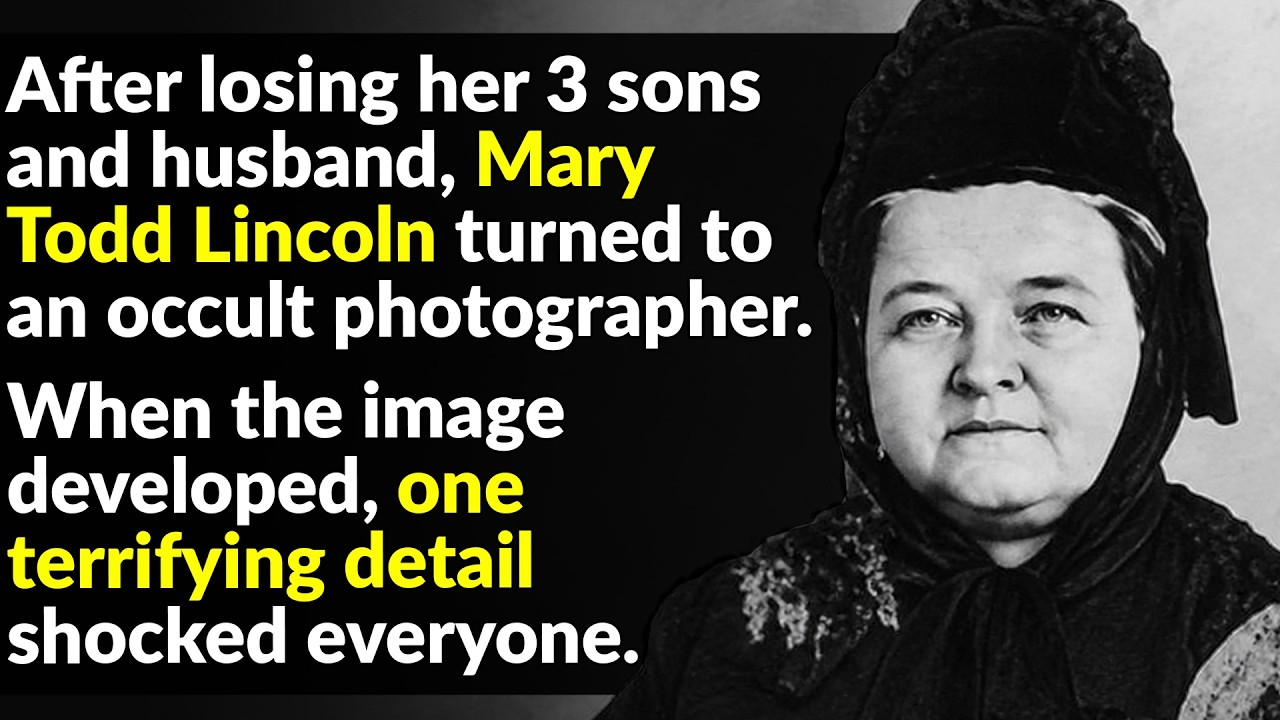
Oddly, she could not escape the fear of becoming poor. Then came the notorious photograph that made some people question her sanity. In 1872, Mary went to see William H. Mumler, a spiritualist photographer.
She kept her identity hidden and asked him to take her picture. When Mumler showed her the portrait, a ghostly image of her late husband appeared beside her. His wife stepped forward and forced Mary to admit who she really was and that the figure in the photograph was Abraham Lincoln. Her belief in spirit photographs, her growing paranoia, and her bizarre behavior with money drove her surviving son, Robert, to make an extreme decision.
He wanted to have her committed to an asylum for her own safety. He knew he would need a judge’s approval, because Mary would never agree to go willingly. So Robert secretly arranged a hearing. On May 19, 1875, Leonard Swett, a lawyer who had known both Mary and her husband, forcibly brought Mary to the courthouse.
She did not know why she was being taken there. Once she arrived, it became clear that a trial about her sanity was taking place, and she was at the center of it. Seventeen different witnesses testified about her behavior. An all-male jury declared Mary mentally ill.
She was to be sent to an asylum, but Mary had other plans. Before she was taken away, she went to several pharmacies and collected enough medication to kill herself. Fortunately, one pharmacist figured out her plan and gave her placebos instead of real drugs. Mary was committed to Bellevue Place Asylum, but she soon began planning her escape.
She secretly sent letters to her lawyer and his wife, who were also her friends. She also wrote to the editor of the Chicago Times. Suddenly, her son Robert became the villain in the eyes of the public, and many criticized the decision to lock her away. After all, Robert was now in charge of his mother’s money.
The unexpected publicity forced the asylum’s administrators to make a surprising decision. They told Mary she was free. Without wasting a minute, Mary left and went to live with her sister Elizabeth in Springfield. Later, she traveled to Europe and settled in France, where her health declined and her money ran low.
In 1881, she went to New York City and tried to get her pension increased. President Garfield had suffered the same fate as Lincoln, and his family was receiving government support. Despite her reputation for wasting money, Congress raised Mary’s pension and gave her an advance. Mary decided to spend the rest of her life in Springfield, Illinois, with her sister.
Exactly eleven years after her son Tad died, Mary fell ill and slipped into a coma. By the next morning, she was dead from a stroke. She was sixty-three years old. Long after her death, people still wonder what was actually wrong with her mind.
In her book The Emancipator’s Wife, Barbara Hambly claimed that Mary used opium throughout her life. In 2007, Jason Emerson published The Madness of Mary Lincoln, in which he argued that she suffered from bipolar disorder. Most historians view Mary as an interfering and disruptive First Lady, but many see her tragic losses as the root of her mental decline. Mary Todd Lincoln was not simply difficult, not simply strange, and not simply wasteful.
She was a woman who buried her mother as a child, watched three of her four sons die, and held her husband as the bullet struck him, and she carried that weight for the rest of her life.