Born in Hungary in 1849, Mary Katherine Horony would become known to history as Big Nose Kate, the woman most often remembered simply as Doc Holliday’s companion. But her life involved far more than her famous and volatile relationship with the tubercular gambler and dentist. Kate was born on November 9, 1849, in Rév-Komárom, Hungary, the daughter of a Hungarian physician and teacher. In 1860, her father, his second wife, and the children emigrated to the United States, arriving in New York City in September of that year before settling in the predominantly German area of Davenport, Iowa.
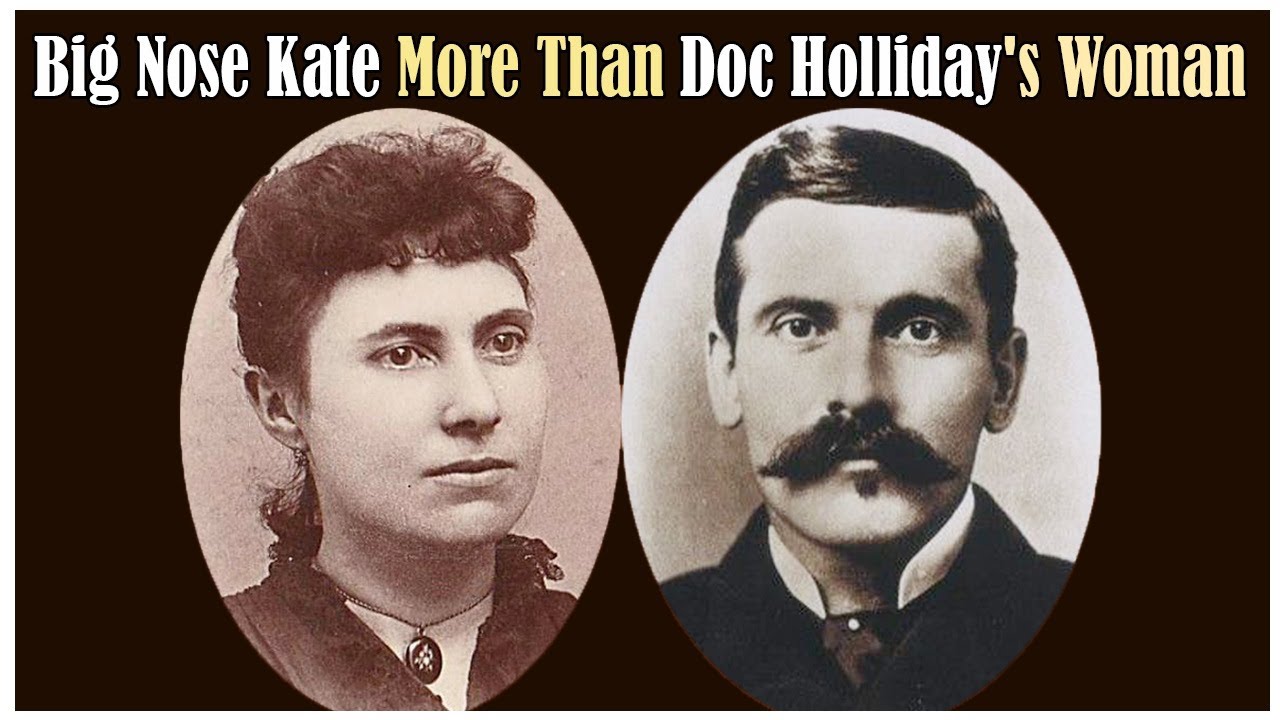
Tragedy struck in 1865 when both of Kate’s parents died within a month of one another. She and her younger siblings were placed in the care of relatives and then a guardian. At age 16, Kate ran away, stowing away on a riverboat bound for St. Louis, Missouri.
Kate later claimed that while in St. Louis, she married a dentist named Silas Melvin and bore him a son, but that both husband and child died of yellow fever in 1874. By the mid-1870s, she was working in Dodge City, Kansas, where she was fined for working as a prostitute in a sporting house run by Nellie Bessie Earp, the wife of James Earp. In 1876, Kate moved to Fort Griffin, Texas, where she met Doc Holliday in 1877.
Holliday once said he considered Kate his intellectual equal. The couple traveled together, registering as Mr. and Mrs. J.
H. Holliday at a boarding house in Dodge City. Doc worked as a dentist by day but spent most of his time gambling and drinking. The two fought regularly, sometimes violently, but always reconciled.
The couple later married in Valdosta, Georgia, and traveled through Colorado and New Mexico, where Holliday worked as a dentist and ran a saloon. They eventually met up again with Wyatt Earp and his brothers on their way to the Arizona Territory. Holliday was making money at gambling tables in Prescott while Kate worked as a prostitute in the upstairs rooms of the Palace Saloon. She left for Globe, Arizona, but rejoined Holliday soon after he arrived in Tombstone during the fall of 1880.
One of the most significant events of Kate’s life came on March 15, 1881, when three cowboys attempted to rob a stagecoach carrying $26,000 in silver bullion near Benson, Arizona. The driver, Eli “Bud” Philpot, and a passenger, Peter Roerig, were killed. One of the men implicated in the robbery was Bill Leonard, a former watchmaker from New York City who had become good friends with Holliday. After Kate had a fight with Holliday, County Sheriff Johnny Behan and Milt Joyce, a county supervisor and owner of the Oriental Saloon, decided to exploit the situation.
Both were members of the Tombstone ring. They plied Kate with alcohol and suggested a way for her to get even with Holliday. Kate signed an affidavit implicating Holliday in the murders and attempted robbery. Judge Wells Spicer issued an arrest warrant for Holliday.
The Earps found witnesses who could attest to Holliday’s whereabouts elsewhere at the time of the crime. Kate later said that Behan and Joyce had influenced her to sign a document she did not understand. With the cowboy plot revealed, Judge Spicer freed Holliday, and the district attorney threw out the charges, labeling them ridiculous. After his release, Holliday gave Kate money and put her on the stage.
She returned to Globe for a time but came back to Tombstone in October of that year. In a 1939 letter to her niece, Kate claimed she was in the Tombstone area with Holliday during the days before the gunfight at the O. K. Corral.
According to Kate, she was with Holliday in Tucson when Morgan Earp rode there on October 20, 1881, to request Holliday’s assistance in dealing with Cochise County cowboys who had threatened to kill the Earps. She wrote that Holliday asked her to remain in Tucson for her safety, but she refused and traveled with him and Earp. Kate reminisced about staying at C. S.
Fly’s boarding house, which bordered the alley where the gunfight took place. She accurately described minor details of the shootout, writing that on the day of the gunfight, a man entered Fly’s boarding house with a bandaged head and a rifle, looking for Holliday, who was still in bed after a night of gambling. The man, turned away by Mrs. Fly, was later identified as Ike Clanton.
City Marshal Virgil Earp had pistol-whipped Clanton earlier that day for carrying a rifle and pistol in violation of city ordinances. Ike testified afterward that he had tried to buy a new revolver but the owner refused to sell him one upon seeing his bandaged head. Clanton was unarmed at the time of the shootout. After Doc Holliday died in 1887, Kate married an Irish blacksmith named George Cummings in Aspen on March 2, 1890.
After working several mining camps throughout Colorado, they moved to Bisbee, Arizona, where she briefly ran a bakery. Cummings became an abusive alcoholic, and they separated in 1900. He committed suicide in Courthouse, Arizona, in July 1915. In 1931, the 80-year-old Kate contacted her longtime friend, Arizona Governor George Hunt, and applied for admittance to the Arizona Pioneers Home in Prescott.
The home had been established in 1910 for destitute and ailing pioneers of the Arizona Territory. It took Kate six months to be admitted since the home had a requirement that residents must be American citizens. She was admitted as one of the first female residents. She lived there and became an outspoken resident, assisting others with living comforts and writing many letters to the Arizona state legislature.
Kate died on November 2, 1940, seven days before her 91st birthday, of acute myocardial insufficiency, a condition she started showing symptoms of the day before her death. She is interred in the Arizona Pioneers Home cemetery in Prescott, Arizona.