Richard Pryor didn’t just perform chaos—he lived it. Born December 1, 1940, in Peoria, Illinois, he was raised in a brothel run by his grandmother, Marie Carter. His mother worked there as a prostitute, and his father acted as a solicitor, bringing in clients. This was the literal structure of his childhood, and it shaped everything that followed.
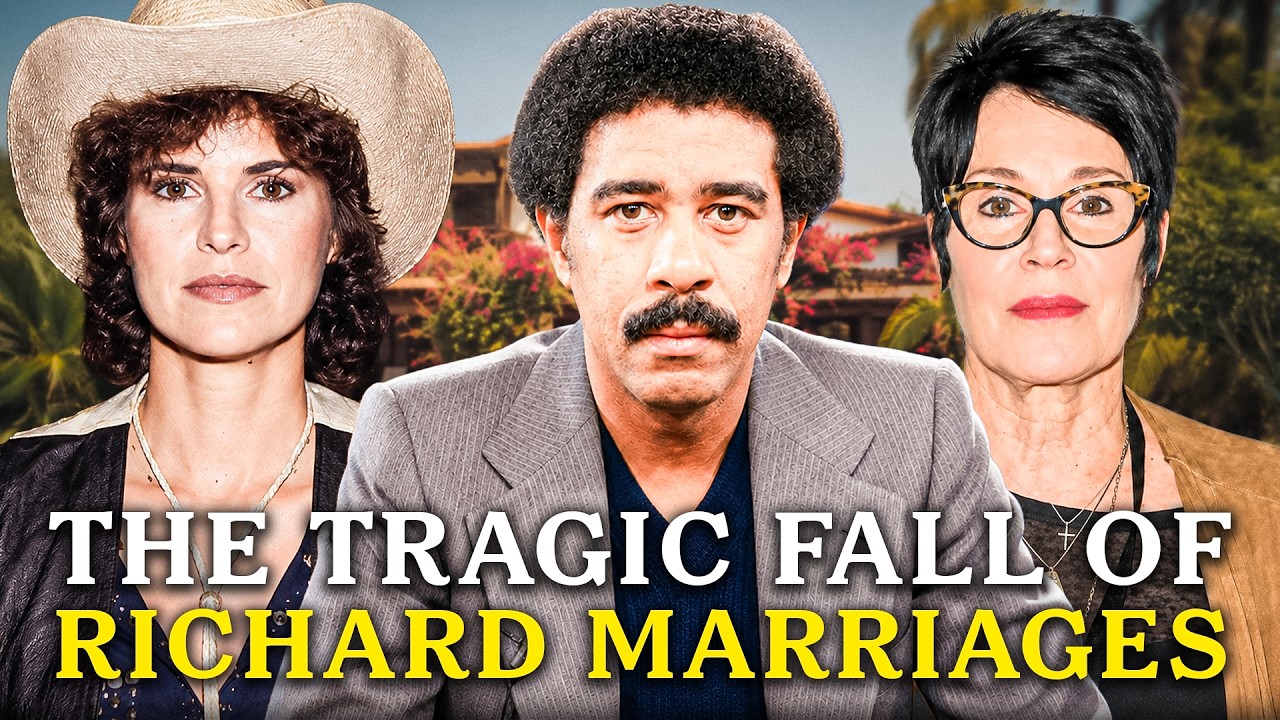
He was expelled from school at 14, worked odd jobs, and joined the army in 1958, where an altercation landed him in the stockade before his discharge in 1960. His first marriage came at 20 when he wed Patricia Price in 1960 or 1961. Their son, Richard Pryor Jr. , was born on April 10, 1962.
The marriage was brief, essentially over before the boy was born, with the divorce finalized in 1966. Patricia largely stayed out of the public record, but Richard Jr. grew up knowing a father whose career and substance use left little consistent space for fatherhood. Leaving Peoria behind, Pryor moved to New York to build a comedy career.
He began by imitating Bill Cosby’s clean, polished style, but in 1967, at the Aladdin Hotel in Las Vegas, he walked off stage mid-performance, realizing the comedy he was doing wasn’t his own. He retreated to Berkeley, California, absorbing the counterculture and black arts movements, and returned with material that was entirely his own—honest, raw, and rooted in his actual life. That same year, he married Shelley Bonus, though some records place the marriage in January 1968. Their daughter, Rain Pryor, was born in July 1969.
During the marriage, Pryor’s relationship with Maxine Anderson produced a daughter, Elizabeth Ann, born April 24, 1967. Rain later wrote and performed about her childhood extensively, describing a father who was warm, funny, and physically affectionate at his best, but entirely inaccessible when drugs shifted everything. Throughout the early 1970s, Pryor released albums that rewrote the possibilities of stand-up comedy: That Nigger’s Crazy in 1974, Is It Something I Said? in 1975, and Bicentennial Nigger in 1976, which won a Grammy.
In 1979, Richard Pryor: Live in Concert was released, considered by many scholars the greatest stand-up performance ever recorded. The divorces and arrests were tabloid stories; the comedy was the actual story—both fueled by the same damage that made his personal life so difficult. In 1977, Pryor was cast alongside Pam Grier in Greased Lightning. The relationship was genuine and intense.
Grier helped him work through reading difficulties connected to his complicated education history. She loved him and recognized he was damaged in deep ways, but she eventually acknowledged she couldn’t save him from himself. While involved with Grier, Pryor married Deborah McGuire on September 22, 1977. The marriage lasted about four months before its most dramatic public incident.
On New Year’s Eve 1977, an argument erupted at their Northridge home, and Pryor fired multiple rounds into cars of guests still in the driveway. Police were called, and he was arrested on assault charges, which were eventually reduced. McGuire later told People that Pryor couldn’t argue—he let things accumulate until he exploded. The divorce was finalized in August 1978.
In June 1980, Pryor set himself on fire at his Northridge home. The circumstances have been described inconsistently over the years; he sometimes framed it as a freebasing accident, at other times implying something more intentional. He ran down a street with his clothing on fire before being helped by passing motorists. He spent six weeks at the Grossman Burn Center undergoing skin grafts and reconstruction.
He later turned the ordeal into comedy in his 1982 film Richard Pryor: Live on the Sunset Strip, a celebrated piece of his catalog. Jennifer Lee, an actress and interior designer, had been hired to redecorate his home around 1980. Something genuine developed between them. They married in August 1981, but by October 1982 the marriage ended, with drug addiction cited as the reason.
Lee later described the addiction as the third person in the marriage, taking up all the room. She didn’t disappear from his life, however, and would return years later. In the mid-1980s, Pryor began a relationship with aspiring actress Flynn Belaine. Their son, Steven, was born in November 1984, two years before they formalized anything.
They married in October 1986, separated after about two months, and the divorce was finalized in July 1987. During that period, Pryor fathered a son named Franklin with Geraldine Mason in April 1987. Flynn gave birth to their daughter Kelsey in October 1987, after the divorce. The couple remarried on April 1, 1990, and divorced again in July 1991.
In 1986, Pryor was diagnosed with multiple sclerosis, though he didn’t announce it publicly until 1991. He suffered a heart attack in 1990, the same year he remarried Flynn, and underwent triple bypass surgery. His film career continued through the late 1980s and early 1990s, including Jo Jo Dancer, Your Life Is Calling in 1986, which he directed, as well as Moving and Harlem Nights in the late 1980s. By the early 1990s, the physical dynamism that marked his earlier performances was no longer possible.
Richard Pryor and Jennifer Lee remarried on June 29, 2001. He was 60, she was 53. The multiple sclerosis had advanced significantly; he used a wheelchair and required substantial daily assistance. By Jennifer’s own account, the decision to remarry him wasn’t complicated—she had loved him since 1980, and the intervening years hadn’t dissolved that.
She became his primary caregiver, managing his care, affairs, and legacy with a ferocity that defined his final years. After his death, her strong views on his estate put her in conflict with his adult children at times. Pryor had a heart attack in 2005, nine days after his 65th birthday, and survived. He had a third and final heart attack at his Los Angeles home.
Jennifer was present and attempted to revive him before emergency services arrived. He was pronounced dead at 7:58 in the morning. He was 65 years old. He had been married seven times, to five women, returning to the same two twice each.
He had six surviving children. Biographer Scott Saul, who wrote Becoming Richard Pryor, described the pattern precisely: the closer women came to Pryor, the more ugliness they often experienced. Having lived in fear growing up, he learned in childhood that love and harm were tangled together and never managed to separate them in his adult relationships. That was the inheritance of the brothel on North Washington Street, of the grandmother who loved him and hit him, of the parents who left.
The women who were close to him experienced real things—real fear, real legal proceedings, real scars. Yet those who knew him when substances weren’t overwhelming him describe someone warm, perceptive, and unexpectedly gentle. Rain Pryor’s account of her father made room for both the difficulty and the love, because both were real and present, and neither cancels the other. Jennifer Lee’s return in 2001 was not made by someone who had forgotten what happened in 1982.
It was made by someone who had weighed the full account and chosen him anyway. Seven marriages, one love story interrupted.