On the morning of May 19, 1536, within hours of her execution on Tower Green, Anne Boleyn’s body was wrapped in whatever cloth was available to the warders standing over her remains on the cold stone floor of the Tower of London.
No coffin had been prepared. No funeral arrangements had been made in advance. No official mourning had been ordered by the crown.
Henry VIII, the man who had torn the English church from Rome partly to marry this woman, had already moved on before her head was cold.
The absence of ceremony around her death and burial is one of the most revealing silences in Tudor history.
To understand the funeral Anne Boleyn did not receive, you first need to understand the funeral she should have received.
In Tudor England, the death of a queen consort was a solemn, elaborate, and deeply ritualized event. Queens who died of illness were laid out in state. Their bodies were embalmed, dressed in their finest robes, and placed on a hearse draped in black cloth. Ladies in waiting kept vigil through the night. Requiem masses were sung. Candles burned continuously.
Catherine of Aragon had received something close to this treatment, though even her burial had been diminished by Henry’s spite. She was buried not at Windsor with the kings of England, but at Peterborough Abbey, as a dowager princess rather than as a queen.
Even in that diminished form, Catherine had received embalming, a lead-lined coffin, a procession, masses, and a grave marker. She had been buried as someone.
Anne Boleyn would not even receive that.
The execution itself took place on a specially constructed scaffold on Tower Green, a private area within the Tower walls rather than on Tower Hill outside, where common criminals and traitors were publicly executed.
This choice was deliberate. Henry did not want a public spectacle.
The witnesses included several of Anne’s ladies in waiting, the constable of the Tower, Sir William Kingston, officials connected to Thomas Cromwell, the Lord Mayor of London, and a small number of aldermen.
The French swordsman brought especially from Calais completed his work quickly and with professional skill.
After the sword fell, her ladies rushed forward. There was no royal undertaker on standby. No official of the king’s household whose specific duty was the preparation of a condemned queen’s body.
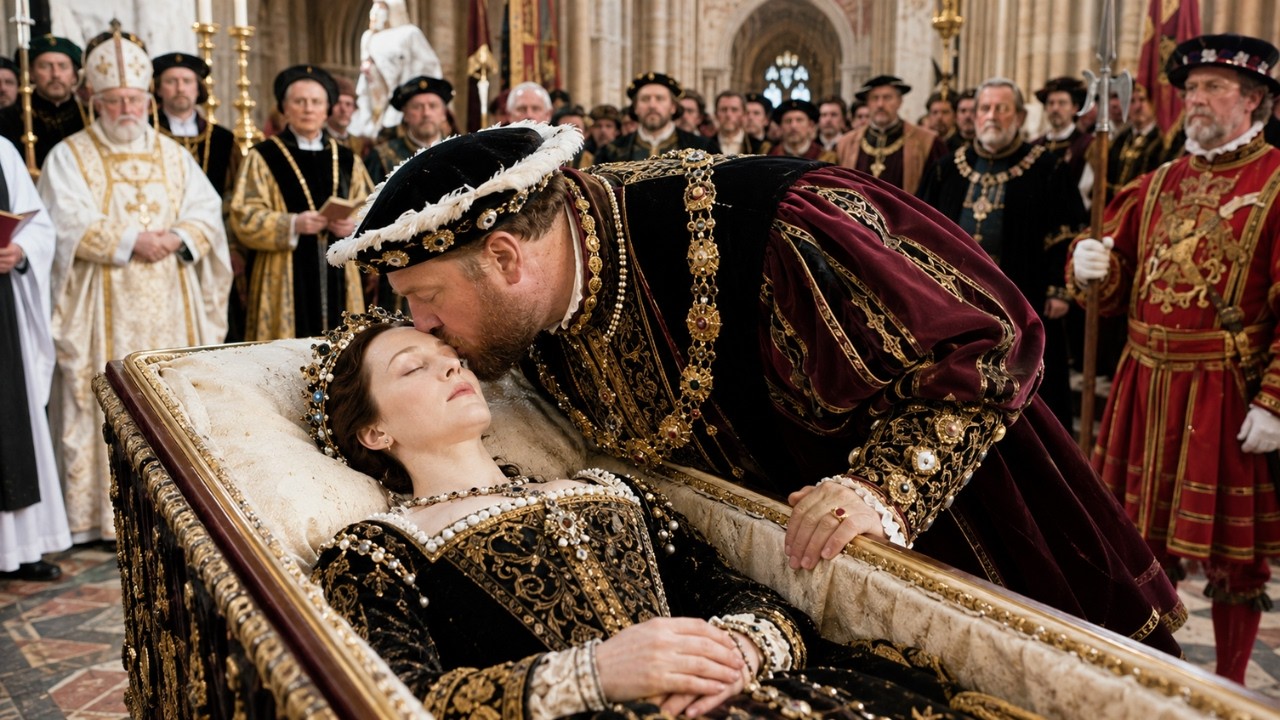
The women gathered Anne’s head and body and faced the immediate practical problem that no one had arranged a coffin.
Contemporary records confirm that the body was eventually placed in an old elm chest, an arrow chest that happened to be available in the Tower.
The woman for whom an entire religious reformation had been at least in part engineered was placed in a box that had been used to store arrows.
Her body was then carried the short distance from Tower Green to the chapel of St. Peter ad Vincula, the small church that stands within the Tower precincts.
The procession consisted of her ladies carrying or accompanying the chest and perhaps a small number of Tower officials. There was no music. There is no record of prayers being said at the graveside.
She was buried in the chancel of the chapel before the altar in an unmarked grave. No monument was erected. No plaque was placed. No official record was made of the precise location within the chancel floor.
The grave was by design meant to be forgotten. And it very nearly was.
For decades, the exact location of her burial within the chapel remained unspecified in the historical record.
It was not until the Victorian era, during restoration work at the chapel in 1876, that a serious effort was made to identify the remains beneath the floor. Remains believed to be those of Anne Boleyn were found in the approximate location where the historical accounts suggested she had been buried.
The remains were reinterred beneath a new marble ledger stone that bears her name. That stone is there today in the chancel of the chapel of St. Peter ad Vincula.
The hours and days following her execution were filled with calculated silences and deliberate erasures.
Consider Henry VIII’s behavior on the day of the execution. He had been at Hampton Court, not at the Tower. He reportedly dressed in white, went out to hunt, and in the evening reportedly attended a celebration of some kind.
He was betrothed to Jane Seymour the following morning, May 20, 1536, less than 24 hours after Anne’s head was removed from her body. They were married 11 days later.
The speed of this progression was noted with varying degrees of shock, admiration, and revulsion by diplomatic observers across Europe.
The erasure took many forms. Anne’s personal motto, “The Most Happy,” was removed from decorative schemes in royal residences. The intertwined initials H and A that had been carved or embroidered into surfaces throughout the palaces were dismantled or altered.
Her daughter Elizabeth, who was 2 years and 8 months old at the time of her mother’s execution, was declared illegitimate by act of Parliament.
Anne’s household was dissolved immediately. The women who had served her found themselves abruptly without positions, without patronage, and in some cases without prospects.
The charges against Anne warrant serious examination because they bear directly on the question of how her death should be understood.
She was accused of adultery with five men: a musician named Mark Smeaton, a courtier named Henry Norris, two other courtiers named William Brereton and Francis Weston, and her own brother George Boleyn, Lord Rochford.
The charge of incest with her brother was the most sensational and, to most serious observers of the evidence, the most demonstrably implausible.
All five men were also executed. All five, with the exception of Mark Smeaton, who confessed under what was almost certainly torture or the threat of it, maintained their innocence to the end.
The evidence presented at the trials was extraordinarily thin. The dates given for alleged encounters were demonstrably impossible in some cases.
Thomas Cromwell, Henry’s chief minister at the time, had determined that Anne needed to be removed. The charges of adultery provided a mechanism that would destroy her without requiring Henry to go through another complex and potentially embarrassing public argument about the validity of a royal marriage.
The men who were executed alongside Anne, or rather in the days before her since they died on May 17 and she died on May 19, represent their own tragedy within the larger tragedy.
Henry was 44 years old in 1536. His first marriage had produced a daughter, Mary, but no son. His second marriage to Anne had produced another daughter, Elizabeth, and at least two pregnancies that had ended either in miscarriage or in the birth of a son who did not survive.
Anne’s failure to produce a living son after the initial triumph of Elizabeth’s birth had progressively undermined her position at court.
The miscarriage she suffered in January 1536, reportedly of a fetus that appeared to be male, is believed by many historians to have been the moment at which Henry and Cromwell concluded that the marriage was finished.
Anne Boleyn was somewhere between approximately 28 and 35 years old when she died. She was a woman who had grown up partly in the French court, who spoke French fluently, and who had absorbed the cultural and intellectual currents of the early 16th century.
She was witty, politically astute, and deeply interested in the religious reform movements that would eventually produce the English Reformation.
Evidence suggests she maintained a French-language Bible and encouraged those around her to read scripture directly, a genuinely radical act in the context of early 16th-century England.
A woman who was placed in an arrow chest without a coffin was, among other things, a woman who had helped reshape the religious landscape of an entire nation.
The immediate aftermath of Anne’s execution also involved a set of responses from abroad.

The Emperor Charles V, Catherine of Aragon’s nephew, received the news with complex feelings. Anne’s fall and death represented in some sense a vindication of his position.
But Charles understood that the speed with which Henry had moved from execution to betrothal to remarriage suggested a king who was not about to become more tractable in his relations with the Holy Roman Empire simply because Anne was gone.
The French court, where Anne had spent significant time in her youth, received the news with a particular kind of dismay. The French ambassador at the English court sent detailed dispatches back to Paris that are among the most vivid contemporary accounts of what happened in those weeks.
Within England itself, the popular response to Anne’s fall was complicated by the fact that Anne had never been universally popular among the common people. Catherine of Aragon had been widely loved.
Anne had been associated in the popular imagination with the woman who had displaced her, which made Anne a target for resentment.
But the evidence also suggests that at least some people in England understood that something deeply wrong had happened.
Thomas Cromwell, who had been the primary architect of Anne’s destruction, would himself be executed four years later in 1540, brought down by the failure of the Cleves marriage he had arranged for Henry.
There is a kind of terrible symmetry to this that people have noted ever since.
Anne’s fall from the highest position a woman could hold in England to an unmarked grave in a chapel took from the beginning of the investigations against her to the morning of her execution approximately three weeks.
The woman who had been Queen of England, crowned at Westminster Abbey in a ceremony of extraordinary magnificence in June 1533, was tried, convicted, and executed in three weeks. And buried in an arrow chest before the afternoon was done.
The chapel where she was buried, St. Peter ad Vincula, is a small, unassuming building. Over the years following Anne’s burial, it received other victims of the Tudor state.
Katherine Howard, Henry’s fifth wife, was buried there in 1542 after her own execution on charges of adultery.
Lady Jane Grey, the young woman placed briefly on the English throne in 1553, was buried there after her execution in 1554.
Robert Devereux, Earl of Essex, the favorite of Queen Elizabeth I, who was executed for treason in 1601, was buried there as well.
The chapel became a place that held the human cost of English history in a way that no monument, however grand, could quite replicate.
The Victorian restoration of 1876 that led to the more careful marking of the burial locations was itself a product of the 19th century’s intense engagement with the Tudor past.
The marker placed over the site identified as Anne’s burial location states simply that she is there.
It does not mention the arrow chest. It does not record the absence of ceremony.
But the Victorian decision to resolve the uncertainty, to plant a marker in the stone floor of that chapel and say “she is here,” was a form of restoration that the 16th century had refused to offer.
The relationship between Anne Boleyn and her daughter Elizabeth is one of the most poignant threads in the entire story.
Elizabeth was 2 years and 8 months old when her mother was executed. She would not have had clear memories of Anne.
As queen, Elizabeth never publicly honored her mother’s memory in the elaborate ways that might have been expected. She maintained a kind of official silence on the subject.
What Elizabeth did do is more interesting than what she did not. She wore a locket ring, which has survived and can be seen today, that contained miniature portraits of herself and of her mother.
She wore it privately, not on public occasions, but she wore it.
The ring is a private memorial from a woman who could not afford to make public memorials.
The question of how Anne should be remembered has been one that each subsequent generation has answered differently.
The immediate Tudor period suppressed her memory. The Elizabethan period could not discuss her directly because she was the condemned mother of the reigning queen.
The 17th century saw various historical works that examined the charges against her with increasing skepticism. The 18th century tended to view her through the lens of classical notions of feminine virtue.
The 19th century romanticized her and gave her back her name on a stone in a chapel floor.
The 20th century produced serious historical scholarship that dismantled the charges against her methodically and established the overwhelming probability of her innocence.
The 21st century has continued to engage with Anne Boleyn at a level of popular and academic interest that shows no signs of diminishing.
She is one of the most written-about women in European history, which is itself a measure of how the silence that Henry VIII tried to impose on her memory has failed.
The man who put her in an arrow chest without a coffin could not keep her there.
Tower Green, the small open area where the scaffold stood on the morning of May 19, 1536, is still there. There is a memorial marker there today, a simple glass and stone structure installed in the early 2000s that lists the names of those who were executed on Tower Green.
Anne Boleyn’s name is on that list.
The Tower of London itself has a relationship with its own history that is unique among the surviving monuments of the medieval and early modern world.
Anne Boleyn is part of that presence. Her name is on the marker on Tower Green. Her supposed remains are beneath the stone in the chapel.
The deliberateness of the erasure that Henry VIII attempted is clear. The absence of a coffin. The unmarked grave. The suppression of official mourning. The rapid remarriage that was intended to communicate that she had been replaced as easily as a piece of furniture.
All of this was designed to remove her from history. And none of it worked.
The contrast between the magnificence of her coronation in 1533 and the improvisation of her burial in 1536 is one of the most powerful before-and-after images in the historical record.
Henry VIII remarried 11 days after her execution. He would marry four more times after Jane Seymour, for a total of six marriages.
Jane Seymour gave him the son he desperately wanted, the future Edward VI, but she died in childbed in October 1537, about 17 months after Anne’s execution.
Edward reigned for only six years before dying at 15 in 1553. Mary, Catherine of Aragon’s daughter, succeeded him. Then Elizabeth, Anne Boleyn’s daughter, succeeded Mary and reigned for 45 years.
The dynastic arithmetic that had seemed so clear and so urgent in the spring of 1536 produced outcomes that no one in that spring could have predicted.
Anne Boleyn was placed in an arrow chest and buried in an unmarked grave. Five centuries later, her name is known on every continent on Earth.
Henry VIII wanted to erase her. He placed her in a box without ceremony and covered her with stone and married another woman before the week was out.
And she refused to be erased.