In February 1945, a Japanese officer sat in a tunnel complex beneath volcanic rock on a small Pacific island, 500 miles south of Tokyo. By the dim light of a lamp, in air thick with sulfur, he wrote about something that had begun to frighten him more than the naval bombardment. His unit had spent months preparing the island. They had abandoned the old doctrine of meeting the enemy at the water’s edge and destroying them in the surf, because they had seen what happened to garrisons that tried it.
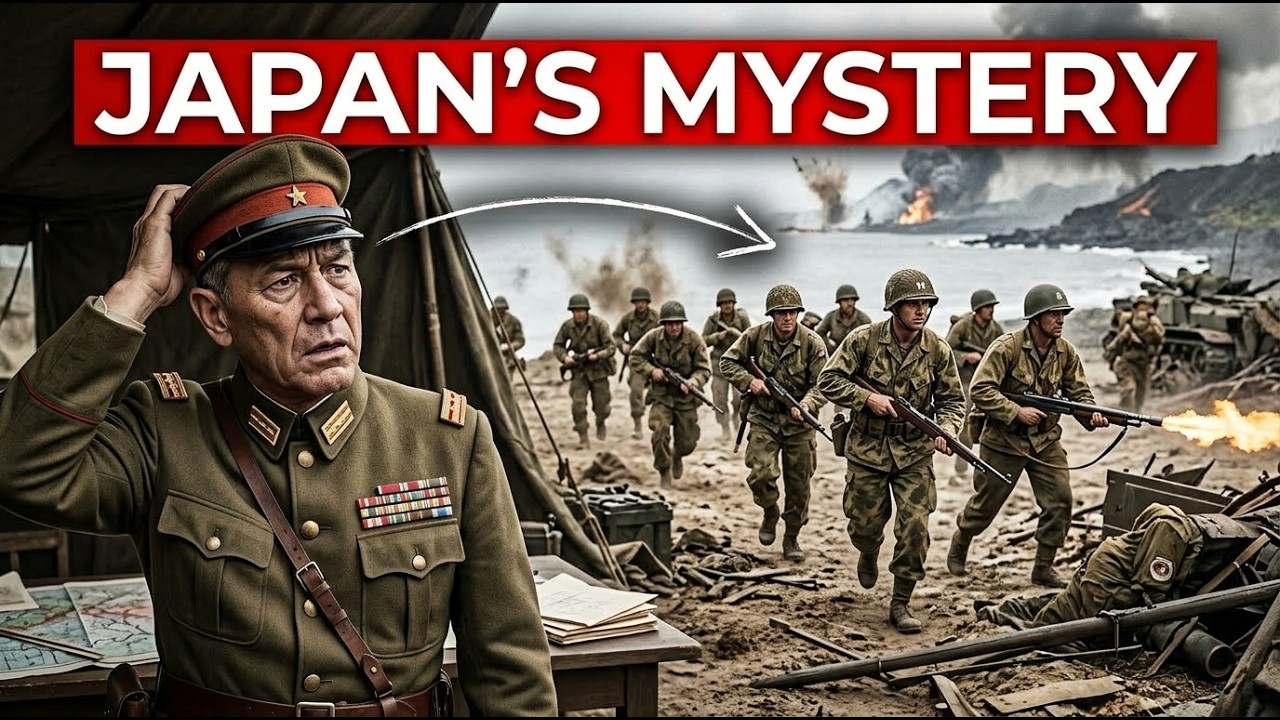
Instead, they had dug miles of tunnels, interlocking positions carved into rock, and guns zeroed to fire along the beaches rather than out to sea. These guns were hidden in concrete and could only be seen when they opened fire. Beneath this engineering lay an assumption about the enemy, a reasonable one derived from centuries of thought about what happens to soldiers in prolonged combat. The assumption was that the Americans would deteriorate.
Landing troops on a fortified beach costs you your best men first. Units that reach the shore are shattered in the first hours. Officers die, sergeants die, and platoons fragment into groups of strangers. Those who survive the first day are exhausted, deaf, dehydrated, and have watched friends killed.
Reinforcements arriving are new replacements who do not know the men beside them. According to this logic, the third day of an amphibious battle should find the attacking force weaker, clumsier, and slower than it was on the first day. Bleed them, make every yard expensive, and eventually the attack collapses under its own weight. That was the plan.
It was not stupid. It was calculated. But what the officer in the tunnel was writing about was the failure of those calculations. The Americans on the third day were not more clumsy.
They were better. Their attacks were more coordinated than those in the first morning. They had stopped doing many things that got men killed on the beach, and begun doing things they had not done at all before. Tanks, infantry, engineers, and flamethrowers worked together in combinations that had not been seen on the first day.
Formations that should have collapsed were instead learning at a speed the Japanese analysis had no category for. The Japanese assessment needs context because it was built on evidence. Japanese planners held a specific model of the American soldier, and parts of it were accurate. They believed the Americans were overwhelmingly superior in matériel and would drown any position in firepower.
They believed American infantrymen lacked the individual endurance and willingness to die that Japanese doctrine demanded. And they believed, crucially, that American units, composed of citizens rather than men culturally prepared for death, would lose cohesion once casualties reached a certain level. Their entire strategy for island defense by 1944 rested on that final belief. If you could not defeat the American fleet, you made the cost of every island so high in American lives and time that the political will supporting the campaign would collapse.
This is why fortifications changed. Beach defense gave way to defense in depth, where landings were allowed and then met with a battle fought from underground, where naval fire and airpower were less effective, and prolonged as long as possible. The theory of victory inside that strategy was attrition of morale. The garrison expected death.
The attacker was supposed to collapse first. For that to work, the attacker’s efficiency had to decline over time. The first mechanism that refuted this expectation is an organizational detail that seems trivial in writing. Early in the war, a Marine rifle squad was built traditionally, with a squad leader and a cluster of riflemen, while automatic weapons were held at higher levels.
When that squad took casualties, it did what most squads in most armies do. It became a smaller version of itself, less capable, more dependent on the survival of the single person in charge. Inspired by the fighting at Guadalcanal, Bougainville, and New Georgia, and by jungle combat experience where units were constantly separated by terrain, the Marine Corps rebuilt the squad from within. The new squad consisted of 13 men: a squad leader and three fire teams of four men each.
Each fire team had its own leader and its own automatic weapon. The effect of this is worth spelling out. The squad is not a single organism with one brain. It is three small organisms, each with its own leader, its own base of fire, and its own ability to maneuver, plus a fourth coordinating among them.
Kill individuals. Kill the squad leader. Three fire team leaders remain, any of them can take command, and the fire teams keep functioning during the transition. Kill an entire fire team.
You have not destroyed the squad’s ability to fire and move, because any of the remaining teams can still do both. Merge two half-strength squads from different platoons, as actually happens in a long battle, and the fire teams re-form like building blocks, because every man in the core knows what a fire team is and what his position in it means. Compare that to a structure that concentrates automatic weapons and decision-making at the top. In that structure, casualties among leaders translate directly into paralysis.
The Marine structure converted casualties into promotions. A corporal who was a fire team leader at dawn takes command of the platoon by noon, and he knows how to do it because he has been performing a smaller version of the same job. There is a second result, less obvious but no less important. A four-man team with its automatic rifle can be assigned an independent mission.
It can clear one position, cover one trail, or advance down one corridor while the rest of the platoon provides support. This means the platoon commander has nine maneuvering elements instead of three, and the company commander has three instead of one. Against a defense built from hundreds of small mutually supporting positions carved into rock, which is exactly what the Japanese built, the ability to subdivide counts for more than numbers alone. You are not attacking one defensive line.
You are solving a very large number of individual problems one after another, and the unit that can split into more pieces solves more of them per hour. This is a doctrinal answer to the strategy the Japanese were following. If the enemy’s plan is to bleed off your leadership, build a unit that produces leaders faster than he can kill them. The second mechanism is stranger, and possibly more decisive.
The Americans industrialized the process of learning. After every major operation, American units wrote reports about what happened, not as history but as instruction. What worked. What failed.
What killed our men. What the enemy did that we did not expect. Those reports went up the chain of command, were analyzed, compared, and came back as training circulars and memoranda to units that had not yet fought that battle. The result was that a Marine division about to land had in hand the specific and current mistakes of the division before it, sometimes within weeks.
The bloodiest example is also the clearest. In November 1943, at Tarawa, an amphibious assault hit a coral reef that planners had badly misjudged. Landing craft hung up hundreds of yards offshore, and Marines had to wade in the open under fire, being slaughtered as they did. Communications failed.
The naval bombardment was too short, leaving defenses largely intact. The lessons were drawn immediately and acted upon at scale. Far more tracked landing vehicles that could crawl over reefs rather than boats that hung up on them. Longer, better-directed preliminary bombardment with different fuses to attack concrete rather than just churning sand.
Underwater demolition teams sent in ahead of time to survey and clear obstacles, men swimming toward an enemy beach carrying boards and grease pencils. Waterproof radios and relays to ensure the command net did not die in the surf. This is an institution receiving 3,000 casualties, examining them coldly, and turning them into changes in equipment and procedure within months. The same process operated on a shorter cycle inside a single battle.
The method of attack that succeeded against cave systems and deep bunkers existed in no prewar manual. It was assembled during combat at Peleliu, Iwo Jima, and Okinawa from what was available at hand. A tank or self-propelled gun to fire directly into the opening. Infantry to pin down anything that could fire back.
Engineers with demolition charges to reach the position in dead ground. A flamethrower to make the interior uninhabitable. Then more explosives to seal it permanently. The men called it the “blowtorch and corkscrew” method, and it was refined position by position in daylight by sergeants and lieutenants swapping notes on what had worked in the last hole in the rock.
The third mechanism most directly attacks the Japanese attrition theory. The Americans evacuated their wounded off the island. A Marine wounded on the third morning had reached him a Navy corpsman attached to his platoon, a man who lived with the squad, knew them by name, and advanced under fire as routine. From there he went back through a chain built to be fast: an aid station, evacuation to the beach, a landing craft to a transport ship, and in serious cases a hospital ship offshore with surgical facilities that would have been respectable in any inland city.
Compare this to the attrition model. The Japanese plan assumed casualties were permanently subtracted from American strength. A very large portion of American wounded were treated, survived, and a good number returned to their units. The subtraction was smaller than the calculations assumed.
And there is a psychological dimension, harder to measure and probably more important. A man who believes he will be reached if he is hit will move when told to move. The knowledge that a corpsman is back there somewhere, and that he will come, matters more on the third day than on the first, because by the third day everyone has seen it happen. The garrison had none of that.
A Japanese soldier wounded in a tunnel on Iwo Jima had, in most cases, no means of evacuation, limited medical resources, and no hope of survival. His officers knew this. His men knew this. This is why the third day looked different from the first.
On the first day, the assault teams did what they had been trained to do. By the third day, they were doing what they had learned worked on this island, against this rock, on this ground, and they were passing it to each other, from squad to squad, within the same hour. The men who figured this out did so from a range where the flamethrower operator had to stand, and the life expectancy of a flamethrower operator was measured in a way no one wants to write down. The Japanese were not incapable of learning.
The officer in the tunnel was a professional who designed his defensive plan with real brilliance. But three structural factors prevented the Japanese from replicating this learning cycle. The first factor is a combination of physics and combat doctrine. A garrison ordered to hold to the last man does not produce veterans.
It produces casualties. Those who learned the most about how the Americans fought, the survivors of Tarawa, Saipan, and Peleliu, mostly died on those islands because doctrine demanded it and there was no realistic mechanism to evacuate them. The American system did the opposite. Marines who survived one island moved to the next one, and a division that was badly hurt was rebuilt around a core of men who had fought before.
Knowledge moved from battle to battle inside the minds of soldiers. The second factor is communications. The lateral flow that made American learning fast, a sergeant telling another sergeant what worked on the last strongpoint, requires radios in the hands of small units and the freedom to reorganize in the field without permission. Japanese units fighting from tunnels under constant bombardment lost their telephone lines within hours and had very limited use of radio at that level.
Their defense was, by necessity, pre-planned in meticulous detail, then executed by isolated groups that could not be redirected once fighting began. This is a devastating asymmetry. The American side could adapt during the battle. The Japanese side had to have adapted before it began.
The third factor is strategic timing. Improvement requires resources. American units that learned they needed more flamethrowers got them, landed on the beach within the same week. They learned they needed armored bulldozers, tank-mounted flamethrowers, more demolition explosives, more stretcher bearers, more water, and it all arrived because behind the beach there was a supply system capable of providing almost any adjustment on demand.
A besieged island garrison could adjust nothing. What they arrived with is what they would die with, and with every day their ammunition, water, medical supplies, and men decreased while the enemy increased. So the two sides ran on opposite curves. The defenders were at their strongest on the first morning, then grew weaker with every passing hour.
The attackers were at their weakest on the first morning, then performed better with every hour, until at Iwo Jima over 5 weeks they reached a proficiency at destroying caves that the garrison’s original planners could not have imagined. None of this should be read as a story about ease. It was not. Casualties in those battles were appalling, and the Marine divisions that improved did so at a price paid by individuals in a way no organizational chart can describe.
The improvement was bought with the lives of the people who improved. The verdict is this. The Japanese defensive strategy of the late Pacific War was built on a model of the enemy that was right about matériel and wrong about personnel. They were right that the Americans relied on overwhelming firepower.
They were right that American infantrymen as individuals were not trained to the standards of the regular Japanese soldier. They were right that American public tolerance for casualties was a strategic factor, and that inflicting enough of them was theoretically the only path to a negotiated outcome. But they were wrong about the direction of the curve. They planned against an enemy that would be bled out.
They met an enemy that treated the first day of battle as a first draft and rewrote it while the battle was still ongoing. The mechanisms were simple and direct. A squad of three independent fire teams, each with its own leader and its own automatic rifle, so that casualties produced replacements from below rather than paralysis. An after-action reporting system fast enough that the mistakes of the last island reached the hands of the division doing the next landing.
Radios and enough confidence in junior leaders that a technique devised at one strongpoint was in use at the next one within an hour. A supply chain capable of delivering everything the lessons demanded within the following week by ship. Put those elements together and you have an army that improves under the impact of damage. That is a very strange property, and it is the opposite of what almost every military theorist in history expects.
The officer in the tunnel was writing by lamplight, watching a formation that by every rational calculation should have collapsed, and noting that it did not. He had no explanatory framework for this, because in his view, men who learn are those who survive to the end, and by then it is too late for the learning to make any difference. In the American framework, the learning did not have to last to the end of the war. It only had to last until the next morning.
The officer in the tunnel is a composite representative figure. The Japanese defensive concept of bleeding the American will, the shift to defense in depth, and the astonishment of Japanese commanders at American adaptability are all documented in records, memoirs, and postwar interviews. The fire team reorganization, the lessons of Tarawa, and the attack methods developed against cave systems are all documented in the records.
The men who learned that job learned it the hard way, and most of them never spoke about it afterward.