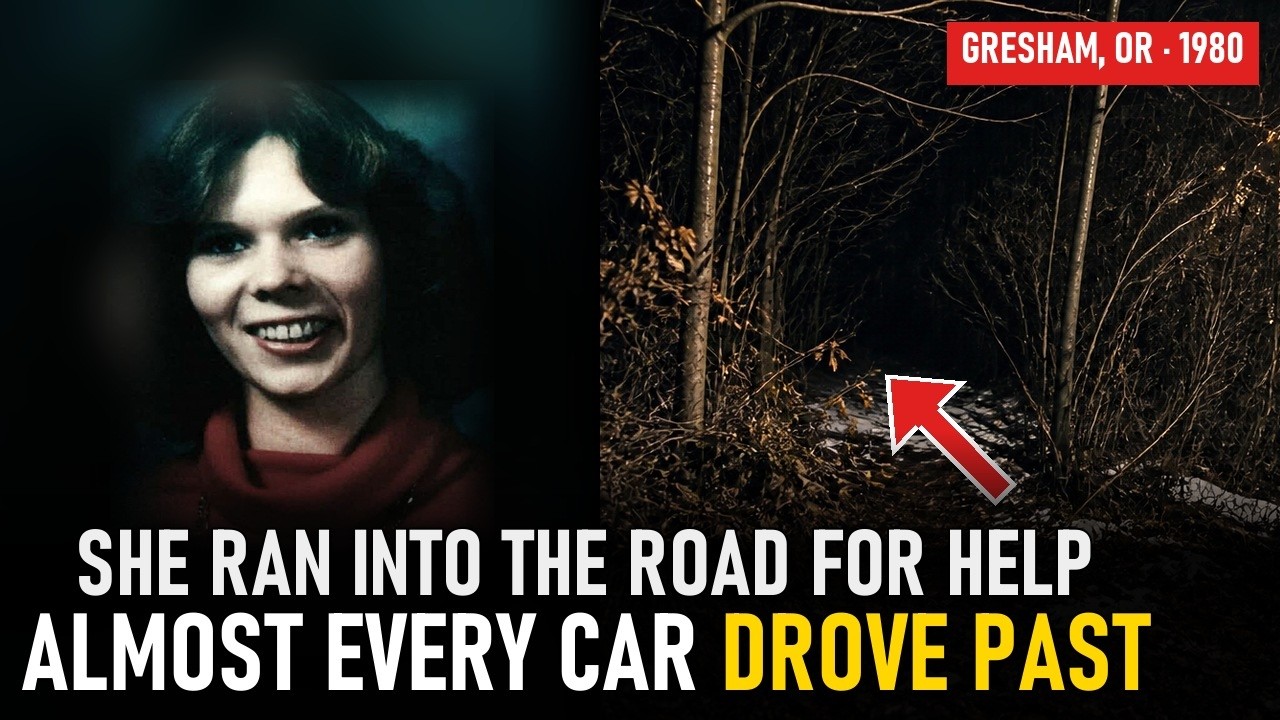
On a Tuesday night in January 1980, a young woman ran out of the trees along Kane Drive in Gresham, Oregon, and into oncoming traffic. Her face was bloody. It was close to 7:00, and cars swerved to avoid hitting her.
One driver had already turned into a parking lot when she saw the young woman. Decades later, she told a courtroom what she had thought in that moment: “If she really needs help, I thought someone else will stop.”
One driver did stop. She got out of her car and walked over. By the time she reached the young woman, a man was standing beside her with his arm over her shoulder. Neither of them answered when the driver asked what was going on. The two walked back toward the tree line.
The next morning, students found the young woman’s body. Her name was Barbara May Tucker. She was 19 years old. Her family called her Barbie.
Barbara grew up in the Westmoreland neighborhood of Southeast Portland. She was the youngest of seven children. She was tall, nearly six feet, strong and athletic, with warm brown eyes. She played basketball at Cleveland High School and competed with the DECA business club at the national level.
She sewed, knitted, and crocheted. She wrote songs, played guitar, and wrote poetry. A family friend called her a goofball. Her childhood best friend remembered that she loved to have fun but was serious about staying out of trouble.
Barbara was the first person in her family to go to college. She was a sophomore at Mount Hood Community College in Gresham, studying business. She took classes at night. Her plan was to open a craft supply store.
On the afternoon of January 15, 1980, she and her friend Lori Stomps went to the gym. They came back early, and Barbara made spaghetti for the two of them. They had been signed up for the same evening class on consumer credit, but Lori had dropped it.
“We were supposed to go together,” Lori would say later, “but she went and I didn’t.”
Barbara called her mother that day and said that if class let out early, she might stop by a friend’s apartment for ice cream. Around 6:30, she left for class. She never got there.
The edge of the Mount Hood Community College campus ran along Kane Drive, a busy road. Between the road and a campus parking lot was a thin strip of trees. That night, there were patches of snow on the ground.
Witnesses saw a woman waving her arms with a bloody face. One saw a man peeking through the bushes near the parking lot. Another saw a woman with mud on her pants at the side of the road.
One by one, the drivers explained it to themselves. An 18-year-old thought it was a prank. A student thought the woman was on drugs. Another witness took her for a hitchhiker. Nobody saw the whole thing.
One woman, Lisa Michaels, got out of her car. Barbara ran out in front of her. Michaels stopped and walked toward her. By the time she got there, a man was standing with Barbara, his arm over her shoulder. Michaels asked what was going on. Neither of them answered.
She went back to her car. While she did, the two of them walked back toward the tree line.
Barbara was found the next morning, face down in the dirt, partially clothed. Around her were her red wool gloves, her purse, and her textbooks. The medical examiner found that she had been sexually assaulted and that she had died of blunt force trauma to the head. There were signs that she had fought back.
The investigation was not small. Hundreds of tips came in. Detectives worked the case for years, and new detectives worked it after them. No name held. One name never came up at all.
Barbara’s mother, Louise Tucker, wrote to prosecutors often. A few months after her daughter died, she wrote: “If it takes 10 years, I don’t care. I just can’t let it rest.”
A year after the murder, she told the local paper: “It’s unreal that people care so little about another human being.”
Barbara’s father, Albert, handled it differently. He would leave the room when Louise talked about their daughter. It was the first time the family had ever seen him cry. Albert Tucker died in 1989. Louise died in 1995. Neither parent ever learned who killed their daughter.
The swabs taken at Barbara’s autopsy stayed in storage for 20 years before technology caught up. In the year 2000, they were sent to the Oregon State Police Crime Lab, which developed a DNA profile of a man. It was compared against existing databases. There was no match.
For another 15 years, the file passed from detective to detective. In 2015, it landed on the desk of Gresham detective Aaron Turnidge. He got it on the anniversary of the murder. By his count, there had been 35 years of detectives before him.
“If that means working around the clock,” he said, “that’s what happens.”
Gresham did not have a cold case unit. Detectives worked the case on top of everything else on their desks. A criminalist named Diana Grossi kept going back through the physical evidence and looking into new techniques.
A few years before the arrest, one of Barbara’s sisters was watching television. Susan Pader saw an episode of 20/20 about genetic genealogy. She reached out to the genealogist from that program herself.
“I’m just so thankful that I saw 20/20 that night,” she would say later.
The DNA profile from 2000 was sent to a company in Virginia called Parabon NanoLabs. There, the case went to C.C. Moore, the company’s chief genetic genealogist. The scene DNA was uploaded to a public site called GEDmatch.
It produced a match, but the relative who matched shared less than 1% of their DNA with the man Moore was looking for. She had to find the common ancestors and build down, generation by generation.
“We started off with not much to work with,” she said.
One prediction stood out. Parabon’s scientists predicted that the man whose DNA was on those swabs almost certainly had red hair. It was the most confident red hair prediction Parabon scientists had ever had.
Moore built out the family tree. In World War II draft registration cards, she found men on one branch listed with red hair. She followed it.
“Follow that red hair down,” she said, “and then I landed in Oregon.”
By March of 2021, Moore had named a likely contributor to the DNA profile. She would later say that the case stuck with her unlike any other.
“I would wake up thinking about it and go to sleep thinking about it,” she said.

The man was Robert Arthur Plimpton. In 2021, he was 58 years old. He lived less than a mile and a half from where Barbara Tucker’s body was found, in a house he shared with his wife and their son. He worked as a river guide.
In January 1980, Robert Plimpton was 16 years old. He was a student at Reynolds High School, not the college, and he lived about half a mile from the Mount Hood Community College campus. As a teenager, by his own lawyer’s description, he had a shock of red hair.
His name had never once come up in the original investigation.
Five years after Barbara’s murder, in February 1985, a woman named Patricia Spangler accepted a ride in his truck. He shoved her into the footwell and tried to bind her arms with duct tape. She got away. He was convicted of kidnapping and served about two and a half years.
In the 1990s, there were drunk driving convictions and parole violations. In 1997, he was accused in an attack on another woman, but a grand jury found the evidence insufficient and the charges were dismissed.
None of it was ever connected to Barbara Tucker.
In 2021, Gresham detectives put Plimpton under surveillance. They waited. He went out on a bike ride along the Sandy River and spat a piece of chewing gum onto the ground. Detectives picked it up, documented it, and sent it to the Oregon State Police Crime Lab.
The DNA on the gum matched the DNA from Barbara Tucker’s autopsy. The prosecutor put the chance of that match being a coincidence at 1 in 650 quadrillion.
“It’s like winning the Powerball lottery,” she said, “2.2 billion times in a row.”
On June 8, 2021, detectives arrested Robert Plimpton. It was 41 years and almost five months after that night on Kane Drive. When questioned, he made one flat denial, then asked for a lawyer.
That same night, detectives went to Susan Pader’s door. She had assumed that whoever did it had to be dead by now.
“I told you,” a detective said to her that night, “I told you I’d solve it.”
“It was amazing,” Susan said. “It was really good news. I’d given up.”
Plimpton pleaded not guilty. He had been 16 that night, but he would be tried as an adult. He chose not to let a jury decide it.
The trial began on February 26, 2024, in Multnomah County Circuit Court. One judge, Amy Baggio, would decide it. Two of Barbara’s sisters were in the courtroom every day. A third watched remotely.
His lawyers did not argue that the DNA science was wrong. They argued that it was distracting, a “bright shiny object” pulling attention away from the witnesses. The best witness, they said, had described a tall man, as tall or taller than Barbara Tucker. Barbara was almost six feet. Robert Plimpton is five foot eight.
Not one witness, they said, had remembered red hair. Investigators had never tested Barbara’s clothing for DNA. The defense also raised the possibility that Barbara and Plimpton had had consensual sex at some point, despite his earlier denial that he had never had sex with her at all.

Prosecutors told the court there was no evidence the two of them had ever known each other. The defense called it unmistakable, unavoidable reasonable doubt.
On March 15, 2024, Judge Baggio gave her verdict. She found Robert Plimpton guilty of first-degree murder and of four counts of second-degree murder, each under a different legal theory.
“This court has zero doubt whatsoever that Robert Plimpton beat Barbara Tucker in her head and face until she died,” she said. “He did.”
She did not find him guilty of rape or sexual abuse because the state could not prove beyond a reasonable doubt that Barbara was still alive at the time. It was a narrow finding and a deliberate one.
When the verdict came, two of Barbara’s family members held each other and cried. Her sister Alice said she was thrilled that it was finally solved.
“Barbie was a special little girl,” she said. “She was bright, bubbly, caring, all of those things.”
Plimpton’s lawyers put out a statement. “We will appeal,” it said, “and we are confident that his convictions will be overturned.”
On October 3, 2024, Robert Plimpton, now 61, came back to court to be sentenced before a different judge, Kelly Sky. His lawyers asked that he be eligible for parole after 20 years. They pointed out that he had no criminal record since the 1990s and spoke about what they called the transience of youth.
Then Patricia Spangler, the woman from the truck in 1985, spoke. “I could have easily been his next murder victim,” she said.
Judge Sky sentenced him to life in prison with a minimum of 40 years before he can be considered for parole. He was taken into the custody of the Oregon Department of Corrections.
“I don’t think he’s had any remorse, any regret, any conscience,” Alice Wan said afterward.
Robert Plimpton did not speak. When one of Barbara’s relatives stood and shouted at him to look at them, he took off his glasses and rubbed his forehead.
At the same hearing, the prosecutor, Kirsten Snowden, opened a baby book. It was Barbara’s, the one Louise Tucker had kept for her seventh child, with a faded yellow cover. On one blank page, there was an entry dated February 25, 1984. That was Barbara’s birthday. She would have turned 24.
Snowden read it aloud. Her voice was shaking.
“Barbie,” Louise had written, “Your mommy loves you and misses you so very much.”
And then: “I just pray that they will get him soon.”
It was read in a courtroom 40 years after she wrote it, with the man she was praying about sitting at the defense table.
After the verdict, Gresham police gave Barbara’s family something that had sat in evidence for more than four decades. Not a DNA sample. One of her earrings.
“It’s just nice,” Susan said, “to have something of hers.”
On a January night in 1980, car after car went past her. It took 44 years, but in the end, someone did stop.