Frank Jack Fletcher won three consecutive carrier battles against the Imperial Japanese Navy. Six enemy carriers went to the bottom of the Pacific under his command in 90 days. No other American admiral accomplished that in the entire war. When it was over, his own navy quietly removed him from the war he was winning.
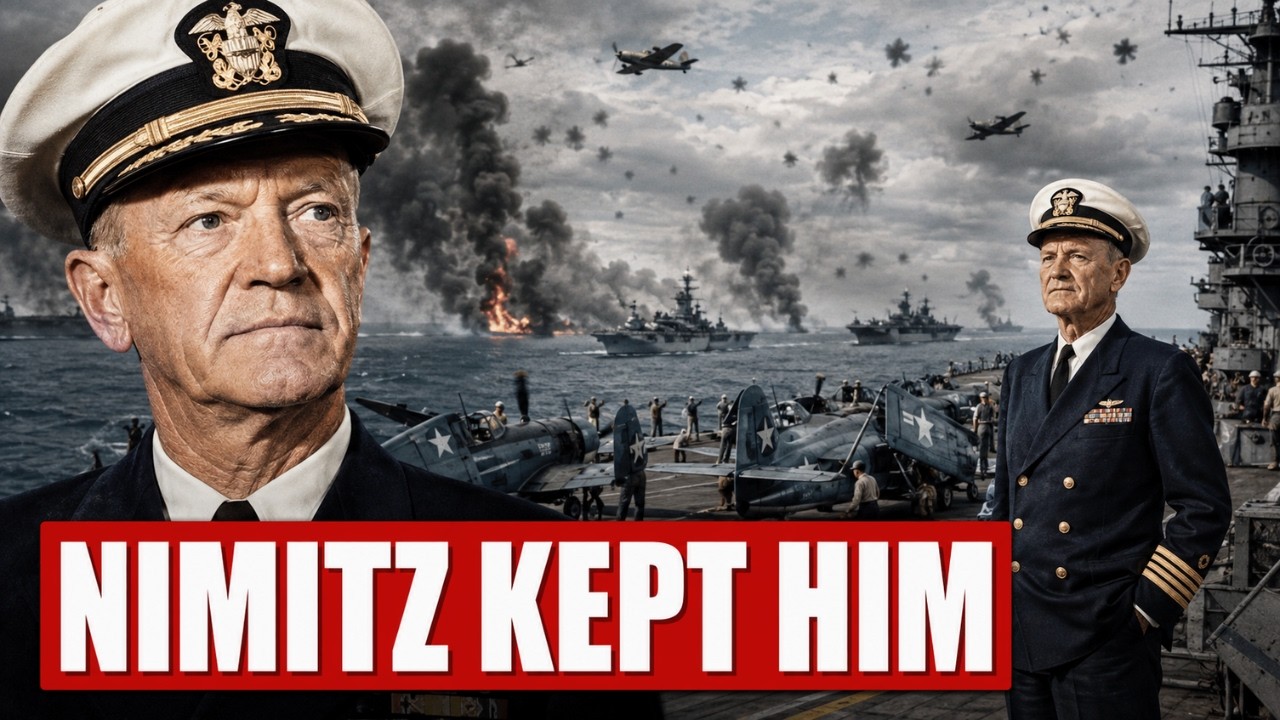
Fletcher began his career decades before carriers existed. In April 1914, he was a 29-year-old lieutenant at Veracruz, Mexico, where he took command of a Mexican steamer, filled it with civilians, and brought it out of the harbor under enemy fire. The next day he returned by train under a flag of truce and rescued more people. He received the Medal of Honor.
His uncle, Rear Admiral Frank Friday Fletcher, who commanded the American naval mission at Veracruz, also received the Medal of Honor for the same operation. They remain the only uncle and nephew in U. S. Navy history to both receive the award.
Fletcher also earned the Navy Cross in World War I commanding a destroyer on convoy duty in the North Atlantic. His courage was established long before World War II began. In December 1941, after the attack on Pearl Harbor, the Pacific Fleet was shattered. The carriers were nearly all that remained.
In late December, Fletcher was sent with the carrier Saratoga to relieve the Marine garrison at Wake Island. One day short of the island, an order arrived from Vice Admiral William Pye, then acting Pacific Fleet commander, to turn back. Fletcher followed the order. Wake Island fell the next morning.
In Washington, Admiral Ernest King read the reports and filed the incident under Fletcher’s name. When Chester Nimitz took command of the Pacific Fleet at the end of January 1942, he had few experienced officers to choose from. He gave Fletcher command of the carriers. Fletcher was a surface officer, not an aviator.
He had never landed a plane on a moving deck. But Nimitz had watched his work for 20 years and trusted him. In May 1942, the Japanese moved toward Port Moresby on the underside of New Guinea. Nimitz sent Fletcher with two carriers to stop them.
The Battle of the Coral Sea became the first carrier battle in history. Neither fleet ever sighted the other. All combat was conducted by aircraft. Fletcher knew his limits.
When Rear Admiral Aubrey Fitch, a veteran aviator, arrived with his task force, Fletcher placed him in charge of the air battle while keeping overall command. He quietly stepped aside and gave the part of the fight that Fitch knew best to the man who knew it better. On the morning of May 4, Fletcher launched every plane on Yorktown against a Japanese seaplane base at Tulagi. On May 7, his planes sank the carrier Shoho in 11 minutes.
The next day they heavily damaged the carrier Shokaku and destroyed the air groups of Zuikaku. Both carriers were so badly hurt they could not sail to Midway a month later. The Japanese canceled the invasion of Port Morresby. It was the first time in the war they had been turned back anywhere.
But the Americans lost the carrier Lexington, which had to be scuttled after internal explosions. King calculated the loss and held Fletcher responsible for it for the rest of his career. On May 29, 1942, Nimitz wrote to King praising Fletcher’s work at the Coral Sea and recommending him for promotion and a Distinguished Service Medal. King did not respond.
He did not approve either recommendation. The letter went into a drawer. On June 4, 1942, four Japanese carriers under Vice Admiral Chuichi Nagumo moved toward Midway Atoll. The American codebreakers at Station HYPO under Commander Joseph Rochefort had determined that “AF” meant Midway.
Nimitz gambled the entire Pacific Fleet on that word. The carrier Yorktown, badly damaged at the Coral Sea, was repaired in 72 hours by 1,400 dockyard workers. Fletcher commanded the battle tactically from her deck while Raymond Spruance, who had replaced the ill William Halsey, commanded Task Force 16 with Enterprise and Hornet. The American torpedo squadrons were slaughtered that morning.
All 15 planes of Torpedo Squadron 8 from Hornet were shot down. Only one man survived. Torpedo Squadrons 6 and 3 were also nearly wiped out. Some 41 torpedo planes launched; 35 never returned.
They scored no hits. But they pulled every Japanese fighter down to sea level. At 10:22 a. m.
, American dive bombers arrived over an empty sky. Commander Wade McClusky, whose fuel was nearly gone, had almost turned back. Then he spotted the Japanese destroyer Arashi speeding to rejoin its fleet and followed it. He found four carriers below.
In five minutes, Kaga, Akagi, and Soryu were burning. Yorktown’s dive bombers helped finish Soryu. The fourth carrier, Hiryu, launched a counterstrike that hit Yorktown with bombs and torpedoes. Fletcher transferred his flag to the cruiser Astoria and sent a message to Spruance: “All orders will conform to your movements.
” He gave the battle to the man still able to fight it. Spruance’s dive bombers found Hiryu that evening and set her afire. She sank by morning. Midway was won.
Fletcher had commanded the tactical battle. In some official histories written while the war was still going on, his name was left out entirely. Two days after the battle, Yorktown was sunk by the Japanese submarine I-168. She took Fletcher’s personal papers, uniforms, medals, and most of his private war records to the bottom.
In August 1942, the first American land offensive of the war began at Guadalcanal. Fletcher, now a vice admiral, commanded three carriers. Before the landing, he told the ground commanders he could only protect the beachhead for two days. They asked for four.
He reluctantly extended it to three. On the evening of August 8, after losing 21 of 99 fighters in two days of combat air patrols, he recommended withdrawing the carriers south to refuel. Vice Admiral Robert Ghormley, the theater commander, approved the withdrawal. That night, a Japanese cruiser force under Vice Admiral Gunichi Mikawa slipped through the Slot and destroyed four Allied heavy cruisers off Savo Island in the worst open-water defeat in U.
S. Navy history. More than a thousand sailors died. The narrative hardened quickly: Fletcher had run.
The charge stuck for the rest of his life, even though the battle was a night surface action the carriers, 100 miles away, could not have influenced. Marine Corps Colonel Melvin Maas, a Republican congressman from Minnesota serving on Fletcher’s staff, wrote in defense of the withdrawal. Nobody wanted to hear it. On August 24, Fletcher fought his third carrier battle at the Eastern Solomons.
He had sent the carrier Wasp south to refuel the day before, leaving him with two carriers instead of three. His dive bombers sank the light carrier Ryujo. The Japanese struck Enterprise with bombs, but she recovered and launched aircraft within the hour. The Japanese convoy turned back.
It was the third straight carrier victory under the same commander. King complained that Fletcher had not pursued the defeated enemy in the dark. Even Nimitz wrote that the fleet should have been used more boldly. A week later, a Japanese submarine torpedoed Saratoga.
Fletcher was thrown against metal and gashed across the forehead. A pharmacist’s mate bandaged the wound by lantern light. The flagship limped to port for repairs. Fletcher had spent nearly all of 1942 at sea.
A photograph taken in September shows him thin, gray, and visibly aged five years in nine months. On September 21, 1942, Saratoga docked at Pearl Harbor. Fletcher went on leave. While he was resting, his career was being decided back in Washington.
According to historian John B. Lundstrom, who spent 40 years inside King’s private files, there was no signed order relieving Fletcher of command. The record instead shows nine months of small cuts. King distrusted surface officers and men who had served in Washington.
He never approved the medal or the promotion requested after the Coral Sea. He wanted Halsey at Midway, not Fletcher. He complained after the Coral Sea that Fletcher had not destroyed Shokaku and Zuikaku. He complained after the Eastern Solomons that Fletcher had not pressed the attack in the dark.
The navy was changing. The aviators were winning the long argument over who would run the fleet. Fletcher was a black-shoe in a brown-shoe war, standing in the current on the day the current changed direction. There was one more quiet piece.
Immediately after Midway, Nimitz pulled Spruance out of sea command and made him his chief of staff, removing him from the grind of the Solomons. Fletcher remained in the fight. When his damaged ship brought him home in September, Nimitz apparently planned to send him back to command the Saratoga task force once she was repaired. Then Halsey recovered his health.
On October 18, 1942, Nimitz relieved Ghormley and gave command of the entire South Pacific to Halsey. The plan to return Fletcher to Saratoga simply faded. Nobody had to relieve him. They just never called.
In November 1942, orders came. Fletcher was sent to Seattle, then north to command the North Pacific Force. He spent a year running an office in Seattle, then took command of all American forces above the 40th parallel in the Aleutians and the Bering Sea. He launched 72 raids from Attu against Japanese bases in the Kuriles, pinning down 100,000 Japanese troops who could have fought at Iwo Jima and Okinawa.
It was important work done in the cold where no one was watching. He never commanded a carrier task force again. His successor in the South Pacific was Rear Admiral Thomas Kinkaid. At the Battle of Santa Cruz on October 26, 1942, Kinkaid fought the kind of close, aggressive battle King had demanded from Fletcher.
He traded carrier for carrier with the Japanese and lost Hornet. Enterprise was the only operational American carrier left in the entire Pacific. The men who called Frank Jack Fletcher a coward were describing an admiral who understood, before anyone else in the navy, that a battle you cannot afford to lose must be fought carefully. King learned that lesson at Santa Cruz.
Fletcher had known it all along. The facts are these: Fletcher commanded American forces in more carrier battles than any other admiral in World War II. He never lost one. Six Japanese carriers went to the bottom under his command.
In the first 289 days of the Pacific war, he spent all but 51 of them at sea, most of it in enemy-controlled or contested waters. No other American admiral came close. The best naval air force on the planet fought him in three battles and lost every one of them. That is not luck.
Luck does not repeat itself three times in a row. On September 9, 1945, at Ominato Naval Base in northern Honshu, Fletcher accepted the surrender of Japanese forces in northern Honshu and Hokkaido. He was the senior American officer present at the last moment, the same admiral who had been there at the beginning at the Coral Sea three and a half years earlier. Fletcher retired in 1947 and was promoted to full admiral on the retired list.
He returned to his home in Maryland, raised horses, and did not write his memoirs. Historians came to interview him; he turned them away. He had lost most of his personal records when Yorktown sank at Midway and more when he was evacuated from Saratoga. He did not want to risk getting a single fact wrong from memory.
Frank Jack Fletcher died on April 25, 1973, at age 87. He was buried at Arlington National Cemetery with a modest headstone. His New York Times obituary ran three paragraphs. In 1992, historian John B.
Lundstrom published a two-part article titled “Frank Jack Fletcher Got a Raw Deal. ” He spent his career going through port files, King’s private papers, and telegrams no one had read since the war. In 2006 he published the book “Black Shoe Carrier Admiral,” which became the basis for this account. Fletcher’s name was finally restored in the historical record.
In 2024, the U. S. Navy laid the keel of a new Arleigh Burke-class destroyer at Bath Iron Works in Maine. Hull number DDG-146.
Her name is USS Frank Jack Fletcher. She is the first warship in U. S. Navy history to bear the name.
The record is still out there in the deep water off the Coral Sea, off Midway, and off the Eastern Solomons. Six Japanese carriers rest on the bottom of the Pacific, where no man in Washington could reach them, and where no signature could ever erase them.