In the spring of 1955, Grace Kelly had been working professionally for five years. She was 25 years old, and her Oscar for *The Country Girl* had been on her mantle for less than three months. By most accounts, she was already burnt out. The studio system had ground her down, photographers camped outside her Manhattan apartment, and her romance with designer Oleg Cassini had just collapsed. When *Paris Match* asked her to pose for a photograph with the reigning prince of a tiny Mediterranean country, she agreed. That photo op rearranged the next 26 years of her life.
Monaco in 1955 bore no resemblance to the principality seen in modern F1 highlight reels. The country ran on one industry: gambling. The Société des Bains de Mer owned the casino and most of the hotels, functioning as the country’s entire economy. By the early 1950s, that economy was bleeding out. Cheaper casinos had opened along the Riviera, American GIs had gone home, and the international super-rich had found newer playgrounds. Sitting on a controlling interest in the SBM was Greek shipping magnate Aristotle Onassis, who watched his investment lose money every quarter.
Onassis understood spectacle and American capital. He needed a face—specifically, an American, Catholic, famous, and photogenic enough to put Monaco back on glossy covers across the United States. He found his partner in Father Francis Tucker, the personal chaplain to Prince Rainier III. In practice, Tucker ran an unofficial matchmaking operation for the 32-year-old prince, who badly needed a wife and an heir. Nothing about the Cannes meeting happened by accident.
Monaco carried a problem older than the casino slump, rooted in the Franco-Monegasque Treaty of 1918. The treaty laid out something simple and brutal: if a reigning Prince of Monaco died without producing a legitimate Grimaldi heir, the principality would lose its sovereignty and revert to France. When Rainier started seriously talking to Grace, the palace shopped for a verified fertile woman who could deliver a baby fast. Rainier had previously been involved with French actress Gisèle Pascal for six years; that relationship collapsed after a palace-arranged medical examination concluded she could not have children. Grace took the same exam and passed.
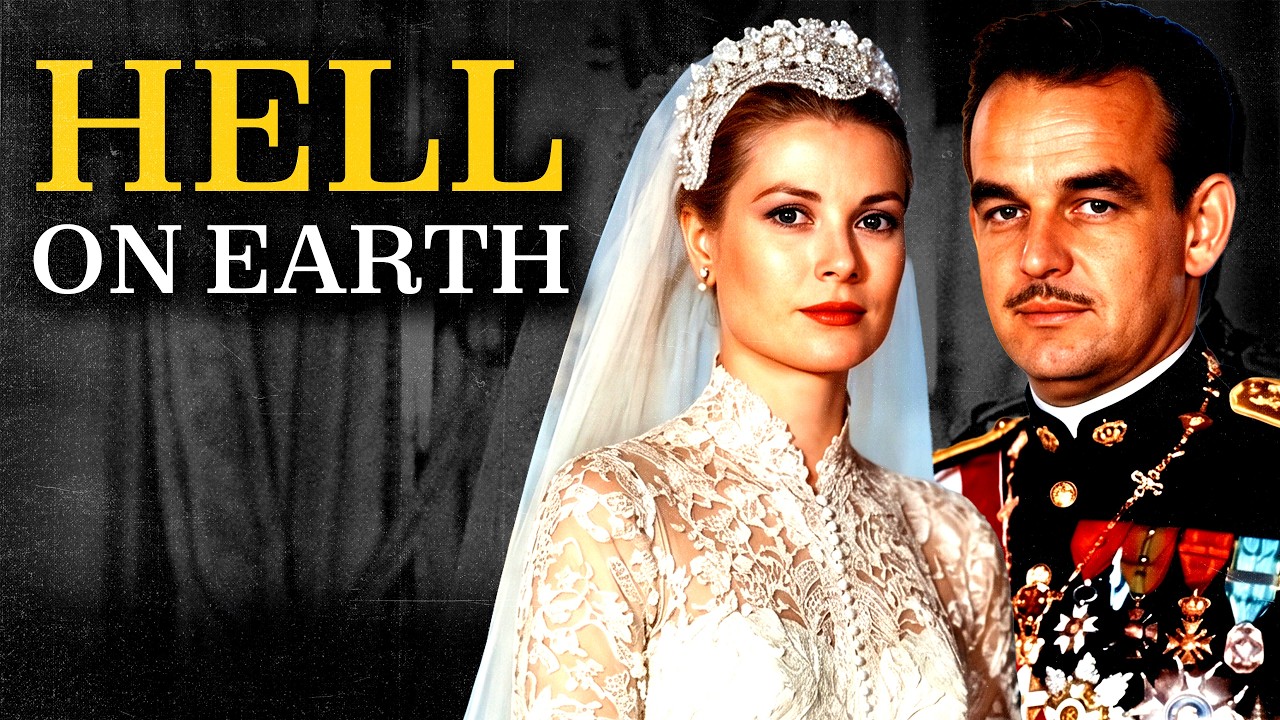
The palace required $2 million to seal the marriage in 1956 dollars, roughly $23 million today. Grace put up half from her own film earnings. Her father covered the rest, reportedly resisting the dowry and finding it humiliating. The wedding unfolded on April 18th and 19th, 1956, in two ceremonies. Thirty million people watched on television. MGM, which still held Grace’s contract, treated the event as a corporate marketing operation. She wore a dress designed by Helen Rose with 25 yards of silk taffeta and rose point Brussels lace.
Then she moved into the palace, and the actual work started. Grace’s French had grown rusty, and she could not carry court-level conversations the way European nobility expected. The Monegasque aristocratic class pegged her quickly as a Hollywood lightweight. Letters she wrote to her American friends describe a woman who felt lonely in a way she had not anticipated. The palace staff belonged to Rainier, not to her. She could not casually walk to a cafe or pick up a phone without somebody knowing about it. At 26, she had signed away her professional life for a job whose rules nobody had really explained.
She conceived fast because that came with the contract. Princess Caroline arrived in January 1957, nine months and ten days after the wedding. Albert followed in 1958, Stephanie in 1965. The succession sat permanently fixed. Grace had completed the assignment the palace had brought her in to complete, and nobody had given any thought to what an Oscar-winning actress in her late 20s was supposed to do with the next four decades of her life.
In 1962, Alfred Hitchcock called her about a film called *Marnie*. The lead role centered on a kleptomaniac, the kind of part Grace had never been allowed to play. Hitchcock wanted her badly. She and Rainier agreed, and the palace formally announced the project in March 1962. Then the floor came out from under everything. The Monegasque public reacted with hostility at the idea of their princess flying to America to play a thief. At the same time, Charles de Gaulle decided he no longer wanted Monaco operating as a tax haven and demanded the principality bring its income tax in line with France’s. Rainier refused. In October 1962, de Gaulle announced France would set up customs barriers around Monaco, effectively blockading it.

Grace withdrew from *Marnie* in June 1962. Her film career ended in that announcement, though nobody fully understood it at the moment. The role went instead to a younger actress named Tippi Hedren. Grace did not return to acting again, ever. Letters she wrote to friends in the months that followed describe a depression that came in waves and never fully receded. She had thought she gave up acting temporarily. The *Marnie* withdrawal clarified the situation: she would remain a princess and only a princess for the rest of her life.
The version of Grace Kelly that gets told most often claims that after *Marnie* she deflated, sitting in the palace for 20 more years feeling sorry for herself. The actual record runs in a different direction. Between 1962 and 1982, Grace built a philanthropic and cultural operation in Monaco that did not exist before her. She rebuilt the Monegasque Red Cross from the studs up. She founded AMADE, the World Association of Children’s Friends, in 1963, which grew into a recognized NGO operating in dozens of countries. She also took on cultural work, finding the Monte Carlo Ballet its modern footing and starting a foundation for emerging artists.
Prince Rainier III carried a temper. That detail appears in the authorized biography by Geoffrey Robinson, the one Rainier himself cooperated with, which describes incidents of explosive anger the palace staff learned to navigate around. Rainier had grown up groomed to act as the absolute authority in any room he entered. Accounts survive of state visits during which the public chanted Grace’s name and Rainier visibly stiffened. Privately, the fame disparity carried consequences. Rainier controlled her schedule more tightly than necessity required and limited her travel to the United States in the 1960s. The *Marnie* veto, when read carefully, did not entirely concern Monaco’s tax fight with France. It concerned *Marnie* itself.
A parallel story circulates in the cheaper end of the biography market, painting Rainier as a serial cheater who tormented Grace for two and a half decades. No documented primary source evidence supports chronic infidelity by Prince Rainier during the marriage. The narrative shows up almost entirely in tabloid biographies published after 2000. Robert Lacey, who wrote the most balanced biography in the field, addresses these claims and dismisses them. Judith Balaban Quine, who would have known, dismisses them as well. The marriage settled into a separate bedrooms arrangement in its later years, which was common in European aristocratic marriages of the period. Rainier could behave as a difficult, controlling, sometimes cold husband. He could also weep openly at her funeral in front of the cameras of the entire world, and then go on to spend 23 more years alive without ever remarrying.

The three children grew up in a household where Rainier’s parenting style fought Grace’s parenting style every single day. Rainier ran the household as a disciplinarian in the old European mode. Albert, the heir, developed a stutter as a child, which palace insiders linked directly to the pressure of being his father’s son. Grace ran the opposite playbook, bringing warmth the household had not previously contained. She sat on the floor with her kids, let them stay loud, and read to them in English. That setup worked while the children stayed small, then started to fall apart when they grew into teenagers in the 1970s.
Caroline broke formation first, deciding at 21 to marry a 38-year-old French banker and playboy named Philippe Junot. The wedding happened anyway in 1978, and the marriage collapsed in 1980. Stephanie presented a different kind of difficulty. Born in 1965, she spent her teenage years pushing every limit the palace had ever drawn. Grace, in the last two years of her life, managed Stephanie almost full-time with a level of daily attention she had not given the older children.
Around 1979, Grace started spending more time at an apartment she had renovated on the Avenue Foch in Paris. She did not move there, and she did not separate from Rainier. The apartment became a workshop for the parts of her she could not put anywhere else. She started giving public poetry readings with British actor John Westbrook, touring together at the Edinburgh Festival and in small concert halls across Europe and the United States. She also started doing pressed flower botanical art, putting together a body of work that hung in galleries in Paris, New York, and Tokyo. It did not represent the act of a woman who had given up on having an artistic life. It represented someone who had figured out how to keep one in the only configuration the palace would tolerate.
On September 13, 1982, Grace and Stephanie had left the family’s country home at Roc Agel to drive back down to the palace in Monaco. Grace took the wheel of a Rover 3500. Stephanie, 17, sat in the passenger seat. About halfway down the Moyenne Corniche, Grace suffered a small cerebral vascular event, a mild stroke. She lost motor control on her right side for several seconds, exactly long enough on a road like that one to put a car off the edge. The Rover hit a low retaining wall, tipped over, and tumbled roughly 120 feet down the mountainside. Stephanie, conscious and shaken but not catastrophically injured, climbed out from the passenger side. Grace suffered a second and much larger stroke during the crash itself. She died the next day, September 14, 1982, after the family agreed to remove life support.
A conspiracy version of this story claims Stephanie drove the car. It does not hold up to basic forensic scrutiny. A truck driver named Yves Billeau saw the whole thing and gave testimony to police on the day of the accident, repeating it consistently in every interview he ever granted. From his vantage, a woman matching Grace Kelly’s description sat in the driver’s seat. The car started to drift. Brake lights flashed on briefly and then quit. The forensic team that examined the wreckage placed Stephanie in the passenger seat by the position of her injuries.
The palace botched the immediate aftermath of the accident. On the afternoon of September 13, the Monaco Palace press office issued a statement claiming Princess Grace had suffered broken ribs and a fractured leg. It skipped the stroke and the brain hemorrhage. She died less than 24 hours later. The reason the palace lied was human: Rainier could not say the words out loud yet. The press office issued the statement he could live with, not the one truth supported. That gap between broken ribs and dead birthed every conspiracy theory about her death.
Rainier was 59 when she died. At the funeral on September 18th, he sat in the front row of the cathedral and wept openly through the entire service in a way European royalty almost never does in public. Then he ruled Monaco for another 23 years. He never remarried. Her rooms in the palace stayed exactly the way she had left them. He visited her grave at the Cathedral of Monaco regularly. He died in 2005 and was buried next to her. A man who hated his wife does not stay alone for 23 years and then ask to lie next to her in the ground. Whatever they built together, he carried it long after she had gone.