Rudolf Höss was one of the most notorious figures of the Second World War. He built Auschwitz concentration camp from the ground up and oversaw its operations for years. During that time, more than one million people were killed there. Höss lived with his family in relative comfort just meters away from the gas chambers.
His wife, Hedwig Höss, has long been a subject of debate. Historians and survivors have questioned what she knew about her husband’s work and how complicit she was in the crimes committed at Auschwitz. Some wives of camp commandants were actively involved in cruelty. Hedwig Höss, however, generally stayed away from her husband’s place of work. She has often been described as an ignorant woman, but her fate after the war remains a point of interest.
Rudolf Höss had a violent history even before the war. He was involved in a murder ordered by Martin Bormann, who later became Hitler’s private secretary. Höss was sent to prison for the killing. In 1929, he married Hedwig Hensel, who was 21 years old at the time. The couple had met through the Artaman League, a political organization that encouraged Germans to return to farming and rural life.
The couple had five children: three daughters and two sons. Their youngest daughter was born inside the Auschwitz complex, in the hospital there. This was the same place where thousands of prisoners were killed through lethal injections and medical experiments. Hedwig received different treatment from the prisoners who suffered and died nearby.
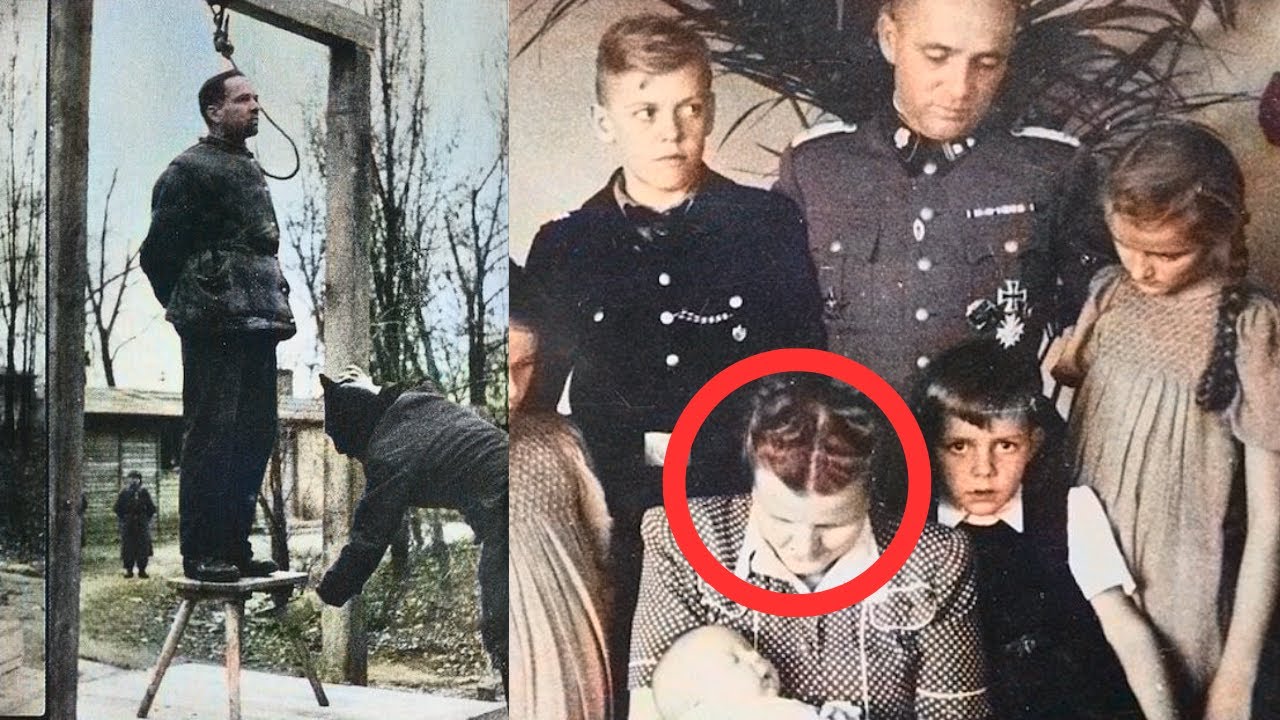
As Rudolf Höss rose through the ranks of the SS, Hedwig stayed at home to look after the children. Höss had worked at other camps before being called to create a new camp in Poland. That camp became Auschwitz. It grew into the largest and deadliest site of slaughter during the war.
Hedwig and her children lived in a specially built villa close to the camp. Prisoners were forced to work in the house, cleaning and tending the gardens. A large concrete wall was built to block the view of the crematoria chimneys from the villa. Despite the horrors happening next door, the Höss family lived in luxury. They had the best food while prisoners starved.
Hedwig later claimed she had no idea what her husband was doing at work. But every day, Rudolf Höss left the villa to oversee mass murder on an industrial scale. He kissed his wife and children goodbye each morning and returned each night. The family was known to have treated prisoners cruelly. Hedwig’s son was known for whipping a servant.
One former gardener who worked at the house said Hedwig forced him to do whatever she asked. She was very anti-Semitic and held views similar to her husband’s. She once said that all Jews had to disappear from the globe and that there would come a time for the English Jews as well.

Survivors of Auschwitz later testified that the stench of burning bodies spread all around the camp and the local area. Civilians who lived nearby complained about the smell. It would have been difficult for Hedwig to avoid knowing what was happening. She also benefited from goods taken from prisoners who arrived at the camp, and the family became wealthy.
There was one incident in which Hedwig confronted her husband. During a gathering of high-ranking Nazis, she allegedly overheard the Gauleiter of Silesia, Fritz Bracht, talking about the gas chambers and crematoria at Auschwitz. She reportedly flew into a rage at her husband and refused to share a bed with him for some time. The couple later reconciled for the sake of their children.
Rudolf Höss was eventually removed from command after an affair with a female prisoner. As the war came to an end, he was instructed by Heinrich Himmler to go into hiding. He obtained a false identity and posed as a gardener in a town called Gottrupel.
Hedwig moved to Flensburg with her eldest son. While there, she was arrested by British soldiers. She was interrogated for weeks about her husband’s whereabouts. Eventually, she gave up the information that he was posing as a man named Franz Lang. Rudolf Höss was seized, and his wedding ring helped confirm his identity. Inside the ring was an engraving of Hedwig and Rudolf’s names.

Rudolf Höss was extradited to Poland and faced charges for his crimes. In a final letter to his wife days before his death, he wrote that he could see clearly that the ideology he had believed in was completely wrong. He said his actions in service of that ideology were wrong, even though he had faithfully believed the idea was correct. He also wrote that he had found his faith in God again.
Rudolf Höss was hanged on a specially built gallows at Auschwitz on April 16, 1947. He was the last person to die inside the camp.
Hedwig Höss had a very different end. After the war, she changed her name and tried to live quietly in postwar Germany. She was questioned during denazification proceedings, but the authorities believed her when she claimed she knew nothing about her husband’s crimes. She was accepted as being ignorant of what had happened at Auschwitz.
She later remarried. Her daughter Bridget moved to America and died in October 2023. In the 1970s, Hedwig visited her daughter regularly in Washington, but they never spoke about Auschwitz. Bridget said it was too painful. She claimed her mother was sad about what happened but could not help it. Bridget also said that prisoners who worked at the villa referred to her mother as the angel of Auschwitz. That claim has been challenged, given what is known about Hedwig’s anti-Semitic views and her financial benefits from the SS.
Hedwig Höss died on September 15, 1989, while visiting her daughter in America. She was 90 years old. She is buried in National Memorial Park in Fairfax County, Virginia. Her gravestone is marked with the word Mutter, which means mother in German. Her remains were never returned to Germany.
Whether Hedwig Höss knew what was happening inside Auschwitz remains debated. She managed to convince authorities that she knew nothing, but the smoke and smell of death from the crematoria would have been hard to ignore. Even civilians who lived miles away knew what was happening. Her fate is often overshadowed by her husband’s execution, but her quiet life in America stands in sharp contrast to the horrors she lived beside.