On January 30, 1933, Adolf Hitler was appointed chancellor of Germany, bringing an end to German democracy. The Nazis quickly established a police state where basic freedoms were abolished and individuals faced arbitrary arrest and imprisonment. Propaganda was used effectively to win support for policies that led to persecution, war, and genocide. Some Germans did resist, but critics of the regime often paid the ultimate price for their defiance.
Alexander Schmorell was born on September 16, 1917, in Orenburg, then part of the Russian Empire. His father Hugo was a physician, and his mother Natalia was the daughter of a Russian Orthodox priest. She had Alexander baptized in the Russian Orthodox Church but died of typhus when he was only two years old. In 1921, the family fled Russia and moved to Munich. A Russian nanny who moved with them helped raise Alexander, and he grew up speaking both German and Russian natively.
Schmorell attended Gymnasium in Munich from 1928 to 1937. After finishing school, he served in the Reich Labour Service and then voluntarily joined the Wehrmacht in November 1937. He trained as a gunner and later spent time in army medical service training. After announcing his intention to become a doctor, he was discharged as a noncommissioned officer and began studying medicine in Hamburg. He later returned to Munich to continue his education at the Ludwig Maximilian University.
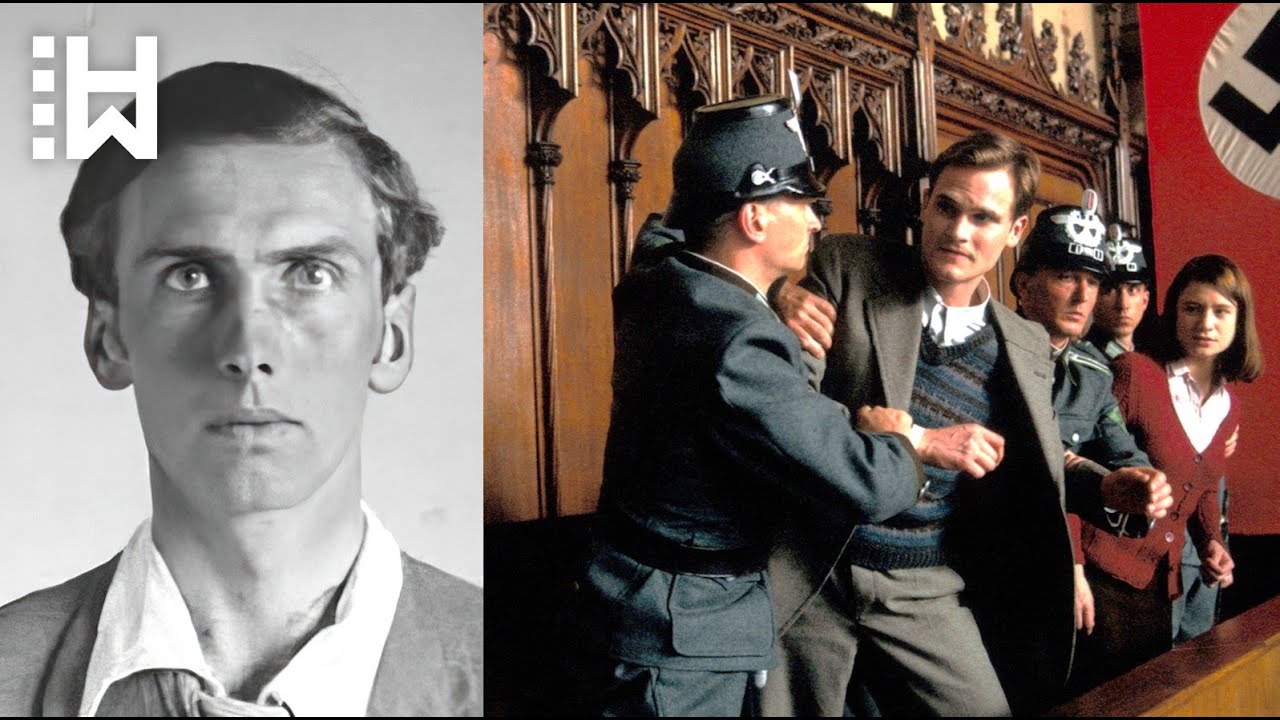
The Second World War began on September 1, 1939, when Germany invaded Poland. Schmorell served as a medical noncommissioned officer during the Battle of France in 1940. In June 1941, he met Hans Scholl through his lifelong friend Christoph Probst. The following summer, he met Willi Graf, another university student. Graf had served as a medic in Poland and Serbia and had witnessed the horrors of the Warsaw Ghetto, where starvation and overcrowding killed over 80,000 Jews.
In April 1942, Graf returned to Munich and shared his experiences with Schmorell, Hans Scholl, and Christoph Probst. Deeply affected by what they learned, the group began the resistance movement known as the White Rose. From late June to mid-July 1942, they wrote their first four leaflets, each more critical of Hitler and the German people than the last. They encouraged citizens to resist the Nazi regime and denounced the murder of hundreds of thousands of Poles.
A passage written by Schmorell in the second leaflet contained the only known public protest by a German resistance group specifically against the Holocaust. It cited the murder of 300,000 Jews in Poland and called it a crime with no counterpart in human history. The text blamed the German people for allowing such crimes to be committed in their apathy. The leaflets were left in phone books, mailed to professors and students, and carried to other universities for distribution.

In the summer of 1942, male students at the University of Munich were required to deploy to the Eastern Front. Schmorell, Hans Scholl, and Willi Graf served as medics in Russia, where they witnessed mistreatment of Jews and prisoners by German soldiers. Because Schmorell understood Russian, he could speak with locals and translate for his friends. The experience strengthened their determination to fight against Nazism.
In the fall of 1942, Sophie Scholl learned of her brother’s activities and joined the movement. Kurt Huber, a university professor known for not pushing Nazi ideology, joined in December 1942. In January 1943, the group produced the fifth leaflet, “Appeal to all Germans!” in thousands of copies. Schmorell distributed leaflets in Austrian cities, including Salzburg, Linz, and Vienna, mailing hundreds of letters from various mailboxes.
On February 2, 1943, the German Sixth Army surrendered at Stalingrad. While Hans Scholl was depressed by the events, Schmorell, who cared deeply about Russia, was happy about the new strategic situation for the Russians. On February 3, 8, and 15, Schmorell, Hans Scholl, and Willi Graf graffitied public buildings in Munich with slogans such as “Hitler the Mass murderer!” and “Down with Hitler.”

On February 18, 1943, Hans and Sophie Scholl were spotted distributing leaflets at the university by a maintenance man who reported them to the Gestapo. Christoph Probst was arrested two days later. The three were tried for treason before the Nazi People’s Court, presided over by the infamous judge Roland Freisler. On February 22, 1943, after a half-day trial, they were found guilty and sentenced to death. They were executed by guillotine the same day at Stadelheim Prison.
Schmorell attempted to flee to Switzerland with a forged passport, but harsh weather forced him back to Munich. He was recognized, denounced, and arrested on February 24, 1943. Willi Graf had already been arrested, and Kurt Huber was taken into custody on February 26. During interrogation, Schmorell spoke of his love for Russia and rejected Bolshevism. He stated that he could not identify as a National Socialist because he was more interested in Russia.
On April 19, 1943, Freisler presided over the second trial of White Rose members. Schmorell admitted his anti-Nazi beliefs in court. Out of thirteen defendants, three were sentenced to death: Schmorell, Graf, and Huber. Unlike the first trial, Schmorell’s execution was delayed as his family petitioned for clemency. During this time, he wrote to his parents, expressing faith that death was not the end but a transition to a new and wonderful life.
After about two months, a letter arrived rejecting all petitions for mercy. It was signed by Adolf Hitler. On July 13, 1943, Schmorell and Kurt Huber were told their execution would take place that day. Schmorell, deeply inspired by his Orthodox Christian faith, received communion from an Orthodox priest and wrote a final letter to his parents. He wrote that he was going with the awareness that he had followed his deepest convictions and the truth.
Alexander Schmorell was executed by guillotine shortly after 5 pm. He was 25 years old. Before his death, he told his lawyer that he had fulfilled his life’s mission and would not know what else to do on earth. After the first White Rose trial, a copy of the sixth leaflet was smuggled to England. In July 1943, the Royal Air Force dropped millions of propaganda copies of it over Germany.
Schmorell’s bravery is honored in Germany to this day. He and other members of the White Rose are remembered as symbols of the struggle for freedom of the human spirit. In 2012, Schmorell was glorified as a saint and passion bearer by the Russian Orthodox Church Outside Russia in Munich. Today, schools, squares, and roads bear his name and the names of other White Rose members, serving as a lasting testament to their courage.