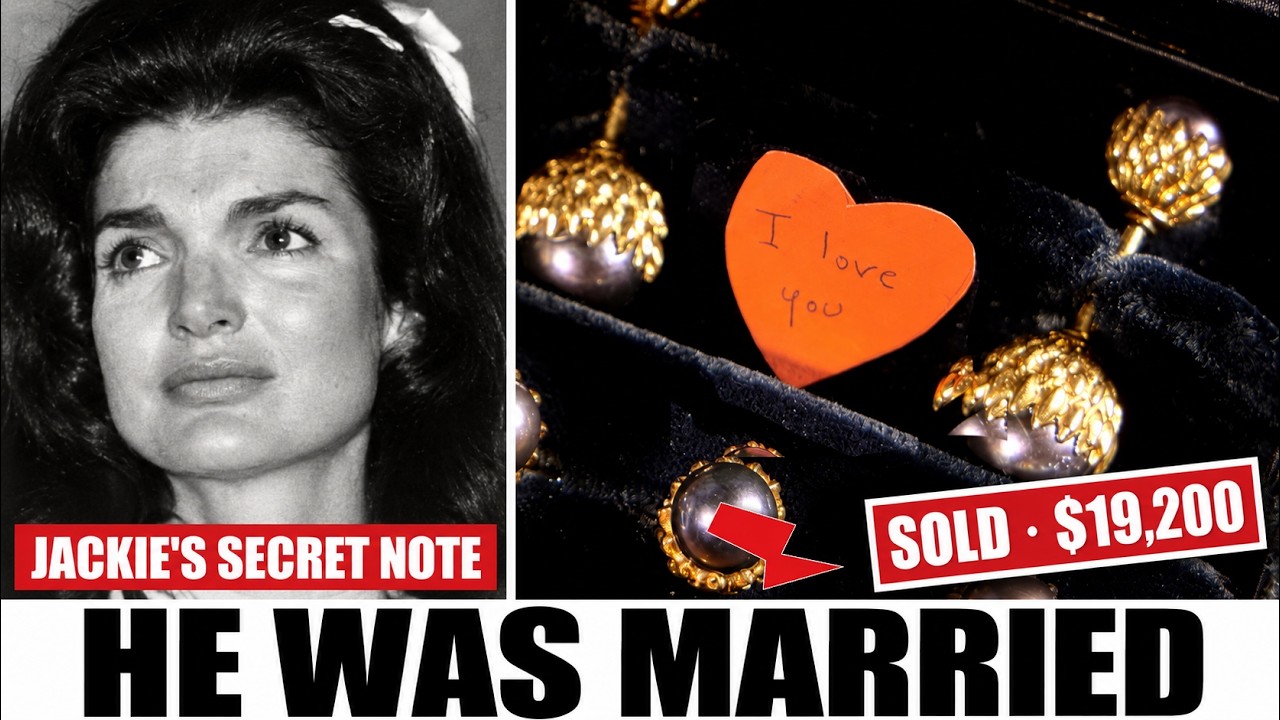
In June 2026, a small piece of paper cut in the shape of a heart sold at auction in New York. Written on it were three words in the handwriting of Jacqueline Kennedy Onassis: “I love you.”
She did not write those words to John F. Kennedy. She did not write them to Aristotle Onassis. She wrote them to a man most people have never heard of: Maurice Templesman.
He was a diamond merchant from Belgium. He was also married to someone else for the entire time he and Jackie were together. The paper heart was sold at Sotheby’s on June 24th, 2026.
So was the last thing she ever gave him. It was a woman’s head carved in white stone, about eight inches tall. It was the only item she left him by name in her will.
The auction house expected the head to bring $10,000. It sold for $24,800. The price reflected a story that had been hidden for decades.
Maurice Templesman was born in Antwerp, Belgium, on August 26th, 1929. Jacqueline Bouvier was born one month earlier on Long Island. They were the same age.
His parents were Orthodox Jews. In 1940, as the German army entered Belgium, the family fled to New York. He was ten years old.
He attended public school and spent two years at New York University before dropping out to work with his father. The firm was called Leon Templesman and Son. They traded diamonds.
By his early twenties, he had convinced the U.S. government to buy African industrial diamonds for its strategic stockpile. He was the middleman. Diamonds, cobalt, and uranium came in from Africa. American farm surplus went out in exchange.
In 1949, he married a woman named Lily. She was also from Antwerp. Her family had fled the same war and settled in the same neighborhood of Manhattan.
They had three children: Reena, Leon, and Marcy. They stayed married. That fact shapes everything that followed.
Maurice and Lily Templesman never divorced. Not when the marriage ended in every way but the legal one. Not when he moved into another woman’s home.
The New York Times later called him “married but long separated.” Newsweek reported that Lily reportedly refused to grant a divorce for religious reasons. She was a deeply religious Orthodox Jew.
Lily outlived Jackie by 28 years. She died in 2022. Still Mrs. Templesman.
In 1957, Templesman flew to the Gold Coast of Africa, the country about to become Ghana. He took his lawyer with him. The lawyer was Adlai Stevenson, who had twice been the Democratic candidate for president.
They came home with one of the first diamond buying licenses in the new market. By his late twenties, Templesman knew Africa and he knew the top of the Democratic Party.
A young senator from Massachusetts wanted both. John F. Kennedy was planning a run for the White House and wanted to meet the people who ran the diamond business in southern Africa. Templesman set it up.
Later, he helped arrange a meeting at the Carlyle Hotel in Manhattan between the president-elect and Harry Oppenheimer, the head of De Beers. That is how he met the senator’s wife.
The Times did the arithmetic when she died. Jackie had known Maurice Templesman longer than she knew either of her husbands.
He was in the room before any of the tragedies. He knew Jack. He knew her when she was thirty, with a husband on his way to the presidency.
Then their lives went in different directions. Hers went to the White House, to Dallas, and to a Greek island. His went to Africa.
The Congo became independent in 1960. It had diamonds, copper, and cobalt, and it had a civil war. An army officer named Joseph Mobutu took power and kept it for more than thirty years.
The Times says Templesman backed him early. Mobutu paid him back with one of the richest copper and cobalt concessions on Earth. It had been promised to a Belgian group.
Newsweek put the accusation in print in 1994. Some people in Zaire believed that bribes and secret partnerships with Mobutu had smoothed his way. His spokesman denied it.
Lawrence Devlin was the CIA station chief in the Congo in 1960, the year the country’s first prime minister was overthrown. Later, he went to work for Maurice Templesman.
In 2008, the New York Times reported that Devlin kept passing information to the CIA while he was on Templesman’s payroll. An American diplomat who watched him work in Africa gave a kind version: “He knew how to stay close to people without getting too close, so that when they fell, he didn’t fall.”
That was the man about to walk into Jackie’s life. A courtly man who read poetry and collected old books, with a dictator for a partner and a former spy on staff.
In March 1975, Aristotle Onassis died in Paris. Jackie was a widow for the second time at 45.
By then she was carrying a heavy load. A daughter born dead in 1956. A son, Patrick, who lived two days in the summer of 1963. A husband shot beside her in a car three months after that.
Her first husband had not been faithful to her. For marrying Onassis, a Vatican newspaper had called her a public sinner. His children called her the gold digger. He had his own name for her: the witch.
She walked away from the Onassis family with $26 million. That was far more than his will had meant her to have.
Then she did two things nobody expected. She got a job.
That autumn she went to work as a consulting editor at Viking Press. The salary was reported at $10,000 a year. A woman with $26 million on the way was working for about $200 a week.
She stayed in publishing for the rest of her life. Years later, she edited Michael Jackson’s memoir.
She handed the $26 million to an old friend to look after. The diamond man who had once set up a meeting for Jack. That is how it began. As a favor and as business.
He was her financial adviser before he was anything else. By every account, he was very good at it. When her will was filed in 1994, the Associated Press wrote that he was thought to have at least quadrupled what she got from the Onassis estate.
The Times put a number on it that same spring. $26 million had become a fortune of $200 million.
Somewhere in those same years, the adviser stopped going home. At first nobody noticed. The gossip columns were busy pairing her with other men.
The architect I.M. Pei. William Paley, the founder of CBS. Prince Rainier of Monaco. Those were the names in print.
The real one was portly, balding, and married. By the early 1980s, the Times wrote, she was turning up more and more on the arm of Templesman. Small restaurants on the Upper East Side. The opera. A dinner at a consulate.
They held hands at the ballet. People who knew them both said they matched. Both private. Both polite to the point of formality. Both in love with art and old things.
They spoke French to each other on their walks in Central Park. There were weekends at her horse farm in New Jersey. There were summers on Martha’s Vineyard, where in 1979 she had bought 340 acres of dunes and ponds at the far end of the island.
He kept a boat there. A white yacht called the Relemar. Say the name next to the names of his three children: Reena, Leon, Marcy.
In 1982, according to the Times, he moved out of his apartment and into a hotel suite. A few years later, he moved into the fifteen rooms at 1045 Fifth Avenue. Nobody announced it. He was there, and then he had always been there.
In 1986, he was at her side at Caroline’s wedding. Her family had a name for him by then: MT. The newspapers had other names. Longtime friend. Frequent escort.
She had a name for the publicity. She called it “the river of sludge.”
Look at who owned what. The apartment was hers. She had bought it in 1964. The land on the island was hers. The job was hers. He had the boat.
There was no wedding. There could not be one. He had a wife.
Twenty years earlier, a Vatican paper had called her a public sinner for marrying a divorced man. Now she shared her home with a married one. This time she explained it to nobody.
He said almost nothing. In 1991, a magazine called Insight asked him about the two of them. His whole answer was: “I hate to deflate the romance, but the reality is a lot more pedestrian.”
Pedestrian. That was the public version.
Newsweek asked the question everybody was too polite to ask. What did she see in this portly, balding diamond merchant?
He had none of Jack Kennedy’s charm, the magazine said. And nothing like Onassis’s money.
A friend of hers answered it. His name was Samuel Pisar, a lawyer in Paris. “Jack was a politician and he was busy. Need I say more? With Onassis, she was a trophy. Templesman didn’t look on her as a trophy.”
Read that again. She had been a wife to one and a prize to the other. With the portly man from Antwerp, she was a person.
The private version was sold at auction this year. First, a wristwatch. A Cartier Tank in yellow gold.
Jackie wore a Tank herself. Hers was a gift in 1963. On the back of this one, there is an engraving.
The jeweler copied her own handwriting into the gold for Maurice. “Love J.” and a date. August 26th, 1985. That was his 56th birthday.
Then the paper heart. It came with a set of gold cuff links and shirt studs made by Schlumberger for Tiffany. Each one is a tiny acorn with a black pearl.
Sotheby’s says he often wore them to formal events. They came from her. And kept with them for decades was the piece of paper.
Sotheby’s describes it in one flat line: “A handwritten heart-shaped note by Jacqueline Kennedy Onassis reading, ‘I love you.’”
One of the most famous women alive wrote three words on a paper heart for a man she would not name to the press.
There is one more small thing. A watercolor, four inches by three and a half. She painted her own tiny copy of The Birth of Venus.
On the back in ballpoint pen, she wrote: “Bacelli by me.” Nobody writes that to an accountant.
So now you have his version and hers. He told a magazine it was pedestrian. She gave him a paper heart.
She was joking with him. She was giving him his birthday in her own hand. She never put any of it into words for the public.
There was a reason. And the reason had a name: Lily.
Only once did she let the whole country see him. It was August 24th, 1993. Bill Clinton was president and on vacation on Martha’s Vineyard.
Jackie had kept away from Washington for decades. That day, she invited the president onto the Relemar.
The guest list read like a history lesson. The president and Hillary Clinton and their daughter. Senator Edward Kennedy and his wife. Caroline Kennedy and her husband.
They sailed for more than four hours. The host on his own boat was the man the newspapers described the next day in careful words: “her longtime companion.”
He was not a husband. He was not a secret anymore. He was the man standing behind the most photographed woman in America while she sailed with a president.
It was her last summer.
In November 1993, she fell from her horse during a hunt in Virginia. In the weeks after, doctors found a swollen lymph node. That winter, she was told she had cancer of the lymph system.
She had three grandchildren by then: Rose, Tatiana, and Jack. The youngest was not yet one year old.
According to the Times, Maurice Templesman did something simple. He moved his office into her apartment. He ran a diamond company from her home so that he would be there.
He took her to the hospital for her treatments and brought her back. After a president and a tycoon, the man who stayed for the hospital visits was the one with no ring and no claim on her at all.
Newsweek described the photographs from those months. A frail woman behind dark glasses in a baggy overcoat. Next to her in every frame, the same man keeping the cameras off her.
Friends said he looked after her almost around the clock. “They were really like an elderly couple,” one of them said. “They took quiet pleasures in each other.”
In February, the news was made public. She kept working. She kept walking in the park.

On March 22nd, 1994, she signed her will. Thirty-six pages. She wrote it knowing how little time she had. She chose every word.
She did one more thing in those weeks. She asked old friends to her apartment one at a time, and together they burned her letters. Letters from Jack. Letters from Onassis.
She was erasing her private life before anyone could sell it. A paper heart survived. She had given it away.
On the Sunday before she died, photographers found her in Central Park one more time. Maurice had taken her out for a walk. It was the last one.
On Wednesday, May 18th, she left the hospital for the last time. She went home to Fifth Avenue, to her own bed and her books.
She died the next night, Thursday, May 19th, 1994. She was 64.
Her children were there. And Maurice was there. She had been widowed twice. She did not die alone.
Here is where the story usually goes wrong. You will hear it told that Maurice Templesman came down to the street and announced her death to the world. It is not what happened.
The next morning, the person who walked out of 1045 Fifth Avenue and faced the cameras was her son. John F. Kennedy Jr. was 33.
“Last night at around 10:15, my mother passed on,” he said. “She was surrounded by her friends and family and her books and the people and the things that she loved. And she did it in her own way. And we all feel lucky for that. And now she’s in God’s hands.”
It was not Maurice at the microphones. But look at the official statement that went out that day. It named three family members who had been at her bedside: Caroline, John, and Maurice Templesman.
Family members. That is the family’s word in the family statement for a man who was legally another woman’s husband.
The funeral was on Monday, May 23rd, at the Church of St. Ignatius Loyola on Park Avenue. A man who worked for Templesman told Newsweek to watch one thing: who got out of the first car.
The people who got out of the car together were John, Caroline, and Maurice.
Only a few people spoke at that mass. He was one of them.
Maurice Templesman, an Orthodox Jew from Antwerp, stood up in a Catholic church and read a Greek poem. It was “Ithaca” by Constantine Cavafy.
It is about a long voyage home. The poem tells you to hope the road is a long one, full of adventure, and not to hurry. The island is only the reason you set out.
When the poem was finished, he added a few lines of his own. They were reported at the time like this: “And now the journey is over. Too short, alas, too short. It was filled with adventure and wisdom, laughter and love, gallantry and grace. So farewell. Farewell.”
Listen to what is missing. He does not say what she was to him. No “my wife.” He could not say that. No “my love.” He did not say that either.
In front of the Kennedys and the cameras, he found a way to say goodbye without once naming what they were.
That afternoon, she was buried at Arlington beside Jack. In front of the casket stood three people in the place kept for the immediate family. Her daughter. Her son. And Maurice.
Newsweek found the phrase for him that week: “the widower in all but name.”
Think about how lonely that phrase is. He had lost the woman he lived with, and he was standing at the grave of her first husband. He had no word for what he was. A widower gets a word. He did not.
Nine days later, her will was filed. It was her turn to say what he was.
The will of Jacqueline Kennedy Onassis was filed in Surrogate’s Court in Manhattan on June 1st, 1994. She named two executors. One was her lawyer, Alexander Forger. The other was Maurice Templesman.
She trusted him with all of it. Every account, every house, every painting passed through his hands.
Almost everything went to Caroline and John. The Fifth Avenue apartment. The land on Martha’s Vineyard. The furniture, the silver, the art, her letters, and her private papers.
$250,000 each in cash on top of the trusts. Her lawyer was left a copy of President Kennedy’s inaugural address signed by the poet Robert Frost.
Then the people who had worked for her. She named them one by one with a sum beside each name.
Nancy Tuckerman, her friend since boarding school: $250,000. Marta Sgubin, who had looked after her children and cooked for the family: $125,000. Providencia Paredes, her aide since the White House: $50,000. Her accountant: $25,000.
She even wrote a sentence for the sister she left out. “I have made no provision in this my will for my sister Lee B. Radziwill for whom I have great affection because I have already done so during my lifetime.”
Everybody in her life got a line. And the man who had quadrupled her fortune, who had moved his office into her home, who had read the poem? One line.
Here it is, word for word: “I give and bequeath to my friend Maurice Templesman, if he survives me, my Greek alabaster head of a woman, if owned by me at the time of my death.”
My friend. One object. No money. No house. No share of anything he had built for her.
The cook got cash. The aide got cash. The accountant got cash. The man who made the fortune got none.
People read that line in two ways, and they still do.
One way says she drew a border. Her children on one side. Him on the other, in ink. He was a rich man already, and he was another woman’s husband. She gave him a keepsake and the title of friend.
The other way says a woman who weighed every object she ever owned did not pick this one at random.
There is one more clause, and it tells you who wrote this document. She asked her children to respect her wish for privacy and to stop her papers and letters from ever being displayed or published. She was closing every door she could reach.
Two years after she died, her children sold much of what was left. Sotheby’s held a four-day auction in April 1996. It brought in $34.5 million.

People paid a fortune for her fake pearls and for Jack’s golf clubs. The stone head was not in that sale. He had it.
He kept it for 31 years.
Think about what he could have done with those 31 years. He was the last witness. He had lived inside the most guarded private life in America. Any publisher in New York would have paid him whatever he asked.
He published no book about her. He went back to his diamonds.
The apartment at 1045 Fifth Avenue was sold, and he moved out. Through all of it, he stayed married to Lily.
She died in 2022. He was past 90 by then. He did not marry again.
And in his home, for every one of those years, there was a woman’s face in white stone.
Maurice Templesman died in Manhattan on August 23rd, 2025. He was 95, three days short of his birthday.
The next June, his family sent his collection to Sotheby’s. Gold snuff boxes. Rare books. Paintings of the sea. And lot 80.
An auction house has to tell buyers what they are bidding on. So, for the first time, someone wrote down the history of that head. It is the paragraph that changes this story.
First, the age. Jackie called it Greek. Sotheby’s does not. The catalog says the head was likely created in the first half of the 20th century, carved in the style of ancient Greece. It is a beautiful imitation.
That is why the estimate was only $7,000 to $10,000.
Then the provenance. The list of who owned it. And the first owners are not Jacqueline Onassis.
“President John F. Kennedy and Jacqueline B. Kennedy. The White House, Washington. Acquired prior to August 28th, 1963.”
It was theirs. Jack’s and hers.
The catalog points to a photograph in the Kennedy Library. A White House photographer took it on August 28th, 1963, in the Yellow Oval Room. That is the family’s private sitting room upstairs.
And there on the mantelpiece is the head.
Look at the date. August 28th, 1963. Nineteen days earlier, the Kennedys had lost their baby son, Patrick. Eighty-six days later, the president was dead.
There is one more paper. It is a note Jackie wrote to the chief usher of the White House, a man named Mr. West. She asks him to have a spotlight put up over the mantel.
In her words, to shine on “our Greek head.” And then she adds: “It would be nice to do this soon as the president would like it.”
Our Greek head.
So that is what she left him. It was no trinket from a drawer. It was the head from the mantel in the room where she lived with Jack.
She carried it out of the White House after Dallas. In 1973, Vogue photographed it on the desk in her study in New York.
It went with her through the Onassis years and through all the years after. And when she sat down in March 1994, with weeks to live, to decide what would go to the man who was married to someone else, she chose that.
She did not hand him a souvenir of their own years. She handed him the thing that had watched the best and the worst of her life. And she trusted him to keep it.
He did.
On June 24th, 2026, the estimate was $10,000 at most. The final price with fees was $24,800. More than twenty times the estimate. Somebody had read the catalog.
The gold studs and the paper heart sold too. $19,200.
The watch did not sell. It was the gift with her handwriting on it. His birthday cut into the gold. Nobody bought it.
So here is the file. A man she met through her first husband. A man with a wife, a dictator for a business partner, and a spy on the payroll.
A man who made her richer than a Greek shipping fortune had, and who told a reporter the whole thing was pedestrian.
And on the other side, three things in her own hand. A birthday engraved in gold. Three words on a paper heart. And one line in a will that calls him “my friend” and gives him a piece of stone.
For 32 years, that line looked like the smallest thing she could have left him. A keepsake for the adviser. A polite way to close the account.
Now we know what the stone was. It was the one object that had stood in every home she made.
It had stood with a president, then with a tycoon, and then with a man she could not marry. And on its way through her life, it had picked up one word from her. “Our.”
She could not give Maurice Templesman her name. He already had a wife. She would not give him her children’s money, and he did not need it.
She gave him the thing that had been there the whole time.
If you came to this story feeling sorry for her, you are not wrong. But look at how it ends.
She had one man who did not leave and did not ask her for anything. She could not be his wife. So she told him in the only way she had left.
And the last line of this story was not written by the diamond man or by the newspapers. It was written by her, in a will, eight weeks before she died.