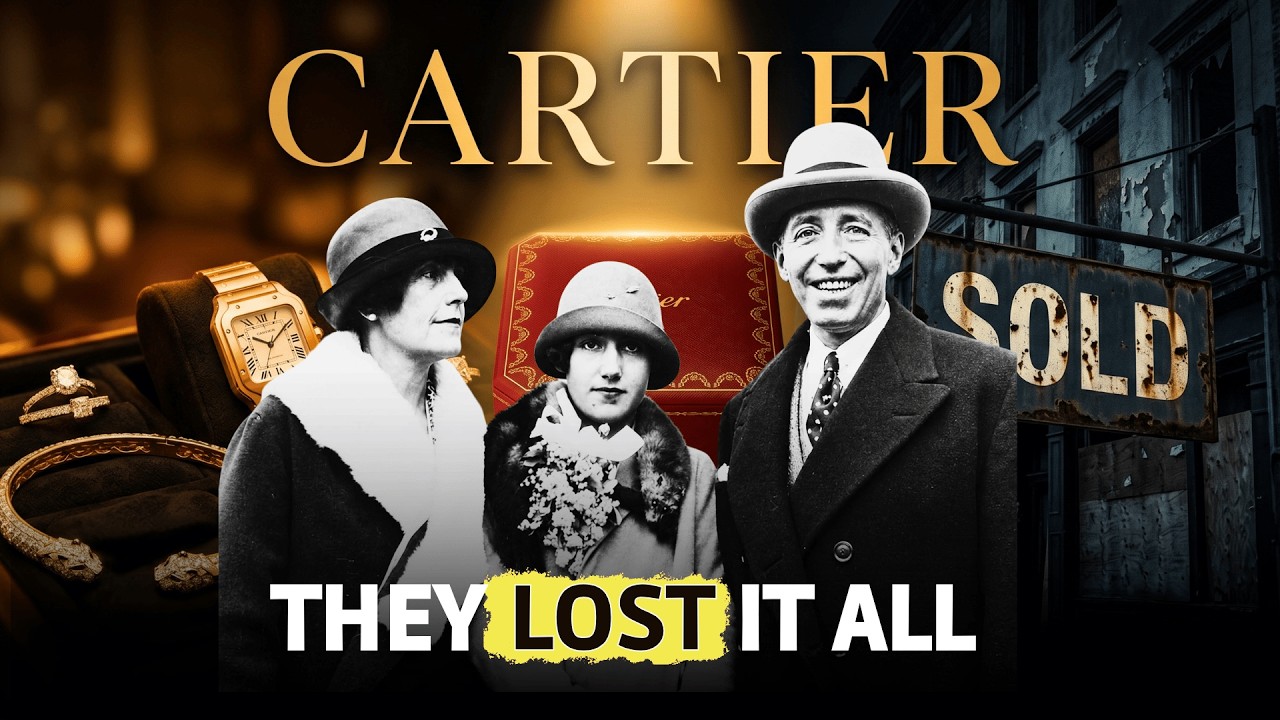
For 170 years, the red Cartier box has been one of the most recognized symbols of luxury on Earth, worn by queens, maharajahs, and Hollywood icons. But behind the diamonds and the prestige, there is a less glamorous truth: the family that built the empire lost control of it entirely. The story begins in 1819 Paris, where Louis-François Cartier was born into poverty. His father was a metal craftsman and his mother a laundress, and the family lived in a cramped apartment marked by factory smoke and constant financial strain.
From an early age, Louis-François studied the world of the wealthy from the outside, watching how light moved through glass and how metal could be shaped into objects that made people stop and stare. His apprenticeship under master jeweler Adolphe Picard was grueling, demanding nothing less than perfection. While other apprentices counted the days until their indentures ended, Louis-François absorbed every skill he could. In 1847, Picard offered to sell him the workshop.
Louis-François spent his entire savings on the purchase, an existential gamble with no safety net. He quickly understood that location was everything in status-obsessed Paris. He moved the business to the prestigious Place Royale in 1853 and later to the Boulevard des Italiens in 1859, placing himself in the path of Napoleon III’s inner circle. The breakthrough came in 1856, when Princess Mathilde, the emperor’s cousin, brought him a broken necklace that other jewelers had declared unfixable.
He repaired it brilliantly, and her praise spread through aristocratic circles, opening doors that would have otherwise remained closed to a craftsman’s son. In 1874, Louis-François handed the business to his son Alfred. Alfred proved to be a shrewd operator. During the chaos of the Paris Commune in 1870, he bought magnificent heirlooms from desperate nobles at pennies on the dollar, building one of the finest jewelry collections in France.
He also bet the company’s future on platinum, a difficult metal other jewelers avoided, and in 1899 moved the headquarters to 13 Rue de la Paix, the epicenter of Parisian elegance. But it was Alfred’s three sons—Louis, Pierre, and Jacques—who turned a respected Parisian house into a global empire. According to family history preserved by descendant Francesca Cartier Brickell, the brothers divided the world map among themselves: Louis took Paris and Europe, Pierre took New York, and Jacques took London. They opened stores in 1902 and 1909, and their coordinated strategy made Cartier the universal currency of status.
Louis Cartier revolutionized jewelry design. He exploited platinum’s strength to create the delicate Garland style, where diamonds appeared to float on the skin. In 1917, inspired by the Renault FT-17 military tank on the Western Front, he designed the Tank watch, turning a weapon of war into an icon of Art Deco elegance. He also introduced the mystery clock in 1912, a timepiece with hands that appeared to float in mid-air, and the Trinity ring in 1924, three intertwined bands representing love, fidelity, and friendship.
The most enduring symbol of the house, however, came from Jeanne Toussaint, appointed director of fine jewelry in 1933. A Parisian style icon who could not draw, she nonetheless guided master craftsmen to create bold, colorful designs. She is credited as the mother of the panther motif, transforming a flat pattern into three-dimensional jeweled sculptures. In 1948, she created the first panther brooch for the Duchess of Windsor, followed by a legendary platinum and diamond panther perched atop a 152.
35-carat sapphire. Jacques Cartier built the London operation in 1902, timed perfectly for King Edward VII’s coronation. The workshop produced 27 tiaras for the occasion, and the king granted Cartier a royal warrant in 1904. The phrase reportedly used by the king, “the jeweler of kings and the king of jewelers,” became one of the most valuable pieces of marketing language in luxury history.
Jacques also traveled extensively in India, establishing direct ties with the maharajahs and importing carved gems that became the basis of the Tutti Frutti style. The Patiala necklace, commissioned in 1925, was his crowning achievement: a five-strand choker with 2,930 diamonds, including a 234. 6-carat yellow diamond, valued in today’s money at approximately $2. 5 billion.
Pierre Cartier conquered America with a mix of audacity and marketing genius. His most famous transaction came in 1917, when he traded a double strand of natural pearls for a six-story mansion on Fifth Avenue, which remains the brand’s New York flagship today. He also bought the Hope Diamond and, struggling to sell it due to its reputation, leaned into and helped create the myth of the cursed diamond. He sold it to Washington socialite Evelyn Walsh McLean, understanding that controversy, when attached to beauty, is not damage but amplification.
The empire reached its peak in the 1920s and 1930s, with royal warrants from Britain, Spain, Portugal, Serbia, and Russia, and clients ranging from the Rockefellers to the Maharajahs of India. The three brothers operated as a single coordinated system across three continents. But the foundations were about to crack. Jacques Cartier died in September 1941 at the age of 57.
Louis Cartier followed in July 1942, at 67. Pierre was left alone to manage a global empire through the Second World War. He managed to keep the business alive, but when he died in 1964, the founding generation was gone. What followed was a slow unraveling.
The fourth generation inherited a magnificent business but not the hunger that had built it. They were successful by social metrics, but they were strangers to the workbench. Geographic distance compounded the problem, as the Paris, London, and New York branches began operating as increasingly separate entities. The global luxury market was also transforming, demanding professional management and capital that a family enterprise could not easily sustain.
Faced with a choice between radical adaptation or exit, the family chose to sell. Claude Cartier sold the New York operations in 1962, before Pierre had even died. The Paris headquarters was sold in 1972 to an investor group led by Robert Hocq and Joseph Kanoui. London followed in 1974, and the New York branch was reunited with the others in 1976.
By 1979, all three branches were consolidated under a new entity called Cartier Monde, but the founding family was completely gone from ownership. After 132 years, the empire built by a metalworker’s son belonged to someone else. The new owners then executed one of the most radical pivots in luxury history. In 1973, Robert Hocq and marketing executive Alain Dominique Perrin launched Le Must de Cartier, a line of accessible luxury goods including gold-plated lighters, leather goods, scarves, perfumes, and quartz-powered vermeil Tank watches.
Traditionalists predicted the move would destroy the brand’s prestige, but it generated over a billion dollars in revenue by the 1980s. The bet was simple: democratize the ultimate luxury name to save it. Behind the scenes, a corporate takeover had been quietly underway. In 1968, Anton Rupert, founder of the Rembrandt tobacco empire, acquired a 20% stake in Cartier America through an unconventional deal that included a license to manufacture Cartier-branded cigarettes.
After Hocq’s death in a car accident in 1979, the Rupert family secured a majority stake. In 1988, Anton’s son Johann spun off the luxury assets into Richemont, a Swiss powerhouse. By 2012, Richemont had purchased the last outstanding shares, achieving 100% ownership of Cartier. Under corporate stewardship, the brand has reached financial heights the founders could never have imagined.
The number of stores has grown to over 200 worldwide, annual revenue exceeds $6 billion, and Cartier is consistently ranked among the most valuable brands in the world. Yet the company that carries the name no longer belongs to the family that created it. The Rupert family controls over half of Richemont’s voting rights while holding only a fraction of the equity, an iron grip maintained through a dual-class share structure. For Francesca Cartier Brickell, the story is not just about corporate strategy.
She discovered a forgotten trunk in a French wine cellar containing the private letters of the three brothers. These letters, she says, reveal not business ledgers but the raw heart of the dynasty: the bond between the siblings, their relationships with the maharajahs, and their relentless drive for perfection. They document what was lost when the family left the boardroom. The paradox is unmistakable.
The brand reached its greatest financial success only after the bloodline was removed. The red box now sits on more vanities in more countries than Louis-François Cartier could ever have dreamed. The family lost the keys to the fortress, but through the letters in that wine cellar, they reclaimed the story.
And it is the story, Francesca argues, that is truly indestructible.