The air inside the Harlem Armory on 142nd Street was thick with cigar smoke, sweat, and the metallic smell of blood. It was a Saturday night in November 1965, and the cavernous hall was packed with 3,000 people. They were hanging off the mezzanine railings, standing on wooden benches, and pressing against the security barriers. All of them were hungry for violence.
For the men in the front row, the boxing match was merely background noise. The real power in the room wasn’t wearing satin shorts. The real power was sitting ringside, sipping a lukewarm ginger ale, watching the spectacle with the detached gaze of a man who owned the very ground the building stood on.
Ellsworth Bumpy Johnson sat in the center seat of the front row. To his left sat June Bug, his longtime enforcer, whose eyes never watched the fighters but constantly scanned the crowd for sudden movement or a glint of steel. To his right sat a corrupt city councilman who owed Bumpy more favors than he could count.
Tonight, Bumpy wasn’t just a spectator. He was the guest of honor. The fight promoter, a nervous man named Sally Weiss, had begged Bumpy to present the winner’s trophy for the main event. Sally knew the politics of the neighborhood. A boxing match in Harlem without Bumpy’s blessing was just a street fight.
In the ring, the main event was reaching its brutal conclusion. The local favorite, a young heavyweight from 116th Street named Marcus the Hammer Little, was in trouble. Marcus was a good kid, a church deacon on Sundays, who fought to buy his mother a house in Queens. But tonight he was out of his depth.
Standing over him was the challenger, Billy the Butcher Brangan. Brangan was a monster of a man. Standing 6’5 and built like a slab of granite, he was a brawler from Hell’s Kitchen who fought with a cruelty that made even hardened fight fans uncomfortable. He didn’t just want to win. He wanted to maim.
The sound of Brangan’s right cross landing on Marcus’ jaw echoed through the armory like a gunshot. Marcus’s head snapped back violently. His knees buckled, and he crumbled to the canvas in a heap, unconscious before he even hit the floor. The referee didn’t even bother to count.
The announcer roared into the hanging microphone. Half the crowd booed. The other half, the gamblers and out-of-towners who had bet on the brute, cheered. Brangan didn’t care about the mood. He prowled the ring like a caged tiger, spitting his mouthpiece onto the canvas and screaming obscenities at the booing crowd.
Sally Weiss scuttled over to Bumpy. It was time for the presentation. Bumpy stood up, adjusted his tie, and buttoned his charcoal gray suit jacket. He climbed the wooden steps leading to the ring apron. June Bug followed closely, his hand resting casually inside his jacket near his shoulder holster.
When Bumpy stepped through the ropes and onto the canvas, the atmosphere shifted instantly. The booing died down, replaced by a ripple of recognition. The chant started as a whisper and grew into a roar. This was Bumpy’s house, and everyone knew it.
But to Billy Brangan, the chant sounded like an insult. He was the winner. He was the gladiator who had just spilled blood. And yet this old man in a suit was stealing his thunder.
Bumpy stopped in the center of the ring. He held the belt out with both hands. His expression was polite, professional. "Congratulations, son," Bumpy said. "You fought a hard fight. You have heavy hands."
Brangan didn’t take the belt. He stood there towering over Bumpy by six inches. He looked down at the belt. Then he looked at Bumpy’s face. "I don’t want that trash," Brangan growled, leaning into the microphone so the whole room could hear him.
The crowd gasped. The armory went silent. The kind of sudden, terrifying silence that precedes an explosion.
Bumpy didn’t flinch. "It’s the Harlem Championship, son. It carries a history. Take it. Show some respect for the sport."
"Respect?" Brangan laughed. It was a harsh, barking sound. "Why should I respect you? You’re just a criminal in a fancy suit. You think because these sheep cheer for you, you’re somebody? You’re nothing. You’re a relic."
Sally Weiss rushed into the frame, looking like he was about to have a heart attack. "Billy, Billy, stop. That’s Bumpy Johnson. Show some respect."
"I don’t care who he is," Brangan shouted. "I’m the king of New York. I’m the one with the fists. This old man, he’s a joke."
Bumpy lowered the belt slowly. He handed it to the stunned announcer. He looked up at Brangan. His face was unreadable, a mask of stone perfected over 40 years of surviving gang wars and prison riots.
"You have a big mouth, boy," Bumpy said calmly. "But in Harlem, we value manners. You are a guest in my house."
Brangan stepped closer. He invaded Bumpy’s personal space. He leaned down, his sweaty red face inches from Bumpy’s cool, composed features. "Make me leave," Brangan whispered.
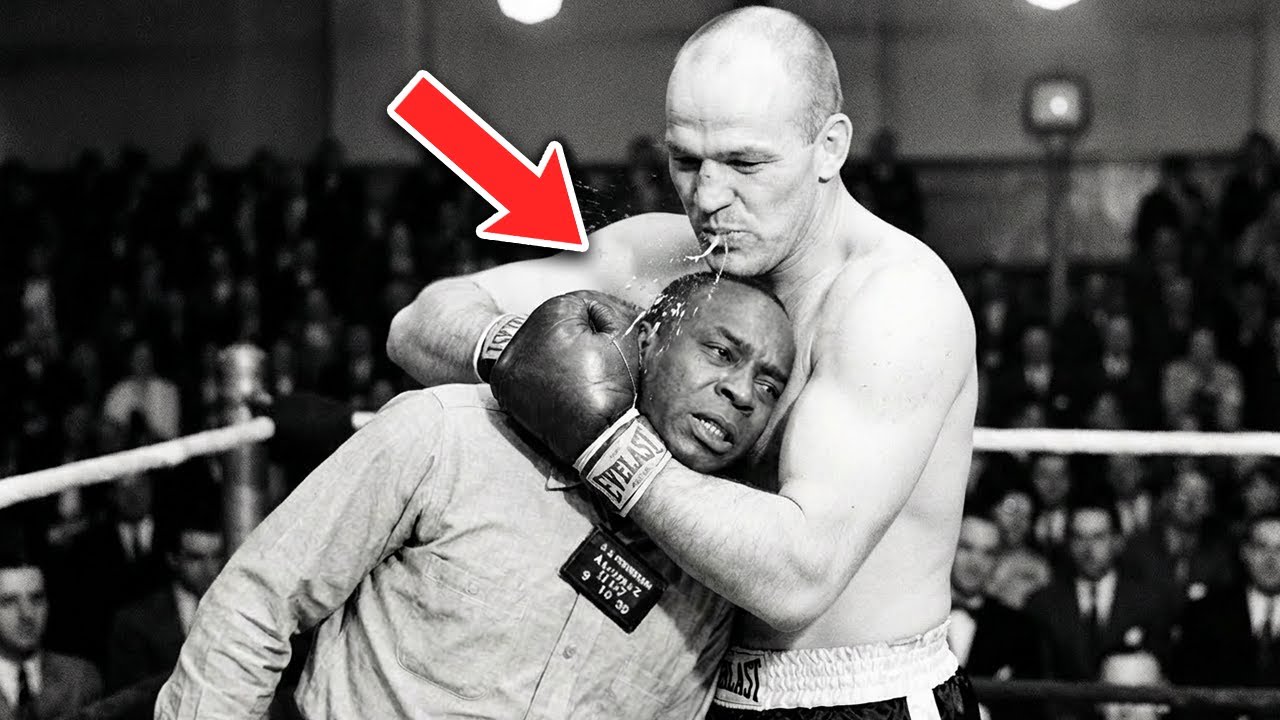
And then he did the unthinkable. Brangan pursed his lips, gathered a mouthful of saliva and blood from his cut gum, and spat. It wasn’t a mistake. It was a deliberate, calculated act of ultimate disrespect. A glob of bloody saliva hit Bumpy directly on the lapel of his charcoal gray suit.
The silence in the armory was absolute. It was the silence of 3,000 people holding their breath at the same time.
June Bug was through the ropes in a split second. He moved with a speed that belied his size. He had a straight razor in his hand before his feet even hit the canvas. Three other men from Bumpy’s crew were vaulting the security barrier. They were going to kill Brangan right there.
"No." Bumpy’s voice cracked through the air like a whip. He held up one hand, palm facing June Bug. June Bug froze.
"Boss, he spit on you. Let me do him."
"I said stand down," Bumpy said. His voice was quiet now, terrifyingly controlled.
Bumpy looked down at his lapel. He reached into his breast pocket and pulled out a pristine white silk handkerchief. Slowly, deliberately, Bumpy wiped the mess away. He folded the handkerchief carefully, contaminated side in, and dropped it onto the canvas at Brangan’s feet.
Brangan was grinning. He thought he had won. "That’s what I thought," Brangan sneered, turning away. "Go back to the nursing home, Grandpa."
Bumpy didn’t speak. He stared at Brangan’s back for three long seconds. He wasn’t looking at a fighter anymore. He was looking at a dead man walking.
Then Bumpy turned. He walked to the ropes. He climbed down the stairs, his movements dignified and slow. "Let’s go," Bumpy said to June Bug, walking past him without stopping.
"Boss, we can’t walk away. The whole neighborhood saw that. We look weak."
"We are leaving," Bumpy said.
He walked up the center aisle. The crowd parted for him like the Red Sea. They were whispering, confused, terrified. Brangan was still in the ring, laughing, holding his arms up in victory, oblivious to the fact that he had just signed his own death warrant.
Bumpy walked out of the armory and into the cool night air. He got into the back of his black Cadillac El Dorado. June Bug got in the front passenger seat, slamming the door hard enough to rock the heavy car.
"Drive," Bumpy said.
"Where to, Mr. Johnson?"
"The office."
They drove in silence for 10 blocks. Finally, Bumpy spoke. "June Bug."
"Yeah, boss."
"What is that boy’s name?"
"The boxer. Billy Brangan. They call him the Butcher."
"He’s a contender, boss. The papers say he’s got a shot at the title next year."
Bumpy reached into his pocket and pulled out a cigar. He lit it with a gold Zippo lighter. He wasn’t angry. He was smiling. A cold, reptilian smile that never reached his eyes.
"He thinks he is a fighter," Bumpy said softly. "But he doesn’t understand the arena. The ring is small, June Bug. It has ropes. It has a referee. It has rules. The world is my ring. And in my ring, there are no referees."
"You want me to send the boys to break his legs?" June Bug asked hopefully.
"No," Bumpy said, shaking his head. "Legs heal. Bones knit together. If we hurt him physically, he becomes a martyr. I don’t want to break his body, June Bug. That’s too easy. I want to erase his future. I want him to wake up tomorrow morning and find out that he doesn’t exist. I want to starve him."
The office was the back room of the Palmetto Chemical Company, a storefront Bumpy used for his legitimate business dealings. Bumpy sat down behind the desk. He didn’t take off his jacket, even though it was stained. He wanted the reminder.
He picked up the phone. He dialed a number from memory.
"Hello."
"Frankie. It’s Ellsworth."
The voice on the other end woke up instantly. Frankie Carbo, the czar of boxing, a man who controlled the International Boxing Guild from the shadows. He and Bumpy had always had a gentleman’s agreement.
"Bumpy. I heard about tonight. I’m sorry, my friend. That kid. He’s a loose cannon."
"I don’t want you to talk to his manager, Frankie," Bumpy said.
"What do you need? You want him suspended? I can get him a six-month ban."
"No," Bumpy said. "I want him gone."
"Gone? Like hit?"
"No. I want him dead professionally. I want him to never step inside a sanctioned ring again. Not in New York, not in Jersey, not in Vegas, not even in a barn in Mississippi."
Frankie hesitated. "Bumpy, the kid is a draw. He brings in gate money. If I blacklist a top contender, the promoters are going to scream."
Bumpy leaned back in his creaking leather chair. "Frankie, do you remember 1958? The union strike at the Garden? The one that cost you a million dollars a week?"
"Silence. I remember," Frankie said softly.
"Do you remember who ended that for you?"
"You did, Bumpy."
"And do you remember who makes sure your numbers runners operate safely north of 110th Street without the police harassing them?"
"You do, Bumpy."
"Good. Now listen to me very carefully. If Billy Brangan fights again anywhere, my protection ends. Your runners will be picked up by the police every single day. Your trucks delivering beer to Harlem will be hijacked and burned. And the strike at the Garden might start up again."
Frankie Carbo sighed. It was the heavy sigh of a businessman counting the cost and realizing the price was too high to argue. "Okay, Bumpy. I hear you. Consider it done. He’s poison. I’ll burn his card."
"Thank you, Frankie."
Bumpy hung up. He didn’t celebrate. He just dialed the next number. This one was to a man named Slick Watts, the biggest sports bookie in the city.
"Slick. Billy Brangan. Take him off the board. No more bets on Brangan. Tell the other bookies. Tell the guys in Jersey. If anyone takes action on a Brangan fight, they answer to me. I want the money to dry up. If there’s no vig, there’s no interest. If people can’t bet on him, they won’t watch him."
"Mr. Johnson, that’s unprecedented. He’s a heavyweight contender."
"He is a ghost, Slick. Do not make me come down there and explain it to you in person."
"You got it, Mr. Johnson. He’s off the board. As of right now, he doesn’t exist."
Bumpy made three more calls. One to a senior editor at the Amsterdam News to ensure the story wasn’t about Brangan’s victory, but about his erratic, dangerous behavior. One to the head of the vendors union to cut off supplies to Brangan’s training camp. And one to the landlord of the Ringside Gym, a man who rented space from one of Bumpy’s shell corporations.
By 2:00 a.m., the web was spun. It was invisible, sticky, and incredibly strong.
Bumpy finally stood up. He took off his ruined jacket. He looked at the spot on the lapel where the spit had been. He walked over to the metal trash can in the corner of the room. He balled up the charcoal gray Italian suit jacket worth $500 and threw it in. He struck a match and dropped it into the can.
June Bug came back into the room holding two cups of coffee. He saw the fire in the trash can and paused. "You finish your calls, boss?"
"It’s done," Bumpy said, his eyes reflecting the dancing flames. "Billy Brangan is a dead man. He just doesn’t know it yet."
"I still think we should have cut him," June Bug grumbled.
"Fast is sloppy," Bumpy said. "And pain fades, June Bug. A broken nose heals in six weeks. But poverty, irrelevance, the silence of a phone that never rings, that lasts forever. When he wakes up tomorrow, he’s going to find out that he has no gym, no manager, no fights, and no money."
Bumpy smiled. It was the smile of a grandmaster who had just moved his queen into position for checkmate. "When he is hungry, when he is begging, when he realizes he is nothing without the machine, then we will pay him a visit."
Bumpy turned off the lights in the office, leaving the fire to burn itself out in the darkness.
Elsewhere in the city, Billy Brangan was celebrating at a club in Midtown, surrounded by hangers-on, drinking champagne, laughing about the old man in the ring, completely unaware that the ground beneath his feet had already turned to quicksand.
The hangover hit Billy Brangan like a sledgehammer made of lead. He woke up at 11:00 a.m. on Sunday in a motel room in Hell’s Kitchen. His mouth tasted like stale champagne and cigarettes. He sat up groaning and rubbed his face.
He felt good despite the headache. He was the winner. He was the king. He remembered the crowd booing him and grinned. Let them boo. As long as they bought tickets, he didn’t care.
And that old man in the suit, Bumpy Johnson, what a joke. Brangan laughed out loud in the empty room just thinking about it. He had spit on the so-called godfather of Harlem and walked away without a scratch.
He reached for the phone on the nightstand to call room service. He wanted a steak and eggs. A champion’s breakfast. The line was dead. He clicked the receiver hook a few times. Nothing. No dial tone.
He got dressed and walked down to the front desk. The clerk, a skinny kid with acne, looked up. He didn’t look scared, which was unusual. Usually, people look scared when Billy Brangan walked into a room.
"Phone’s broken in 204," Brangan barked.
"It’s not broken, Mr. Brangan," the clerk said, not making eye contact. "Service was cut off."
"Cut off? What are you talking about? I paid for the week."
"The manager said you have to leave," the clerk said, sliding a piece of paper across the counter. It was his bill marked paid, but with a note scrawled in red ink. "Out now."
"You kicking me out?" Brangan leaned over the counter, flexing his shoulders. "Do you know who I am? I’m the guy who just knocked out Marcus Little. I’m the next heavyweight champ."
"I know who you are," the clerk said, finally looking up. His eyes weren’t filled with awe. They were filled with pity. "Look, mister, the owner called. He said if you aren’t out by noon, the police are coming. And he said something about the ice delivery. If you stay, the ice truck stops coming and the linen service. We can’t run a motel without ice and sheets. Just go."

Brangan snatched the bill. "Screw this dump anyway."
He stormed out to his car, a flashy red convertible he had bought on credit. He jumped in and turned the key. It clicked. The battery was dead or disconnected.
He got out and slammed the door. He’d take a cab to his manager’s office. Goldman would sort this out.
He hailed a cab on 10th Avenue. The driver, an older guy with a thick Bronx accent, pulled over. Brangan got in. "Goldman, 54th and Broadway."
The driver looked in the rearview mirror. His eyes widened as he recognized the passenger. He didn’t say a word. He just put the car in park. "Get out," the driver said.
"What?"
"I said get out. I ain’t taking you nowhere."
"You want a broken nose, old man? Drive the car."
"I got a union card, pal," the driver said, turning around. "Dispatch came over the radio an hour ago. No rides for Billy Brangan. Anyone picks you up, they lose their medallion. I got three kids. I ain’t losing my medallion for you. Get out."
Brangan stared at him. The reality of the situation was starting to trickle in, cold and confusing. He got out of the cab, slamming the door so hard the window rattled.
He started walking. It was 20 blocks to Goldman’s office. He walked fast, his anger building with every step. People on the street recognized him. Usually they would stop and ask for an autograph or shy away in fear. Today they just watched him. They watched him like he was a contagion.
He reached the office building. He burst through the glass doors of Goldman’s office. "Goldman. Where’s my money?"
The receptionist’s desk was empty. The office was quiet. He walked into Goldman’s private office. Morty Goldman was packing a box. He was taking pictures off the wall. He looked like a man evacuating a sinking ship.
"Billy," Goldman said, not looking happy to see him. "You shouldn’t be here."
"Where’s my purse, Morty? I knocked the guy out. I get the win bonus. I want my cut."
Goldman stopped packing. He looked at his fighter. "There is no money, Billy."
"What do you mean no money? The gate was huge."
"The commission held the purse," Goldman said, his voice shaking. "They’re investigating irregularities in the betting. They froze the funds."
"And the fight in Philly," Goldman continued, ignoring the question. "Cancelled. The venue pulled out this morning. Said they had electrical problems."
"Electrical problems? Morty, what the hell is going on?"
Goldman walked around the desk. He looked tired. "Billy, you’re a great fighter. You got a chin like iron, but you’re stupid. You’re really, really stupid."
"Watch your mouth, Morty."
"Or what? You’re going to hit me? Go ahead. It won’t change anything. Billy, do you know who you spit on last night?"
"Some old gangster. So what?"
"So what?" Goldman laughed. A hysterical, high-pitched sound. "That old gangster is Bumpy Johnson. He runs Harlem. He runs the numbers. He knows Frankie Carbo. He knows the unions. He knows everybody."
Goldman picked up his box of personal effects. "I got a call at 8:00 a.m., Billy, from the head of the managers association. If I represent you, none of my other fighters can get on a card in New York, New Jersey, or Pennsylvania. I have 12 other fighters, Billy. I have families to feed. I can’t represent you anymore. You’re fired."
"You can’t fire me. I’m the champ."
"You’re nothing," Goldman screamed, losing his composure. "You’re poison. You’re walking dead. Look around you, Billy. The phone isn’t ringing. The gym is locked. You think that’s a coincidence? Bumpy Johnson snapped his fingers and you cease to exist."
Goldman walked past him to the door. "I’m leaving. Don’t be here when the security guard comes up. He’s got instructions to call the cops if you trespass."
Brangan stood alone in the empty office. The silence was deafening.
He left the building. He walked to his gym on 125th Street. It was his sanctuary. If he could just hit the heavy bag, he could think.
The metal grate was pulled down over the entrance. A heavy padlock secured it. There was a sign taped to the metal. "Closed for renovations."
Brangan grabbed the grate and rattled it. "Open up. It’s Billy. I need my gear."
Nothing. He kicked the grate. He screamed. But inside the gym was dark.
He had no car, no money, no manager, no gym. He walked to a pay phone on the corner. He had a few coins in his pocket. He dialed the number for Mickey Cohen’s outfit in Jersey. They were tough guys. They wouldn’t be scared of Bumpy Johnson.
"Yeah."
"This is Billy Brangan. Put me through to Tony."
"Hold on."
Silence. Then a click. Then a dial tone. They hung up.
He tried again. "Yeah. Don’t hang up. It’s Billy. I need help."
"Look, kid," the voice said, low and hurried. "Tony said to tell you he doesn’t know you. He said if you call again, he’s going to send guys to break your jaw. You stepped in it deep, kid. You spit on the wrong shoes. Don’t call here again."
Click.
Brangan dropped the receiver. It swung on its metal cord, hitting the side of the booth. He stood on the corner of 125th Street, the heart of Harlem. The people walking by looked at him. They knew. They all knew. The word had spread on the street faster than the wind. That’s the white boy who spit on Bumpy. That’s the dead man.
He felt a sudden, crushing wave of paranoia. Every car slowing down looked like a hit squad. Every man with a hand in his pocket looked like an assassin.
He was hungry. He hadn’t eaten since yesterday. He walked into a diner. He sat at the counter. "Coffee and a burger," he said to the waitress.
The waitress, a heavyset black woman, looked at him. She looked at the cook in the back. The cook shook his head slowly. "We ain’t got no burgers," the waitress said coldly.
"I see people eating burgers right there," Brangan pointed to a booth.

"Grill’s broken," she said. "And the coffee machine broke, too. You got to go."
"I have money. I can pay." He pulled out a crumpled $10 bill.
"Your money ain’t good here," she said. "Your money ain’t good anywhere in Harlem. Get out before I call my husband."
Brangan stumbled out of the diner. It was 4:00 p.m. The sun was starting to go down. The shadows were getting longer.
He realized then that Bumpy wasn’t going to kill him. Not with a gun. He was killing him with silence. He was killing him with hunger. He was showing him that physical strength meant nothing in a world run by power.
Desperation took over. The arrogance was gone, replaced by a cold, shaking fear. He needed to fix this. He needed to beg.
He knew where Bumpy’s legitimate office was. The Palmetto Chemical Company. He had heard the stories. He walked. He walked for 40 blocks because no cab would take him.
By the time he reached the storefront, it was dark. He was sweating, thirsty, and exhausted. He looked less like a champion and more like a vagrant. There was a light on in the back.
Brangan banged on the glass door. "Mr. Johnson. Mr. Johnson, please."
The door opened. June Bug stood there. He looked at Brangan with pure disgust. He didn’t have a weapon drawn. He didn’t need one.
"He’s expecting you," June Bug said.
Brangan walked in. The office was simple. Bumpy Johnson sat behind the desk reading a newspaper. He looked immaculate in a fresh navy blue suit. He looked like a businessman closing a deal.
Brangan stood in front of the desk. His hands were shaking. "Mr. Johnson," Brangan stammered. "I came to apologize."
Bumpy didn’t look up from the paper. "Apologize for what?"
"For last night in the ring. I was out of line. I was hyped up. I didn’t mean it."
Bumpy slowly folded the newspaper. He placed it on the desk. He looked at Brangan. "You didn’t mean to gather spit in your mouth and project it onto my person?" Bumpy asked calmly. "That seems like a very deliberate action for something you didn’t mean."
"I was stupid," Brangan said, his voice cracking. "I’m sorry. Please, just call them off. Call Goldman. Call the commission. I can’t get a fight. I can’t get into my gym. Even the motel kicked me out."
Bumpy leaned back. "You are finding life difficult today, Billy."
"I’m ruined. They said I’m blacklisted. I’m a fighter, Mr. Johnson. It’s all I know. If I can’t fight, I starve."
"Then starve," Bumpy said.
The words hung in the air.
"Please," Brangan begged. He fell to his knees. The big, tough heavyweight champion. The man who called himself the Butcher. He was on his knees in a chemical supply store office. "I’ll do anything. I’ll give you my purse. I’ll fight for free. Just let me back in."
Bumpy stood up. He walked around the desk. He stood over Brangan. "Get up," Bumpy commanded.
Brangan stood up slowly, wiping his nose.
"You think this is about money?" Bumpy asked. "You think you can buy respect? You spit on me, Billy. You spit on a man who has walked through fires you can’t even imagine. You spit on this community."
Bumpy stepped closer. He was much shorter than the boxer, but in that moment, he seemed 10 feet tall.
"I could have had you killed last night," Bumpy said softly. "June Bug wanted to cut your throat in the ring. I stopped him. Do you know why?"
"No," Brangan whispered.
"Because death is too easy, and because I wanted to teach you a lesson about power. You have muscles. You have fists. That is violence. Violence is cheap. Any fool with a temper can be violent."
Bumpy tapped his own temple. "This is power. The ability to take a man’s life away without ever touching him. That is power."
Bumpy walked to the door and held it open. "I will make one call," Bumpy said.
Brangan’s face lit up with hope. "Thank you. Oh, God. Thank you, Mr. Johnson."
"I will call the bus station," Bumpy continued, his voice ice cold. "I will buy you a one-way ticket to Ohio. You have family there, don’t you?"
Brangan’s face fell. "Ohio? But my career?"
"Your career is over," Bumpy said. "Billy Brangan, the boxer, died last night in that ring. He died the moment he forgot his manners. You are leaving New York tonight. You are never coming back. If I see you in this city tomorrow, if I see your name on a fight card anywhere on this coast, then I will let June Bug have his way."
Bumpy looked at June Bug. June Bug smiled, a nasty, predatory grin, and patted the bulge under his jacket.
"Do you understand?" Bumpy asked.
Brangan looked at the old man. He looked at the eyes that held no fear, only absolute authority. He realized then that he had lost the fight before the first bell had even rung.
"I understand," Brangan whispered.
"Good," Bumpy said. "June Bug will drive you to the Port Authority. He will make sure you get on the bus. Do not miss it."
Brangan walked out of the office. He walked with his head down, his shoulders slumped. He looked smaller than he had ever looked in his life.
Bumpy watched him go. He watched June Bug escort the broken giant to the car.
May came out from the back room. She had been listening. She walked over to Bumpy and placed a hand on his shoulder. "You showed him mercy?" May said softly.
"Did I?" Bumpy asked, looking out at the dark street. "He was a king yesterday. Tomorrow he will be a factory worker in Ohio, wondering where it all went wrong. Sometimes, May, letting a man live with his failure is the cruelest punishment of all."
Bumpy turned off the lights. The office went dark.
Billy Brangan was never heard from in the boxing world again. His record was forgotten. His name was erased from the marquees. He became a ghost story told in Harlem gyms. A warning whispered to young fighters who got too arrogant.
"Don’t be like Billy," the old trainers would say. "He won the fight, but he lost the war. He tried to fight a ghost with his fists."
And Bumpy Johnson, he went back to the Lenox Terrace. He sat on his balcony, watched the sunrise over his city, and drank his coffee. He was the king of Harlem. And the king didn’t need to throw a punch to knock a man out. He just needed to make a phone call.