In October 1885, a nine-man U.S. Cavalry detachment rode into a remote stretch of Sonora, Mexico, known locally as *La Tierra Que Escucha*—the land that listens. Five men came back.
The patrol was part of the extended pursuit of Geronimo, who had broken from the reservation months earlier. The men were worn thin by the chase. The detachment was led by Captain Halford Merrowfield, a 41-year-old Pennsylvanian who had stayed in the territories because he no longer remembered how to be a civilian. His second was First Lieutenant Othniel Quintrell, 28, a lean academy man from Boston. The sergeant was Ambrose Stillwell, a broad-shouldered Tennessean with hands so large he had his gloves made special in El Paso.
The rest of the troop included Corporal Mercer Bidwell, a soft-spoken Kentuckian; Trooper Asahel Wainwright, a Maine schoolteacher’s son who wrote letters for the others; Trooper Linus Caulfield, who talked constantly about Indiana; and Trooper Wendell Stuckey, a small, wiry man from southern Illinois who hummed Methodist hymns under his breath as he rode.
Two more men rode with the detachment but were not of it. Augustus Trelawney was a civilian topographer from Washington, sent to survey the country south of the Gila. He wore wire spectacles and looked like a country doctor who had lost his way. He was not lost. The ninth man was the scout, a Navajo the soldiers called Ne-ol. In the language of the Diné, the word means wind.
On the fifth day of the patrol, they crossed the line into Sonora. Ne-ol stopped his horse at the border and spoke a name under his breath. It was not a prayer. It was the name of a place his grandfather had warned him about as a young man. The warning translated roughly to “the place that is not to be visited.” His grandfather had told him the army would one day make him ride to it.
They rode for two more days through high desert, past yucca and ocotillo, over gravel that rang hollow under the horses’ hooves. The trail they followed was three days old. On the seventh evening, the first small thing happened. Stuckey sat by the fire and began to sing “Shall We Gather at the River?” He stopped mid-verse. He said he had forgotten the next line. Bidwell recited it for him. Stuckey said he did not know that one either. Across the camp, Ne-ol stood with his back to the firelight, staring south at a ridge, as still as a man who had heard his name called from a long way off.
The next morning, Stuckey woke and could not remember the name of his horse. He had called the sorrel mare Beulah for seven months. When Caulfield laughed, Stuckey laughed too, but the laugh did not sound right. He had been looking at an empty space three feet to the right of the mare when he asked the question.
On the eighth day, they found the cave. It was in the south wall of a narrow valley of black basalt. The mouth was a low slot in the rock, about eight feet at its highest. The valley was not on any of Trelawney’s maps. He said it had been deliberately left out.
Ne-ol stopped his horse two hundred yards from the wall. He told the captain the cave did not want them. He said his grandfather had told him of this place. He said, “If you go in, you will not bring out what you went in for. You will bring out something else. The cave gives you that instead.”
Merrowfield looked at the cave, looked at his men, and gave the order to have a look. They would not go in deep.
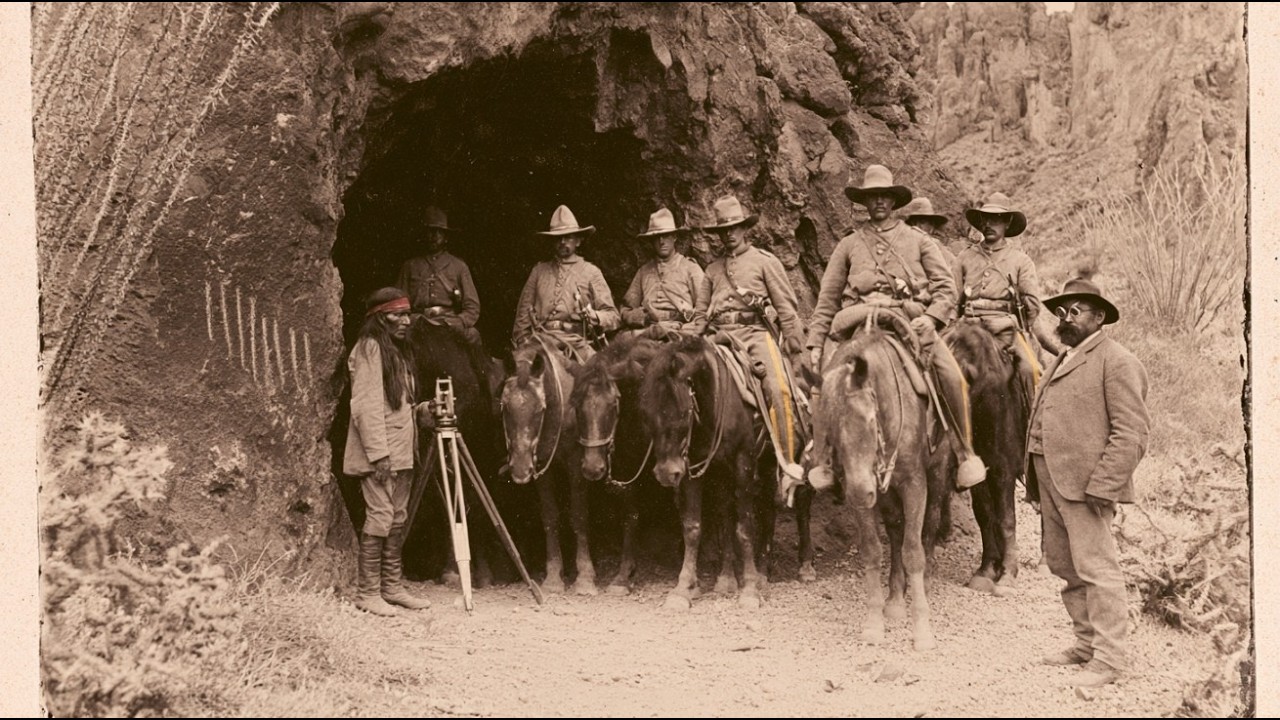
Trelawney found markings just inside the mouth. Eleven vertical lines cut into the rock, unevenly spaced, one of them crooked. Above them was a single horizontal scratch. Trelawney said they looked like tally marks. Quintrell stepped back from the wall because he had felt a small movement of air come out of the cave. The cave was breathing. There was no wind in the valley.
Merrowfield sent Stuckey in with a torch and a revolver. Stuckey walked in stooped, then called back that the passage opened up. He went around a turn. He was gone for nine minutes.
When Bidwell and Wainwright went in after him, they brought Stuckey out between them. He was on his feet but his weight was on the other men. His hands were perfectly clean—no pitch, no dust, no calluses. He was not blinking. He sat on the gravel and looked at his hands. When the captain asked what had happened, Stuckey said he had counted the lines on the wall. There had been eleven when he went in. There were twelve when he came back.
Ne-ol made a small sound from his horse. It was the sound a man makes when he has been told a thing he already knew and did not want to be right about.
They rode east that afternoon. Stuckey sat his horse like a sack of corn. That night, Caulfield began talking by the fire about a creek near his uncle’s farm. He stopped mid-sentence. He said he did not know that creek. He did not have an uncle. He had been telling a story he did not know.
Quintrell wrote in his journal that something in the cave had learned to count. It had learned, and it had brought what it had learned out with it. It was counting their memories, their names, their small histories. It was trying them on like coats.
That night, the horses stood facing west, back toward the cave. Stuckey lay on his bedroll with his eyes open. He did not blink for seven hours.
In the morning, Stuckey sat up in one smooth motion and said good morning in a cheerful voice. He saddled his mare perfectly. The mare took two steps backward when he approached. She had never done that before. She stood still after that, but it was not the stillness of a calm horse. It was the stillness of a thing that had been told it could not move.
On the ninth day, Trelawney opened his theodolite case to take a reading. The instrument was gone. The case was undisturbed. The straps were buckled. There was simply nothing inside.
That evening, Wainwright opened his small black book to make his daily entry. The page was filled top to bottom in his own handwriting with the same line repeated twelve times: “I have not been in the cave.” He had no memory of writing it.

On the tenth day, Caulfield was gone. His bedroll was empty. His boots were beside it. His rifle was leaned against the saddle. His blanket was folded the way a man folds a blanket when he is leaving it for someone else to find. They searched for two hours. They found no tracks. They found a small pile of eleven pebbles stacked on the gravel, on the line of sight between the camp and the cave.
Ne-ol looked down at the pile as they rode past. He said one thing in Diné. The school teacher at Fort Defiance later recorded the translation: “Ten now. He is counting down.”
On the eleventh day, Bidwell vanished in daylight. He knelt at a seep to fill his canteen. He stood up. He turned to walk back. Between one step and the next, he was not there. There was no sound. There was no movement. There was only the full canteen lying on the gravel. On a flat stone beside the seep were ten pebbles stacked one on top of the next.
Stuckey smiled. It was the smile of a man who had heard a piece of news that confirmed something he had wanted confirmed.
Merrowfield ordered Stuckey off his horse. He ordered him to give up his rifle. He ordered him to walk ahead of the column where the men could see him. Stuckey obeyed easily. He walked the rest of that day and did not look tired.
That night, Ne-ol came to the captain in front of the men. He said they were eight. He said the count would not stop at zero. It would go past zero. There was no rule that said it must stop. He said the cave had given Stuckey to them in that country. The country knew him. The country could hold him. But the country north of the line would not know what he was. The count would get very big.
Stuckey, sitting cross-legged at the edge of the firelight, looked up from his cup of coffee. He asked if he could go for a walk in the morning. He said he would like to walk south. He said he thought it would be the right thing to do. His eyes were the same eyes he had ridden out of Fort Huachuca with. They were not, however, his eyes.
Merrowfield said, “In the morning, Trooper.” Stuckey politely thanked him.
In the gray light before dawn, Stuckey rose. He folded his blanket. He left it neatly on the ground. He left the cold cup of coffee beside it. He walked south on foot. The men watched him go. None of them moved to stop him.
Ne-ol watched until the figure was no longer visible. Then he said to the captain, in a voice so low only he heard it, “It will stop now. Where it is.”

The detachment rode north. They crossed back into Arizona on the eleventh day of the patrol and reached Fort Huachuca on the fourteenth. The official record listed Caulfield and Bidwell as deserters. Stuckey was listed as missing in action. His mother received a small box of his personal effects. The mare was reissued to another trooper.
Trelawney returned to Washington. He never referred to the patrol in any published paper. He died in 1892 of a heart condition. His personal papers covering the autumn of 1885 were withdrawn from the Smithsonian collection in 1894. The ledger does not say by whose order.
Stillwell served until 1898. He retired to a boarding house in Tennessee. On three occasions, he asked the landlady to remove a small stone from his windowsill. She could not see any stone there at all.
Wainwright left the army the year after the patrol. He went home to Maine and took a teaching position. He died in 1921. His sister burned his little black book on his instructions. She said her brother had once told her there were certain books a man kept not because he wanted to keep them, but because he was not sure whether they would let him let them go.
Quintrell served until 1911 and made colonel. He retired to a town outside Boston. He kept his journal in a drawer of his desk. He died in 1928. His daughter read the journal that night, read it again the next morning, and burned it in the yard. She told a priest in Santa Fe that the pages had been warm in her hands when she took them from the drawer, as if they had been sitting in the sun even though the drawer had been shut for years.
The priest asked her if she had counted the marks in the back. She said she had not looked at the back. She said there had been a page near the end she could not make herself turn. The priest said it was well that she burned it.
Ne-ol left army service in the spring of 1886. He went back to the country around Chinle. He took up sheep. He married. He had a long life. In 1922, he told the story once to a Methodist school teacher who was leaving for the east. He told her the cave was still where it had been. He told her there were now, he believed, more than eleven marks on the wall. He said he could feel it. He said any man who had stood at the mouth of that place could feel it every day for the rest of his life.
He said the wind that blew from the south was a counting wind. He said, “It is still counting. It will count until there is no one left to count.”
The school teacher wrote the story down that evening. She kept the pages in her Bible. When she died in 1947, the Bible was given to a museum in Albuquerque. The pages were filed under a label that read simply, “NM Miscellaneous Correspondence.”
The person who found them there counted the marks. There were twenty-three of them.