In the winter of 1891, a Siberian trapper named Vasili Yegorovich Kerzhakov returned from the taiga forest with a story he would spend the rest of his life trying to explain. He was 38 years old, a veteran of nearly two decades in the wilderness, and not a man given to fear. But what he encountered in the high ridges east of the Kirenga River changed the way he understood the forest forever.
The taiga is the largest forest on Earth, stretching from the Ural Mountains to the Pacific coast. At its widest point, it would take four months to walk across in a straight line. There are no roads, no towns, no other human voices for weeks in any direction. The Evenki people, who have moved through this land for thousands of years, had a name for what lives there. They called it the thing that walks between the breath of the trees.
Kerzhakov was a trapper from Ust-Kut, a settlement on the Lena River so remote that residents measured distance in weeks of travel rather than miles. He had been working the same trap line for six years, a five-day loop covering roughly 45 kilometers of dense forest. He knew every section of it. He knew where the light had to push harder to get through. He knew the silence so well that it had become home.
In the third week of November, the silence changed.
Kerzhakov found one of his sable snares missing entirely. The stake, driven eight inches into frozen ground at a 45-degree angle, had been pulled straight up with enough force to remove it cleanly from the earth. There were no signs of digging. No animal tracks. Just a clean hole and a faint compression in the snow, as though something very heavy had stood there for a time.
That night, he woke in his shelter to the sound of footsteps. Not the wide, heavy tread of a bear. These were bipedal. Left, right, left, right. Something walking a slow circuit around his camp, roughly 30 meters out. He lay still in his sleeping furs, rifle within reach, and did not get up. Later, he would say this was one of his better decisions.
When he returned to Ust-Kut, he heard two things that troubled him. A Tungus hunter named Prokopy Dzerzhinsky had not returned from his autumn trapping run. His camp was undisturbed. His traps had been checked and reset normally. Then his tracks simply stopped. The district officer wrote it up as a hunting accident, but Kerzhakov knew better. Men like Prokopy did not fall through ice.
The second thing came from an Evenki elder named Agrafena Okladnikova. She told him that the thing in the high forest had been restless that autumn. She said it appeared every 30 to 40 years, regular as a season. It came and it walked and it looked, and the men it had looked at longest were the men who did not come back.
She said it was not a creature. It was more like a memory, she told him. A memory the forest had made from all the silence it had accumulated over thousands of years.
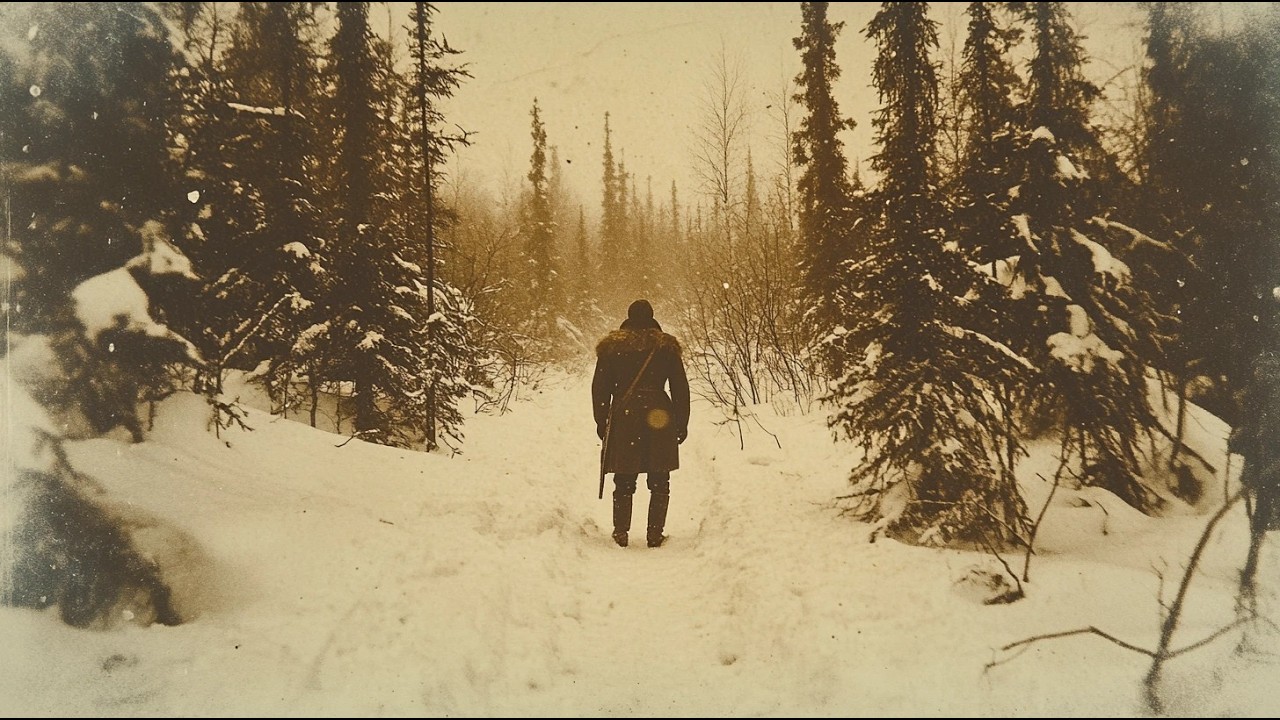
Kerzhakov went back out in December. He told himself he was looking for Prokopy. But the whole truth was that he wanted to see.
On the fourth night of his December run, he woke at approximately 3:00 in the morning. The stove was still going. The silence had changed again. Then he heard a single sound from directly outside the east wall of his shelter. A long, slow pressure. Like a hand placed flat against the logs and dragged across them. Deliberate. Intended.
In the morning, he found a mark in the frost on the wood. The length of a large hand, maybe a hand and a half. There were no footprints in the snow around the shelter. Nothing had stood there to make it.
He went up anyway, toward the high ridges where Prokopy's tracks had stopped. In the afternoon, he found a clearing between three enormous old spruce trees. The snow in the center had been disturbed in a pattern. Sections pressed down to ice, sections left untouched. The pressed sections formed shapes, roughly oval, roughly the proportion of feet, but larger than any human foot. The geometry was wrong in a way he could not articulate.
The trees around the clearing were marked. Deep lines cut into the bark, not like claw marks. Something more deliberate. Something that might have been writing, or a record. The marks covered the inner bark and extended around the curve of the trees further than was visible from the clearing.
He did not copy them that day. He turned around and walked back down the ridge.
Kerzhakov did not return to the eastern ridges for two years. He shifted his trap line south and west. The catches were worse. He made less money. But the dreams persisted. He would wake at 3:00 in the morning with the sensation of having been in the middle of a sound, catching only the reverberation of something that had already ended.
In the autumn of 1893, he went back. He brought a proper bound journal, charcoal sticks for drawing, and a piece of glass from a broken window, wrapped in cloth, to copy the marks on the trees. He spent two days below the clearing waiting. Nothing happened. On the third day, he went up.
The clearing was as he had left it, overlaid with new snow and new impressions. He began to copy the marks on the trees. It took several hours. The marks were more numerous than he had realized. On close examination, they covered not just the inner bark of the three spruces but extended around the curve of the trees. The oldest marks were deep in the bark, partially healed over. Newer marks sat in fresh wood.

By firelight that night, he looked at his copies. The marks meant nothing to him individually, but the arrangement of them, the way they grouped and repeated, looked like the structure of language. Not any language he knew. But something that carried information. Something that had accumulated over time.
On the fourth night, at approximately 3:00 in the morning, he saw it.
The moon was high and almost full. In the blue-white clarity of moonlight on deep snow, something moved into the clearing. It was large. It moved upright on two points of contact, like a person, but the proportions were not a person's proportions. The length from shoulders to the ground was too great. The way it balanced was slightly wrong, like a memory of a person drawn by someone who had heard one described but never seen one.
It stood in the center of the clearing for a long time. Kerzhakov could not say how long. His sense of time had become strange. It might have been 20 minutes. It might have been 2 hours.
Then it looked toward him. He was hidden below the clearing edge, in shadow, behind a tree. By any rational account, invisible. It looked directly at him. He had the sensation of being seen the way you see a word on a page. Noted. Recorded. Filed. Not as a threat. Not as prey. Just seen.
Then it moved to the trees at the clearing's edge. In the cold still air, he heard the sound of the marks being made. A slow, deliberate sound. Not like claws. Like something being pressed and turned.
He did not move until the sound stopped and the clearing was empty again.
Kerzhakov left the eastern ridges the following morning. He did not run. He felt something close to calm. The calm of a man who has decided that what happened was what it was, and that the rest is beyond the range of understanding available to him.
He spent the winter writing. He filled three journals with everything: the missing trap stake, the footsteps, the mark on the shelter wall, the clearing, the shapes in the snow, the marks on the trees, the night he watched. He wrote it the way you would write a survey report. What was here, what I saw, what I heard, what I found.

He gave the journals to a retired school teacher named Afanasy Miroshnikov, asking him to keep them and to give them to someone after his death who might know what to do with them. Miroshnikov asked if he was dying. Kerzhakov said he did not think so. He said he was just careful.
He continued trapping for another 11 years, but never returned to the eastern ridges. Not because he was afraid of what was there. He was afraid of himself. He was afraid that the curiosity was too strong, that if he went back, he would try to get closer. He had a clear-eyed enough understanding of his own nature to know that this was the direction most likely to end the way Prokopy Dzerzhinsky had ended.
Some things look back. And the men they look at longest are not the careful ones. They are the ones who needed to be seen.
Kerzhakov gave his final account in 1904, at the age of 61, to a young newspaper correspondent named Stepan Petrov. Petrov wrote it down faithfully. His editor rejected the article as too strange to print beside serious news. Petrov kept his notes.
Those notes passed through several hands over the following decades, through revolution and war and forced resettlement. What remained were Petrov's notes, incomplete but detailed enough, and a single copied page from one of Miroshnikov's transcriptions of the journals. The page described the marks on the trees. Researchers who looked at it later noted that the marks bore no resemblance to any known writing system. But several of them independently noted the same thing Kerzhakov had noted by firelight: that it had the structure of language. The marks were not random. They were arranged with the internal consistency of something that carries meaning.
The trees on the eastern ridge above the Kirenga River tributary were still there as of the last serious expedition to that area in 1973. The researcher noted in his report that the clearing was still present, recognizable from Kerzhakov's description. The marks on the trees had continued past the ones Kerzhakov had copied. The newest marks were cut deeper than the older ones, as though whatever made them had become more certain of what it was writing, or more urgent.
On the third night of that expedition, the researcher woke at approximately 3:00 in the morning with a conviction that something outside his tent had been standing there for a long time. He reported no sounds, no tracks, no visible disturbance. Only the conviction. He left the following morning.
He never returned to the region. He died in Novosibirsk in 1989 at the age of 71. In the margin of his original field notebook, there was a line that did not make it into the published report. His daughter found it when she was clearing out his belongings. The ink looked older than the surrounding notes. The handwriting was slightly different, more careful.
The line was: "It was already there when we arrived. It will be there when we are gone. The forest does not forget."
His daughter said she did not know what it meant. She said her father had never talked about the Siberian work. She said that in his last years, he would sometimes wake at night and sit in the kitchen until dawn. When she asked him about it, he would say he was just thinking.
There are places like this on every continent. Forests, deserts, cave systems. Places where something patient has been keeping its record for longer than we have been here. The taiga is one version of this. The Appalachians are another. Different forest, different names, same patience.
Some things are the forest remembering you.