In the final months of her life, Queen Elizabeth I sat in her chambers at Richmond Palace, surrounded by food she would not touch. The kitchens continued their work as they had for 45 years. Fresh manchet bread, roasted chicken, marzipan shaped like fruit, and syllabub in a silver bowl were all brought to her table. She left them untouched. For the court, that uneaten plate was a signal more feared than any whispered diagnosis. Elizabeth Tudor had controlled everything for nearly half a century. When she stopped eating, the court understood that England was running out of time.
Richmond Palace stood on the southern bank of the Thames, about 16 kilometers from Westminster. Elizabeth called it her “warm winter box” when she left London in January 1603. She retired there knowing she was dying, while the court followed its usual rules and pretended otherwise. The palace carried heavy memories. Her grandfather Henry VII had died there in April 1509. He had rebuilt the palace after a fire in 1497 and named it after his former earldom. His granddaughter would end her reign in the same rooms.
Food in the Tudor court was never just food. It was a stage, a display of hierarchy, and a language of power. A noble seated near the queen received the finest meats as a public sign of favor. The placement of dishes carried messages understood by every courtier in the room. Elizabeth ate moderately and deliberately, with a self-control that extended to everything else she did. The historian William Camden attributed her healthy longevity partly to her abstinence from wine and her careful eating habits. Unlike her father Henry VIII, who turned excess into a monument to himself, Elizabeth ate to feed her mind, not to display her wealth.
A documented menu from a formal dinner in November 1576 shows the queen’s table was simpler than her father’s. The first course included beef, lamb, veal, swan or goose, capon, rabbit, fruits, custards, pies, manchet bread, beer, and wine. The second course offered lamb or kid, heron or pheasant, hens, pigeons, larks, butter, and fritters. By modern standards this was extraordinary. By the standards of her father’s court, it was almost modest.
But Elizabeth was not moderate in everything. She was, by all accounts, addicted to sugar. In the 16th century, sugar was a luxury so expensive it served as a symbol of power. It was imported from Cyprus, from colonial ventures in the Americas, and through Arab trade routes across the Mediterranean. It was costly to refine and costly to transport. It also destroyed teeth with an efficiency Elizabethan medicine could not understand. By the time Elizabeth reached her fifties, her love of marzipan, sweetmeats, dried fruits, and pastries had left most of her teeth decayed, blackened, or missing. Foreign visitors wrote about the queen’s teeth with astonishment in letters that spread across European courts.
Courtiers, as they often did, began to imitate what they saw. They deliberately blackened their own teeth. A blackened mouth signaled that one consumed enough sugar to destroy it. Women colored their teeth to resemble the queen’s. Even Elizabeth’s most visible decay became something others aspired to. The queen herself never treated her teeth as something to boast about. Every portrait she oversaw, and she oversaw them with what historians called near-obsessive precision, showed her with a closed or barely open mouth. The image she enforced, later called the “Mask of Youth,” presented a queen forever in her prime, untouched by time.
The mask was cracking, both figuratively and literally. Elizabeth’s choice of cosmetics was influenced by her bout with smallpox in 1562, which left scars on her face. The available treatment was a cosmetic called Venetian ceruse, also known by a name that horrifies modern listeners: “Spirits of Saturn.” It was made from white lead mixed with vinegar, processed into a paste that gave a porcelain-pale complexion. It was popular, expensive, and the most effective skin treatment of the 16th century. It was also poison, as would be officially proven 31 years after Elizabeth’s death. Lead accumulates in the body and never leaves. Chronic lead poisoning causes hair loss, and Elizabeth’s hair had become noticeably thin under her elaborate wigs by the end of her reign. It also causes cognitive disturbances, skin deterioration, and organ damage that worsens over time.
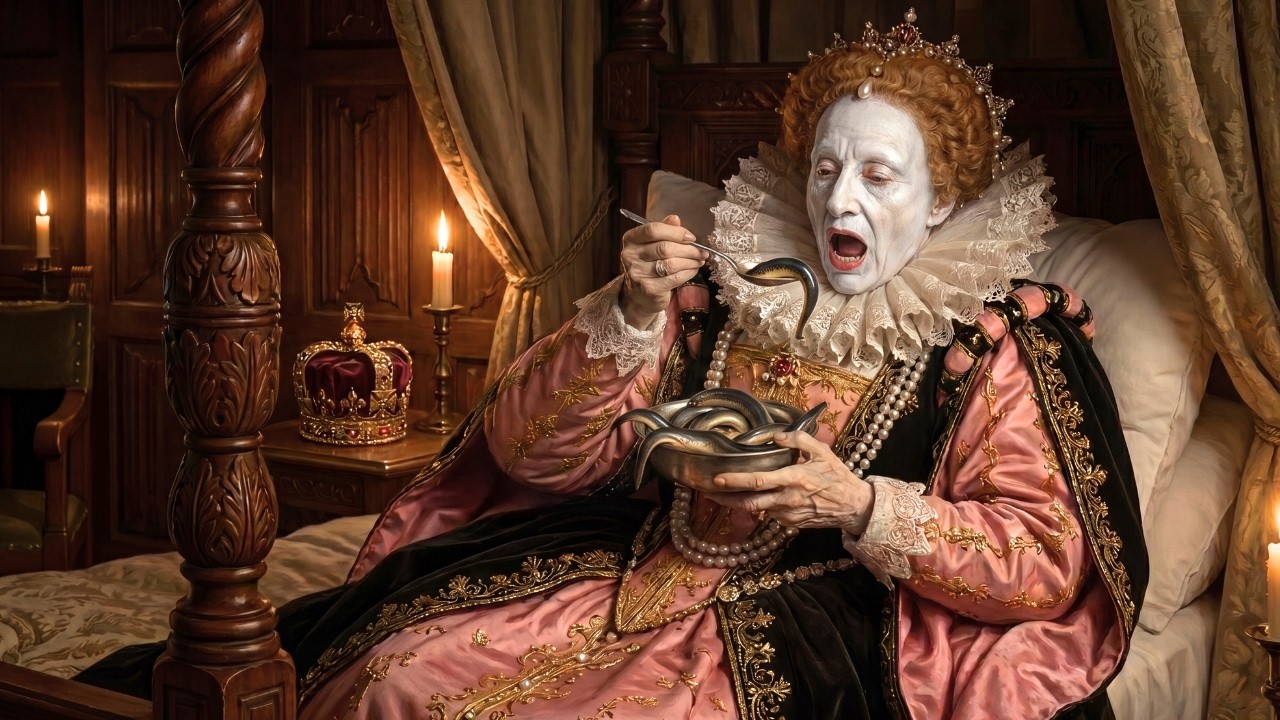
Historians have not settled on the primary cause of Elizabeth’s death. It may have been lead poisoning, or the strep throat identified by biographer Alison Plowden as the direct physical cause, or pneumonia, or grief that worsened her physical decline. The question cannot be resolved because Elizabeth refused to allow an autopsy. What is certain is that she had been slowly damaging her face for four decades. The cosmetic damage and the sugar damage worked together. Tooth decay caused abscesses. Abscesses infected her throat. The throat infection made swallowing agony. Even syllabub, light and almost insubstantial, was painful to pass through a swollen throat.
The kitchen kept sending food. This detail matters. The kitchen kept sending food because that was the kitchen’s role. The monarchy was built on the necessity of feeding the court, and the court included the queen. The machine ran whether or not the queen ate what it produced. Stopping it, canceling the rituals of the table, would have been an admission. It would have declared, in the language the court understood better than any announcement, that the queen was dying. No one could say that while Elizabeth still lived.
A formal dinner at Elizabeth’s court was a play that began hours before the first dish appeared. Food was tasted for poison before reaching the table, a ritual that had become theater but still expressed the queen’s importance. Dishes arrived in a procession carried by servants ranked by their proximity to power. Silver tableware was placed according to rules older than Elizabeth herself. She did not always sit at the formal table. Often she dined privately in her chambers with a few ladies, eating modest amounts of meat, some bread, and seasonal fruit. The elaborate royal table ceremony continued even when the queen chose not to attend, because it was not about the queen eating. It was about the continuation of her presence. That presence was confirmed daily through the ritual of a meal prepared and served. The deeper function of the royal table was daily affirmation. The food arrives, the queen eats, the ceremony proceeds. Another day passes, the reign continues. When the food arrives and is not eaten, the ceremony continues, but it becomes a ritual emptied of meaning.
The banquet course was where Elizabeth’s discipline failed every time. In the Elizabethan era, a banquet did not mean the entire meal. It meant the final course, served in a separate location. There was a banquet hall in some palaces, a garden pavilion in summer, a tower room in winter. The room was lit by candles and decorated with the finest silver. On those silver dishes, placed in every corner, there was only sugar. Marzipan, comfits, fruits preserved in sugar syrup, crystallized ginger, dried fruits coated in sugar until they looked like gemstones, biscuits made with sugar as a primary ingredient, wine sweetened with sugar, and sugar sculptures shaped like ships, animals, castles, and playing cards. Everything at the banquet was made of sugar. Everything at the banquet was Elizabeth’s exposed weakness.
There is something worth pausing over here. The English navy that Elizabeth sponsored, the fleet that defeated the Spanish Armada in 1588, depended on skilled sailors drawn largely from fishing communities. Elizabeth deliberately supported these communities. The fish days she mandated by royal decree in 1563, making Wednesday a compulsory fish day in addition to the existing Friday and Saturday restrictions, were not religious in nature. The 1563 statute stated this clearly. These days were meant to improve the maintenance and increase the strength of the navy. Elizabeth ate fish because she ordered everyone to eat it, and because she was, in almost everything, the strictest enforcer of her own rules. But the sugar that arrived through the same colonial ventures, sweetening tables across England in increasing quantities, she consumed without any restraint. The empire was building England. At the same time, the empire, through its sweetest product, was destroying the queen’s teeth one by one.
She reportedly used a toothpaste made of sugar. This detail, preserved in Tudor personal care records, seems almost impossible to consider today. Polishing teeth with the very substance that causes their decay. But it made sense in an era before the mechanism of tooth decay was understood. Sugar was white, refined, and associated with wealth and purity. It seemed like the ideal ingredient for keeping teeth white. The logic was sound. The results were catastrophic. By the end of her court’s final years, her teeth had largely eroded, and what remained was black. She continued eating marzipan. She continued eating comfits. The damage was done, the pleasure remained, and there was no longer any reason to deny herself the one appetite she had never been able to control.
The year 1602 was full of losses. It began, in a sense, in February 1601, when Elizabeth signed the death warrant for Robert Devereux, Earl of Essex. He had once been her closest confidant, perhaps the last man she allowed herself to feel something like love for. The love was complicated by an age gap of 26 years and by Essex’s miscalculated ambition. He bet that the queen would forgive his rebellion against her ministers as she had forgiven lesser crimes before. She did not. She signed the warrant, and Essex was executed in the Tower courtyard. Mentioning his name afterward caused her deep grief. She wept and beat her chest with her fist. She never spoke of it publicly. She kept it inside.

In the autumn of 1602, a series of deaths among those closest to her deepened the weight of Essex’s execution. Then in February 1603, Katherine Howard, Countess of Nottingham, died. Katherine had served Elizabeth for nearly 45 years. She was one of the women who had been there from the beginning, who knew the queen’s face without layers of makeup, who knew the rhythm of her silences and her anger. When Katherine died, something in Elizabeth stopped trying to continue. She withdrew to Richmond, called it her “warm winter box,” stopped eating, refused medical examination, and refused to lie down.
She refused to lie down because she understood, with the clarity that comes when the body exhausts its remaining capacity for self-deception, that if she went to bed, she would not rise again. Contemporary accounts confirm this. Elizabeth, nearing 70, suffering from a severe throat infection that made swallowing nearly impossible, with decades of lead accumulated in her blood and suppressed grief in her chest, stood in her bedchamber for hours at a time. Standing was her last remaining form of refusal. Her ladies placed cushions on the floor around her in case she fell. She refused doctors. She refused food. And she refused, as long as she could, the one thing her entire court had sought for 45 years: she refused to name her successor.
This refusal was the defining political act of her reign. From her first Parliament in 1559, counselors, ambassadors, and foreign powers pressed Elizabeth on the succession question. She evaded, delayed, negotiated, and sometimes raged at those who raised it. The reasons were both political and personal. Naming an heir would have created a rallying point for every discontented faction in England. She had lived as a child and teenager under arrest in the Tower. She would not expose herself to that danger. She kept the succession question secret as the last weapon in her arsenal. Now, in her final days, with Robert Cecil at her side, the Archbishop kneeling in prayer, and Robert Carey in the palace waiting for news he had arranged to carry north, the question was posed one final time.
The palace was full of waiting people. Every noble family in England, every European court, every faction watched Richmond as one watches a fire one hopes will not reach them. By mid-March, the standing had ended. Elizabeth moved from standing to sitting, from sitting upright to sitting exhausted, from chair to cushions on the floor. Contemporary accounts, including one attributed to Lady Southwell which historians treat with appropriate caution but which reflects the picture confirmed by other sources, describe the queen sitting motionless for hours, staring at the ground, sucking her index finger, not speaking and not eating. It is almost impossible to reconcile this image with the Gloriana of the portraits, the ageless queen in her Mask of Youth. The woman on the floor with cushions is the same woman. The image was always a construction. The woman on the floor was what the construction was built to hide. Now the hiding was over.
Robert Cecil leaned toward her and said, gently, with the gentleness of a man who had run out of gentler options, that she must go to bed. Elizabeth looked at him. Her voice was barely a whisper. The throat that had delivered speeches for 45 years, that had warned Parliament, charmed ambassadors, and inspired armies with her declaration that she had the body of a weak and feeble woman but the heart and stomach of a king, was nearly gone. But something in her still worked. Something produced the words: “The word ‘must’ is not to be used to princes, little man.” He stepped back. She stayed on the floor. This was Elizabeth I, even at the end, even after losing food, after losing sleep, after losing the mask.
Her refusal to surrender was not stubbornness in the ordinary sense. It was the guiding principle of her entire existence. She refused to surrender to the expectation of marriage. She refused to surrender to the demand for an heir. She refused to surrender to the smallpox that scarred her face, to the years that stripped her teeth and hair, to the grief that took everyone close to her. She built her reign, the longest in Tudor history, 45 years of unbroken personal sovereignty, on the systematic refusal to comply with orders. She stood when she should have lain down. She refused food when it was brought from the kitchen. She sat on the floor among cushions instead of the bed that was only a meter away. These were not the failures of a dying woman. They were the final expressions of the same will that had governed everything.
But wills, however extraordinary, operate through bodies, and bodies have their own accounts to settle. The throat infection, which historians believe based on available contemporary accounts and the sequence of symptoms was a bacterial strep infection, likely originated or was worsened by the dental abscesses that were inevitable after years of sugar consumption. Biographer Alison Plowden, after examining the evidence, linked the infection to dental poisoning. The rotting roots remaining in Elizabeth’s damaged mouth provided a pathway for bacteria that her immune system, possibly weakened by age and lead poisoning, could not contain. The kitchen sent soft foods, liquids, syllabub that required almost no effort to consume, broths, everything the ladies who had served the queen for decades thought might pass through her nearly closed throat. Nothing worked.

The coronation ring had already been removed. This detail deserves attention because it carries the weight of everything the queen’s death represented. Elizabeth had worn the ring since her coronation day in January 1559. She never took it off. Over the following 44 years, the ring grew into the flesh of her finger, becoming part of her body, just as the office it symbolized had become part of her political identity. The ring symbolized, as Elizabethan England understood literally, her marriage to England. She had chosen the kingdom over every human marriage offered to her. The ring was the witness to that choice, worn without removal for four and a half decades. When doctors decided it must come off, that the swelling in her finger required it medically, they filed it off her body. The court received the news as an omen. The marriage would end, not by her choice, not in the way any of them had imagined the reign ending, but by the action of the one force Elizabeth had spent 45 years proving she could overcome. The ring was gone. The plate remained untouched.
The queen lay on cushions on the floor, and still no heir had been named. James VI of Scotland, son of Mary Queen of Scots, was the leading candidate. He had been preparing himself patiently, a man told since childhood that the throne was coming. He had given a sapphire ring to Lady Scrope, one of Elizabeth’s ladies-in-waiting and sister of Robert Carey, with the understanding that whoever reached Edinburgh first with news of the queen’s death would receive a great reward. Carey was stationed at Richmond, ready. The palace was thick with a particular tension, people waiting for the death of someone whose dying was not yet complete.
The end came gradually over several days. The succession question had to be formally settled even as Elizabeth lost the ability to speak. What happened in those final hours? The nature of the communication by which the next King of England was confirmed is a disputed historical detail. Robert Cecil and the council gathered. They spoke names. They asked her to signal. Some accounts say she raised her hand to her head in the shape of a crown when she heard the name James. Some say she moved her finger. Others say she made no discernible movement and the signal was interpreted. Historians note that the council members present needed confirmation, and they confirmed it, and this was consistent with what Elizabeth had been quietly indicating for years. Her refusal to name James publicly had been political theater, not genuine doubt. Everyone knew. The final ceremony was a formality. The woman who never spoke the name aloud communicated her final decision to England without speaking a word.
She died in the early hours of March 24, 1603, between two and three in the morning, at Richmond Palace, in the room she had chosen. The Archbishop of Canterbury and her ladies were with her. The historians and clergymen who recorded the moment wrote that she departed this life as quietly as a lamb, as easily as a ripe apple from a tree. Robert Carey was in the building. Lady Scrope came to the window. The sapphire ring fell from her hand into the courtyard below. Carey caught it or retrieved it and rode. He reached Edinburgh after 60 hours. James VI of Scotland was informed that he was now also James I of England.
The kitchens at Richmond had to learn, in time, to feed a different court. New faces, new preferences, a new king who had never eaten an English meal at an English royal table, who remembered nothing of Elizabeth’s court, who did not know and could not know what it had taken to maintain that image for 45 years. What had been on the table all those years? Records from one year of Elizabeth’s court show the consumption of 8,200 sheep, 2,330 deer, 1,870 pigs, 1,240 oxen, 760 calves, and 53 wild boars. Fish was served on Wednesdays, Fridays, and Saturdays by her own law, because the queen who ordered the sacrifice ordered it herself. She built her navy on the shoulders of fishermen she supported by making fish a political requirement. Even her food laws were instruments of state. And beneath it all, in every banquet hall, every pavilion, every winter tower where candles guttered and sugar sculptures gleamed on their silver plates, there was marzipan, syllabub, comfits, dried fruits, that sweetness which seized everything and left behind only its destructive traces.
What does it mean that Elizabeth’s greatest pleasure in life was also, systematically and quietly, one of the things that destroyed her? What does it mean that the queen who controlled everything could not control that one appetite she allowed herself without reservation? There is a reading of Elizabeth, not a reductive one, that sees her entire reign as a continuous act of concealment. She concealed her feelings about the execution of her mother, which happened when she was two years old. She concealed her religious convictions until it was safe to reveal them. She concealed her intentions about marriage for decades, using the possibility of a royal match as a diplomatic tool. She concealed the aging of her face under layers of white lead. She concealed the state of her teeth behind a closed mouth in every portrait she permitted. The banquet was the one place she concealed nothing. The sugar arrived, and the queen ate it, and everyone knew, and no one commented, because the queen’s pleasure was not a subject for comment. It was the one real, unregulated appetite in a life that consisted mostly of carefully managed performance. Now even that was gone.
The silver plate was placed on the table. The candles burned down. The cloth cooled. The edges of the bread hardened. The syllabub settled and stilled. Elizabeth I’s table was prepared 10,000 times over 45 years. The ceremony was held during a childhood in which she was declared illegitimate, then legitimate, then nearly executed. During her coronation in the cold January. During the Armada and the plots against her life and the execution warrant of Mary Queen of Scots. During Essex’s rebellion. During the deaths of everyone close to her. The table was prepared through all of it. The food arrived through all of it. The ceremony continued because it was not about food. It was about the reign. It was daily proof that England had a queen, that she was alive, that another day had passed and the great project of the Elizabethan age had continued. Now the ceremony performed itself without purpose. The plate was cold, and the queen lay on the floor. The reign was ending as it had always been, without concession, without surrender, without the admission everyone had demanded of her for 45 years. The admission that she was human, that the body has its needs, that even a queen, in the end, needs food.
She did not eat. And in that refusal, in the cold March pain, in the untouched syllabub, in the silver plate returned to the kitchen as it had arrived, untouched, there was one final act of the absolute, unreasonable, magnificent will that had made her. The fires of the Richmond kitchen stayed lit, because kitchens do not know how to go out. The dishes were cleared. The food was taken away. And the last Tudor monarch departed this life as quietly as a lamb, as easily as a ripe apple from a tree, in the room she had chosen, at the hour she had chosen.