In January 1844, Missouri Governor Thomas Reynolds spent months complaining about what he called abuse from his political opponents. On Friday, February 9, he walked into his office in the governor’s mansion, wrote a brief letter, tied a string to his gun’s trigger and his thumb, then pulled it. He died instantly. His successor, Meredith Marmaduke, completed the term.
That November, he delivered the only semi-annual message he would ever give. Hidden inside routine reports on border surveys and bond tables was something no one had ever proposed to the Missouri legislature before: building an asylum for the insane. Historians argue Reynolds’s death helped push the issue forward at that moment. Marmaduke never wrote that, but he did write a number.
Based on the 1840 census, he estimated there were 50 insane people in the entire state. He was off by a factor of 25. The legislature asked Robert Wells, a federal judge and former state attorney general, to verify the figure. He reported in January 1845.
The census had counted 270 people, and even that number was far too low because data collectors did not think it was worth following up. So Wells took rates from six New England states that already had asylums and applied them to Missouri. The result was nearly 1,280 people. Missouri law had one answer for all of them: the county jail, with the same corridors and the same keys used for thieves and murderers.
Wells wrote that he personally saw Missouri citizens held in wooden cages throughout winter and summer without fire, light, or clothing. Four years later, a legislative committee chairman named Hawkins went further, using Missouri examples instead of European ones. He reported that some counties auctioned off their insane residents. This is institutional language meaning bidding.
Care of a living person went to whoever would accept the lowest amount, and the lowest bidder had only one incentive. Hawkins described what happened when such a person became difficult to manage. He would be tied to a chair. Cold water would be poured over him until his body temperature dropped and he stopped complaining.
This is the thing Fulton was built to replace. The Senate voted 27-4 on January 15, 1847. The governor signed the resolution a month later. The law named eight counties in the middle of the state, then did the thing that defined everything that followed.
It asked them to bid against each other. Commissioners set out on horseback that June, and sealed bids were opened in Boonville on Tuesday, July 13. Three counties offered nothing. Callaway County offered 500 acres and $11,500 in cash and won the contract.
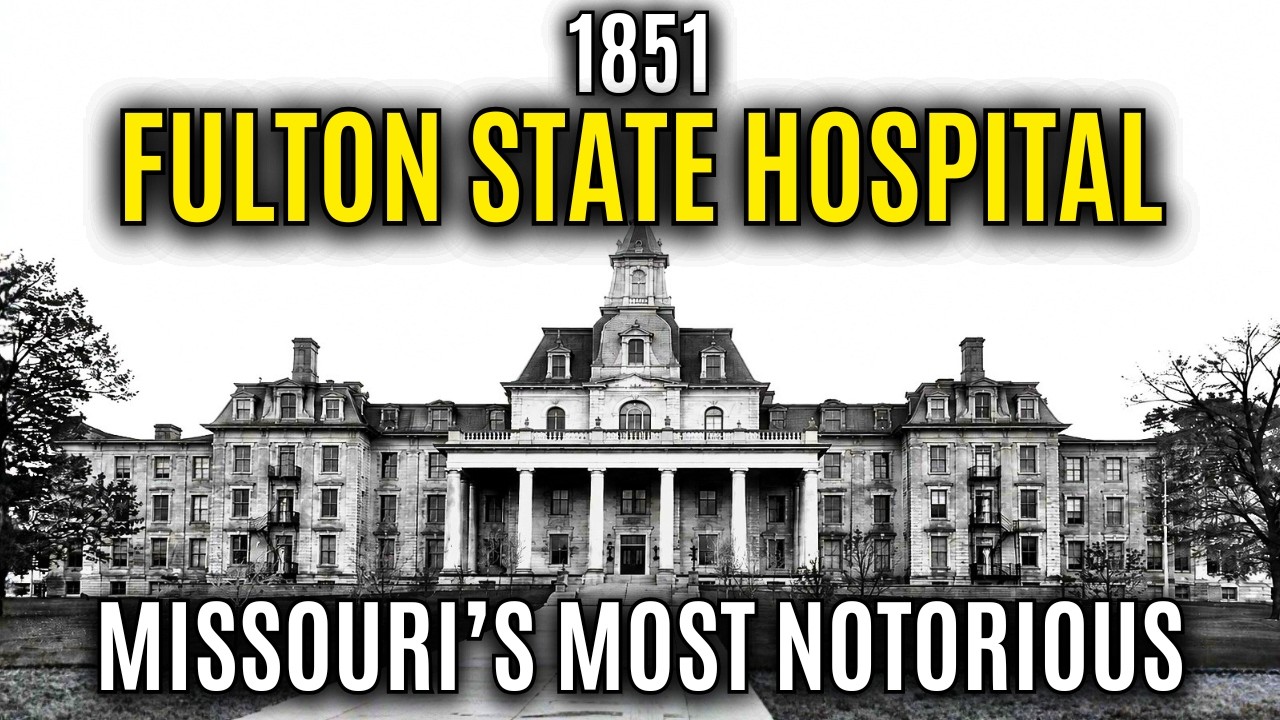
The commissioners were impressed by the land, the timber, coal, a water source that never ran dry, and as they recorded, an abundance of building stone on the site itself, suitable for all required stonework. The asylum would be built from the hill it stood on. Before any foundation was poured, Missouri sent a doctor east to learn the methods. William McIlhany toured asylums in Ohio, Indiana, and Maryland, and returned recommending Missouri copy the new building in Indianapolis.
His recommendation included one problem: the Indianapolis cost would be around $60,000. The legislature had approved only $30,000. So Missouri did what states usually do. It accepted the lowest bid.
Solomon Jenkins from St. Charles signed the contract in April 1849 to build the asylum for $47,450. By January 1851, he had already spent $50,000, and the legislature allowed him to draw an additional $25,000. By autumn 1852, the state had put nearly $75,000 into it.
The 1847 law required the structure to be as fireproof as possible. Keep that sentence. We will come back to it. What was built was three stories above a basement and attic with 72 individual rooms.
How many people it was designed to hold is the first thing about Fulton that sources disagree on. State history itself says 72. Legislative records say 100. No one has ever reconciled the two.
The building was flawed from the day it was delivered. The hot air pipes meant to heat it were installed in the wrong places. A repair was made before patients arrived. The repair did not work.
The floors Jenkins laid were white pine instead of yellow, too soft for traffic, and the state had to re-tile the entire facility within 5 years. That first detail matters more than any other in this story. There was one thing the asylum did not have, and its absence was a deliberate decision. It had no fence.
The legislature would not pay to build one, and the first superintendent did not want one anyway. He planted 16,000 Osage orange trees around 40 acres and explained clearly to the state why he refused the fence: it would give the institution a prison character. Missouri built this place to get the mentally ill out of its jails. The man in charge did not want a wall around it, because the wall would make it look exactly like a prison.
In 1851, the state wrote the rules. To understand what happened inside Fulton, one must first understand the system it operated under, which almost no one bothers to explain. It was called the doctrine of “moral treatment. ” It came from Paris through Philippe Pinel and claimed that madness was a physical illness that could be cured by kindness, not intimidation.
Fulton’s regulations made this a strict, binding rule. Violence must never be used against a patient, no matter the provocations. A blow must never be returned. Employees who are insulted or attacked are forbidden from reproaching or threatening patients.
No attendant may mock a patient, imitate him, or lie to him. No patient may ever be called by a nickname. Now, here is what that same document demanded of employees. No hats indoors, no rolled-up shirtsleeves, no loud talk, no laughter, no games with patients, no alcohol or tobacco either on duty or off.
No gifts from a patient’s family, under penalty of immediate dismissal. Every employee lives on the grounds, and no one leaves without permission. Wards are inspected at 8 a. m.
in summer, 9 a. m. in winter. After every meal, knives and forks are counted.
The rules reached the level of socks. A patient with offensive foot odor changes socks daily. If bedding is wet, the straw inside the mattress must be emptied and replaced, because attendants were caught trying to dry it. This was the nature and detail of the place.
Absolute gentleness, written down by people who also counted the cutlery. Records do not tell us what the rooms looked like inside. No published sources give the dimensions of patient rooms at Fulton. What we know precisely is how one got in.
Under an 1835 law, any citizen could petition for an examination of a person’s mental faculties. A jury of 12 men decided whether the person was sane. The petitioner paid all costs. On paper, this looks like real protection.
In May 1846 in Callaway County, a man named Jacob Wagner petitioned the court to determine whether Mary Wagner was insane. The court convened the jury the same day. There is no indication in the records that Mary was present, represented, notified, or given any time to respond. The jury found her insane.
A guardian was appointed with a $700 bond. No one had to prove she was dangerous. Someone only had to be heard first. Once inside, a county-supported patient cost $1.
50 per week. A private patient cost between $2 and $10, depending, in the words of the internal regulations, on the amount of trouble the patient causes. Then the beds ran out. By November 1852, there were 62 patients inside.
By 1854, the superintendent was refusing 70 applications a year, placing two patients in rooms designed for one, and using authority granted by the legislature to discharge incurable cases to make room for patients he believed he could still save. Within 3 years of opening, rationing of treatment had already begun. The state kept building. In 1854, it funded a 60-by-40-foot, four-story wing connected to the main building by a 40-by-76-foot corridor.
By 1859, Fulton held 350 patients. Then 125 patients when it reopened after the Civil War in 1863, and 303 by 1870. The thousand-patient mark was crossed in either 1910 or 1920. Sources disagree categorically.
State history says 1910. The county historical society says 1920. No one has resolved it. By 1940, the population was 2,476.
The building the state bought in 1851 held 100, and the medical staff never matched the numbers. In the early 1930s, the ratio was one doctor for every 543 patients. Do the math yourself. If a doctor saw patients for eight straight hours and did nothing else, no notes, no rounds, no administration, each patient gets 53 seconds a day.
These are the calculations everything that follows rests on. The central mechanism at Fulton was water. In 1910, the hospital formally requested hydrotherapy equipment from the state after reading about its success in Europe. This was not marginal cruelty introduced by a rogue doctor.
It was requested, budgeted, and approved. Here is the procedure. You are stripped. Sheets are soaked and wrapped around your body, arms pinned inside, and you are placed in a tub.
Water flows over you. And keeps flowing. Not for a minute, not for ten minutes. Records describe hours.
You cannot move your arms. You cannot get out. The word used to describe this in annual reports is “treatment. ” Fulton State Hospital used it until the 1960s.
Its use declined nationally, not because it stopped working, but because doctors noticed two things. Patients resisted it, and it was used as punishment. Water appears elsewhere in the state’s own list. Needle showers, steel cabinets you sit inside while water is blasted at high pressure against your skin.
Rotating chairs designed to spin a person in fast circles to separate the humors of the brain. Sensory deprivation chairs, straps, and a hood lowered over the head. Straitjackets and shackles. One artifact survives in Missouri state archives.
It is a straitjacket designed for a woman, with ruffles to be worn under a long skirt. It allowed the wearer to look normally dressed. Someone designed a restraint that looked like a piece of clothing. When Fulton opened its maximum-security building, called Biggs, it contained wards, a kitchen, a dining room, and a hydrotherapy facility.
Even the year is disputed. Engineers say 1937. The Department of Mental Health says 1940. It was built with federal Depression-era works funds and lasted 80 years.
In 1941, one year after the technique reached the United States, Fulton adopted electroshock. Insulin and Metrazol shock followed. And before 1966, doctors there performed lobotomies as a last resort, preferring invasive intervention to palliative care, reasoning that a patient who recovered could return home. The last lobotomy at Fulton was performed in 1966.
Now for the part that should bother you most. We can tell you what these machines did because the state published that. We cannot tell you how many people underwent them. There is no count of lobotomies.
There is no count of hydrotherapy sessions. There is no count of electroshock courses. No names are attached to the first ones. Or the last ones.
Missouri published the catalog and never published the records. The documentation is incomplete, and it is incomplete in a very specific direction. What was done is recorded. Who it was done to is not.
What finally forced Missouri to act was not the fire, not the lobotomies, not deinstitutionalization, not a court order, not press scandals. It was a workers’ compensation line item. Between 2009 and 2013, employees at Fulton filed about 600 compensation claims, settled for $9. 4 million.
Missouri’s other eight mental health facilities, with more than twice the staff, settled for $4. 7 million. In 2013, one in three Fulton employees filed a claim. The statewide average was one in 23.
Fulton has no famous inmates. This is not a research failure. It is the result. Patient files at Fulton are sealed under Missouri privacy policy, closed even to historians commissioned by the hospital itself.
What was not sealed burned. The 1911 Capitol fire consumed much of the legislative archive, including the original asylum law, of which only charred fragments survive in a folder. Then in 1956, the hospital’s administration building burned, taking with it everything that survived for a century. So Fulton’s 19th-century patients exist in published records only as initials.
The first two patients admitted in December 1851 were Thomas G. from Jackson County and H. F. H.
from Callaway. That is all that remains of them. A patient recorded as Charles T. was admitted in 1852.
He was discharged four times, and each time he returned. He died there 59 years after his first admission, never cured. The first person to die at Fulton was a woman. She had been insane for 12 years when she arrived.
The superintendent’s report described her as more like a living skeleton, unable to walk. The report did not record her name. By 1861, 119 patients had died there. Only four from unnatural causes.
One choked, one used a sheet to end his life, one was killed by another patient, and one was a boy named Theodore McGrady. Theodore McGrady was admitted in April 1853. That is nearly all we know about his life before Fulton. No age, no county, no diagnosis, no family.
Now back to the heating. The system had been installed wrong. The repair had failed. By the winter of 1853, the consequences were known to everyone working there.
In the coldest weather, patients could not safely stay in their rooms. So staff moved them, a few at a time, to the warming rooms in the middle of the building. It was customary to move those suffering most from cold first. In January or February 1854, Theodore McGrady was the first to be moved.
None of the staff stayed with him. There were not enough of them, and there were more patients to bring in. While they were returning through the ward, they heard him scream. He had burned to death.
The superintendent investigated and concluded there was no negligence by staff. His recorded justification to the legislature was that the boy had been in that room many times before and had never come close enough to the stove for his clothes to catch fire. That seemed an acceptable conclusion at the time. It was not.
The heating system was eventually ripped out and replaced. Patients at Fulton had heat in their rooms for the first time in the winter of 1859, 5 years after Theodore McGrady died from the lack of it, and 8 years after the state accepted a building it was required to make as fireproof as possible. We do not know where he was buried. Records do not say whether his family took the body home or he was buried in the asylum cemetery east of the main buildings.
That land still exists. The oldest legible stone there dates a death in December 1854. The name has been worn off the stone. The man who ran all this was Turner R.
H. Smith, and he deserves better than being cast as a villain. He was 31 when he took the job, with a medical degree from Transylvania University and no experience at all treating mental illness. That was normal.
No American medical school taught a course in mental illness between 1813 and 1867. He refused the blanket opium dosing his peers favored. He wrote the rule against returning a blow. He rejected the wall.
He also got the job because he was married to Mary Harden, whose brother Charles was a member of the board that appointed him and would later become governor of Missouri. By 1854 he was discharging incurable cases to make space. What that cost him in the end, we cannot tell you. The end of his tenure is not established in any source we could access.
Follow the money, and Fulton stops looking like a hospital. The financial model was written in Wells’s 1845 report before a single brick was laid. He argued that out of every 100 patients, there would always be enough willing to work to farm 150 acres and produce almost all the food the place needed. He was explicit that this would reduce its cost.
He was also explicit that it would improve the patients’ condition. Both statements were made in the same sentence. Only one was measurable. In its first full year, the Fulton farm produced 1,000 bushels of corn, 18 tons of hay, and 418 pounds of pork.
Fulton remained food self-sufficient until the mid-1980s. Wages tell the rest of the story. At the end of 1852, house servants and the assistant cook earned $5 to $6 a month, the lowest on the list. The engineer running the boiler made $50.
Seven employees were recorded on the payroll as colored and were at its lowest levels. Then there were those hired at all. From 1872 to 1923, Missouri asylum jobs were political spoils. A 1921 law was supposed to end that, but patronage continued for another two decades regardless.
The first Black doctor was hired in 1960. The model never really changed. Only the currency did. By 2013, Fulton was bringing in $52.
4 million annually from federal and third-party reimbursements and employing about 60 people. It was the largest facility in Callaway County by a wide margin. It also cost the state $4 million annually in workers’ compensation, the highest of any state-run facility, including every prison. By Missouri’s own math, working at Fulton was more dangerous than working in prisons.
That looks like an argument for hiring more staff until you notice the other number from that year: a 40% vacancy rate in nursing. Now, about the title. Fulton State Hospital is widely described online as America’s first asylum for the criminally insane. This spreads through articles, lists, compilation pages, and video descriptions.
It is wrong. The first institution in America built for the criminally insane was in New York. An 1858 law created an asylum for insane convicts on the grounds of Auburn State Prison. It opened in 1859 and moved to Matteawan in 1892.
Fulton did not separate its criminal patients from other patients at all until 1882. Its maximum-security building did not open until 1937 or 1940. That is a gap of about 80 years. What Fulton actually was, without dispute, is the first public mental institution west of the Mississippi River, and it is still the oldest continuously operating one.
That claim is smaller. It is also true, and it is enough. Fulton is also not the Missouri institution you have seen. Ghost tours happen at the Missouri State Penitentiary in Jefferson City.
The restraints behind glass are in the Glore Psychiatric Museum in St. Joseph. Fulton is a working hospital. It sells no tickets and has produced no folklore of its own.
We looked. There is nothing recorded. And in that void, everyone owns the narrative. Ken Kesey’s 1962 novel, which is about none of this.
The popular version costs us the memory of Theodore McGrady. On March 15, 1956, a fire broke out at Fulton State Hospital. The administration building and the two attached wings, housing about 250 patients, burned. Firefighters came from Jefferson City, Columbia, and Mexico, Missouri.
Westminster College students came down the hill and helped move patients out. We cannot give you an hour-by-hour timeline. There is no ignition time, no starting point, no official cause in any record we could find. In the chaos, two local women were locked in with the patients.
One tried to explain she was a newspaper reporter to staff. She was dismissed as delusional. Both were eventually released. No one died in that fire.
Not one patient, not one employee, not even one firefighter. Here is what actually died. Many patient records and many hospital records burned. The cost is disputed, and the two published figures may not refer to the same thing.
The Department of Mental Health says the cost of demolishing the damaged buildings alone exceeded $114,000. The Columbia Missourian says the fire caused more than $1 million in damage. Patient admissions were suspended for months. A replacement administration building was completed in 1958.
Missouri responded to the fire with a construction budget, the appropriate response to a fire, but useless for everything else. The slower collapse came later. In 1974, the Joint Commission withdrew Fulton’s accreditation entirely, citing understaffing and fire and safety code violations. There were about 1,200 patients inside.
Eighteen years after the fire, the state still could not pass a fire safety inspection. The building Missouri bought in 1851 outlived nearly everyone who fought for it. In 1984, the oldest standing units, the pre-Civil War north and south wings, collapsed. They cost the state $40,000 a month to heat and had sat empty since the 1960s.
The rest went in this century. The transfer of lower-risk patients between 2008 and 2011 reduced Fulton from 471 to 300 beds and cut the expected rebuilding cost from $340 to $211 million. Funding was secured with $97. 2 million in bonds in 2016.
The Jeremiah Nixon Center for Forensic Psychiatry opened on August 1, 2019, and the Biggs building was finally demolished after patients moved out. Look at Fulton’s sisters, and you will see the futures it did not get. State Hospital No. 2 in St.
Joseph became the Glore Psychiatric Museum, where the public pays to see restraints. Hospital No. 3 in Nevada was, on opening day, the largest single building in Missouri. Most of it is gone, and 25 of its forensic beds were transferred to Fulton.
Hospital No. 4 in Farmington, opened on New Year’s Day 1903, still operates as museum, ruin, and survivor. Fulton got none of that. Fulton was replaced because the need for it never stopped.
It is Missouri’s only maximum-security psychiatric facility, at 600 East 5th Street. Since 2007, it has received more than a thousand cases from all 99 counties and the city of St. Louis. Capacity is estimated at about 450 today, though published unit numbers exceed that.
On September 11, 2015, a federal judge ruled Missouri’s handling of the civil commitment program at Fulton unconstitutional, citing systemic failures in risk assessment and release. At the time of that trial, not one person had completed the program and no one had been released. The ruling was later reversed on appeal. In January 2025, a patient at Fulton State Hospital died after being attacked by another patient.
First-degree murder charges were filed. They built it to empty the jails. They built it from the stone beneath it. They built it without walls, because a wall would make it a prison.
They built it to be as fireproof as possible, and it burned anyway. The State Lunatic Asylum. State Lunatic Asylum No. 1.
State Hospital No. 1. Fulton State Hospital. Now the Nixon Forensic Center, the most fortified building Missouri operates.
The four pillars at the entrance still stand. So does the cemetery east of the main buildings, where the oldest inscribed stone marks a death in December 1854 without a name. Missouri built this place because it decided jails were not the right place for the mentally ill. After 179 years, what is the state doing with the only building it has left?
The stone does not answer. It only remains.