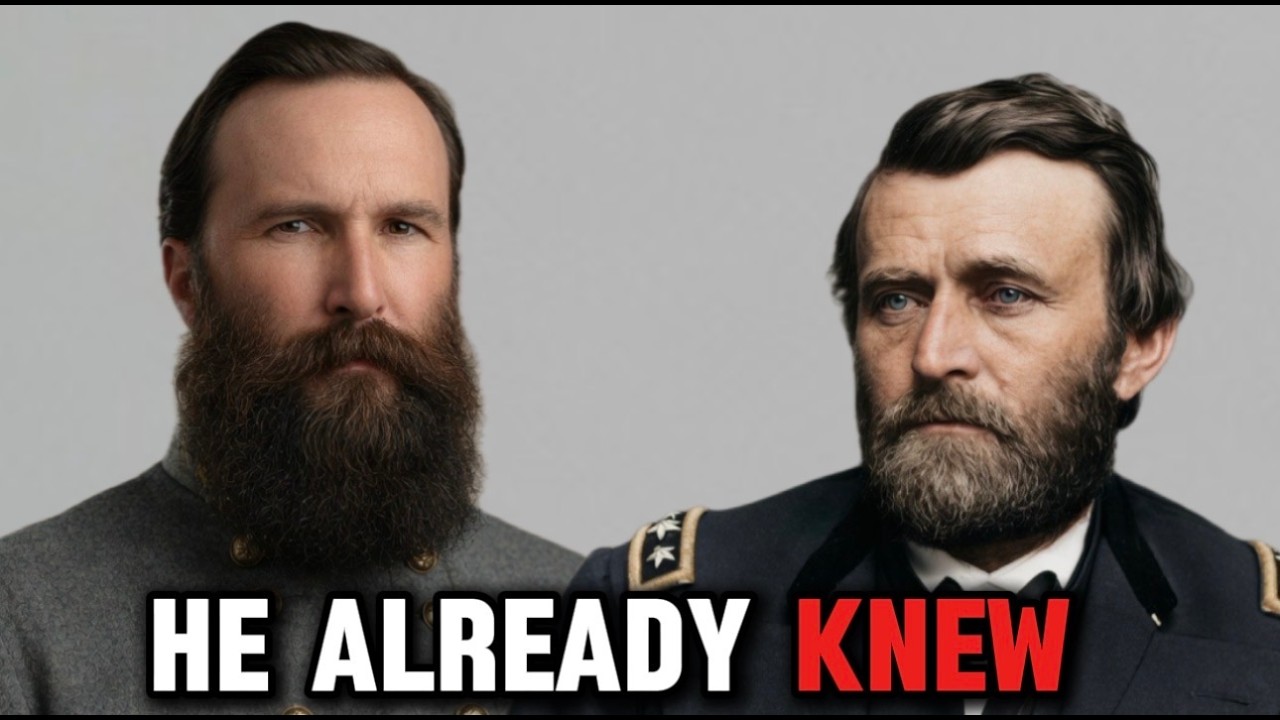
In 1844, two cadets at West Point became close friends. One was a broad-shouldered young man from Georgia named James Longstreet. The other was a quiet, unremarkable young man from Ohio. Most of their classmates assumed he would never amount to anything. His name was Ulysses Grant.
They lived near each other, fought together in Mexico, and when Grant married in 1848, Longstreet stood beside him as his best man. Neither could have imagined that sixteen years later, they would face each other across a Virginia forest so dense that soldiers could not see the men they were killing. Nor could they have known that Longstreet, more than any other Confederate general, would understand exactly the kind of man he was fighting.
Everyone in Lee’s army assumed Grant would behave like every Union commander who came before him. Longstreet knew better. What happened next proved him right in a way he himself found difficult to process.
The friendship between Longstreet and Grant did not end when the country split in 1861. It became complicated in the way many friendships did during that war, turning into something neither man could fully resolve.
Longstreet had known Grant during the years when no one else in the U.S. Army believed Grant would get anywhere. Grant struggled with alcohol and peacetime assignments that bored him. He resigned under mysterious circumstances in 1854 and spent the years before the war failing at a series of civilian jobs in Missouri and Illinois.
The men who served with him in Mexico remembered someone competent but unremarkable. He was steady under fire and attentive to his men, but he was not a figure anyone expected to reshape American history.
Longstreet was among the few who watched Grant work under real pressure in actual battles at Molino del Rey and Chapultepec during the Mexican War. What he saw there stayed with him in a way it apparently did not for most of Grant’s other peacetime acquaintances.
There is a specific story from those Mexican War years that Longstreet told later in life, and it illustrates the kind of firsthand evidence he relied on when he made his predictions in 1864.
During the attack on Chapultepec Castle in September 1847, Grant showed an instinct for improvisation under fire that impressed the officers around him. At one point, he dragged a small cannon into a church tower to provide covering fire for advancing infantry. It was a maneuver that required physical effort and a level of tactical creativity rarely shown by junior officers in that campaign.
Longstreet was wounded in that same battle, shot in the thigh while carrying his regiment’s flag during the assault. Grant was among the officers who helped him afterward. The two men had literally seen each other bleed on a battlefield years before either wore a different uniform.
That kind of shared experience produces a judgment unrelated to rank, reputation, or the public narrative built around a man in the newspapers years after the events. Longstreet was not reading dispatches about Grant the way most Confederate officers eventually would. He had watched him personally make decisions in real time under fire, when the outcomes of those decisions were genuinely unknown to anyone standing near him.
By the spring of 1864, after three years of a war that had already killed more Americans than any conflict before or since, Grant’s reputation had changed completely, at least in the North. He had captured Fort Donelson, fought the bloody Battle of Shiloh to a standstill, and held the field. He took Vicksburg after a campaign professional soldiers on both sides admitted was genuinely brilliant, and he lifted the siege at Chattanooga.
Lincoln brought him east and made him general-in-chief of all Union armies in March 1864.
But within the Confederate high command, doubts remained about whether Grant’s successes in the West would repeat against Robert E. Lee in Virginia. Lee had defeated every Union general sent against him. McClellan, Pope, Burnside, Hooker. He had stopped the advance at Gettysburg.
Confederate officers who had spent three years watching Union commanders withdraw after every serious setback assumed Grant would follow the same pattern. Longstreet did not share that assumption, and he said so repeatedly to anyone in the Confederate command structure willing to listen.
The specific warning Longstreet issued was recorded by several officers present to hear it. It deserves to be quoted closely because it turned out to be one of the most accurate predictions made by any general on either side during the entire war.
Longstreet told his fellow Confederate officers that the Union soldiers they were about to face were not fighting under a general who would retreat after a defeat. He told them Grant would continue pressing forward regardless of losses, and that he would not be shaken by one bloody repulse the way McClellan was after Antietam or Hooker after Chancellorsville.
Longstreet said Grant was a general who would fight it out on that line all summer. That phrase, “fight it out on that line all summer,” is remarkably close to the language Grant himself used in a dispatch to Washington only weeks later, after fighting at Spotsylvania had already produced staggering losses on both sides.
Longstreet had read the man correctly before a single shot was fired in the campaign that was about to begin.
What made Longstreet’s prediction so unsettling to the men around him was not that it seemed impossible. It was that no one in the Confederate command had a frame of reference for what he was describing.
The Confederate army had spent three years developing a working theory about how Union generals behaved under pressure. That theory was built entirely on the pattern established by figures like McClellan, Burnside, and Hooker. Leaders who, whatever their individual failures, shared one consistent trait. When they took heavy losses in a major battle, they retreated and reorganized, giving Lee’s army time to recover.
That pattern had shaped every Confederate expectation about how the coming campaign would unfold. Longstreet was telling them that pattern was about to break. And he was telling them based on a kind of knowledge no one else in the room possessed. Twenty years of watching one man solve problems under conditions where retreat was the easiest option.
The campaign began on May 4, 1864, when Grant crossed the Rapidan River and pushed the Army of the Potomac into the dense forest known as the Wilderness. It was the same ground where Lee and Jackson had won their most famous victory a year earlier.
The fighting that followed on May 5 and 6 was among the most chaotic and confused chapters of the war. Visibility in the thick brush dropped to a few dozen yards in some places. Units lost contact with each other. Fires broke out in the dry woods and burned wounded soldiers where they lay.
By the end of the second day, Union losses approached 18,000 men, nearly the same size as the losses the Army of the Potomac had suffered at Chancellorsville a year earlier. That was a defeat so demoralizing that Hooker’s army took months to regain its fighting confidence.
The fighting itself had a character veterans on both sides described as unlike anything they had faced before in the war. The forest was so dense that entire regiments fired toward muzzle flashes rather than visible targets. Men reported hearing the screams of wounded soldiers burning to death in the brush without being able to locate them through the smoke.
Confederate soldiers who had fought at Chancellorsville a year earlier in nearly identical terrain said the Wilderness was worse. Not because the tactical stakes were higher, but because the confusion made it impossible to know whether the battle was being won or lost while it was still happening.
Grant remained outwardly calm throughout both days of fighting, according to several staff officers present at his headquarters. This astonished observers given the scale of casualties being reported to him. At one point, when a subordinate began anxiously speculating about what Lee might do next, Grant reportedly cut him off and told him to stop worrying about what Lee was going to do to the Union army and start thinking about what the Union army was going to do to Lee.
That single exchange, recorded by more than one officer who claimed to have witnessed it, captured something of Grant’s temperament that Longstreet seemed to understand intuitively long before it was tested under these specific conditions.
Longstreet did not see how the rest of the battle unfolded. On the morning of May 6, while leading a flank attack that briefly promised a decisive Confederate breakthrough along the Orange Plank Road, his own men shot him in the confusion of the dense woods. He was hit in the throat and shoulder by fire from Confederate soldiers who mistook his group for Union cavalry in the smoke and brush.
It happened almost exactly a year after Stonewall Jackson was hit by friendly fire in the same general area. The echo was so precise that Confederate soldiers who witnessed it went pale at the coincidence before they even knew whether Longstreet would survive.
He did survive, though the wound left his right arm partially paralyzed for the rest of his life and kept him from active command for more than five months.
After the Battle of the Wilderness, with roughly 18,000 Union casualties behind him, Grant did not retreat toward Washington the way every predecessor in that command had done after a bloody engagement in that same part of Virginia. He moved south instead.
On the night of May 7, Union soldiers marching toward a crossroads called Spotsylvania Court House realized from the direction of the march alone that their commander was pushing deeper into Confederate territory rather than withdrawing to regroup. The men who had fought at Chancellorsville and watched Hooker withdraw after taking a similar beating began cheering in the darkness. Some were in tears, because for the first time in three years, they had a general who kept advancing.
Spotsylvania produced even more brutal fighting than the Wilderness. On May 12, Union forces attacked a Confederate salient known as the Mule Shoe, and the fighting in what soldiers called the Bloody Angle lasted nearly twenty continuous hours. Men fought face to face across wooden breastworks, stabbed each other through gaps in the logs, and fired rifles placed over the fortifications at point-blank range.
An oak tree nearly two feet thick was completely cut down by the sheer density of rifle fire that struck it.
Grant’s losses at Spotsylvania approached another 18,000 men. Combined with the Wilderness losses just a week earlier, Grant’s army had suffered roughly 36,000 casualties in just over a week of fighting. That was a rate of loss no Union force had ever sustained without ending the campaign entirely.
Grant did not stop the campaign. He kept moving south, looking for another opening, forcing Lee’s exhausted army to match him mile after mile in a continuous battle neither side could break away from.
What made Grant’s willingness to absorb these losses even more surprising was the political environment he was operating in. The 1864 presidential election was months away, and Lincoln’s chances of reelection were genuinely uncertain by summer. Northern newspapers were publishing casualty lists that ran across full pages, and a growing faction within the Democratic Party was building a campaign around the argument that the war had become an unwinnable slaughter that should be ended through negotiation.
Every previous commander of this army, when suffering losses approaching this scale, faced enormous political pressure to justify continuing the fight. Most responded to that pressure by becoming more cautious, not less.
Grant did the opposite. He understood, apparently better than anyone else in Washington, that a negotiated peace in 1864 would almost certainly mean Confederate independence, and that the only path to preserving the Union ran through the same kind of costly, sustained pressure he was applying.
He was betting his personal reputation, and arguably Lincoln’s presidency along with it, on the belief that continued aggression would break the Confederacy before it broke the political will of the North. It was an exceptionally high-stakes bet from a general who had never commanded an army this size against an opponent of Lee’s caliber.
Longstreet had predicted exactly this kind of resolve in early May, months before the campaign’s political stakes became fully clear to anyone else.
The reports that reached Longstreet while he recovered described an opponent behaving in ways that contradicted everything the Confederate high command had assumed about how this war was fought. Officers who visited him during his convalescence later recalled Longstreet listening to accounts of the continuous fighting with an expression that mixed vindication with something closer to genuine concern.
He had been right. He had told them Grant would not stop, and Grant did not stop. The casualty numbers arriving with each new report confirmed a version of the war Longstreet had only described theoretically.
There is a significant difference between accurately predicting that an opponent will absorb heavy losses without retreating, and watching the death toll actually pile up on a scale no American army had ever seen within days rather than years. Longstreet had understood Grant’s character. He had not necessarily understood what that character would cost in human terms once actually tested against Lee’s army at full strength.
The pattern continued after Spotsylvania in ways that made Longstreet’s original warning seem modest in retrospect. Grant pushed the campaign to the North Anna River in late May, found Lee’s position too strong to attack directly, and instead of withdrawing, maneuvered around it and kept pressing south.
By the first days of June, the armies had reached a crossroads called Cold Harbor, about nine miles from Richmond, where Lee’s engineers had constructed one of the most elaborate defensive fortifications of the entire war.
On June 3, Grant ordered a massive frontal assault on that position. It produced about 7,000 Union casualties in less than an hour. Some of the worst losses were concentrated in the first eight minutes of fighting.
Even Grant, in his memoirs written years later, described it as the only attack in the entire war he regretted ordering.
But what followed the failure at Cold Harbor was, in its way, the clearest possible confirmation of everything Longstreet had told his fellow officers in early May. Three of Grant’s own corps commanders, after observing the results of the morning assault, quietly refused to relay his order to renew the attack at noon.
Grant absorbed the failure, accepted that a direct assault would not work, and began planning his next move toward the James River instead. He did not retreat. He adjusted his plan and kept advancing.
The men who fought at Cold Harbor knew what they were walking into before the attack even began. Survivors and witnesses later described soldiers in the night before the assault tearing scraps of paper from letters and pocket Bibles, writing their names, regiments, and home addresses on them, and pinning the scraps to the backs of their coats so their bodies could be identified later.
That single detail captures something important about how much the psychology of this campaign had changed since the Wilderness a month earlier. These were not new recruits lacking combat experience. Many were veterans of Gettysburg and Chancellorsville who understood exactly what a frontal assault against a fortified position might cost.
Yet they advanced anyway, because the army they served in had developed under Grant a culture of continuous forward pressure that individual soldiers had learned not to question, even when the odds seemed impossible.
By the time Longstreet returned to active command in October 1864, the war he returned to was completely different from the one he had left in May. The Army of Northern Virginia was now entrenched in siege lines around Petersburg, facing an opponent who had absorbed nearly 65,000 casualties during the Overland Campaign. That was a scale of loss that would have ended the tenure of any previous Union commander and threatened the political survival of any previous Northern administration, but Grant kept pressing anyway.
The Confederate army Longstreet rejoined had lost a higher percentage of its experienced officers than the Union army, because Confederate officers shared their men’s risks in ways many Union officers had not in earlier campaigns. Lee’s command structure, which Longstreet had helped build over two years of campaigning, was noticeably weaker than he remembered it.
Lee himself had independently arrived at a version of Longstreet’s conclusion, though much later and at far greater cost. At the start of the campaign, Lee reportedly expressed skepticism to his staff that any Union general would be willing to absorb the losses the Wilderness produced without withdrawing to reorganize. By the time the armies reached Cold Harbor in early June, that skepticism had vanished entirely.
Lee began digging entrenchments wherever his army stopped moving, something the Army of Northern Virginia had rarely done in its previous campaigns. While Lee’s reputation rested primarily on offensive maneuver and surprise strikes rather than defensive fortifications, this shift reflected a general who had recalculated what war he was actually fighting.
Lee no longer expected Grant to withdraw after any setback, and he adjusted his entire operational approach based on that calculation, preferring fortified positions and defensive economy of force over the kind of bold offensive maneuvers that had marked his earlier victories against McClellan and Hooker.
That was, in effect, Lee arriving at the same conclusion Longstreet had reached months earlier. But he arrived at it the hard way, through direct battlefield experience rather than personal knowledge, and only after both armies had suffered tens of thousands of casualties on ground neither general had expected to need twice.
What Longstreet understood about Grant in 1864, based on twenty years of personal knowledge that predated the war entirely, turned out to be a more accurate strategic assessment than anything produced by Confederate intelligence or any other general in Lee’s army.
He did not predict specific battles or specific casualty figures. He predicted something harder to quantify and ultimately far more decisive. A change in the fundamental psychology of Union command.
Every previous commander of the Army of the Potomac operated under an implicit assumption that a catastrophic defeat required a period of recovery before any further offensive action could be considered. Grant did not operate under such an assumption. He treated heavy losses as the unavoidable price of continued pressure, not as evidence that he should stop. And he was willing to continue that approach for as long as it took to crush an opponent whose human reserves, in absolute numbers, were far smaller than his own.
Longstreet’s insight into this was not military genius in the traditional sense. It was something more personal, and more unsettling in its own way. It was the product of actual knowledge of the man over two decades, watching him work in Mexico under real combat pressure, and drawing conclusions about his character that proved more important than any analysis of Union troop strength or supply lines.
The Confederate officers around Longstreet in early May 1864 were reasoning from historical patterns. Longstreet was reasoning from personal knowledge of a specific human being, gained at West Point and in Mexico years before either man had any reason to imagine they would one day try to destroy each other’s armies.
That difference, though small, turned out to be the difference between correctly predicting the deadliest and most sustained campaign of the Civil War, and being caught off guard by it as nearly every other Confederate officer was.
After Appomattox, the two men resumed something resembling their old relationship. Longstreet’s postwar willingness to work with the Republican administration and support reconciliation with the North cost him considerable standing among former Confederates who never forgave what they considered a betrayal of the Southern cause.
When Grant became president, he appointed Longstreet to a series of federal positions, an act of loyalty to an old friend that many Republicans in the North found difficult to understand. Many white Southerners found it impossible to forgive.
The bond formed at West Point in 1844, tested and nearly broken by four years of war in which the two men tried to kill each other’s soldiers by the tens of thousands, held in a form neither man ever fully explained to the public in the years that followed.