She was the most photographed woman of her era, yet she remained essentially private. Jacqueline Lee Bouvier Kennedy Onassis lived three distinct lives under three last names, each shaped by tragedy, reinvention, and an unrelenting public gaze. Her life began on July 28th, 1929, in Southampton, New York, born into a fractured household. Her father, John Vernou Bouvier III, known as “Black Jack,” was a charming but unreliable stockbroker and heavy drinker.
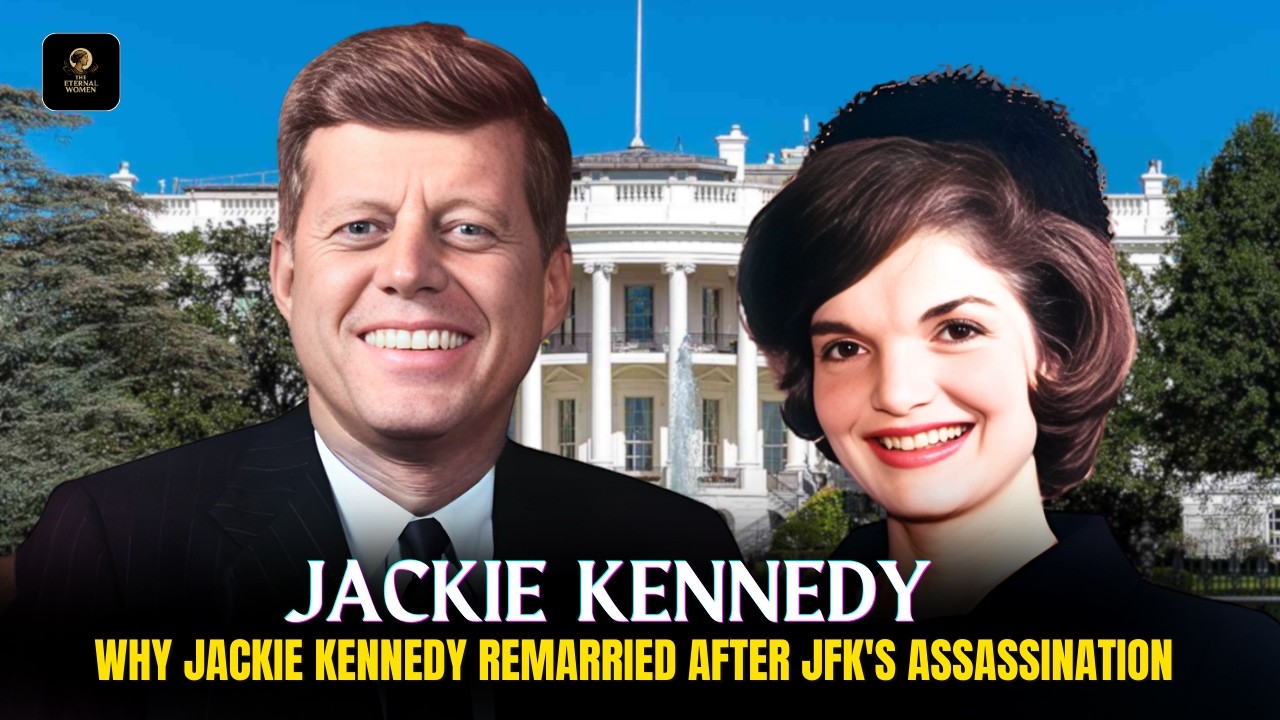
Her mother, Janet Norton Lee, was ambitious, cold, and obsessed with social standing. The couple’s toxic marriage collapsed when Jackie was seven, and her mother remarried into the wealthy Auchincloss family. Jackie grew up shuttling between her father’s affectionate but inconsistent presence and her mother’s rigid demands for perfection. She learned early to hide her true self behind a composed facade.
After an academically strong but socially rebellious youth, Jackie spent a formative year studying at the Sorbonne in Paris, where she discovered a love of art, culture, and intellectual life that would define her tastes. She returned to America, graduated with a degree in French literature, and briefly worked as the “Inquiring Camera Girl” for the Washington Times-Herald, interviewing strangers and gaining an education in public life. In May 1952, she met John F. Kennedy, then a senator running for re-election and a rising Democratic star.
Kennedy was charming, brilliant, and famously unfaithful. The courtship was uneven, with Kennedy pursuing her intensely and then disappearing, but she accepted his proposal in June 1953. The wedding took place on September 12, 1953, in Newport, Rhode Island, a lavish event paid for largely by his father. Jackie’s own father was too drunk to attend, and her stepfather walked her down the aisle.
The marriage was difficult from the start. Kennedy was rarely home, constantly traveling for politics, and continued his affairs. Jackie learned to maintain her dignity publicly while withdrawing privately. In 1956, she suffered a stillbirth, and her husband was overseas on a yacht when she went into labor.
The loss nearly ended the marriage, but she decided to stay, hardening herself emotionally and focusing on her own pursuits. In November 1957, she gave birth to Caroline, and in November 1960, just weeks after her husband won the presidency, she gave birth to John Jr. As first lady at age 31, Jackie redefined the role. She restored the White House, transforming it into a showcase of American art and history, and hosted state dinners that became cultural events.
A nationally televised tour of the restored White House in February 1962 drew 56 million viewers. Her fashion sense, including her trademark pillbox hats, was copied instantly, but she was also reducing herself under this praise, seen often as a style icon rather than a serious person. Her marriage remained strained. As president, Kennedy continued his infidelities, which were facilitated by staff and Secret Service agents.
Jackie coped by retreating to a rented Virginia estate, focusing on her children, and taking on diplomatic roles that were often more successful than official efforts. In June 1961, she charmed French President Charles de Gaulle so thoroughly that her husband joked, “I am the man who accompanied Jacqueline Kennedy to Paris. ”
Her final pregnancy ended in tragedy in August 1963 when her son, Patrick, died two days after birth from a respiratory condition. The shared loss briefly brought the couple closer, and she agreed to accompany her husband on a political trip to Texas in November to show a united front.
On November 22, 1963, riding in the presidential limousine in Dallas, Jackie watched as shots struck her husband. The second shot hit his head, killing him. She scrambled onto the trunk of the car, later unable to remember why, as Secret Service agent Clint Hill pushed her back into her seat. At Parkland Memorial Hospital, she held his head in her lap, refusing to let go until doctors took him.
When asked if she wanted to change clothes before Lyndon Johnson was sworn in, she refused, saying, “No, let them see what they’ve done. ”
She planned the funeral meticulously, modeling it on Abraham Lincoln’s, complete with a horse-drawn caisson and riderless horse. A few weeks later, she gave an interview to Theodore White of Life magazine, carefully crafting the “Camelot” myth that still frames public memory of the Kennedy presidency. It was a deliberate effort to shape how history would remember her husband.
After leaving the White House, Jackie moved to New York seeking anonymity, but the grief and scrutiny continued. Her closest confidant was her brother-in-law, Bobby Kennedy. When he was assassinated in June 1968, she reportedly said she feared her own children were next. Within months, she shocked the nation by agreeing to marry Aristotle Onassis, a Greek shipping magnate known for his wealth and ruthless business dealings.
They married in October 1968 on his private island, Scorpios, under a prenuptial agreement that made her a well-compensated companion. The American public felt betrayed by what they saw as a rejection of Kennedy’s memory, and the press mockingly called her “Jackie O. ” Onassis lavished her with jewels and provided the security and privacy she craved, but the relationship soured. He was often absent, continued seeing his long-time mistress Maria Callas, and resented the demands of her children.
By the mid-1970s, the marriage was effectively over. Onassis died in March 1975. After a legal battle with his daughter Christina, Jackie settled for $26 million, far more than the contract specified. At age 45, she was finally financially independent and free to define herself.
In September 1975, six months after Onassis’s death, she stunned people once more by taking a job. She became a consulting editor at Viking Press and later moved to Doubleday, where she worked for 15 years, building a reputation as a serious professional. She took the subway to work, sat through long editorial meetings, and earned respect from colleagues who initially expected her to be a figurehead. She also became a passionate advocate for historic preservation, helping lead the successful fight to save Grand Central Terminal from demolition.
Her later years were marked by a long, quiet relationship with Maurice Tempelsman, a Belgian-born diamond merchant who asked nothing of her but companionship. Unlike her marriages, this partnership brought her a measure of ease and happiness. In November 1993, she was thrown from a horse during a fox hunt in Virginia. She recovered, but in early 1994 she was diagnosed with non-Hodgkin’s lymphoma.
The cancer was aggressive and had spread by April. She chose to stop treatment and return to her own apartment to die surrounded by her children and the things she loved. Jacqueline Kennedy Onassis died on May 19, 1994, at 10:15 p. m.
, at age 64. Caroline held one hand, John held the other. Her funeral was private, attended by about 300 invited guests. She was buried at Arlington National Cemetery next to President Kennedy and near their two infant children.
At her grave, the perpetual flame she lit in 1963 still burns, a symbol of a life defined as much by tragedy as by resilience. She was a private woman who lived in the most public of spotlights, a survivor who transformed herself repeatedly when the world demanded she stay frozen in grief.