As the Battle of Fredericksburg raged across a muddy Virginia field on December 13, 1862, a woman dressed in the flamboyant uniform of a Zouave moved among the wounded and dying. She was not a soldier, but she would be shot in the heel on that field and remembered for more than a century as a heroine of the battle. Known to history as French Mary, she served as a vivandière with the 114th Pennsylvania Infantry. The role had its roots in the Crimean War: a woman attached to a regiment who sold supplies such as whiskey, handled laundry, mended uniforms, and sometimes ventured onto the battlefield to aid the wounded.
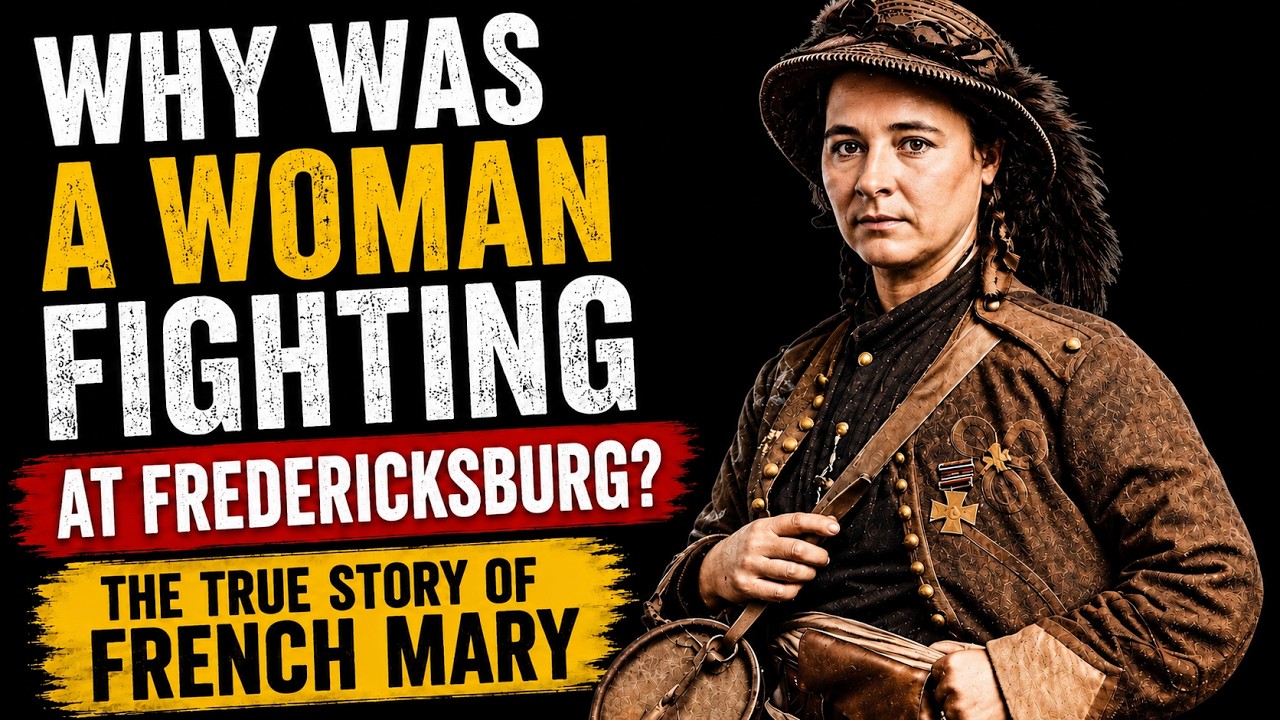
At Fredericksburg, that meant carrying a small, ornate cask of whiskey and other supplies into the open ground known as the Slaughter Pen Farm, one of the deadliest sectors of the fight. The 114th Pennsylvania was initially held in reserve beyond Bowling Green Road but was later ordered forward into the field. As the men fell under heavy Confederate fire, Mary went out among them, helping to dress wounds and offering whiskey to the injured. During that work, she took a bullet to the heel and had to be carried off the field.
While she recovered, she was presented with a silver cup and awarded the Kearny Cross in recognition of her courage and devotion to the regiment. Her life before the war had already been eventful. She had married a man named Bernard and used the surname Tepe, and her husband was later taken prisoner during the conflict. After the war, she remarried another soldier and eventually ran a toy store in Pittsburgh, Pennsylvania.
In the early 1900s, according to accounts that have circulated, Mary was suffering badly from the old wound and it reportedly drove her into a dark place. She ultimately took her own life. The Slaughter Pen Farm itself witnessed some of the most savage fighting of the battle. Union forces under General George Meade attacked across the open ground against Confederate troops that included North Carolinians, Georgians, Virginians, and South Carolinians under General Maxcy Gregg.
Meade managed to break through part of the Confederate line, and Gregg was shot in the back and later died. But the breakthrough was never supported, and Union soldiers were eventually driven back across the field they had taken at heavy cost. Separate engagements on the field saw the Medal of Honor earned by Private George Maynard of the 13th Massachusetts Infantry, who went back out under heavy fire to carry a wounded comrade to safety. Confederate soldiers were described as fighting with clubbed muskets, bashing Union troops over the head as they crossed the field.
One account described Union soldiers falling “like wheat before the reaper. ”
In the end, the battlefield produced roughly 5,000 Union and 4,000 Confederate casualties. French Mary’s story has been preserved mainly through a photograph and caption in an old Civil War book, where she is identified simply as the vivandière of the 114th Pennsylvania.
On the field where she was wounded, she is remembered as the young woman who risked her life to care for the men around her.