In the autumn of 1876, Elijah Johnson, a 38-year-old fiddle player from Bitter Hollow in the Cumberland Hills, walked down to a crossroads and encountered a stranger in a black coat who knew his name. The man offered to erase every problem in Elijah’s life—his mounting debt, the threatened auction of his family land, his financial ruin—in exchange for one thing: his fiddle. Elijah refused, and what followed was not a punishment, but something far more unsettling. Elijah’s troubles had begun the previous spring when his wife, Mahala, died of a fever at 31.
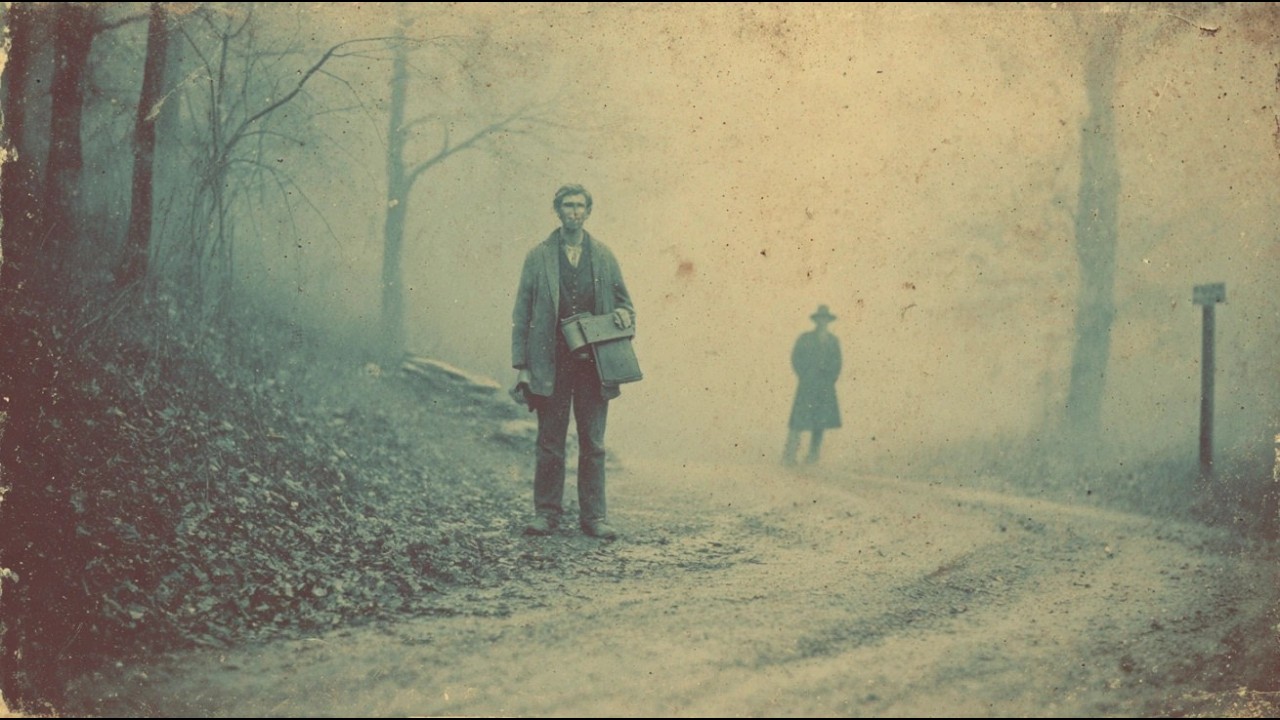
By August, he was deeply in debt to a local merchant named Cornelius Scaggs, who had carried him on store credit through her illness and burial. Scaggs was closing in, and by mid-September he was discussing claims on Elijah’s cabin and land with the county sheriff. A notice arrived on the 29th of September stating the property would be sold at public auction on the 15th of October. Elijah had nothing left to sell except the fiddle—a handbuilt instrument that had belonged to Mahala’s father—and he would not part with it.
That night, Elijah took the fiddle case and walked to the crossing, a clearing where two wagon roads met. He later told a preacher named Reverend Cashes Holloway that he wasn’t looking for the devil; he just wanted to see if the old story was real. According to Elijah, the wind stopped, and a man in a black coat appeared on the road behind him. The man spoke in a perfectly ordinary voice, sat down on the rock beside him, and offered a deal: he would pay off the debt in coin, have the county notice rescinded, ensure Elijah never wanted for money again, and protect his aunt.
In return, he wanted the fiddle. Elijah came close to accepting. His hand touched the latch on the case. What stopped him was a thought: if he gave up the fiddle, he would never play Mahala’s song again—a tune he had written for her in 1858 and never written down.
The song existed only in his head and in the wood and strings of that instrument. He took his hand off the latch and said, “I can’t. ” The man told him he had until sunrise to change his mind, then stood up and vanished. Elijah walked home without looking back, and the next morning he played her song for the first time in five months, believing he had won.
He had not won. Over the following weeks, Elijah began seeing the man at a distance—on a far ridge, on the road, in a window. In the fourth week, from down the slope, he heard a fiddle playing Mahala’s song perfectly, including a distinctive turn he had invented and never shared with anyone. He put the fiddle under the bed and did not take it out again.
By the eleventh week, he understood the trap: the man had given him everything he was about to ask for, for free. No soul was taken. But the knowledge that the man was real and willing to wait had already taken possession of his life. On the 18th of December, Elijah packed a bag, left the cabin door unlocked with a note saying the place was given, and walked east for three days to a town called Cold Water Glenn.
He asked for a preacher and was directed to Reverend Cashes Holloway. For two days, Elijah told him the whole story. Holloway, a Presbyterian who had preached for 40 years that the devil was a metaphor, stopped believing that. He told Elijah he was not going mad and that he had heard four other accounts of the same man.
He told him the man could not enter a place where he was named correctly and refused, and that Elijah would have to refuse him out loud every day for the rest of his life. Elijah stayed in Cold Water Glenn. He worked at a sawmill and married a widow named Levvenia Cawley at 51. He played the fiddle quietly in the evenings—mostly Mahala’s song and a few hymns—but never in churches or at weddings.
He died of pneumonia in 1894 at the age of 56, with his wife holding his hand. Before he died, Holloway visited him. Elijah asked whether the man was still waiting. Holloway told him yes, and that Elijah had won because he was dying in his own bed.
Elijah’s last words were that the man could have the cabin, the hollow, and the road, but not her song—he never got it. The story did not end there. Holloway kept a journal for 53 years, which eventually passed into a private archive in Eastern Kentucky after passing through family and historians. In an entry dated three years after Elijah’s death, Holloway wrote that he was driving past a little-used crossroads on the edge of Cold Water Glenn and saw a man in a black coat sitting on a flat-topped rock, holding a fiddle.
He recognized the instrument as Elijah’s, which had been buried with him. As Holloway passed, the man drew the bow across the strings once, softly, as if testing the instrument. Holloway drove faster and prayed the rest of the way home. He did not write what tune the man began to play.
The fiddle, by his account, had been buried with Elijah and should not have been anywhere else. The man at the crossroads, after 18 years of waiting, had finally claimed the only thing he had ever actually wanted.