The first day at Gettysburg is often treated as a prelude to the larger drama that followed. But on July 1st, 1863, it was one of the most destructive single days of the entire Civil War. The fighting consumed whole regiments in under an hour, killed one of the Union Army's finest generals before noon, and sent thousands of soldiers running through the streets of a Pennsylvania town.
The battle started the way many catastrophes start: accidentally. Confederate General Henry Heth sent his men up the Chambersburg Pike toward Gettysburg on the morning of July 1st, partly because of reports that shoes might be found in town. His leading brigades ran directly into Union cavalry under General John Buford, who was holding McPherson's Ridge.
Buford understood the ground. He saw that the ridges west of town were the best defensive terrain for miles, but behind him lay Cemetery Hill and Cemetery Ridge, a fishhook of high ground that any engineer would recognize as naturally defensible. His 2,500 dismounted cavalry troopers, armed with breech-loading carbines, needed to hold long enough for the infantry to arrive. He sent a message to General John Reynolds: come fast.
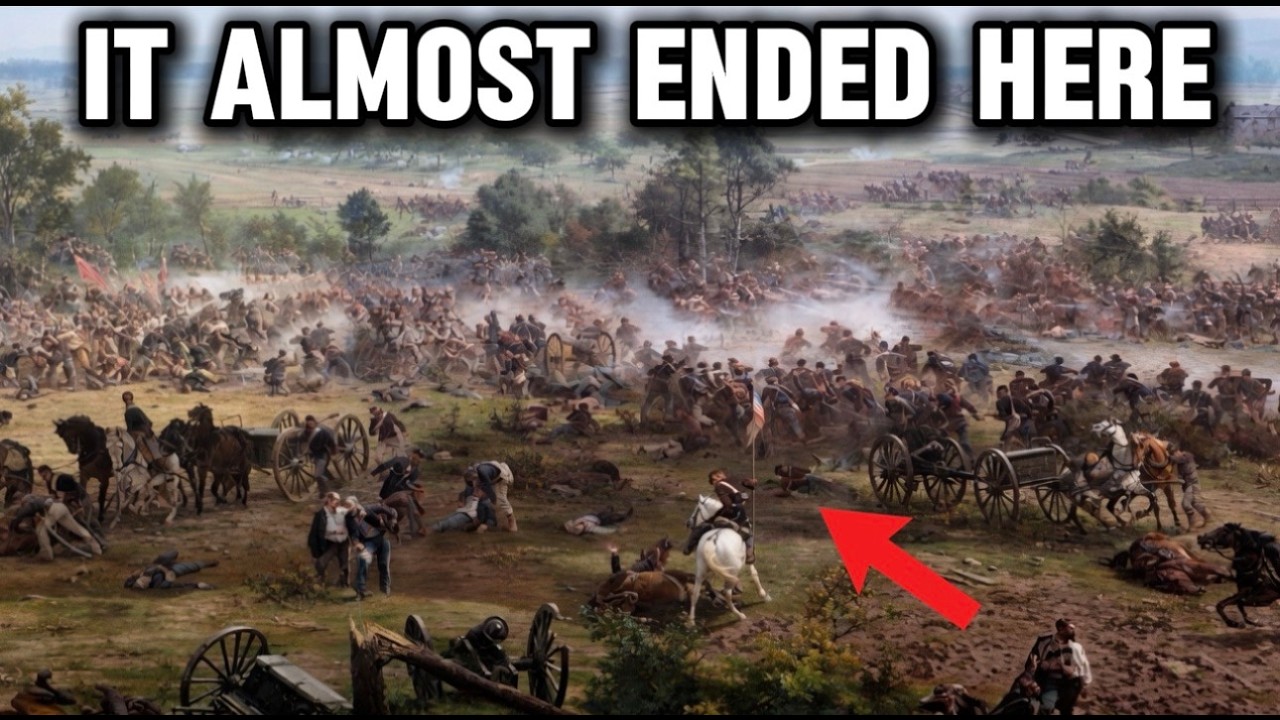
Reynolds arrived with the vanguard of the First Corps around 10:00 in the morning. He was 42 years old, a Pennsylvanian, and one of the most trusted generals in the army. He rode forward immediately to see the ground himself, moving ahead of his infantry toward the fighting. He was shot through the head by a Confederate sharpshooter and was dead before he hit the ground.
Command passed to Abner Doubleday, but the loss of Reynolds was felt at every level within minutes. What he had set in motion, however, was already past the point of recall. The First Corps was deploying, and with it came the brigade that would define the cost of July 1st: the Iron Brigade.
The Iron Brigade wore tall black hats, and Confederate soldiers learned to recognize them across a battlefield. On the morning of July 1st, they went into McPherson's Woods against James Archer's Confederate Brigade in a close-range fight that lasted under 30 minutes. The 24th Michigan Infantry entered the fight with approximately 496 men. They came out with 97 still standing.

Across from them, the 26th North Carolina Infantry suffered similar devastation. They brought 800 men to the fight and lost nearly 600 of them. Company F went in with 91 men and came out with three. The regimental commander, Henry Burgwyn Jr., 21 years old and the youngest full colonel in the Confederate Army, was killed carrying the regimental flag. James Archer himself was captured, the first Confederate general officer taken prisoner since Lee had assumed command.
But the First Corps was fighting on only one side of the field. North of Gettysburg, a second crisis was building. The Union 11th Corps, carrying the reputation of their destruction at Chancellorsville, faced a tactical problem no amount of courage could solve. Robert Rhodes' Confederate division arrived on Oak Hill and began pressing their right flank around 2:00 in the afternoon. Then Jubal Early's division hit the exposed Union flank with four fresh brigades.
The Union line north of Gettysburg gave way. The retreat became a route that ran directly through the town. Thousands of Union soldiers ran through the streets under fire, squeezing through alleys and ducking into cellars. Confederate soldiers came in from three directions at once, capturing men at intersections and in doorways. The 157th New York Infantry lost nearly two-thirds of its men in the chaos of those blocks.

Cemetery Hill was what kept the army from disappearing entirely. Oliver Howard had positioned a reserve division there earlier in the day, a choice viewed at the time as overly conservative. When the retreating soldiers came streaming up the hill, there was a formed defensive line waiting for them. Winfield Hancock arrived around 4:00 in the afternoon, sent by Meade to take command. He rode along the line, being visible, being loud, projecting certainty that the position would hold. Men who were demoralized and separated from their units watched him and stood their ground.
By evening, the Union Army held Cemetery Hill and the ridge stretching south from it. Meade arrived after dark and understood immediately what the day's disaster had accidentally produced. He had a place to fight from. But the price was almost beyond accounting.
The First Corps went into July 1st with approximately 9,400 men. By the time the fighting ended, it had lost more than 6,000 of them, a 64% casualty rate in a single day. The Iron Brigade lost more than 700 men out of roughly 1,800 engaged. Total Union losses on July 1st ran between 9 and 10,000 men. The Confederate army lost somewhere between 6 and 7,000.
By every conventional standard, July 1st was a Confederate victory. They had driven the Union army from the ridges west of town and the fields north of it. Richard Ewell's men were in Gettysburg by late afternoon when Lee sent him a discretionary order: "Take the hill if practicable." Ewell looked at the hill, looked at his exhausted men, and did not attack.
That decision has been argued over more intensely than almost any other command choice of the war. But the hill was not taken. The Union Army spent the night improving its fortifications. By morning, what Hancock had held together with presence and authority had been reinforced by shovels and the organized labor of exhausted soldiers.
The fields outside Gettysburg look like what they are now: gentle Pennsylvania countryside. But the first day was the day the battle was actually shaped. The bill for everything that followed was written on July 1st by men who thought they were buying time, by a general who rode forward to see the ground and didn't ride back, and by soldiers in black hats who gave everything they had to a fight that was simply the whole world, and it was ending fast.