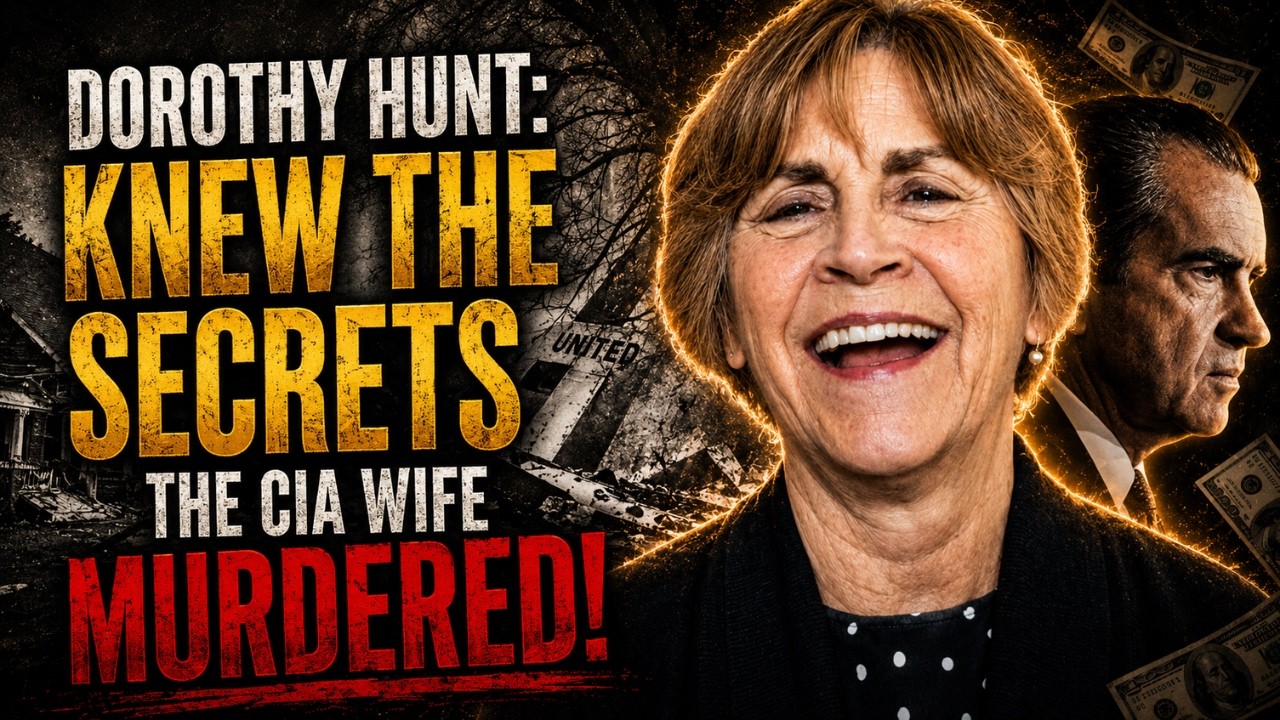
Dorothy Hunt, the wife of Watergate conspirator E. Howard Hunt, was not the suburban housewife she appeared to be. She was a decorated intelligence operative who, after her husband’s arrest, successfully extorted the Nixon White House with a trove of classified documents—before dying in a plane crash that remains the subject of intense speculation. Born April 1, 1920, in Dayton, Ohio, Dorothy Louise Wetzel grew up in severe poverty.
She developed what intelligence agencies look for in top recruits: high intelligence, emotional detachment, and complete self-sufficiency. She began her career at the US Treasury Department tracking financial flows before joining the Office of Strategic Services, the CIA’s predecessor, during World War II. Working directly under future CIA Director Allen Dulles in Bern, Switzerland, Dorothy was assigned to Operation Safe Haven, tasked with tracking and recovering gold, currency, and artwork looted by Nazi leadership. She infiltrated Swiss banking networks and deciphered complex financial transfers.
After the war, she was deployed to Shanghai during China’s collapse and later to Paris, where she served as an intelligence liaison during the Marshall Plan. In 1949, Dorothy married E. Howard Hunt, a fellow CIA operative. Former CIA Director Richard Helms later stated plainly that Dorothy was the superior intelligence officer—smarter, more resilient, and possessing better operational judgment.
After marriage, she officially resigned from the CIA, adopting the cover of a traditional housewife while the family moved through Cold War flashpoints: Tokyo, Montevideo, Mexico City, Paris, and Madrid. The couple had four children: Lisa, Kevin, St. John, and David. Dorothy ran the household with the strict discipline of a CIA station chief.
She hosted dinner parties that were actually intelligence-gathering operations. Affection was scarce; emotional outbursts were treated as security risks. When St. John turned 16, Dorothy brought him into her bedroom, locked the door, and revealed his father was a spy who had orchestrated government overthrows and participated in the Bay of Pigs invasion.
She did this to bind him to the family’s code of silence—a decision that paid off three years later. In the early hours of June 17, 1972, five men were arrested inside the Democratic National Committee headquarters at the Watergate complex. E. Howard Hunt, who had orchestrated the break-in from a hotel room across the street, fled home to Potomac, Maryland, in a state of panic.
He had left incriminating evidence in his White House safe and at his office. Dorothy did not panic. She took total control. With federal agents certain to arrive, she activated her 18-year-old son.
She ordered St. John to hide thousands of dollars in illicit cash inside the structural framing of the house. She supervised as he scrubbed illegal surveillance equipment with industrial chemical solvents to obliterate fingerprints and serial numbers. He then drove to the Chesapeake and Ohio Canal and hurled the sterilized gear into the water.
The most dangerous piece of evidence was a typewriter. Months earlier, Hunt had used it to forge documents—known as the Diem cables—designed to make it appear President John F. Kennedy had ordered the 1963 assassination of South Vietnamese President Ngo Dinh Diem. The Nixon administration planned to leak the forgeries to destroy the Kennedy legacy.
Dorothy knew a typewriter’s mechanical signature is as unique as a fingerprint. She ordered St. John to dismantle the machine and dispose of the parts in separate, untraceable locations across the Maryland suburbs. In less than 48 hours, Dorothy had directed the systematic destruction of evidence that could have accelerated the fall of a president.
But she knew destroying evidence was not enough. She needed leverage. She needed capital. The Nixon White House had cut the Hunts loose, issuing public denials and distancing themselves from the burglars.
Howard unraveled, chain-smoking and descending into depression. Dorothy took command. She became the point of contact, isolating her emotionally unstable husband from negotiations. She reached out through intermediaries—including Howard’s attorney William Bittman—and directly to Chuck Colson, special counsel to the president, who had brought Howard into the White House Plumbers unit.
Dorothy dictated terms. She demanded hundreds of thousands of dollars in untraceable cash for legal fees and living expenses for the families of the arrested men. She demanded a guarantee of executive clemency—pardons for everyone involved after the November election. When the White House balked, she warned that she possessed documented evidence that could, in her words, “blow the White House out of the water.
”
The threat registered like an earthquake. On the secret White House audio tapes, President Richard Nixon can be heard discussing the situation with White House counsel John Dean. Dean warned that keeping the burglars quiet could cost a million dollars. Nixon did not hesitate.
“You could get a million dollars,” Nixon told Dean. “You could get it in cash. I know where it could be gotten. ” He later stated it was essential to keep Hunt happy.
The White House established a covert financial pipeline. Money, largely illegal corporate campaign contributions, was funneled from a safe in the office of Maurice Stans, finance chairman of the Committee to Re-elect the President. Two bagmen moved the cash—Fred LaRue and former NYPD detective Anthony Ulasewicz, who operated under the alias Mr. Rivers.
Dorothy executed the drops with rigorous tradecraft. She received coded instructions by phone, dressed impeccably, and carried a loaded . 25 caliber semi-automatic pistol in her handbag. She drove to payphones across the Maryland and Virginia suburbs, received further instructions, and retrieved locker keys taped beneath phone booths at bus terminals and airports.
Inside the lockers, she found parcels of sequential $100 bills. She then divided the cash, paying her husband’s legal defense and personally delivering envelopes to the wives of the incarcerated Cuban operatives in Miami. Through July, August, and into autumn 1972, Dorothy moved hundreds of thousands of dollars and kept the burglars silent. But the pressure took a toll.
She noticed surveillance: strange cars, clicks on the phone line, men in suits near her payphones. The FBI was hunting for the source of the funding, and the White House viewed her as an expensive liability. Dorothy knew that paying a blackmailer is temporary; eliminating one is permanent. In late October, Dorothy’s iron facade cracked.
She found St. John and handed him $5,000 in $100 bills. She ordered him to buy a van, pack his things, take his girlfriend, and leave Washington—not to return for at least a month. “Because I need to clean up this mess,” she told him.
“And it is no longer safe for you to be here. ”
Dorothy’s leverage rested on a shadow archive: Howard’s classified trove of operational files, memos, photographs, and blueprints he had smuggled out of his White House office. The files documented a devastating ledger of crimes. They included documents linking Nixon to Operation 40, a CIA assassination squad—which President Kennedy had reportedly called “Murder Incorporated”—tasked with eliminating political leaders in Latin America and the Caribbean.
The archive also contained plans for the Plumbers to firebomb the Brookings Institution, disguised as firefighters in a fake fire engine, to steal classified documents. The plot was aborted only because the $100,000 cost of buying and retrofitting the fire engine was deemed too expensive. Dorothy held proof of the September 1971 break-in at the office of Daniel Ellsberg’s psychoanalyst, Dr. Louis Fielding, in Beverly Hills.
Hunt and Liddy had ransacked the office looking for damaging personal information on Ellsberg, the Pentagon Papers leaker. The archive included sabotage plans for the 1972 Democratic National Convention. One plan involved disabling the convention hall’s air conditioning. Another involved a luxury yacht moored in Biscayne Bay, where prostitutes would lure Democratic politicians, LSD would be slipped into their drinks, and hidden cameras would capture the results for blackmail.
Dorothy also held records of an order to frame the Democratic Party for the attempted assassination of Governor George Wallace. In May 1972, hours after Wallace was shot, Hunt was ordered to fly to Milwaukee, break into shooter Arthur Bremer’s apartment before the FBI secured it, and plant McGovern campaign materials. Hunt aborted the mission when he realized the FBI had already sealed the apartment—but the order was documented. Finally, Dorothy understood the money trail.
She knew the mechanics of the “Mexican Laundromat”—the illegal laundering of corporate campaign donations through a Mexico City bank into the Miami account of burglar Bernard Barker. Handing that financial map to investigators would indict the president’s top campaign financiers, his attorney general, and his closest aides. Beneath it all lay the deepest secret—what Nixon on the tapes called “the Bay of Pigs thing. ” H.
R. Haldeman later wrote that he believed this was Nixon’s coded reference to the assassination of President John F. Kennedy. The overlap between the Watergate operatives and the anti-Castro Cuban exile community was undeniable.
Dorothy possessed files detailing the overlapping networks between Operation 40 and the Watergate personnel. By threatening to expose these networks, she was pointing a gun at the heart of the CIA itself. By December 1972, the stalemate had reached critical mass. The White House had paid out massive sums, but demands were increasing.
The trial of the burglars was approaching. Dorothy could not be permanently bought—and the men around Nixon knew it. On the afternoon of Friday, December 8, 1972, Dorothy arrived at Washington National Airport. She was scheduled to board United Airlines Flight 553 to Chicago Midway.
In her purse, she carried exactly $10,000 in untraceable $100 bills. She had arranged a face-to-face meeting with Michelle Clark, a 29-year-old CBS News reporter investigating the Watergate money trail. Dorothy planned to use Clark as a conduit—a calculated leak designed to signal to the Oval Office that she was prepared to go public. At 12:50 p.
m. , Dorothy boarded the Boeing 737-222 with 55 passengers and six crew members. The cockpit crew was highly experienced: Captain Wendell Lewis Whitehouse had 18,000 flight hours; First Officer Walter Cobble had over 10,000; Second Officer Barry Elder served as flight engineer. The flight was uneventful until the descent into Chicago.
Fourteen minutes before the crash, the flight data recorder—the heavily armored black box designed to survive catastrophic impacts—suddenly stopped functioning. Simultaneously, a breakdown in cockpit discipline occurred. Second Officer Elder noticed a minor irregularity on his instrument panel, unbuckled his harness, and began rummaging through the circuit breaker panels searching for a blown fuse. Both other crew members turned their attention to the troubleshooting.
For several fatal minutes, no one was actively flying the aircraft. When the crew refocused, Flight 553 was 1,500 feet too high approaching the Kedzie outer marker. Captain Whitehouse forced the aircraft into a rapid aggressive dive, fully deploying the flight spoilers—large panels that kill aerodynamic lift and allow steep descent. The plane dropped at 1,550 feet per minute.
Whitehouse leveled off at the required altitude—but he forgot to retract the spoilers. Air traffic control then ordered a missed approach after noticing Flight 553 was too close to a smaller aircraft. Whitehouse pushed the throttles forward and reduced the flaps from 30 to 15 degrees. With the flaps reduced and the spoilers still deployed, the wings could no longer hold the aircraft in the air.
At 1,000 feet above residential Chicago, Flight 553 experienced a full aerodynamic stall. The cockpit voice recorder captured the final seconds: the blaring stall warning, the roar of engines fighting a losing battle, and Captain Whitehouse’s grim final words: “I’m sorry. ”
At 2:28 p. m.
, the plane sheared through high-voltage power lines and plummeted into a residential block at 3722 West 71st Place. On the ground, Veronica Kukulich and her daughter Teresa were killed instantly. Aboard the aircraft, 43 people lost their lives, including Michelle Clark and Dorothy Hunt. What happened next is a matter of documented federal record.
Within 45 minutes of the crash—before local firefighters had fully extinguished the jet fuel fires and long before the NTSB could mobilize—an estimated 50 FBI agents descended on the neighborhood. They bypassed standard triage zones and moved directly into the wreckage of the passenger cabin. They specifically located the area where Dorothy Hunt had been seated and confiscated her belongings: her luggage, her documents, and her purse containing the $10,000 in untraceable $100 bills. The FBI’s invasion compromised the official investigation.
Agents commandeered the Midway air traffic control tower, seizing audio tapes and logs. They intercepted and interrogated surviving flight attendants before the NTSB could conduct interviews. The interference was so unprecedented that NTSB Chairman John Reed drafted a scathing formal letter of protest to the acting FBI director. At the White House, Nixon’s reaction was devoid of empathy.
On the secret tapes, he is heard urgently asking Chuck Colson about the $10,000 in Dorothy’s purse, demanding to know if the serial numbers could be traced back to the campaign or the White House pipeline. The next day, December 9, 1972, Nixon appointed Egil Krogh to the position of Under Secretary of Transportation. Krogh was not an aviation expert—he was a core member of the White House Plumbers unit, the same covert team Hunt and Liddy operated within. The appointment placed a Watergate conspirator in direct oversight of the NTSB, the agency investigating the crash.
The NTSB officially ruled the crash was caused by pilot error: the crew’s failure to maintain proper flying speed and the captain’s failure to retract the spoilers. Independent investigators raised anomalies—allegations of a jammed instrument landing system and traces of cyanide in Captain Whitehouse’s blood—but the NTSB dismissed these claims. By 1974, Chuck Colson stated publicly: “I think they killed Dorothy Hunt. ”
Whether assassination or accident, the strategic result was absolute.
The extortion pipeline was severed. E. Howard Hunt’s resolve collapsed. Terrified that his children would be left as orphans if he spent his life in prison, he broke his silence, began cooperating with federal prosecutors, and testified about the administration’s direct involvement in the cover-up and the illicit payments.
His testimony triggered the cascade of indictments that swept through the president’s inner circle and led directly to the resignation of Richard Nixon on August 9, 1974.