In October 1994, Quaker Oats paid $1. 7 billion for Snapple, the largest acquisition in the company’s history. Wall Street applauded the deal, and analysts called it visionary. Just 27 months later, Quaker sold the same company for $300 million, writing off $1.
4 billion in what became one of the most spectacular brand collapses in American consumer goods history. The product itself never changed. The tea still tasted the same, the bottles looked the same, and the flavors remained on the shelf. What vanished was the relationship between the three Brooklyn-born founders and the millions of Americans who had deliberately chosen to trust them.
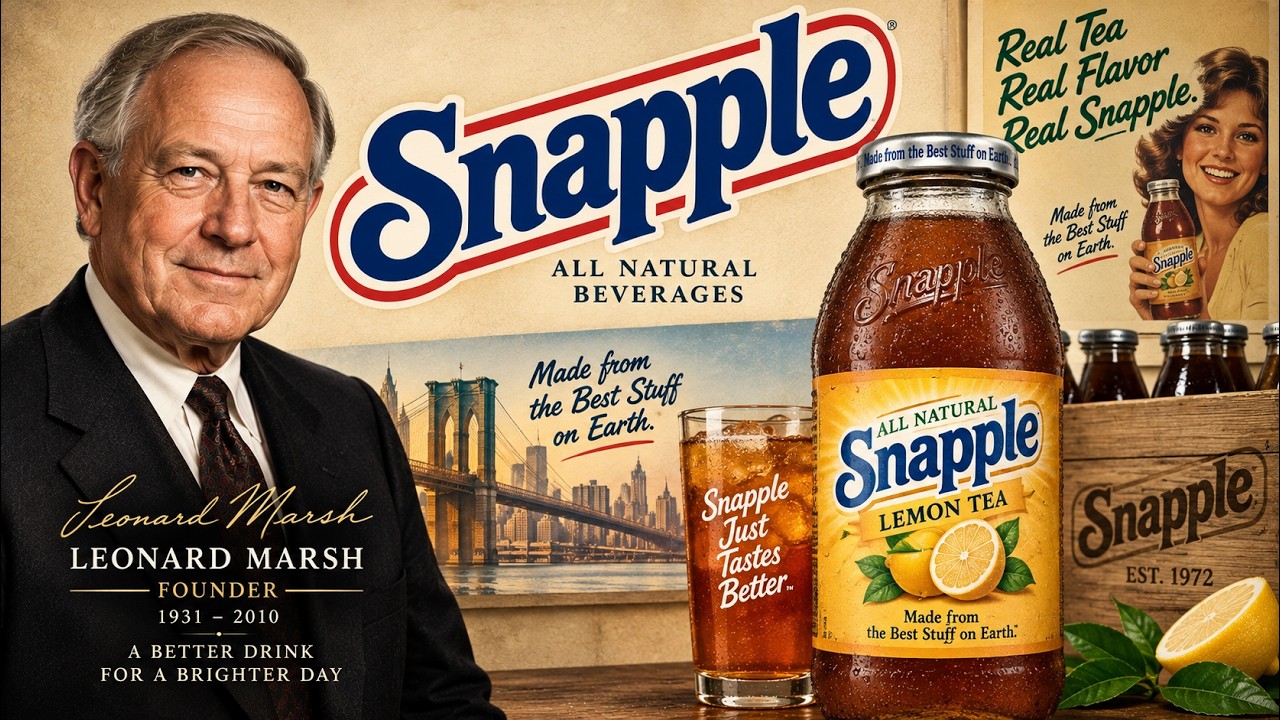
The story began in 1972, when Hyman Golden, Arnold Greenberg, and Leonard Marsh pooled $3,000 and started a small juice business in a rented Bronx facility. Golden was the son of a neighborhood shopkeeper; Greenberg’s father sold furniture on Flatbush Avenue; Marsh rounded out a friendship that had lasted since young adulthood. Their first product was fresh-pressed apple juice with no additives, sold directly to health food stores and independent retailers in the New York area. Rent was $400 a month, and first-year output was roughly 500 cases, with Golden driving the delivery van himself.
They adopted the name Snapple in 1980, salvaging it from an earlier sparkling apple juice that had failed commercially. The name, a portmanteau of “snappy” and “apple,” survived on instinct. The turning point came in 1987, when Snapple introduced its ready-to-drink bottled iced teas. Unlike competitors, Snapple brewed actual tea leaves hot rather than using concentrates or powders.
The result was a cloudier, deeper flavor that customers could immediately recognize. The marketing slogan was simple: “Made from the best stuff on earth. ”
The packaging was equally distinctive. Wide-mouth glass bottles, harder and more expensive to produce than the slim cans that dominated the category, gave the product a homemade feel.
Under every twist-off cap, the company printed a numbered trivia fact, such as “A group of flamingos is called a flamboyance. ” Customers began collecting the caps and writing letters to request missing numbers. Snapple did not go to supermarkets first. It went to delis, corner stores, and independent health food shops across New York City.
The distribution network was built on roughly 300 independent, often family-run distributors who personally knew the roughly 100,000 store owners they supplied. Every new flavor moved from distributor to retailer to customer by word of mouth, one conversation at a time. By 1991, revenues reached $230 million. By 1993, they hit $516 million.
In 1994, Snapple brought in $700 million and controlled about 35 percent of the premium ready-to-drink tea market. One in three premium bottled teas sold in America carried the Snapple label, and the brand was stocked in an estimated 80 percent of all independent delis and convenience stores in New York City. Part of the cultural breakthrough came from Wendy Kaufman, a woman from Queens hired to work in Snapple’s shipping and order fulfillment department. When fan mail began arriving in volume, she started answering letters by hand and returning phone calls personally.
In 1992, the small New York ad agency Kirschenbaum Bond put her on camera reading and responding to actual fan letters with no script. The campaign ran during daytime television and local news, costing a fraction of a conventional ad production. Radio amplified the brand further. Howard Stern and Rush Limbaugh, whose audiences barely overlapped, both endorsed Snapple authentically, and both drove surges in demand.
Limbaugh’s first on-air endorsement in 1993 overwhelmed distributor phone lines for three days. At its peak, Snapple carried about 50 flavors and employed a growing network of bottlers and distributors across the Northeast. The three founders remained visible and hands-on, with Golden in his mid-60s still a familiar face in New York’s beverage community. Then the investment bankers arrived.
In the fall of 1994, the founders accepted a bid of $1. 7 billion from Quaker Oats. Quaker CEO William Smithburg had championed the deal, believing he could apply the same playbook he had used to turn Gatorade into a national powerhouse after acquiring it in 1983. Gatorade had been built for supermarkets and centralized distribution; Smithburg assumed Snapple could be scaled the same way.
He was wrong. Snapple had been built on personal relationships, and Quaker saw those relationships as inefficiency. Within the first 90 days, Quaker began consolidating its distribution network, terminating the independent distributors who had carried the brand for nearly a decade. Many had invested heavily in trucks and warehouses specifically for Snapple and received only a legal notice and a termination date.
Retailers who depended on those distributors saw supply disrupted almost immediately, and some switched to alternatives. Quaker then decided Wendy Kaufman was a liability. Her campaign was unscalable and informal, and the fan mail was treated as a customer service problem rather than an asset. She was let go.
Customers responded immediately, not with complaints about the tea, but with letters asking where Wendy had gone. Quaker did not publicly respond. Limbaugh’s endorsement contract expired in 1994, and Quaker did not renew it. The Stern relationship had already ended during the transition.
In Quaker’s first full fiscal year of ownership, Snapple revenues fell from roughly $700 million to about $440 million. A polished national advertising campaign launched in 1995 did not stop the decline. Quaker reduced the product line from 50 flavors to fewer, eliminating unusual varieties that had once signaled the brand’s refusal to behave like a normal company. Customers noticed the absence before anything else.
By early 1997, Quaker announced it was selling Snapple to Triarc Beverages for $300 million. The transaction closed in March 1997, 27 months after the acquisition. Smithburg resigned shortly afterward. Quaker itself was acquired by PepsiCo in 2001, a deal driven almost entirely by Gatorade’s value, with Snapple playing no part.
Arizona Iced Tea, which had launched in 1992 with a 24-ounce can priced at 99 cents, moved aggressively into the independent retail channel Snapple had abandoned. By 1997, Arizona was the dominant premium bottled tea brand, having displaced in five years a position Snapple had taken more than two decades to build. Triarc sold Snapple to Cadbury Schweppes in 2000 for $1. 45 billion, a partial recovery.
Cadbury stabilized distribution and began rebuilding relationships with independent retailers. The wide-mouth glass bottle returned to prominence, and new flavors were introduced. The real facts remained under every cap. In 2008, Cadbury spun off its beverage division as Dr Pepper Snapple Group, which merged with Keurig Green Mountain in 2018.
Snapple remains part of that portfolio and still sells today, with the peach and lemon teas still moving in convenience store coolers across the country. What the brand has not regained is the loyalty that once made sales feel inevitable. Collectors still trade vintage merchandise and early bottle caps from the pre-Quaker era, documenting the original numbered facts with the care of baseball card enthusiasts. For many drinkers now in their 50s and 60s, Snapple was the first premium beverage they chose deliberately, a product that was genuinely better, made by people who cared, and sold through a network that knew its customers by name.
Wendy Kaufman went on to become a motivational speaker, teaching customer service principles based on what she had learned at Snapple. She told the story without bitterness, in the same direct voice she had once used to answer fan letters. Quaker Oats had paid $1. 4 billion to learn what Kaufman had known intuitively: that Snapple’s success was not a formula that could be acquired and redeployed.
It was a relationship built one deli counter, one fan letter, and one radio endorsement at a time. Corporations can buy a name, a bottle shape, and a place on a shelf, but they cannot buy the reason people chose the product in the first place.